Airbnb Host Marketing Software: What Actually Drives Direct Bookings

Airbnb host marketing software refers to the tools hosts use to reduce reliance on Airbnb's own algorithm and instead build an independent channel for finding and converting guests, typically through guest data capture, direct booking websites, email and SMS automation, and search-optimized content. The category exists because Airbnb and VRBO combined take 17 to 19 percent of every booking in host and guest fees, and that cost compounds fast across a busy season.
- Airbnb host marketing software spans direct booking sites, guest CRM and email tools, WiFi-based contact capture, and content platforms that build organic search traffic over time.
- Airbnb and VRBO fees combined typically run 17 to 19 percent of every reservation, meaning a single $2,000 direct booking saves a host $340 to $380 compared to booking through the platform.
- A single direct vacation rental booking is often worth $1,000 to $4,000 in revenue, which is why even a handful of direct bookings a year justifies investing in marketing tools.
- Freelance content writers charge $300 to $700 per blog post, and writing one well requires 3 to 5 hours of manual research and drafting, according to industry benchmarks.
- A ranking blog article can drive organic search traffic for 2 to 5 years once published, making content one of the few marketing assets with compounding, long-term ROI.
- inkSTR automates the content side of this stack, generating, scheduling, and publishing SEO-targeted blog articles for hosts and property managers, starting at $99/month, so search visibility doesn't depend on hours you don't have.
If you're reading this in 2026, you've probably already noticed the math doesn't work in your favor. Every guest who books through Airbnb costs you a slice of revenue you'll never see again, and the algorithm that decides whether your listing even shows up isn't something you control. Building a direct channel isn't optional anymore for hosts who want to keep more of what they earn.
At inkSTR, we work with hosts and property managers across the country who are trying to solve exactly this problem: how do you get found by travelers searching online, without handing another cut to a platform every time someone books? The honest answer is that no single tool solves the whole thing. Airbnb host marketing software is really a stack, guest data capture, a direct booking site, and content that ranks in Google, and each piece does a different job.
This guide breaks down what the category actually includes, what each type of tool costs, and where most hosts get stuck. We'll also cover the four questions we see searched most often around this topic, including a couple of Airbnb-specific policies that trip up hosts who assume "marketing" and "platform incentives" mean the same thing.
What Software Do Airbnb Hosts Use?
Airbnb hosts typically use a combination of four software categories: guest messaging and automation tools, dynamic pricing engines, direct booking site builders, and guest data capture systems like WiFi splash pages. No single platform covers all four well, which is why most serious operators run two or three tools alongside their Airbnb listing.
Messaging automation handles guest questions and booking confirmations around the clock, which matters because slow response times hurt your Airbnb search ranking. Pricing tools like dynamic rate engines adjust nightly rates based on demand signals, competitor rates, and local events. Direct booking site builders let you accept reservations outside Airbnb and VRBO entirely, syncing calendars across channels so you don't double-book.
The piece hosts consistently underinvest in is content. You can have a beautifully designed direct booking site and still get zero traffic to it, because nobody searching Google for "cabin rental near Gatlinburg" has any reason to find your specific site. Guest data capture tools, often built into property WiFi, solve the retention side by collecting emails during a guest's stay so you can market to them after checkout. But retention only works if you already have guests booking direct in the first place.
That's the gap between the tools and traction. Most software in this category assumes you already have search visibility. inkSTR exists specifically for the step before that: building the blog content and keyword targeting that gets your direct booking website found in the first place, so the rest of your stack, pricing, messaging, guest capture, has something to work with. We built the AI Content Writer for exactly this reason: most hosts know they need blog content but don't have four hours to spare writing one post.
Why Isn't Your Direct Booking Website Getting Any Traffic?
Your direct booking website gets no traffic because a website with no published content has nothing for Google to index or rank. Design alone doesn't generate search visibility. Travelers find vacation rentals through specific search queries, "beachfront condo Gulf Shores pet friendly" or "mountain cabin near Asheville hot tub," and if your site has no pages answering those queries, it's invisible no matter how good it looks. Here's the part that's genuinely frustrating for hosts: Airbnb itself dominates search for vacation rental terms. Research from BuildUp Bookings found Airbnb appears on the first page of Google for vacation rental searches in 79 percent of the top vacation rental markets analyzed. That's a hard baseline to compete against with a static site.
But there's a nuance most hosts miss. The same research found Airbnb placed in the top 3 organic results in only 5 percent of those markets. Airbnb's brand dominance gets it onto page one, but it rarely wins the top spots for specific, long-tail searches. That's exactly where a host with a targeted, well-written blog article can outrank Airbnb's own listing pages.
The manual alternative is brutal. Writing one solid blog post yourself takes 3 to 5 hours of research and drafting, and you'd need a dozen or more published articles before Google starts sending meaningful traffic. Hire a freelance writer instead, and you're paying $300 to $700 per post, with no guarantee any single article ranks.
This is exactly the problem inkSTR was built to solve. Our Keyword Research tool identifies the specific long-tail searches travelers use in your market, the ones Airbnb doesn't dominate, and our content engine writes and publishes the articles that target them automatically. If your direct booking website has been live for months with nothing to show for it, the content gap is almost always the reason. Related reading: why your vacation rental website is not ranking on Google.
What Is the 75/55 Rule in Airbnb?
The 75/55 rule refers to a guideline some Airbnb hosts use around cancellation flexibility and pricing strategy, where a portion of listings or nights are kept at a baseline rate while a smaller share is discounted to maintain a target occupancy floor. It's not an official, universally documented Airbnb policy, and interpretations vary across host communities, so treat any specific numeric rule with some skepticism unless you've verified it against your own account settings. What matters more than memorizing a specific ratio is understanding the underlying principle: pricing strategy on Airbnb and pricing strategy on your own direct booking channel should not be identical. Airbnb's algorithm rewards responsiveness to demand signals, while your direct site can offer more stable, loyalty-driven pricing.
Here's where hosts go wrong: they treat their Airbnb pricing rules as their entire pricing strategy, and never build a parallel, direct-booking-specific pricing approach. If every guest sees the same rate whether they book through Airbnb or your own site, you've given them no reason to book direct and save you the 17 to 19 percent platform fee.
Content plays a role here too, even though it's not obvious at first. A direct booking page that explains why booking directly gets a guest a better rate, or added perks, needs to actually exist and rank in search for a guest to find it before they default to Airbnb. Most hosts never write that page, or write it once and never update it as their strategy shifts.
We see this constantly in our work with hosts: pricing strategy questions almost always trace back to a content and communication gap, not a rate-setting problem. inkSTR's Content Calendar schedules recurring updates to pages like this automatically, so your direct booking value proposition stays current instead of going stale after the first publish. For more on pricing strategy specifically, see our piece on revenue maximization for hosts.
What Is the 80/20 Rule for Airbnb?
The 80/20 rule, applied to Airbnb hosting, generally reflects the Pareto principle: roughly 80 percent of your bookings or revenue tend to come from a smaller share, often around 20 percent, of your marketing efforts, listing optimizations, or repeat guests. It's a framework for prioritization, not an official Airbnb-published policy, so don't treat it as a fixed platform rule. Applied practically, this means most hosts are spending time on marketing activities that produce very little return, while ignoring the smaller number of actions that actually move bookings. Repeat guests and referrals, for example, often generate outsized value relative to the effort required to earn them, especially once you've captured their contact information directly.
The content angle here is significant and consistently overlooked. A handful of well-targeted blog posts, the ones answering specific, high-intent traveler questions about your exact market, will usually outperform a large volume of generic content. Hosts who publish 30 posts about "top attractions near our rental" often get less traffic than a host who publishes 8 posts targeting precise long-tail searches like "dog friendly cabin with hot tub near Pigeon Forge." That's the 80/20 principle in practice: a small number of the right articles drive most of the organic traffic, while a large volume of the wrong articles drives almost none. Knowing which 20 percent to focus on is the hard part, and it's where most solo hosts get stuck without dedicated keyword research.
This is precisely why we built inkSTR's keyword research to prioritize by search intent and competition, not just volume. Instead of guessing which topics matter, the platform surfaces the specific queries your target guests are actually typing into Google, so your limited publishing time goes toward the 20 percent that counts. If you want the deeper breakdown on ranking factors, we cover it in ranking on Google: what STR operators need to know.
What Is the $750 Host Incentive on Airbnb?
The $750 host incentive on Airbnb refers to promotional offers Airbnb has periodically run to encourage new or existing hosts to list additional properties or reach specific booking milestones, typically structured as a bonus credited after meeting defined conditions like completed reservations within a set window. These incentive programs change frequently and vary by market and eligibility, so hosts should always verify current terms directly through their Airbnb host dashboard rather than relying on secondhand information. The bigger point for marketing strategy is what this incentive represents: Airbnb wants more supply and more bookings flowing through its platform, and it will pay hosts short-term to get there. That's a reasonable trade for hosts still building review history or occupancy. But it's not a substitute for a direct booking strategy, because the incentive rewards platform dependence, not independence.
Here's the trade-off worth thinking through. A one-time bonus is valuable when you're new and need bookings fast. But every booking that comes through that incentive still costs you the standard 17 to 19 percent in combined host and guest fees. A host who takes the short-term incentive while simultaneously building organic search traffic to a direct booking site ends up in a much stronger position two years out than one who relies on incentives indefinitely.
We tell hosts this directly: use platform incentives to build initial reviews and occupancy, but don't let them delay your content and SEO strategy. The hosts who start publishing blog content in year one, even a modest two posts a month, are the ones who've built real domain authority by the time incentive programs dry up or shift terms, which they periodically do.
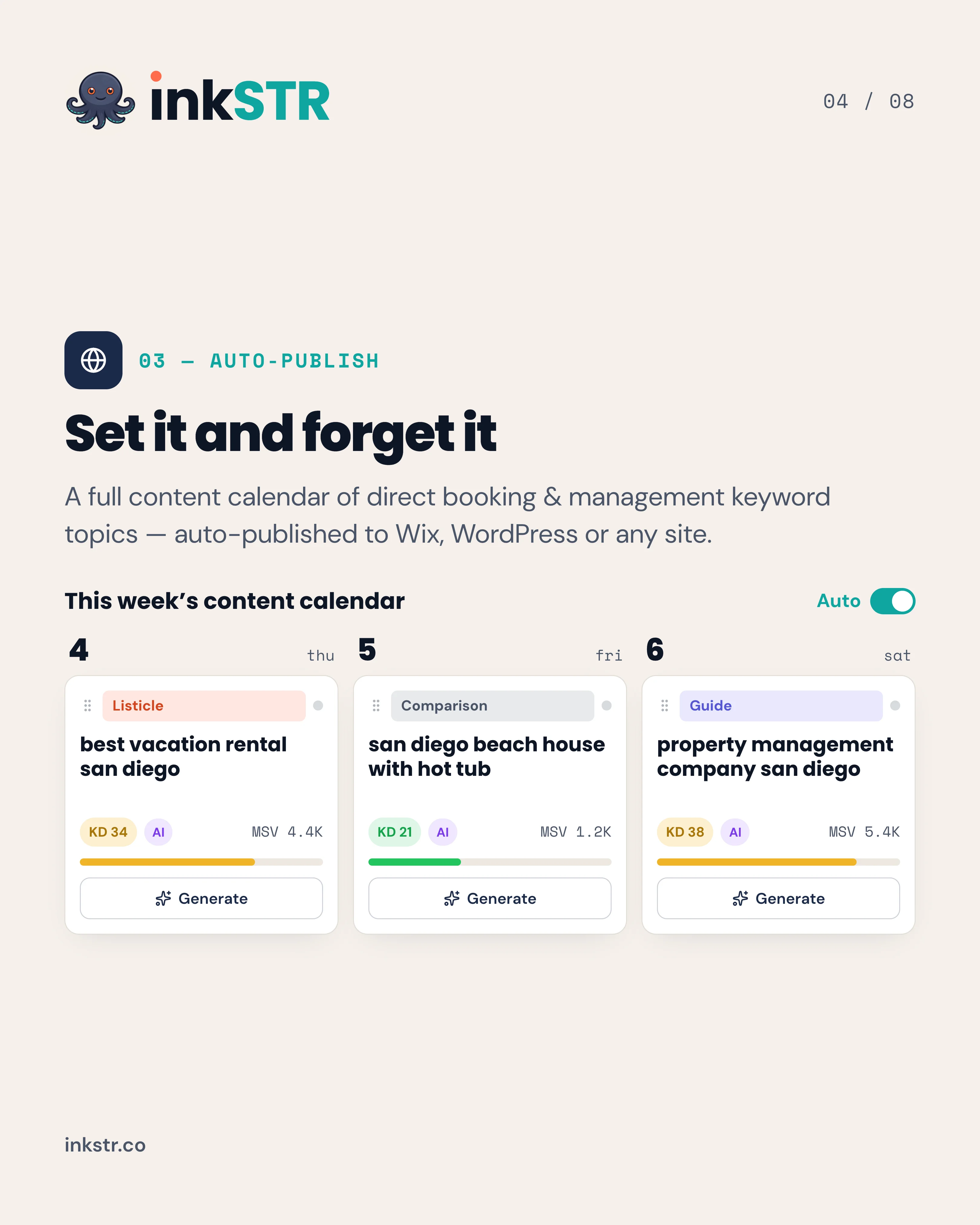
inkSTR's Auto-Publishing feature keeps that content flowing on a set schedule without you having to remember to log in and hit publish every time. It's the kind of consistency that's easy to plan but hard to execute manually once you're also managing turnovers, guest messages, and everything else that comes with running a property.
Ready to automate your content marketing?
inkSTR handles keyword research, content strategy, article writing, and publishing, all on autopilot.
Data and Evidence: Comparing the Airbnb Host Marketing Software Stack
The Airbnb host marketing software category breaks into distinct functional layers, and understanding which layer each tool addresses prevents hosts from buying redundant software or missing a critical piece entirely. The table below maps the core categories, what industry research shows about typical costs, and what each layer does and does not solve.
| Software Category | What It Solves | Typical Cost Range | What It Does Not Solve |
|---|---|---|---|
| Guest messaging automation | 24/7 auto-replies, response time, booking confirmations | Often bundled into broader PMS platforms | Does not generate new search traffic or guest discovery |
| Dynamic pricing tools | Rate adjustments based on demand and competitor data | Varies by portfolio size | Does not build a direct booking channel or guest list |
| Direct booking site builders | Accept reservations outside Airbnb and VRBO | Often a flat monthly fee per property | A site with no content has no organic search visibility |
| WiFi guest data capture | Collects guest emails/contact info during stay | Reported starting around $10/month per property | Only useful once guests are already booking, doesn't drive new discovery |
| SEO content automation (inkSTR) | Keyword research, blog writing, scheduling, publishing | Starting at $99/month | Content takes months to compound; not an instant traffic fix |
Notice the gap. Every category above except content automation assumes travelers are already finding your site. According to industry data, roughly 70 percent of B2B and B2C marketers use content marketing as a key tactic across sectors, and SEO specifically is reported to deliver an 8x return on investment, roughly twice that of other marketing channels, according to SeoProfy's 2026 analysis. Vacation rental hosts who skip the content layer are leaving the highest-ROI piece of the stack unused.
Property management is also professionalizing quickly. Industry estimates suggest professional operators now manage a large and growing share of active listings globally, and the broader vacation rental software market, spanning marketing, channel management, and payments, was valued in the tens of billions in the mid-2020s and is projected to roughly double by the mid-2030s. Software adoption in this space isn't a trend, it's becoming table stakes.
How Do You Migrate From Airbnb Dependence to Owning a Direct Guest Channel?
Migrating from Airbnb dependence to a branded direct booking channel is a gradual process that starts with capturing guest data during the stay, builds a searchable content asset over months, and shifts a growing share of repeat and referral bookings away from the platform over time. There is no single switch that flips; it's a compounding shift, usually visible over two to three booking seasons rather than weeks. Step one is guest data capture. Every guest who stays with you and never gives you their email is a guest you can only reach again through the Airbnb inbox, which Airbnb controls and can restrict. WiFi-based capture tools or simple post-stay forms solve this at low cost. Step two is the direct booking site itself, built to actually accept and process a reservation, not just display photos. Step three, the one most guides skip, is making that site discoverable. A direct booking site with zero published content ranking in Google is functionally a business card nobody sees.
This is where most published guidance stops short and where we think the real work happens. You need a steady publishing cadence, ideally two to four articles a month, each targeting a specific traveler search query in your exact market, "lake house rental with dock near [your lake]" performs very differently than "vacation rentals near [your lake]." Specificity wins. Generic content, the kind targeting broad, already-crowded terms, rarely outranks Airbnb's own market pages.
We built inkSTR's entire workflow around this exact migration path: keyword research that finds the specific, winnable searches in your market, an AI writer that turns those keywords into full articles without eating your afternoon, and scheduled publishing that keeps the cadence going even during your busiest booking months. See the full process at How inkSTR Works. For more on the strategy behind converting readers, we've also written about how to create content for Airbnb hosts that books direct.
Practical Guidance: Choosing and Prioritizing Your Marketing Software Stack
Choosing the right combination of Airbnb host marketing software depends on how many properties you manage, how much time you have, and whether your bottleneck is guest capture, pricing, or discovery. Most hosts should prioritize solving discovery first, since none of the other tools matter if travelers can't find you. Here's the order we recommend based on what we see work across our client base:
- Start with content and keyword research. Without search visibility, a direct booking site is invisible. This is the highest-leverage, lowest-cost fix for most hosts.
- Add guest data capture next. Once you have any direct traffic or bookings, start collecting guest contact info so repeat and referral bookings compound.
- Layer in messaging automation. Response time affects both guest experience and, on Airbnb specifically, your search ranking within the platform.
- Only then consider dynamic pricing tools. Pricing optimization matters, but it optimizes bookings you already have, it doesn't generate new ones.
The most common mistake we see is reversing this order: hosts invest in pricing tools and messaging bots first because they feel more "operational," while their direct booking site sits untouched for a year with zero published content. That's backwards. A perfectly priced listing nobody finds still books zero nights.
The second most common mistake is treating content as a one-time project instead of an ongoing publishing cadence. One blog post won't move the needle. A ranking blog article can drive organic traffic for 2 to 5 years once it gains traction, but it takes a sustained library of posts, usually a dozen or more, before Google starts sending meaningful volume. That's a scale problem manual writing can't solve affordably, at $300 to $700 per freelance post.
This is exactly the gap inkSTR fills. Instead of choosing between doing it yourself for hours each week or paying a freelancer per article, our plans starting at $99/month generate, schedule, and publish that content automatically, so the highest-leverage layer of your marketing stack runs without becoming another job on your plate.
Frequently Asked Questions
What software do most Airbnb hosts actually use to market their properties?
Most Airbnb hosts combine a messaging automation tool, a direct booking site builder, and increasingly a content or SEO platform to drive traffic to that site independently of Airbnb's search results. Larger operators layer in dynamic pricing and guest data capture tools as their portfolio grows. inkSTR fits into this stack as the content and keyword research layer that gets a direct booking site found in the first place.
Is it worth paying a content writer for my vacation rental business?
Freelance travel writers typically charge $300 to $700 per quality blog post, and a single well-optimized article can drive traffic for years once it ranks. For hosts publishing occasionally, freelancers make sense. For hosts needing a consistent monthly cadence, that cost adds up fast, which is why platforms like inkSTR exist to automate the same output at a fraction of the per-post cost.
How long does it take for vacation rental content to start ranking on Google?
Most vacation rental websites need a consistent library of published articles, often a dozen or more targeting specific long-tail searches, before meaningful organic traffic shows up. This typically takes several months of steady publishing rather than weeks. Consistency matters more than any single "perfect" post.
Can I market direct bookings to Airbnb guests without violating Airbnb's terms?
Airbnb's terms restrict soliciting guests to book off-platform for the same reservation, but building a separate content and search presence, capturing guest emails through your property WiFi during a stay, and marketing to past guests for future direct bookings are standard, widely used practices. Always review Airbnb's current host policies directly, since terms are updated periodically.
What is the difference between optimizing an Airbnb listing and building a direct booking SEO strategy?
Optimizing an Airbnb listing improves your ranking within Airbnb's internal search algorithm, controlled entirely by Airbnb. A direct booking SEO strategy builds your visibility in Google's organic search results, which you own independently and which continues working even if Airbnb changes its algorithm. Both matter, but only one reduces your dependence on the platform.
Do I need a separate blog for each property I manage?
Hosts managing a single property can run one blog on their direct booking site. Property managers or multi-property owners typically benefit from separate content pipelines per property or brand, since search intent and local keywords differ by location. inkSTR supports this through independent content pipelines built for exactly this use case.
Conclusion: Building Marketing Software Around Direct Bookings, Not Platform Dependence
Airbnb host marketing software works best as a layered stack, not a single tool: guest messaging, pricing, direct booking infrastructure, and content that actually gets found in search. The layer most hosts skip, consistent, keyword-targeted blog content, is also the one with the longest compounding return, often driving traffic for 2 to 5 years from a single well-ranked article. Given that Airbnb and VRBO fees eat 17 to 19 percent of every booking, and a single direct booking is often worth $1,000 to $4,000, the math on investing in content is straightforward. The hosts who build real independence from platform fees in 2026 are the ones treating content as infrastructure, not an afterthought.
If you've read this far and recognized your own direct booking site in the "no traffic" section above, that's the starting point, not a failure. Start with keyword research, commit to a publishing cadence, and let the content compound while you focus on running the property itself.
If content has been the missing piece in your marketing stack, get started with inkSTR and see how the content calendar turns keyword research into published, search-ready articles on autopilot, so your direct booking site finally has something for Google to rank.
Content powered by inkSTR.co
Enjoyed this article? Share it:
Get more of inkSTR in Google Search
Add inkstr.co as a preferred source and our articles show up more in Top Stories, AI Overviews, and AI Mode — with a “Preferred” badge.
Get more guides like this
New SEO and AI-search guides, straight to your inbox. No spam, unsubscribe anytime.