The Best Alternate for Google Search: A Practical Guide
An alternate for Google is any search tool, browser, or AI assistant that guests and property owners might use instead of Google to find a short-term rental, from privacy-first engines like Brave Search to AI systems like ChatGPT and Perplexity. For STR operators, the real question is not which engine to switch to, but whether your content shows up no matter which one someone opens.
Key Takeaways
- Google still processes more than 5 trillion searches per year and holds close to 90% of global search market share, according to SearchEngineLand and StatCounter data cited industry-wide in 2026.
- Bing, DuckDuckGo, and Brave Search are the most-used mainstream alternates for Google, each with a different approach to privacy, indexing, and ads.
- AI search tools like ChatGPT Search and Perplexity are pulling meaningful referral traffic away from traditional engines, and content built for citation extraction performs better across all of them.
- Independent-index engines (Kagi, YaCy) differ fundamentally from metasearch tools (Startpage, MetaGer) that repackage results from Google or Bing rather than crawling the web themselves.
- A single vacation rental blog post can drive organic visibility across Google, Bing, and AI answer engines simultaneously for years once it is published and indexed.
- inkSTR generates and auto-publishes SEO and AI-search-optimized content on a schedule, so your property shows up whether a traveler searches on Google, asks ChatGPT, or scrolls an AI Overview.
Short-term rental operators ask about alternates for Google for two different reasons. Some want to know if switching their own personal search habits away from Google actually protects their privacy or improves results. Others, and this is the more common concern we hear from property managers, want to know if they need a different SEO strategy now that guests are searching on Bing, asking ChatGPT for hotel recommendations, or reading an AI Overview instead of clicking a blue link.
Both questions matter in 2026. Google's dominance is real, but it is not absolute, and the rise of AI-native search means the old playbook of "just rank on Google" no longer covers the whole picture. This guide walks through the mainstream alternates, the AI-driven ones, the genuinely independent search engines, and what any of this actually means for a vacation rental business trying to win direct bookings.
We built inkSTR because we watched operators pour hours into content that only ever targeted Google's classic algorithm, while a growing share of their potential guests were already asking AI assistants for recommendations instead. This article covers both worlds: the tools people use instead of Google, and how your content strategy needs to adapt so it doesn't matter which one they pick.
Who Is Google's Biggest Competitor?
Bing is Google's largest traditional search competitor by market share, though it remains far behind. Google holds nearly 90% of global search traffic, according to StatCounter data referenced across the industry in 2026, while Bing, DuckDuckGo, Yahoo Search, and newer AI-native tools like ChatGPT Search and Perplexity split most of the remainder.
Bing's advantage comes from default placement on Windows devices and deep integration with Microsoft Copilot, which pulls live web results into conversational answers. For STR operators, Bing is not irrelevant: it still indexes blog content, still rewards structured pages, and still sends bookable traffic, just at a fraction of Google's volume.
The more interesting competitive pressure in 2026 comes from AI search products rather than traditional engines. ChatGPT Search and Perplexity do not operate like classic crawlers returning ten blue links. They synthesize an answer and cite sources, which means your vacation rental content needs to be structured for extraction, not just keyword matching. That is a different discipline than ranking on Google alone, and it is one most STR websites are not built for yet.
In our experience helping property managers build content strategy, the operators who treat "ranking on Google" and "getting cited by AI search" as the same task are the ones who fall behind. inkSTR's AI Content Writer builds articles with answer-first structure specifically so the same piece of content can rank in Google and get pulled into an AI Overview or ChatGPT answer.

What Should You Use Instead of Google in 2026?
The right alternate for Google in 2026 depends on what you are optimizing for: privacy, independent indexing, or AI-generated answers. Brave Search and DuckDuckGo suit privacy-conscious users, Kagi appeals to people who want an ad-free independent index, and ChatGPT Search or Perplexity suit users who want a synthesized answer instead of a list of links.
None of these tools have meaningfully dented Google's share of everyday search behavior. But guest search habits are shifting in a specific way that matters for direct bookings: more travelers are opening an AI assistant first to ask "find me a pet-friendly cabin near the Smokies with a hot tub" instead of typing that same query into a traditional search bar.
This shift changes what "getting found" means. A guest asking ChatGPT for a recommendation is going to get an answer built from content the AI has already indexed and trusts enough to cite. If your vacation rental site has never been optimized for that kind of extraction, you are invisible in that conversation, even if you rank fine on page one of Google for the same keyword.
We've watched this play out directly. A Charlotte and Lake Norman property management company running on inkSTR generated four property-owner leads from AI search in its first month on the platform, with Google impressions running at 4.6 times the year-ago level within three months, based on our own project data. That is not a Google ranking story, it is an AI-citability story, and it required a different content structure than a standard blog post.
inkSTR's Keyword Research tool surfaces the specific phrases guests are typing into both traditional search and AI assistants, so your content targets both audiences from the first draft instead of retrofitting it later.
Which Website Is Better Than Google?
No single website is objectively better than Google for general search, since Google's index size, freshness, and personalization remain unmatched at scale. Certain alternates outperform Google for narrower tasks: WolframAlpha for computational queries, the Wayback Machine for viewing archived versions of a webpage, and Kagi for users who specifically want an independent, ad-free index rather than Google's advertising-supported model.
For everyday vacation rental research, most travelers are not choosing a "better" engine, they are choosing convenience and speed. Google remains the default because it processes more than 8.5 billion searches per day, according to figures reported across the search industry in 2026, and that scale creates a network effect no smaller engine has replicated.
What actually separates a good search experience from a mediocre one for a specific query, like finding a lake house rental, is not the engine, it is the quality and structure of the content available to index. A well-built local area guide with specific, verifiable details about a destination will outperform generic listing copy on any engine, Google included.
This is where we spend most of our time with STR clients. Instead of chasing a "better" search engine, the more productive question is whether your existing content is structured well enough to win regardless of which platform a guest opens. Our local area guides that sell post covers exactly how to build that kind of destination content, and inkSTR's content pipeline applies that same structure automatically to every article it generates.
What's an Alternate Browser to Google's Chrome?
Firefox, Brave, and Safari are the most common alternates to Google's Chrome browser, each built around a different priority: Firefox for open-source independence, Brave for built-in ad and tracker blocking, and Safari for tight integration with Apple hardware. Switching browsers changes privacy defaults, but it does not change which search engine loads by default unless you also change that setting manually.
For STR operators, browser choice matters less than one specific technical detail: how your website performs when tested across different browsers and devices. A vacation rental site that loads slowly in Chrome will load slowly in Brave too, and page speed is a factor across every major search engine's ranking signals, not a Google-specific quirk.
Where browser alternates do matter for content strategy is testing. If you are checking how your own listings and blog posts appear in search, testing across Chrome, Firefox, and Brave gives you a more accurate picture than assuming every guest sees exactly what you see. Tools like the Google SERP Simulator let you preview how your meta titles and descriptions actually render before a guest ever clicks.
We tell operators the same thing every time this comes up: your browser choice is a personal preference, but your site's technical performance across browsers is a ranking factor you cannot ignore. inkSTR's Auto-Publishing feature pushes content directly to Wix or WordPress in a clean, standard format that renders consistently across browsers, removing a whole category of formatting errors that hurt page speed and readability.
What's the Real Difference Between an Independent Search Index and a Metasearch Engine?
An independent search index is a search engine that crawls the web itself and builds its own results, while a metasearch engine retrieves and repackages results from other providers, usually Google or Bing, often with a privacy layer added on top. Kagi operates its own independent index internally named Teclis, while Startpage delivers Google's results through a privacy wrapper without maintaining its own full web index.
This distinction matters more than most comparison articles admit. If a search engine is technically just retrieving Google's results, then optimizing your STR content for "Google alternates" broadly is really still optimizing for Google's underlying ranking signals in most cases. MetaGer, an open-source metasearch engine based in Germany, and Searx, a privacy-friendly open-source metasearch tool, both fall into this retrieval category rather than building fully independent indexes.
Genuinely independent alternatives are rarer. YaCy, a decentralized peer-to-peer search engine, crawls and indexes pages on its own infrastructure, as does Kagi. The practical implication for content strategy: if you optimize well for Google's core ranking factors, structured data, page speed, backlink quality, and clear on-page answers, you are simultaneously optimizing for most metasearch tools riding on Google's index.
Where this breaks down is with the newer AI-native layer. AI Overviews and AI Mode inside Google itself now change how results get surfaced even within Google's own ecosystem, as covered in Google's own AI Mode update announcement. That is a separate optimization target from either classic Google ranking or metasearch retrieval, and it is the one most vacation rental sites have not addressed yet. Our ranking in AI search guide for STR operators breaks down what that specifically requires.

How Does This Actually Affect Your Vacation Rental's Direct Bookings?
Search engine choice affects your direct bookings when your content strategy assumes every guest finds you the same way. If you only optimize for one engine's classic ranking factors and ignore AI-native search behavior, you lose visibility with the growing share of travelers who ask an assistant for a recommendation instead of typing a query and clicking through ten results.
Here is the version of this problem we hear most often from property managers: they've spent months building a blog, it ranks fine on Google for a handful of terms, but bookings still route almost entirely through Airbnb and VRBO. Combined host and guest fees on those platforms run 17-19% of every booking. A single direct booking is typically worth $1,000 to $4,000 in revenue, so every booking pushed through a third-party platform instead of your own site has a real cost attached to it.
The manual fix for this is brutal. Writing one quality blog post takes 3-5 hours of research and drafting, and that is before you think about whether the post is structured for AI extraction, whether it targets the right keyword cluster, or whether it gets published on any kind of consistent schedule. Hiring it out costs $300-$700 per post through a freelance travel writer, and most operators cannot sustain that spend across the volume of content needed to compete.
This is exactly the problem inkSTR was designed to solve. Our Content Calendar schedules and publishes articles automatically, and every article inkSTR generates is built with the answer-first, self-contained structure that works for Google's classic algorithm and for AI citation extraction at the same time. Across inkSTR customer sites, we've secured 1,198 verified AI-search citations for customer content as of September 2026, alongside more than 4,169 published articles.
Ready to automate your content marketing?
inkSTR handles keyword research, content strategy, article writing, and publishing, all on autopilot.
Comparing Search Alternates: What Each One Actually Offers
| Search Tool | Type | Best Use Case | Relevance to STR Content Strategy |
|---|---|---|---|
| Bing | Independent index, integrated with Copilot | Windows default, AI-assisted answers | Still indexes standard SEO content; rewards structured pages |
| DuckDuckGo | Metasearch with privacy focus | Users avoiding tracking | Rides on underlying index sources; classic SEO still applies |
| Brave Search | Independent index | Privacy-first, ad-light results | Growing niche audience; standard on-page SEO still relevant |
| Kagi | Independent index (Teclis) | Ad-free, paid subscription search | Small but growing user base of researchers and professionals |
| Startpage | Metasearch (Google-sourced) | Privacy layer over Google results | Optimizing for Google directly covers this audience too |
| ChatGPT Search / Perplexity | AI-native synthesis | Conversational, cited answers | Requires answer-first, extractable content structure |
The takeaway from this table is not that you need six different SEO strategies. Most of these alternates either rely on the same underlying ranking signals Google uses, or they reward the same structural clarity that AI systems look for. Building content once, correctly, covers nearly all of this ground.
What Should You Actually Do About Google Alternates as an STR Operator?
The practical answer is to stop treating "Google alternates" as a separate strategy and start building content that performs across search formats simultaneously. That means answer-first paragraphs, clear structured data, specific factual detail, and a publishing cadence steady enough to build authority over time rather than a one-off blog post.
A few specific steps we recommend to every operator working through this:
- Audit your existing blog content for answer-first structure. If a reader or an AI system has to read three paragraphs to find your point, rewrite the opening.
- Check whether your keyword targeting reflects how people actually phrase questions to an AI assistant, not just how they type into a search bar. Conversational, specific phrasing performs better in AI citation.
- Publish consistently. A ranking blog article can drive organic search traffic for 2-5 years once indexed, but that only works if you have enough published volume for search engines and AI systems to recognize topical authority.
- Track performance across more than one channel. Google Search Console still matters, but AI referral traffic is a separate signal worth watching as it grows.
- Avoid generic content. A "10 Things to Do" post with no specific detail underperforms in Google's helpful content system and gets ignored by AI systems looking for concrete, citable facts.
One mistake we see constantly: operators assume that because AI search is newer, it requires an entirely separate content library. It does not. The same well-researched, specific, factually grounded article that ranks on Google is the one AI systems prefer to cite. inkSTR's content engine builds that overlap in by default, which is why our ranking on Google guide for STR operators and our AI search guide point back to the same underlying principles.
How Do You Track Whether This Strategy Is Working?
Tracking success across search alternates means watching more than one metric: Google Search Console impressions and clicks, AI referral traffic where visible in your analytics, and direct booking conversions tied back to organic content. A single metric, like Google ranking position alone, no longer tells the full story of whether guests are finding you.
In a five-market luxury rental portfolio we've worked with, monthly Google search visits went from 26 to 1,924 in four months after publishing 114 articles built with this exact pillar-and-cluster structure, with commission-free direct booking revenue exceeding $2,500 in that same window, based on our project's own Wix Analytics and Search Console data. That growth curve happened because the content was structured to perform across search formats from day one, not retrofitted after the fact.
For a single cabin rental brand, monthly Google clicks grew from 788 to 5,195 over 11 months, with $309,775 in attributed direct booking revenue across the first fourteen months, according to our own Search Console and Analytics tracking on that project. Impressions grew from 130,000 to 450,000 monthly over the same period, with more than 26,000 distinct keywords ranking.
These are not results from switching search engines. They come from consistent, structurally sound content published on a schedule long enough for authority to compound. inkSTR's Pricing starts at $99 a month, which is less than a third of a single freelance blog post, and the platform runs the full pipeline, from keyword research to scheduled publishing, without requiring you to manage six different tools for six different search formats.
Frequently Asked Questions
What is the URL for Google search?
The URL for Google's main search engine is google.com. For STR content strategy purposes, what matters more than the URL itself is how your site appears within Google's search results, which depends on structured, keyword-targeted content rather than the address you type to reach the engine.
Does Google still dominate search in 2026?
Yes. Google holds close to 90% of global search market share as of 2026, according to StatCounter data cited across the industry, and processes more than 5 trillion searches per year. Alternates like Bing, DuckDuckGo, and AI-native tools like ChatGPT Search are growing, but none has meaningfully closed that gap.
How do I search websites with Google more effectively?
Use specific, natural-language queries rather than short keyword fragments, since Google's algorithm and its AI Overview layer both favor content that directly answers a full question. For vacation rental research, phrasing a query the way you would ask a person, such as "pet-friendly cabin near the Smokies with a hot tub," returns more relevant, specific results than a generic search term.
Is switching to a Google alternate worth it for my own personal search habits?
It depends on your priority. If privacy is the concern, Brave Search or DuckDuckGo reduce tracking compared to Google. If you want an ad-free independent index, Kagi is a paid alternative worth testing. For most everyday research tasks, though, Google's scale and freshness remain difficult to match.
Do I need a separate SEO strategy for AI search engines like ChatGPT?
Not a separate strategy, but an expanded one. The same well-structured, answer-first, factually specific content that ranks on Google is what AI systems prefer to cite. inkSTR builds every article with that dual structure from the first draft, which is why we treat AI-search optimization and Google SEO as one connected discipline rather than two separate projects.
Can AI-generated content actually rank on Google and get cited in AI search results?
Yes, when it is built correctly. AI-generated content that follows answer-first structure, includes specific verifiable detail, and gets published consistently can rank on Google and get cited by tools like ChatGPT and Perplexity. Across inkSTR customer sites, we have secured 1,198 verified AI-search citations as of September 2026, alongside more than 4,169 published articles.
What's the fastest way to know if my vacation rental site is missing AI search visibility?
Ask ChatGPT or Perplexity a question a guest might type about your destination or property type and see whether your site, or any site like it, gets cited. If nothing resembling your content appears, your site likely lacks the answer-first structure and factual specificity these systems look for when selecting sources to cite.
Conclusion: The Real Alternate for Google Is Structure, Not a Different Engine
Google is not going anywhere in 2026, holding close to 90% of global search share while processing trillions of queries a year. The alternates worth paying attention to, Bing, Brave Search, Kagi, and especially AI-native tools like ChatGPT Search and Perplexity, matter less as engines to chase individually and more as a signal that content built for one narrow algorithm no longer covers the full picture.
The operators pulling ahead in 2026 are not the ones who picked the "right" search engine to optimize for. They are the ones publishing specific, answer-first content consistently enough to build authority across every format a guest might use to find them, whether that is a Google search, a Bing query, or a question typed into an AI assistant.
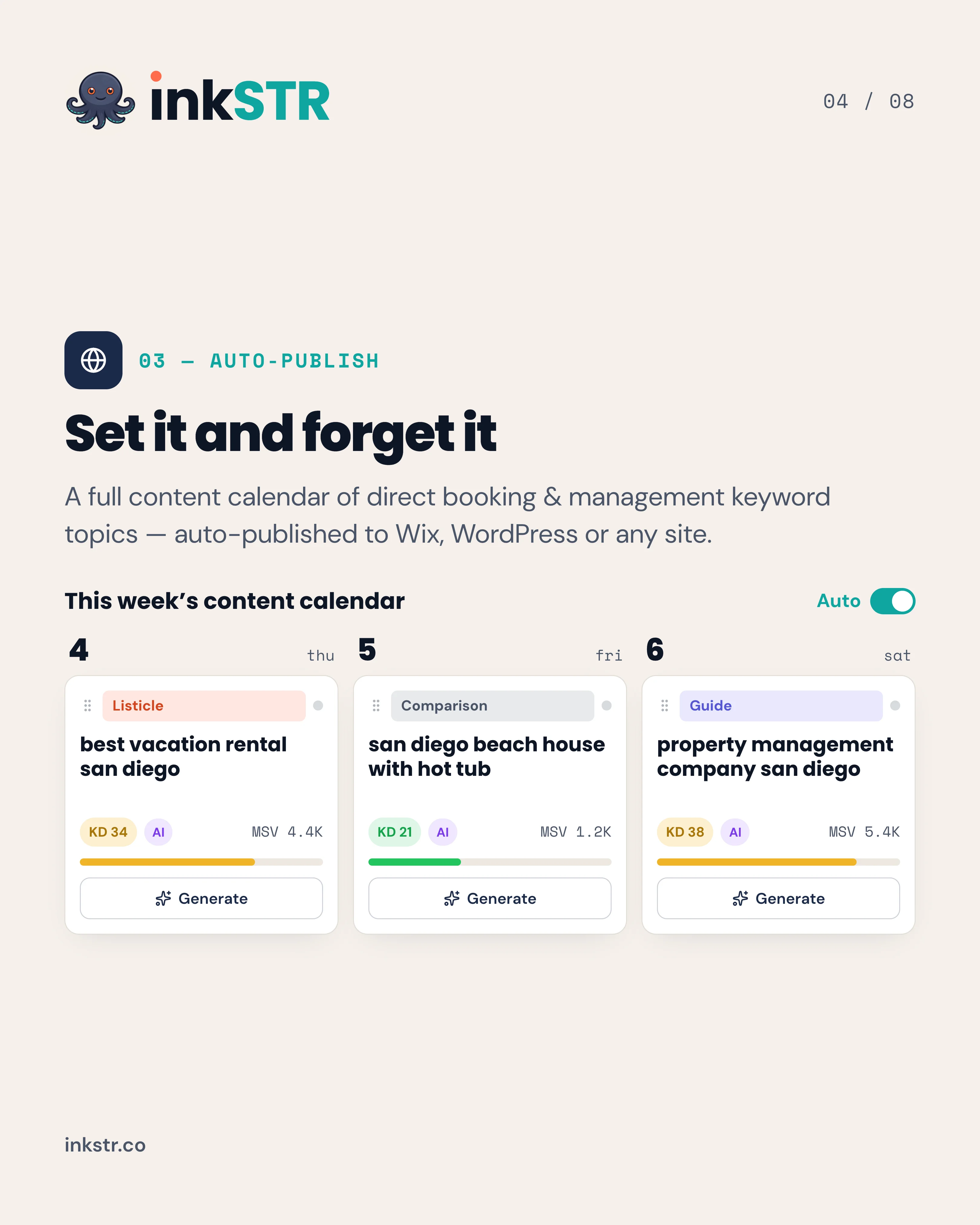
If keeping up with keyword research, Google's shifting algorithm, and the rise of AI search feels like more than you can track alongside actually running your properties, get started with inkSTR. It generates, schedules, and publishes SEO and AI-search-optimized content automatically, so your property shows up no matter which search tool your next guest decides to open.
Content powered by inkSTR.co
Enjoyed this article? Share it:
Get more of inkSTR in Google Search
Add inkstr.co as a preferred source and our articles show up more in Top Stories, AI Overviews, and AI Mode — with a “Preferred” badge.
Get more guides like this
New SEO and AI-search guides, straight to your inbox. No spam, unsubscribe anytime.