Direct Booking Blog Strategy: Turn Stories Into Bookings
A direct booking blog is a series of search-optimized articles on your own vacation rental website, written to reach travelers while they plan a trip and send them to your booking page instead of Airbnb or VRBO. Each article that ranks can bring in guests for years, without the 17-19% in combined host and guest fees an OTA booking carries.
Key Takeaways
- A direct booking blog works by ranking trip-planning articles on your own site, then routing readers to a booking page where the guest pays you directly.
- The strongest topics pair travelers' planning questions with verified details from your own properties: area guides, seasonal itineraries, and property stories.
- Every article needs a deliberate booking path, meaning a specific property, offer, or inquiry page matched to the reader's trip intent.
- You can measure blog-assisted reservations with Google Search Console, Google Analytics, and a simple 'how did you find us' question at booking.
- inkSTR automates keyword research, article drafting, scheduling, and publishing to Wix or WordPress for $99/month, so your blog keeps publishing while you run your properties.
You check your analytics and the page views look healthy. Reservations through your own website sit at zero, and every confirmed stay still arrives through Airbnb or VRBO. That gap is where a direct booking blog earns its place in 2026.
At inkSTR, we build AI content tools for short-term rental operators, and the question we hear most is how to get a website to earn bookings, not just views. This guide covers what to write, how to verify it, how to connect each article to a booking page, and how to measure what comes back.
Expect a slow start. SEO takes months, not days, and no honest guide can promise a ranking date. You control consistency and accuracy, and both get easier once the workflow is set.
Table of Contents
- What Does a Direct Booking Blog Do for a Vacation Rental?
- Which Keywords Bring Travelers to Your Vacation Rental Website?
- What Should You Write About on a Vacation Rental Blog?
- How Do You Check Local Details Before You Publish a Guide?
- How Do You Connect Each Story to a Booking Path?
- How Often Should You Publish, and What Workflow Fits Your Portfolio?
- How Do You Measure Reservations Your Blog Influences?
- Can AI Write Your Blog Without Sounding Like Everyone Else's?
- Frequently Asked Questions
- Conclusion: Start Your Direct Booking Blog With One Verified Story
What Does a Direct Booking Blog Do for a Vacation Rental?
A direct booking blog is the article section of your own vacation rental website, written to rank for the searches travelers make while planning a trip. A guest finds an article on Google or in an AI answer, clicks through to your booking page, and pays you without Airbnb or VRBO in the middle. The booking engine behind that page can be a PMS-connected widget on Wix or WordPress.
The alternative costs more than most hosts calculate. Airbnb host and guest fees combined take 17-19% of every booking, and the traveler who stayed twice with you may never learn you have a website. A single direct booking is typically worth $1,000 to $4,000 in revenue, so the fees you skip add up quickly. On a $2,500 week, that fee range is roughly $425 to $475 you keep. Wix Blog reports that Mackenzie and Joe Precht get 60% of their Kindling Home bookings directly through their Wix site.
Most hosts stall because the blog needs steady output. A ranking article can drive organic traffic for 2-5 years, but only after somebody researches and writes it. We built inkSTR to handle that loop from keyword to published post, and our direct bookings page shows how the pieces connect.
Which Keywords Bring Travelers to Your Vacation Rental Website?
Trip-planning keywords are the searches travelers type before they pick a place to stay: an activity near a lake, a seasonal event, a pet-friendly stay in a specific town. They convert better for you than broad terms like 'vacation rental [town]', where large management companies and the OTAs already hold page one.
We recommend starting narrow. A specific trailhead, a winter festival, or a drive-time question has fewer strong pages competing, and the person asking is usually close to a decision. A query like 'pet-friendly cabins near Gatlinburg with a hot tub' tells you far more about the searcher than 'Gatlinburg rentals' does. Broad terms can wait until your site has some authority.
The manual route is a spreadsheet, a free keyword tool, and an afternoon of guessing which topics competitors cover. Then you repeat it next quarter. Most hosts quit after the first sheet.
inkSTR's keyword research replaces that afternoon by finding the terms your target guests search. The brand audit surfaces competitor keyword gaps, and Google Search Console integration flags queries where you already earn impressions but few clicks. For the location side, see our breakdown of the local signals behind direct booking SEO.
What Should You Write About on a Vacation Rental Blog?
A vacation rental blog topic is any article that answers a question a future guest asks before booking, using details only you can supply. Four types work best: area and activity guides, seasonal itineraries, practical arrival and stay guides, and property stories.
Property stories are the least crowded of the four. Write about the cabin's renovation, why you chose the lakefront lot, or a guest anecdote shared with permission. A guide titled 'Why we built the deck facing the ridge' can answer a real question about views and sunsets while pointing to one specific unit. A template keeps these from turning into diary entries:
- One real detail only you know
- One traveler question that detail answers
- One next step toward your booking page
Generic content is the usual failure. A freelance travel writer charges $300-$700 per quality post and has probably never stayed at your property, so the result reads like every other 'Top 10 things to do' page on page one.
inkSTR's AI Content Writer drafts articles in a writing style customized per project. The PMS integration with Hospitable and OwnerRez pulls in real reviews and photos, so stories come from your guests, not a template. Our list of vacation rental blog topics that drive bookings and the guide to local area guides that sell give you starting points.

How Do You Check Local Details Before You Publish a Guide?
Local detail verification is the step where you confirm every hour, price, access rule, and distance in a guide against an official source before it goes live. It matters because a guide that sends a family to a closed trailhead costs you the five-star review you were trying to earn.
- Hours and seasonal closures: check the venue's own website or call.
- Access and permit rules: confirm on the managing agency's official page, since rules change.
- Drive time: test it from your property's address, in the season guests actually travel.
- Reservations versus walk-ins: state which one applies.
- Freshness: add a 'last verified' line and recheck before peak season.
Most hosts skip this because it is tedious, and stale guides pile up. A page with one wrong detail can still rank, so the damage is slow and easy to miss. A scenic road that closes each winter, listed as open in a December itinerary, is the classic example.
inkSTR runs quality scoring and pre-publish validation that catch weak or risky content before it goes live. We still recommend a human spot-check for hours and access rules, because someone who has hiked the trail beats any tool. The Content Calendar schedules posts days ahead, which gives you a review window before anything publishes.
How Do You Connect Each Story to a Booking Path?
A booking path is the specific route from an article to a reservation: which property, which dates tool, and which page the reader lands on next. Matching the story's audience to the right property beats a generic 'book now' banner at the bottom of every post.
For illustration, imagine a winter weekend guide for a mountain town. It should link to the property with the fireplace and hot tub and name that property's availability page in the call to action. A family reunion guide should point to your largest home instead. A fishing-trip article might send readers to the cabin with the boat dock and a gear-cleaning station.
Without that match, readers leave happy and never book. Your analytics show strong page views and a booking page that gets almost no visits from the blog. Our guide to booking page conversion optimization covers the page itself, and why blog content fails to convert visitors into guests covers the handoff.
inkSTR's internal link management routes readers to the primary booking or inquiry pages you set, and the AI Content Writer places those links in each draft where the reader's intent peaks. You choose the destination once, and every new article inherits it.
Ready to automate your content marketing?
inkSTR handles keyword research, content strategy, article writing, and publishing, all on autopilot.
How Often Should You Publish, and What Workflow Fits Your Portfolio?
Publishing cadence is how many articles you release per month, and for a direct booking blog, a steady rhythm beats a burst. As a practical rule from our experience, a one-property host who posts twice a month for a year does better than one who writes ten posts in January and goes silent. Search engines reward sites that keep adding useful pages.
Portfolio size changes the workflow. A single-property host needs one pipeline. A manager with 15 or more units needs separate pipelines per property or market, or every article ends up generic.
| Approach | Time or cost per post | Main risk |
|---|---|---|
| Write it yourself | 3-5 hours of research and writing | Cadence collapses in busy season |
| Hire a freelance travel writer | $300-$700 per quality post | Content lacks your property details |
| inkSTR | Included in $99/month; generated, scheduled, and published automatically | Needs a quick human review for local facts |
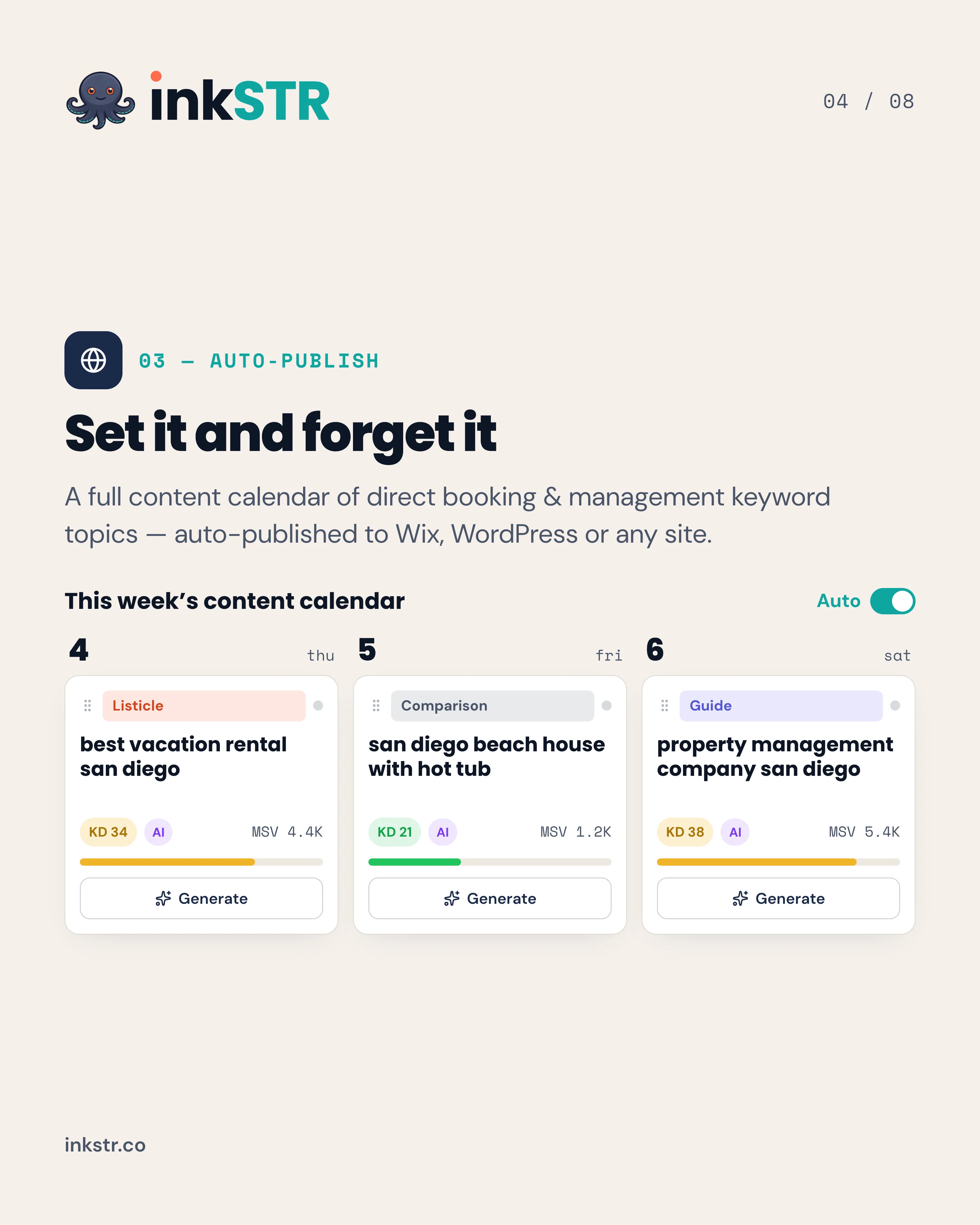
In the content calendar, you drag an article to Tuesday and the scheduler publishes it to your WordPress or Wix site through Auto-Publishing. Multi-project support gives each property or brand its own independent pipeline. In one case, a five-market mountain rental brand published 114 inkSTR articles in four months and went from 26 to 1,924 monthly Google search visits. See pricing for plan details.
How Do You Measure Reservations Your Blog Influences?
A blog-assisted reservation is a booking where the guest read at least one of your articles before reserving, even if they booked later through a different page or visit. Counting only last-click traffic undercounts the blog, since readers often browse, leave, and return days later.
- Tag every booking link inside articles so you can see article-to-booking-page clicks in Google Analytics.
- Review Google Search Console per page to see which queries each article earns.
- Ask every direct guest how they found you, and log the answer.
- Compare article topics monthly and update the ones with impressions but weak clicks.
Without this, you track page views and guess. A post can draw thousands of readers and send none to your booking page, and you will not know unless you look at the path.
In one case, a Smoky Mountains cabin rental brand grew monthly Google Search clicks from 788 to 5,195 in 11 months on inkSTR and attributed $309,775 in direct booking revenue over its first 14 months. Those figures were measured in Google Search Console and Google Analytics. Our Search Console integration tracks keywords and detects opportunities in the same dashboard where you schedule posts.

Can AI Write Your Blog Without Sounding Like Everyone Else's?
AI blog writing for vacation rentals is the use of a language model to draft articles from keyword research and property data, which you then review and publish. It can rank on Google when the content is specific, accurate, and edited, and it fails when it produces the same listicle every competitor already has.
The fix is grounding. Feed the draft real reviews, photos, and amenity details, and it stops sounding generic. Skip a tool that writes from a keyword alone, because you will spend more time rewriting than you saved.
inkSTR articles run 2,500 to 3,500 words, are written for STR operators, and are structured for AI Overviews, ChatGPT, and Perplexity citation. As of October 2026, we have published more than 5,100 articles across customer sites and secured more than 1,400 verified AI-search citations. Our guides on article automation without losing your brand voice and ranking in AI search go deeper.
Frequently Asked Questions
Will SEO help me rank higher than Airbnb and VRBO?
For broad searches like 'vacation rental [town]', outranking the big platforms is unlikely early on. You can win specific long-tail searches, such as a trail or an event, where a focused article answers better than a listing page. Our guide on how to rank your vacation rental website on Google walks through it.
How do I get more direct bookings for a boutique hotel?
Publish area guides, room-specific stories, and event-based itineraries on your own site, and link each one to the exact room type or package it fits. The same blog approach works for a boutique hotel as for a cabin rental. You can start building that content plan with inkSTR.
How can I use AI tools to write blog articles for my rental business?
Use a tool that drafts from keyword research and your real property data, then review local facts before publishing. inkSTR's AI Content Writer generates full articles and scores quality before they go live. Add your own photos, reviews, and guest anecdotes for the details a tool cannot know.
What software helps with blog publishing, SEO recommendations, and website analytics?
inkSTR combines keyword research, a drag-and-drop content calendar, one-click publishing to Wix and WordPress, and Google Search Console integration for tracking and opportunity detection. For deeper behavior data, pair it with Google Analytics.
How long does a direct booking blog take to rank?
Expect months before a new blog earns steady traffic, and no one can guarantee a date. Consistent publishing and accurate, specific content are the factors you control.
Do I need my own website, or can I rely on Airbnb and VRBO?
You need your own site to run a direct booking blog, because an Airbnb or VRBO listing does not let you publish ranking articles you own. An owned site also lets you keep guest contact details for repeat stays.
Conclusion: Start Your Direct Booking Blog With One Verified Story
A direct booking blog turns trip-planning searches into reservations you do not split with an OTA. Pick narrow keywords, write from details only you know, verify every local fact, and give each article a specific booking path. Measure with Search Console and Analytics, and keep a steady cadence through 2026 and beyond as AI search keeps rewarding specific, well-sourced pages.

If you would like to publish consistently without writing every post yourself, start a free trial of inkSTR and let it draft, score, and schedule search-optimized articles that send readers to your own booking page.
Content powered by inkSTR.co
Enjoyed this article? Share it:
Get more of inkSTR in Google Search
Add inkstr.co as a preferred source and our articles show up more in Top Stories, AI Overviews, and AI Mode — with a “Preferred” badge.
Get more guides like this
New SEO and AI-search guides, straight to your inbox. No spam, unsubscribe anytime.