What Is Answer Engine Optimization AEO for Vacation Rentals?
Answer engine optimization (AEO) is the practice of structuring your website content so AI systems like ChatGPT and Google AI Overviews can extract and cite it as the direct answer to a question. For short-term rental operators, answer engine optimization AEO means your blog earns citations that send informed guests to your direct booking site.
Key Takeaways
- AEO builds on SEO. It structures each page so ChatGPT, Perplexity, Gemini, and Google AI Overviews can lift a self-contained answer and cite your site, while classic ranking work still supplies the foundation.
- Answer first. Open each section with a direct answer of about 40 to 60 words. That length is a widely repeated convention, not a proven threshold, so test it against your own results.
- Measure with a fixed prompt set. Log unlinked mentions, linked citations, answer placement, and referral traffic as separate numbers.
- Formatting has limits. Schema and crawl access help eligibility, but outdated or unsupported facts can hurt you faster than formatting helps.
- The money is in direct traffic. A single direct booking is typically worth $1,000 to $4,000, while Airbnb host and guest fees combined take 17-19% of every booking.
- Automation makes it sustainable. inkSTR automates keyword research, answer-first article writing, scheduling, and publishing for $99/month, so your AEO content ships on a set schedule.
You wrote a solid blog post. It sits on page two of Google, and ChatGPT still recommends a booking platform when a guest asks where to stay. That gap is the AEO problem. According to Moonrank's 2026 data, over 40% of product discovery begins on AI-powered search engines like ChatGPT and Perplexity.
At inkSTR, we have watched property managers with portfolios of 15 or more units hit the same wall: plenty of listing views and thin direct traffic, with a blog written to hit keyword counts instead of answering questions. Answer engines reward the opposite approach.
This guide covers what AEO is, how it differs from SEO and GEO, how to improve your visibility in ChatGPT answers, how to measure results, and where the tactic breaks down. It ends with a 30-day plan you can start in 2026.
What Is Answer Engine Optimization AEO and How Does It Work?
Answer engine optimization AEO is the discipline of writing and structuring pages so AI answer engines, including ChatGPT, Perplexity, Gemini, and Google AI Overviews, can retrieve a passage and quote it with a link. It works by pairing crawlable pages with self-contained answers and consistent facts.
The mechanics matter. When a traveler or property owner asks a long question, the engine splits it into smaller sub-questions, retrieves pages for each one, and stitches a single response together. A page that answers only the headline question loses to a page that also answers the follow-ups, such as pricing and pet rules.
Doing this by hand is slow. One quality post takes 3-5 hours of research and writing, and a freelance travel writer charges $300-$700 per post, usually with no plan for how an AI will extract the result. Most operators publish three posts, see nothing, and quit.
That is the gap we built the AI Content Writer to close. It generates SEO and GEO-optimized articles from keyword research, with question headings and answer-first openers built in. For background on how AI Overviews reshape brand visibility, read this analysis of the AI impact on the search landscape.

How Is AEO Different From SEO and GEO?
SEO earns rankings and clicks in a list of links, while AEO earns mentions and citations inside a generated answer. GEO, or generative engine optimization, targets the same AI answer surfaces, so in practice AEO and GEO describe one workflow with slightly different vocabulary.
| Dimension | SEO | AEO and GEO |
|---|---|---|
| Where you appear | A ranked list of links | Inside a generated answer |
| Success signals | Rankings, clicks, conversions | Mentions, citations, brand visibility |
| Unit that gets judged | The whole page | A single passage on the page |
| Shared foundation | Crawlability, speed, internal links | The same foundation |
Our position: do not run two content tracks. Every AEO tactic that matters rests on SEO fundamentals. Pages must be crawlable, indexed, fast on mobile, and internally linked. We treat AEO as SEO with a stricter writing standard.
The trouble starts when you split the effort. One track for Google rankings and another for AI answers doubles your cost and halves your consistency. We built Keyword Research in inkSTR to surface the question-form queries your guests and owners actually type, so one article serves both surfaces. Our guide to ranking in AI search goes deeper on the overlap.
How Can You Improve Your Visibility in ChatGPT Answers?
You improve visibility in ChatGPT answers by publishing pages that directly answer the question a traveler or owner asks, keeping those pages crawlable, and stating facts consistently across your site and profiles. No setting forces a citation. You earn it through clear, current content.
Most vacation rental sites fail this test on the first line. Welcome to our cozy mountain retreat answers nothing a guest asked, so the engine has no passage to quote. Meanwhile, established property management companies publish pages that state fees and pet rules in plain sentences.
Writing those pages by hand across every property is where the plan collapses. You draft one, get pulled into a turnover day, and the blog goes quiet for six weeks. Pages that go stale tend to lose ground to pages that stay current.
We designed the Content Calendar in inkSTR for exactly this problem. You schedule articles on a drag-and-drop calendar and they publish on time, so your site keeps adding quotable pages while you handle guests. Consistent facts matter too, and our breakdown of direct booking SEO local signals covers the checks.
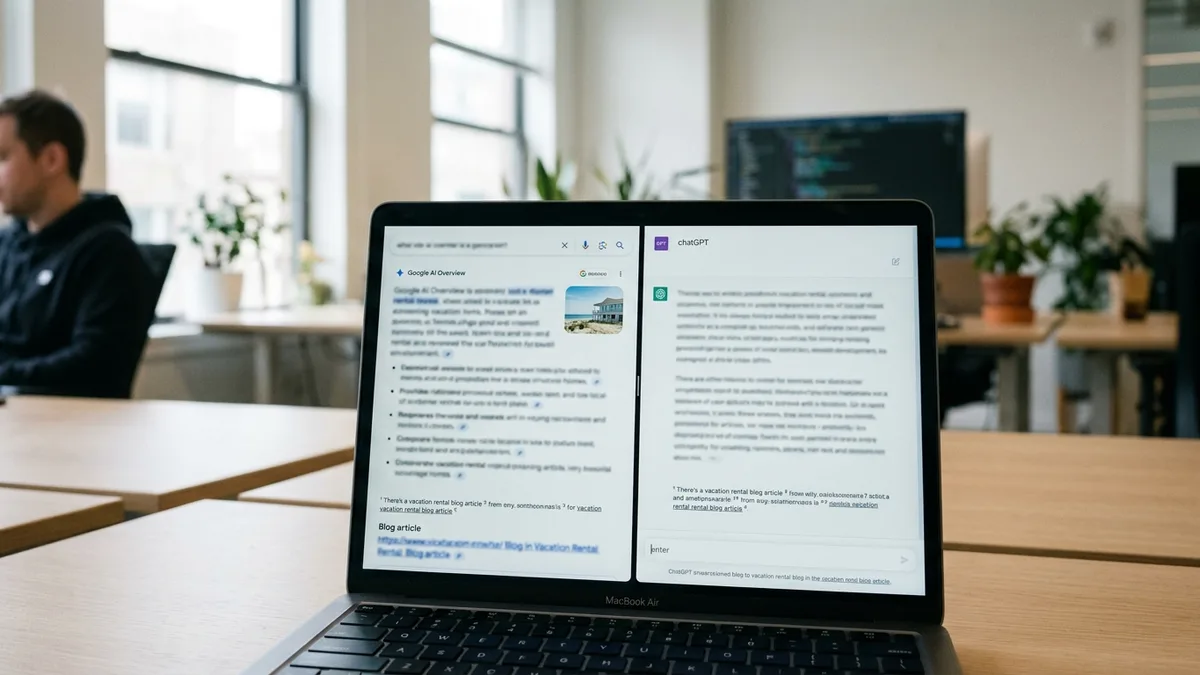
Do ChatGPT and Google AI Overviews Cite Sources the Same Way?
No. Each engine retrieves pages differently and shows citations in its own format, and public documentation on exact source selection is thin. Google's AI Mode is built into Google Search, per the Google AI Mode update, so indexation in Search Console still matters there.
Most guides lump the engines together and imply one tactic transfers everywhere. We have no public evidence that it does. Treat each engine as its own test: run the same prompts in ChatGPT, Perplexity, Gemini, and Google AI Overviews, then record which page each one picks.
What Does an AEO-Ready Blog Post Look Like?
An AEO-ready blog post opens each section with a self-contained answer of about 40 to 60 words, then supports it with specifics: numbers, named entities, a table, and a short FAQ. The 40 to 60 word length is a convention, not a tested threshold, so judge it by your own citation results.
The anatomy is simple:
- A question-format heading that matches how someone would ask it aloud.
- A definition-first answer paragraph that makes sense if quoted alone.
- Evidence below it: a figure, a named platform, or a comparison table.
- A closing FAQ block marked up so engines can parse each question and answer.
Most STR blogs do the opposite. They open with two paragraphs of scene-setting, bury the answer in paragraph five, and publish a generic list of 10 things to do that does nothing for direct bookings. Reformatting every old post costs you another afternoon each.
This is what we built inkSTR's article generation to do by default. It writes answer-first sections and FAQ blocks, then runs quality scoring and pre-publish validation before anything goes live. For local content, local area guides that sell shows how one direct answer, such as whether a lakefront cabin needs a car, beats a generic roundup.
How Do You Measure AEO Results Without Guessing?
You measure AEO by running a fixed set of buyer-style prompts across several answer engines on a schedule, then logging four outcomes: unlinked mentions, linked citations, answer placement, and referral traffic. Track assisted conversions separately, because a mention with no click still shapes what a guest believes.
| Metric | What it records | Where to find it |
|---|---|---|
| Unlinked mention | Your brand named in an answer with no link | Your prompt log |
| Linked citation | A link to one of your pages, plus which page the engine chose | Your prompt log |
| Answer placement | Whether you appear among the first sources or lower down | Your prompt log |
| Referral traffic | Visits arriving from AI engines | Google Analytics |
| Assisted conversions | Bookings or inquiries where an AI visit appeared earlier in the path | Google Analytics conversion paths |
Some practitioners recommend testing 15 to 30 prompts. Write them in your guests' words, run them before you change anything, and keep the wording identical every round. That baseline is what lets you prove improvement later. Some AI visits arrive without referrer data, so treat the traffic number as a floor.
Without a baseline, you are left saying it feels like it is working. And the manual version, with prompts and spreadsheets, eats the hours you meant to spend on guests. inkSTR connects to Google Search Console, so you see impressions and clicks for each published article and only need to log the AI side by hand.

What Are the Risks and Limits of AEO?
AEO carries four main risks: outdated or conflicting facts that engines repeat, unsupported claims that erode trust, schema that does not match the visible text, and overconfidence in access files like robots.txt or llms.txt. Formatting alone cannot fix any of them.
Consider the cost of a wrong fact. An engine quotes last year's pet policy or an amenity you removed, and a guest arrives expecting it. You lose a review and sometimes a booking. Schema that describes content the page does not show creates a similar mismatch.
On access files, robots.txt controls whether a crawler can reach a page, but it cannot make an engine cite you. We also have no public evidence that llms.txt moves citations, so do not spend a week on it before fixing your content.
We built inkSTR to ground articles in real property details and to validate each draft before publishing, but you still own the facts. Review rates and rules whenever they change. Our piece on article automation without losing your brand voice explains the review step we recommend.
Ready to automate your content marketing?
inkSTR handles keyword research, content strategy, article writing, and publishing, all on autopilot.
What Kinds of AEO Tools Should a Small STR Business Use?
A small short-term rental business needs two core layers of AEO tooling: measurement and content production. Technical checks such as crawlability and schema come from your site platform and Search Console. Anything beyond that is optional until your portfolio grows.
| Option | Cost | Your time | What it covers |
|---|---|---|---|
| Search Console and Google Analytics | Free | Setup, then regular reviews | Measurement only |
| Spreadsheet prompt log | Free | Varies with prompt count | AI mentions and citations |
| Writing posts yourself | Your time | 3-5 hours per post | Content |
| Freelance travel writer | $300-$700 per post | Briefing and editing | Content |
| inkSTR | $99/month | Review and approve | Keyword research, writing, scheduling, publishing |
On free trials: Search Console and Analytics are free, and many paid platforms offer trials, though terms change, so confirm on each vendor's pricing page. inkSTR offers a free trial, and you can see current plans on our pricing page.
The painful alternative is paying freelancers for every post or burning evenings on drafts. inkSTR is the one tool in that stack that handles production end to end, at a fraction of one freelance post per month. If you manage 10 or more properties, our property management page explains how multi-property operators run it.
What Results Can STR Brands Expect From AEO-Style Content?
STR brands that publish answer-first content consistently tend to gain in both Google Search and AI citations, though timelines vary. As of October 2026, inkSTR customer sites have secured more than 1,400 verified AI-search citations, and one cabin rental brand grew monthly Google clicks from 788 to 5,195 in 11 months.
That brand, a Smoky Mountains rental management company, had plateaued and leaned on OTAs and paid channels. We ran a continuous pipeline of pillar-and-cluster articles grounded in real property data, written answer-first and auto-published to WordPress. Monthly impressions rose from 130,000 to 450,000, measured in Google Search Console.
A Charlotte and Lake Norman management company with a 50+ property portfolio started at the end of April 2026 with owner-facing content built for AI search. It received four property-owner leads from AI search in its first month. Across all customer sites we have published more than 4,600 articles as of October 2026.
Results vary, and we never promise ranking positions. Most sites see meaningful traffic gains within 3 to 6 months of consistent publishing. A ranking article can keep driving traffic for 2-5 years, which is why the direct bookings payoff compounds.

What Does a 30-Day AEO Plan Look Like for an STR Operator?
A 30-day AEO plan has four phases: baseline your AI visibility, fix your foundation, publish answer-first articles on a schedule, and re-test with the same prompts. Most operators finish the setup in a month, then let publishing run on autopilot.
- Write 15 to 30 prompts in your guests' and owners' own words, covering pricing, pet rules, seasonality, and booking questions.
- Run every prompt in ChatGPT, Perplexity, Gemini, and Google AI Overviews, and log mentions and citations, plus the page chosen.
- Check in Search Console that your key pages are indexed and crawlable, and confirm no crawler block hides them.
- Pick question-form topics from keyword research and publish answer-first articles on a fixed weekly rhythm.
- Keep property facts and rates identical across your site and listing profiles.
- Re-run the identical prompts at day 30 and compare against your baseline.
Four mistakes sink this plan: changing prompt wording between rounds, treating llms.txt as a fix, publishing generic roundups, and never updating old facts. Doing every step by hand across several properties is where most plans die.
That is why we pair the Auto-Publishing feature with the calendar. Approved articles go straight to Wix or WordPress with no manual steps, and custom sites work too. You can start your content plan here, and how inkSTR works walks through the workflow from keyword to published post. Our guide on how to rank your vacation rental website on Google covers the SEO side.
What Should You Do Next About Answer Engine Optimization?
Answer engine optimization AEO comes down to direct answers and consistent facts, plus a repeatable way to measure citations. Start by logging your baseline prompts this week. Then publish on a schedule you can sustain, because AI engines in 2026 and beyond will keep rewarding current, specific pages over occasional bursts.

You do not need to become an SEO expert to earn AI citations for your rentals. You need a system that does the research and writing for you. inkSTR generates and publishes answer-first articles on autopilot. Start a free trial with inkSTR and see your first content plan.
Frequently Asked Questions
What does a GEO site audit check in AI search optimization?
A GEO site audit checks whether AI engines can reach and understand your pages. It typically reviews crawl access and indexation, answer-first page structure, schema that matches visible text, and consistency of business and property facts. Our brand audit with competitor keyword gap analysis covers the content side of that review.
Can you track improvement after implementing audit recommendations?
Yes, if you capture a baseline first. Run the same fixed prompt set before and after your changes, then compare mentions, linked citations, answer placement, and referral traffic. Changing the prompt wording between rounds ruins the comparison, so keep it identical.
Which AEO tools offer free trials or free plans?
Google Search Console and Google Analytics are free and cover measurement. Many paid platforms offer trials, but terms change, so verify on each vendor's site. inkSTR offers a free trial, and plans start at $99/month.
Can AI-generated content get cited in ChatGPT and AI Overviews?
Yes, when it is specific and accurate and opens with the answer. As of October 2026, inkSTR customer content has secured more than 1,400 verified AI-search citations. Generic, unreviewed text rarely earns them, so ground every article in real property details.
Do you need schema markup for AEO?
Schema helps engines parse your content, but it is not a magic switch. It must match what the page visibly says, or it creates the kind of mismatch that erodes trust. Fix content quality and crawlability before adding markup.
How long does answer engine optimization take to work?
Most sites see meaningful traffic gains within 3 to 6 months of consistent publishing, and results vary by market and competition. The Smoky Mountains brand above took 11 months to grow clicks from 788 to 5,195. No one can guarantee a timeline.
Is AEO worth it for a small, independent host?
Yes, because one direct booking is typically worth $1,000 to $4,000 and avoids the 17-19% Airbnb host and guest fees. A handful of cited articles that send guests to your site can cover the cost of $99/month. The trick is publishing consistently without spending your weekends writing.
Content powered by inkSTR.co
Enjoyed this article? Share it:
Get more of inkSTR in Google Search
Add inkstr.co as a preferred source and our articles show up more in Top Stories, AI Overviews, and AI Mode — with a “Preferred” badge.
Get more guides like this
New SEO and AI-search guides, straight to your inbox. No spam, unsubscribe anytime.