How to Get Your Vacation Rental Recommended by ChatGPT
To get a vacation rental recommended by ChatGPT, keep your property facts identical everywhere, let OpenAI's search crawler read your site, earn real third-party mentions, and publish answer-first pages that match traveler questions. At inkSTR, we build that content layer for operators, but no tactic guarantees placement.
Key Takeaways
- ChatGPT recommends rentals by blending trained knowledge with live web retrieval, so consistent, crawlable facts on many sources beat one polished listing.
- ChatGPT search depends on OpenAI's search crawler, OAI-SearchBot, so blocking it in robots.txt or at your CDN removes your site from consideration.
- Reviews, local directories, and forum mentions act as third-party proof that AI systems can cross-check against your own claims.
- Answer-first FAQ and comparison pages on your own site give AI engines quotable text, which also supports direct bookings that avoid the 17-19% combined Airbnb host and guest fees.
- You can measure visibility by running a fixed set of traveler prompts across several assistants each month and logging how often you are named.
- inkSTR automates the research, drafting, and scheduling of citation-ready articles for short-term rental sites, so the owned-content step runs without weekly effort.
How Does ChatGPT Decide Which Vacation Rentals to Recommend?
ChatGPT recommends vacation rentals by combining what its model learned in training with live web retrieval when search is switched on, then favoring properties and brands that appear consistently across sources it can read. There is no submission form and no paid placement slot for a single rental.
The painful part is opacity. You can write a flawless Airbnb description and still never see your property named, because the answer is assembled from many pages you do not control. Most operators respond by rewriting the same listing again, which changes nothing about the wider evidence trail. A better move is to widen the trail: more sources, same facts, clear wording that a retrieval system can quote without guessing.
Each engine pulls from a slightly different pool, which is why a single tactic never covers everything:
| AI surface | Typical source behavior | What you can influence |
|---|---|---|
| ChatGPT search | Live retrieval through OpenAI's crawler, plus model knowledge | Crawler access, clear page text, outside mentions |
| Google AI Overviews | Indexed pages eligible for a snippet; see Google's AI Mode update | Indexing, helpful content, structure |
| Microsoft Copilot | Favors fresh, structured, clear HTML; this overlaps with how Bing ranking factors connect to ChatGPT search | Clean markup, key facts in plain text |
| Perplexity, Gemini, Claude | Retrieval plus citations; answers vary between runs | Same evidence trail as above |
We built inkSTR around this reality. It writes pages with answer-first sections and entity-rich phrasing so the retrieval layer has clean text to quote, instead of asking you to guess what each engine prefers.
Step 1: How Do You Make Your Rental Easy for AI to Identify?
Entity consistency means your property or brand carries the same name, address, and core facts on your website, every OTA listing, your Google profile, and your social bios. AI systems merge those mentions into one entity; mismatches split it into several weak ones.
The usual failure looks small. Your site says "Pine Hollow Cabin, sleeps 8" while one listing says "Pine Hollow Retreat, sleeps 10" and another omits the pet policy. A retrieval system sees three conflicting records and has no reason to trust any of them.
Run a quarterly audit on these fields across every channel:
- Property name and spelling of the area or neighborhood
- Bedrooms, beds, bathrooms, and maximum guests
- Check-in and check-out times
- Rules for pets, children, parties, parking, and stairs, written as plain text
Doing this by hand across a multi-property portfolio eats a full afternoon per quarter. When inkSTR drafts articles, it works from your project's own property details, so the facts on new pages start from one source of truth rather than from memory.
Step 2: How Do You Let ChatGPT's Crawlers Read Your Site?
Crawler access means your robots.txt file, hosting firewall, and CDN allow retrieval bots such as OAI-SearchBot, Claude-SearchBot, and PerplexityBot to fetch your public pages. Retrieval bots differ from training crawlers like GPTBot, ClaudeBot, and CCBot, and you can allow one group while limiting the other.
This is the silent killer. A security plugin or a CDN bot-protection rule often blocks unfamiliar user agents by default, and nobody on your team knows. Your pages are excellent, and the assistant never sees them.
Check two places first: robots.txt and your hosting or CDN bot settings. Then confirm in your search indexing reports that your key pages are indexed. Keep important facts out of tabs and PDFs, because clean, fresh HTML is easier for Copilot and others to parse. Even then, access only makes you eligible; placement is never promised.
None of this is a content problem, so inkSTR does not fix it for you. What it does is publish directly to WordPress or Wix through auto-publishing in standard, crawlable page format, so new articles do not hide behind scripts or manual copy-paste formatting errors.

Step 3: How Do You Build Third-Party Proof, Reviews, and Forum Presence?
Third-party proof is any independent source that describes your rental: guest reviews, local tourism directories, press mentions, and forum or Reddit discussions. AI engines treat agreement across independent sources as stronger evidence than anything on your own domain.
Here is the gap. You can publish brilliant pages, yet if no outside source mentions you, the assistant has nothing to corroborate. Operators who live only on Airbnb and VRBO often have reviews trapped inside those platforms, invisible to most retrieval.
Work these in order of effort:
- Complete your Google business profile and keep it current.
- Ask recent guests to leave detailed reviews that name the area, the trip type, and what stood out.
- Get listed in your local tourism or chamber directory.
- Answer questions honestly in relevant forum threads, without dropping links everywhere.
Be careful with forums. Promotional posting gets removed and can hurt more than it helps. In our experience, a short, factual answer from a host who knows the market earns more than a dozen sales pitches.
Our property management users add one more layer: owner-facing articles that other local sites quote and link. inkSTR writes those pages on a schedule, so your outside-mention surface grows as a side effect of publishing.
Step 4: How Do You Get a Vacation Rental Recommended by ChatGPT With Your Own Content?
Answer-ready content is a page that states a direct answer under a question-style heading, adds local detail second, and ends with a selling point. A self-contained block of roughly 130 to 170 words gives an AI engine a passage it can lift without surrounding context.
Compare the manual route. A freelance travel writer typically charges $300 to $700 per quality post, and writing one yourself takes 3 to 5 hours of research and drafting. Most operators publish a few posts and stall. The question pool stays uncovered, and competitors with steady publishing fill the gap.
The pages that earn mentions are usually these:
- FAQ pages built from real guest questions, such as pet policy or distance to the trailhead
- Comparison pages that say who each property suits, for example a dog-friendly house for eight versus a quiet couples' cabin
- Local guides with specific recommendations: what to order, when to go, what to skip
Each page also gives you a direct booking path, and a single direct booking is typically worth $1,000 to $4,000 in revenue. See our guide to optimizing a vacation rental website for ChatGPT for page-level formatting.
This is the step inkSTR was designed for. The AI Content Writer generates answer-first, citation-ready articles from keyword research, and the workflow from keyword to published post runs without you opening a blank document.
Step 5: Does Schema Markup Help ChatGPT Find Your Rental?
Schema markup is structured data, usually JSON-LD, that labels page content such as a property's name, address, amenities, and FAQ answers so machines read it without guessing. It helps Bing and Copilot label content, but Google states AI Overviews need no special schema beyond normal indexing and snippet eligibility.
The trap is believing markup rescues thin content. It does not. If your page says little, structured labels on that little will not make an assistant recommend you. Markup amplifies clear pages; it does not replace them.
Add what is accurate and visible. Use VacationRental-style property markup on listing pages and FAQPage markup on question blocks, and make sure every marked-up fact also appears in the visible text. Mismatches between markup and page copy erode trust. Validate the result and confirm the page is indexed after each change.
On inkSTR, FAQ sections are formatted for FAQPage extraction, and the feature set includes pre-publish quality scoring and validation. That catches structural gaps before a page goes live, which beats discovering them months later.
Ready to automate your content marketing?
inkSTR handles keyword research, content strategy, article writing, and publishing, all on autopilot.
Step 6: How Do You Test Whether ChatGPT Recommends Your Property?
Prompt testing means running a fixed list of realistic traveler questions across several AI assistants on a regular schedule and logging whether your brand or property is named. Because answers vary between runs, you need repetition, not a single check.
Without a method, you test once, see nothing, and conclude AI search does not work. Or you see a mention once and celebrate a fluke. Both lead to bad decisions.
Build the test this way:
- Draft 10 to 20 guest questions, split into branded and non-branded.
- Run each across ChatGPT, Perplexity, Gemini, and Claude, more than once.
- Log whether you were named, which sources were cited, and the reason given.
- Calculate your mention rate as a percentage, date it, and rerun monthly.
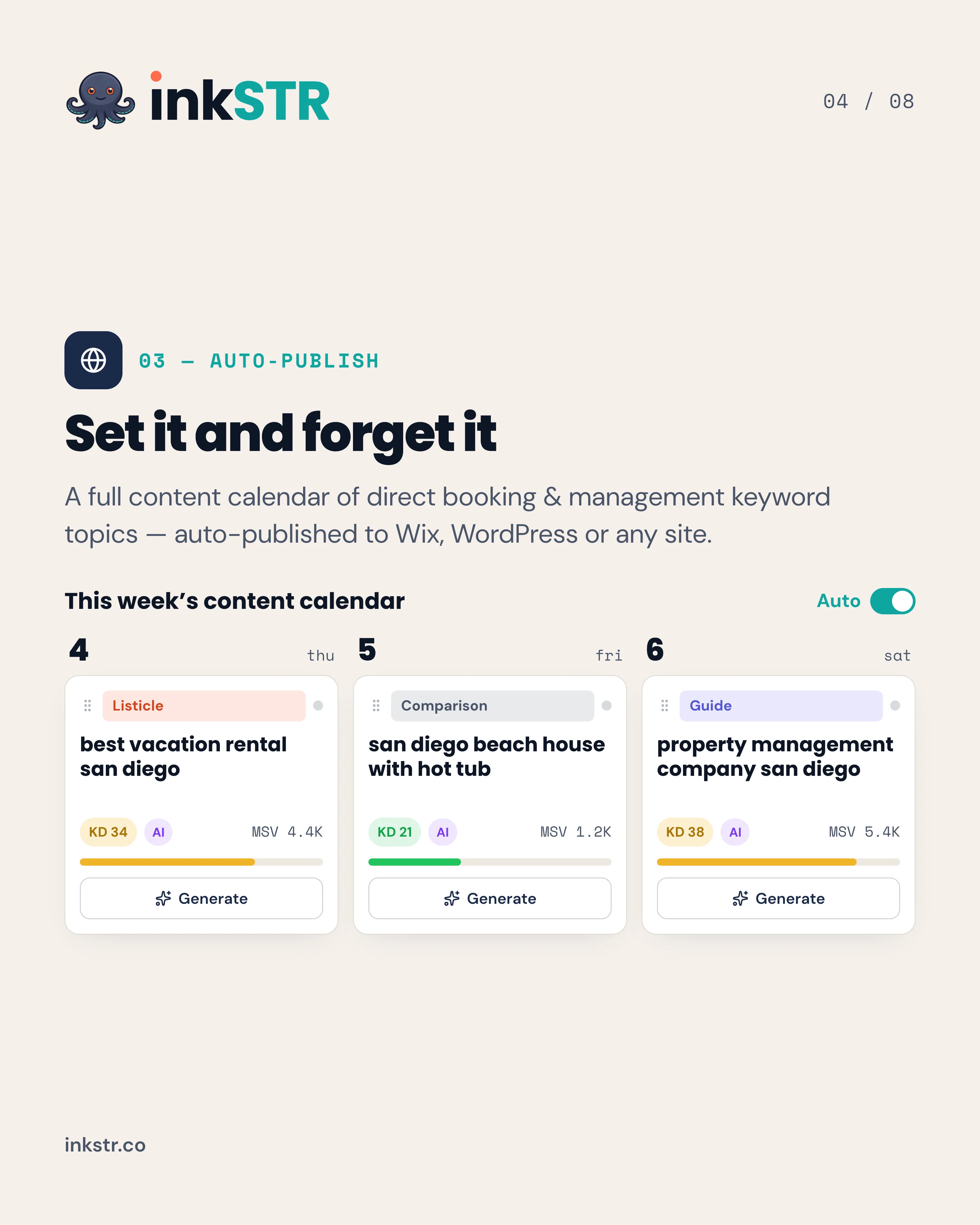
For tools, a shared spreadsheet is a fine starting point, and your search analytics show whether the matching pages earn impressions. We tie ours together in inkSTR with Search Console integration, and the Content Calendar makes a monthly retest-and-publish rhythm easy to hold. Across inkSTR customer sites, we have secured more than 1,700 verified AI-search citations as of November 2026.

Which Traveler Prompts Should You Match, and What Is the Best Site to Book Vacation Rentals?
Traveler prompts are conversational requests such as the best area to stay, a dog-friendly house for eight near the town, or a design-forward place with a pool under a set budget. Your pages win mentions when their wording mirrors those constraints.
Operators write for keywords like "lake house rental" while travelers type full sentences with party size, pets, and budget. A page that never states pet rules or sleeping capacity in plain text cannot match the sentence.
Travelers also ask which site is best for booking. Assistants often name large platforms such as Airbnb and VRBO for that, which is fair; the best site depends on whether you want marketplace reach or a direct relationship. Your goal is to be the specific option inside the answer, with a booking path that avoids the 17-19% combined Airbnb fees. Our direct bookings page explains how content feeds that channel.
Build prompt coverage by property type: family stays, pet-friendly stays, accessible stays, group stays. inkSTR's Keyword Research turns these traveler phrasings into a topic list so you do not guess which sentences matter.
What Can You Not Control, and Which Mistakes Waste Time?
You cannot control whether any assistant names your rental, because model knowledge, retrieval pools, and answer variation sit outside your hands. You control the evidence you leave behind, and that is the whole job.
The costly mistakes are predictable. Operators buy a tool and run one prompt. They see nothing and quit. Others chase schema while their pages stay thin, or block crawlers by accident. Some copy one listing blurb across every channel, which gives engines zero new information.
Also be wary of precise promises. Vendor studies about AI answers are observational, not controlled experiments, so treat any claim that a specific tactic causes recommendations with caution. Honest expectations: this builds over months, and results vary by market competition and publishing consistency.
One real result: a Charlotte and Lake Norman management company started on inkSTR at the end of April 2026. Within its first month, it received four property-owner leads from AI search, measured through its search analytics and its own lead records. You can read more outcomes in our case studies, and our vacation rental SEO strategy guide covers the Google side that feeds the same evidence trail.
Frequently Asked Questions
Does ChatGPT recommend specific Airbnb or VRBO listings?
It can name platforms and sometimes individual properties or brands, depending on what retrieval finds. It rarely surfaces a single listing page, so building your own site and outside mentions gives you more ways to appear than a listing alone.
What is generative engine optimization for vacation rentals?
Generative engine optimization is the practice of structuring your site and outside mentions so AI assistants can find and quote your rental. They also need to trust it. It covers crawler access, consistent facts, answer-first content, and prompt testing. It supplements SEO rather than replacing it.
How do I get my vacation rental website to rank on Google?
Publish pages that answer specific traveler searches and keep them indexed. Link them to your booking pages. Check your search analytics for impressions and position. Our SEO content guide for vacation rental hosts walks through the basics.
What company focuses on vacation rental SEO in 2026?
inkSTR focuses exclusively on short-term rental and hospitality content, covering keyword research, article generation, scheduling, and publishing. Generalist SEO tools serve any industry, so they lack vacation rental terminology and traveler intent. You can see current plans on the pricing page.
What tools track AI visibility for vacation rentals?
A dated spreadsheet of repeated prompts works well for a small portfolio, and your search analytics show the search side. Dedicated AI visibility trackers exist, but verify what they measure before paying. inkSTR focuses on writing citation-ready content and tracking keyword movement through Search Console.
What are the best niche rental platforms for a lake or cabin property?
Marketplaces with strong cabin and lake inventory can add reach, but each takes a commission and owns the guest relationship. Pair any platform with your own site so travelers asking an assistant can also find a direct option.
How long does it take to show up in ChatGPT answers?
It typically takes months, not weeks. The timing varies by market competition and publishing consistency. A ranking article can drive organic traffic for 2 to 5 years, so early pages keep paying off while you add more.
Conclusion
Getting a vacation rental recommended by ChatGPT comes down to evidence: identical property facts across channels and open crawler access. Independent mentions and answer-first pages on your own domain matter too. Start with the crawler and consistency audit this week, then run your first prompt test and date the result. In 2026, the operators who keep publishing and retesting each month will hold the advantage as AI travel planning grows.
The part most operators cannot sustain is the steady research and writing. That is why we built inkSTR to draft and score keyword-targeted articles. It also schedules them to publish to your site automatically. Start Free Trial and queue your first month of citation-ready content.
Content powered by inkSTR.co
Enjoyed this article? Share it:
Get more of inkSTR in Google Search
Add inkstr.co as a preferred source and our articles show up more in Top Stories, AI Overviews, and AI Mode, with a “Preferred” badge.
Get more guides like this
New SEO and AI-search guides, straight to your inbox. No spam, unsubscribe anytime.