Automatic SEO WordPress: What Actually Works in 2026
Automatic SEO WordPress tools handle the technical plumbing of search optimization, meta titles, XML sitemaps, schema markup, image alt text, and 404 redirects, without you touching a line of code. What they do not automate is the strategy behind what to write about, which keywords actually bring in bookings, and whether your content gets cited by AI search engines. That gap is where most short-term rental sites lose the game before it even starts.
Key Takeaways
- Automatic SEO WordPress plugins handle technical tasks like metadata generation, sitemap updates, schema markup, and redirect management, but they do not write strategic, keyword-targeted content.
- WordPress has minimal built-in SEO functionality on its own; nearly all "automatic SEO" capability comes from installed plugins that connect to Google Search Console.
- SEO can be partially automated (technical tasks, metadata, content generation) but ranking still requires a keyword strategy and consistent publishing cadence, which most plugins do not provide.
- ChatGPT and similar tools can draft SEO content, but generic AI output written without vacation rental search intent in mind tends to read as thin, interchangeable content.
- Across inkSTR customer sites, we have published more than 3,900 articles as of September 2026, generating over 2.5 million Google Search impressions in the trailing 90 days.
- inkSTR combines automatic technical SEO with a content strategy engine built specifically for short-term rental keyword intent, then publishes directly to WordPress or Wix on a set schedule.
WordPress still runs a significant share of vacation rental and property management websites in 2026, and for good reason: it is flexible, self-hosted, and compatible with almost any plugin ecosystem you want to build around it. But "automatic SEO WordPress" means something narrower than most operators assume. It refers to plugin-driven automation of technical SEO tasks, not a magic switch that makes your site rank for "cabin rental near me" searches.
If you run a vacation rental business, a boutique property management company, or a growing portfolio of short-term rentals, you have almost certainly Googled some version of this question while staring at a site that gets views but no bookings. This guide breaks down exactly what automatic SEO on WordPress can and cannot do for you, where the real work still happens, and how inkSTR fits into that picture for operators who do not have time to babysit a plugin dashboard every week.
We built our content pipeline specifically for short-term rental search intent, not general small-business SEO, and that distinction matters more than most WordPress plugin comparisons let on.
Is WordPress Outdated in 2026?
WordPress is not outdated in 2026. It still powers a substantial share of self-hosted websites globally, including a large portion of vacation rental and property management sites, and its plugin ecosystem for SEO, booking integrations, and content management remains more mature than most newer platform alternatives.
The confusion comes from comparing WordPress to no-code website builders like Wix or Squarespace, which have closed the gap on ease of use. WordPress requires more setup: choosing a host, managing plugin updates, configuring caching. For a solo host running one or two properties, that overhead can feel disproportionate to the benefit.
But for property management companies scaling past five or ten units, WordPress's flexibility becomes an asset. You can integrate a property management system, run a multilingual site, or build custom booking widgets without fighting platform restrictions. The tradeoff is that none of that flexibility helps you rank if your content strategy is thin.
That is exactly where operators get stuck. They pick WordPress because it is powerful, install a plugin because it promises automatic SEO, and then wonder why their vacation rental website is not ranking on Google months later. inkSTR's Auto-Publishing feature connects directly to WordPress (and Wix) so the content side of that equation stops being the bottleneck, whichever platform you already run.

Does WordPress Have Built-In SEO?
WordPress does not have meaningful built-in SEO beyond clean URL structures and basic semantic HTML. Nearly everything operators mean by "automatic SEO WordPress," meta titles, XML sitemaps, schema markup, canonical tags, comes from an installed plugin, not the core WordPress software itself.
Out of the box, WordPress gives you permalink customization and a reasonably clean HTML output. That is a decent foundation. But it will not generate a sitemap automatically, will not suggest meta descriptions, and will not flag duplicate content or orphaned pages without a plugin doing that work.
The typical setup workflow starts with installing an SEO plugin and running its setup wizard, which asks whether your site is a blog, store, portfolio, or local business, since that answer changes the default schema types applied later. From there, most plugins can auto-generate title and meta-description templates for any page you have not manually customized, including posts you publish while you are out running turnovers instead of at a keyboard.
Automatic XML sitemaps typically need to be enabled once and submitted to Google Search Console, after which the plugin updates the sitemap whenever content is published or unpublished. Built-in audit tools in most plugins also flag missing focus keywords, duplicate meta descriptions, and orphaned pages with no internal links pointing to them, three of the most common technical issues we see on vacation rental sites.
This is the layer inkSTR was never designed to replace. Instead, our AI Content Writer generates the SEO-optimized articles that fill the technical structure your plugin builds, so you get both halves working together instead of a well-configured empty site.
Can SEO Be Automated?
SEO can be partially automated. Technical tasks like metadata generation, sitemap updates, schema markup, and redirect monitoring automate well because they follow predictable rules. Strategic tasks, keyword research, content planning, and ongoing publishing cadence, require more judgment and are harder to automate reliably without niche-specific intelligence.
This is the distinction competitors gloss over, and it is the one that actually determines whether your site ranks. A plugin automating your title tags does not know that "pet-friendly cabin near Gatlinburg with hot tub" converts better for your business than "cozy mountain retreat." That requires understanding traveler search intent, not just technical formatting.
We see this pattern constantly across property management portfolios: the technical SEO score looks great, every page has a green checkmark in the plugin, and organic traffic still sits flat because nobody is publishing content that targets what actual guests search for. Automated technical SEO fixes symptoms. It does not generate demand.
What Actually Gets Automated Well
Redirect management, image compression, canonical URL assignment, and default metadata templates automate reliably because they are rule-based. A plugin can enforce these consistently across hundreds of pages without human review slowing anything down.
What Still Needs a Strategy Behind It
Keyword targeting, content calendars, and publishing cadence need a plan built around your specific market and property type. inkSTR's Keyword Research tool automates the research step itself, surfacing the exact terms your target guests search, so the strategic layer stops depending on hours of manual spreadsheet work. That is the part of "can SEO be automated" that most WordPress plugins never touch, because they were built for general small businesses, not short-term rental search behavior.
In one case, a multi-market vacation rental brand across five locations went from averaging 26 monthly Google search visits to 1,924 in four months, publishing 114 articles built around buying-intent search terms and auto-published to their site. That growth came from strategic keyword targeting layered on top of technical SEO, not from a plugin alone.

Can ChatGPT Do SEO?
ChatGPT can draft SEO content, suggest keyword ideas, and generate meta description variations, but it does not have live access to your Google Search Console data, cannot publish directly to WordPress, and does not specialize in vacation rental search intent without significant manual prompting and editing.
Plenty of hosts use ChatGPT to draft a blog post in a pinch, and that is a reasonable use of the tool for a single piece of content. The problem shows up at scale. Generic AI output written without niche context tends to repeat the same structure, the same "hidden gem" language, and the same generic advice you would find on any travel blog, not content built to convert a guest searching for a direct booking.
ChatGPT also cannot schedule itself. Every article still needs manual copy-pasting into WordPress, manual metadata entry, manual internal linking, and manual publishing. For a solo host publishing one post a month, that is manageable. For a property management company trying to maintain a content pipeline across a dozen properties, it becomes another full-time job layered on top of guest communication and turnovers.
That gap is exactly what inkSTR was built to close. Our platform generates full-length, SEO and AI-search-optimized articles (typically 2,500 to 3,500 words) specifically for vacation rental terminology and traveler search intent, then schedules and publishes them automatically through the Content Calendar feature. You get the drafting speed of an AI tool combined with the niche specificity and publishing automation that ChatGPT alone does not provide. Read more about how AI automation tools compare across the content pipeline if you want the fuller picture.
What Should You Actually Automate on Your WordPress Site?
The tasks worth automating on a vacation rental WordPress site are the ones with clear, rule-based outcomes: metadata templates, XML sitemaps, schema markup, image alt text, and redirect monitoring. Tasks that require judgment, like keyword strategy and content planning, need a system built around your specific niche, not a one-size-fits-all plugin default.
Below is a practical breakdown of where automation genuinely helps versus where it creates risk if left unsupervised.
| SEO Task | Safe to Fully Automate? | Why |
|---|---|---|
| XML sitemap generation and submission | Yes | Rule-based, updates automatically as pages publish or unpublish |
| Default meta title and description templates | Yes, with review | Fills gaps for uncustomized pages, but generic templates can read as thin |
| Schema markup (article, product, FAQ types) | Yes, if type is set correctly | Wrong schema type applied automatically causes structured-data errors |
| Image compression and alt text | Yes | Rule-based, low risk of factual error |
| 301 redirects for known URL changes | Partially | Preconfigured redirects work, but automatic 404 monitors still need a human to review flagged links |
| Keyword targeting and content topics | No | Requires understanding of your specific market and traveler search intent |
| Publishing cadence and content calendar | Yes, with the right platform | Requires a system that understands vacation rental content strategy, not just scheduling |
| Bulk AI-generated pages at scale | Risky without review | Can create thin, duplicate, or low-originality content if unsupervised |
The last row deserves its own conversation, because it is where a lot of operators get burned.
How Do You Avoid Thin Content When Automating SEO?
Thin content happens when automation generates large volumes of pages without editorial review, originality checks, or indexing controls. Programmatic page generation tools can produce hundreds of pages quickly, but if each page repeats the same structure with only location names swapped, search engines increasingly flag that pattern as low quality.
The distinction that matters here is safe automation of technical SEO versus risky hands-off generation of bulk content. Automating your sitemap is low risk because the output is structural, not editorial. Automating hundreds of AI-written pages with no human review is a different category of risk entirely, because Google's helpful content systems specifically look for information gain, meaning your content needs to add something a searcher cannot already find elsewhere.
Before publishing anything generated automatically, run it through a basic checklist:
- Does the page contain at least one specific, verifiable detail about your property or market that a generic template would not include?
- Is the meta title and description unique, not a duplicate of another page on your site?
- Does the assigned schema type match the actual content (an FAQ page should not carry Product schema, for example)?
- Are internal links pointing to and from the page, so it is not an orphaned page with zero navigational paths?
- Would this page still make sense if a reader landed on it with no other context from your site?
inkSTR builds quality scoring and pre-publish validation directly into the content pipeline, so articles get checked against these kinds of standards before they go live, rather than after a traffic drop tells you something went wrong. That validation step is part of why our approach differs from bulk programmatic tools: every article is grounded in real vacation rental terminology and market-specific detail, not templated location swaps.
What Does a Practical WordPress SEO Setup Look Like?
A practical setup separates technical SEO automation from content strategy, then connects both to Google Search Console for real performance data. First, connect your site to Search Console so you can see which queries are already sending traffic. Then configure your plugin's default metadata templates, submit your sitemap, and set your primary schema type based on site structure. From there, build a content plan around actual guest search behavior instead of guessing.
Here is the sequence we recommend to operators setting this up for the first time:
- Install and configure a WordPress SEO plugin, running its setup wizard to establish default schema types for your site structure.
- Connect Google Search Console and submit your XML sitemap once; most plugins update it automatically after that.
- Audit for missing focus keywords, duplicate meta descriptions, and orphaned pages using your plugin's built-in checks.
- Preconfigure 301 redirects for any known URL changes, and leave automatic 404 monitoring active for anything missed.
- Layer a content strategy on top: research the keywords your target guests actually search, not generic travel terms.
- Publish consistently on a schedule rather than in bursts, since search engines and AI citation systems both reward steady publishing patterns over sporadic spikes.
Steps one through four are where automatic SEO WordPress plugins genuinely earn their keep. Steps five and six are where most operators stall out, because they require either significant time investment or a system built specifically for this. That is the exact gap our full inkSTR workflow was designed to close, from keyword research through scheduled publishing.

Ready to automate your content marketing?
inkSTR handles keyword research, content strategy, article writing, and publishing, all on autopilot.
What Mistakes Do Operators Make With Automatic SEO Plugins?
The most common mistake is running two SEO plugins at once, which creates conflicting metadata and duplicate schema markup on the same page. Search engines see two sets of conflicting signals and often default to neither, weakening your rankings instead of strengthening them.
A second common mistake: assigning the wrong schema type. We regularly see vacation rental pages tagged with generic Article schema when they should carry more specific structured data, or FAQ pages with no schema at all, missing an easy chance at a featured snippet.
A third mistake is treating automatic redirects as a "set and forget" feature. Automatic 404 monitors flag broken links, but if nobody reviews those flags, you end up with redirect chains, sometimes even redirect loops, that slow page load and confuse crawlers.
The fourth, and most costly for direct bookings specifically, is assuming technical SEO automation alone will drive traffic. It will not. A perfectly optimized page with no strategic keyword behind it, and no ongoing publishing cadence, sits invisible on page eight of Google no matter how clean its metadata looks. This is the mistake inkSTR's Direct Bookings approach is built around solving: technical hygiene paired with a genuine content strategy, not one without the other.
How Much Does Manual SEO Content Cost Compared to Automation?
Writing one quality, SEO-optimized blog post manually typically takes three to five hours of research and writing, and hiring a freelance travel writer for that same post commonly runs $300 to $700 per article. For a property manager needing consistent output across a growing portfolio, that cost compounds fast.
Run the math on a modest publishing schedule: two posts a month at the low end of that freelance range works out to roughly $600 monthly, and that number climbs quickly if you want more frequent publishing or multiple properties each needing their own content pipeline. Compare that to inkSTR's pricing, starting at $99 a month for a platform that generates, schedules, and publishes articles automatically on a set schedule.
The revenue side of the equation matters just as much. A single direct booking is typically worth $1,000 to $4,000 in revenue, and Airbnb host and guest fees combined commonly run 17 to 19% of every booking that routes through the platform instead of your own site. A ranking blog article, once it earns its position, can drive organic search traffic for two to five years with minimal ongoing maintenance. That is the long-term math that makes content investment different from a paid ad campaign that stops the moment you stop paying for it.
In a separate case, a Smoky Mountains cabin rental brand grew from 788 to 5,195 monthly Google Search clicks over eleven months using a continuous content pipeline, and attributed $309,775 in direct booking revenue in the first fourteen months on the platform, measured directly in Google Search Console and Google Analytics. That is the kind of compounding return technical SEO automation alone cannot produce.
Data & Evidence: What the Market Tells Us About Automation Demand
The global vacation rental property management software market was valued at $4,900 million in 2026 and is projected to reach $12,500 million by 2035, an 8.9% compound annual growth rate, reflecting how quickly operators are adopting automation across every part of their tech stack, not just booking and pricing tools. Content and SEO automation is following the same trajectory as revenue management and channel management software before it.
Most short-term rental operators already juggle three to five separate software tools to run their operations, according to industry benchmarks, which means adding one more disconnected tool for content creates real workflow fragmentation rather than solving it. That is part of why we built inkSTR to connect directly to WordPress and Wix publishing, rather than handing you another export-and-import step.
As of September 2026, across inkSTR customer sites we have published more than 3,900 articles and secured over 1,100 verified AI-search citations for customer content, all-time. In the trailing 90 days, connected customer sites generated more than 2.5 million Google Search impressions and over 19,000 clicks. Those numbers reflect what happens when technical SEO automation gets paired with a content engine that actually understands the niche it is writing for.
Practical Guidance: Choosing the Right Automation Level for Your Site
Choosing how much to automate depends on your technical skill, your portfolio size, and how much time you have to review output before it publishes. A solo host with one property has different needs than a property management company running fifteen listings across multiple markets.
If You Manage One or Two Properties
Focus on getting the technical basics automated correctly first: metadata templates, sitemap submission, and basic schema. Your content volume needs are lower, so a plugin's default automation plus a manageable publishing schedule usually covers it. Check out must-have tools for short-term rental managers scaling up if you are weighing your broader tech stack.
If You Manage a Growing Portfolio
Technical automation alone will not keep pace with the content volume a multi-property portfolio needs. Each property, or each market if you operate across several, needs its own content pipeline without multiplying your workload. inkSTR's multi-project support gives each property or brand an independent pipeline managed from one dashboard, which is the architecture a fifteen-unit portfolio actually needs, not fifteen separate manual workflows.
Common Trade-offs to Understand
Fully automated bulk content generation is faster but carries thin-content risk if unreviewed. Fully manual content is safer editorially but slow and expensive at $300 to $700 per post from a freelancer. The middle path, automated drafting with built-in quality validation and niche specificity, is where most operators land once they've tried both extremes. For a deeper look at building a durable content plan, see why generic travel content kills conversions.
Frequently Asked Questions
What is automatic SEO on WordPress exactly?
Automatic SEO on WordPress refers to plugin-driven handling of technical tasks: XML sitemaps, schema markup, canonical URLs, image compression, and meta title or description templates. It does not include keyword strategy or content creation on its own, which is why most sites still need a separate content plan layered on top.
Do I need a plugin to do SEO on WordPress?
Yes, effectively. WordPress core does not generate sitemaps, suggest metadata, or manage schema markup without a plugin handling that work. Nearly all "automatic SEO" functionality operators refer to comes from an installed plugin connected to Google Search Console.
Can AI write SEO content that actually ranks?
AI-generated content can rank when it is specific, well-structured, and grounded in real search intent rather than generic templates. Thin, repetitive AI content without editorial review tends to underperform, which is why platforms like inkSTR build quality validation and niche-specific detail directly into the generation process before publishing.
How long does it take for a vacation rental website to rank on Google?
Most sites see meaningful organic traffic gains within three to six months of consistent, keyword-targeted publishing, though this varies by market competitiveness and publishing frequency. A single blog post rarely moves the needle; a sustained content pipeline over several months typically does.
Is it worth automating SEO if I already have a WordPress plugin installed?
A plugin covers the technical layer, but most operators still need a strategy for what content to publish and how often. Automating the content creation and publishing schedule on top of your existing technical setup, rather than replacing it, is usually the highest-leverage next step.
Can ChatGPT publish directly to my WordPress site?
No. ChatGPT can draft content, but it has no built-in connection to WordPress publishing, scheduling, or Google Search Console data. Getting a ChatGPT draft live still requires manual copying, formatting, metadata entry, and publishing, which is the exact manual step platforms with direct WordPress integration, like inkSTR, are built to remove.
What's the difference between SEO automation for a single listing versus a property management company?
A single listing typically needs a lighter publishing cadence and simpler technical setup. A property management company managing multiple properties needs independent content pipelines per property or market to avoid duplicate content and workflow overload, which is a structural difference, not just a volume difference.
Conclusion: Automatic SEO Handles the Plumbing, Not the Strategy
Automatic SEO WordPress plugins do real, valuable work: sitemaps, metadata, schema, redirects. They just were never designed to figure out what your target guests are searching for or how often you should be publishing to compete for those terms. That strategic layer is still where most vacation rental sites stall, and it is not a plugin problem, it is a content problem.
In 2026, the operators pulling ahead are the ones treating technical SEO and content strategy as two separate systems that need to work together, not one plugin doing both jobs. That is the model we built inkSTR around: technical hygiene handled by your existing WordPress or Wix setup, paired with a content engine built specifically for short-term rental search intent, publishing on autopilot instead of sitting in your to-do list.
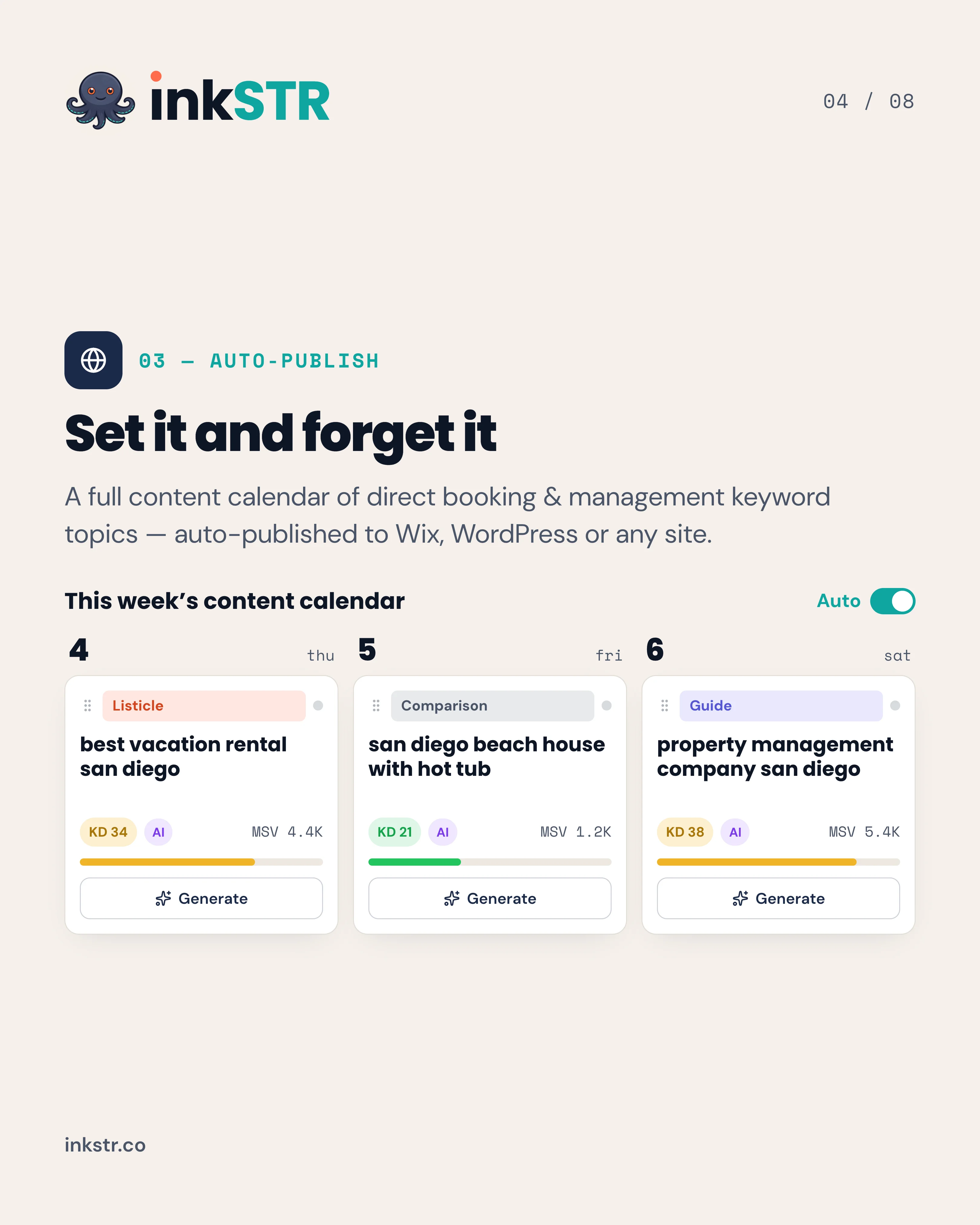
If keeping up with keyword research and blog publishing across your WordPress site feels impossible on top of running guest communication and turnovers, inkSTR was built to automate exactly that gap. Get started with inkSTR and see your first content plan today.
Content powered by inkSTR.co
Enjoyed this article? Share it:
Get more of inkSTR in Google Search
Add inkstr.co as a preferred source and our articles show up more in Top Stories, AI Overviews, and AI Mode — with a “Preferred” badge.
Get more guides like this
New SEO and AI-search guides, straight to your inbox. No spam, unsubscribe anytime.