How to Repurpose Airbnb Reviews Into Blog Content in 2026
To repurpose Airbnb reviews into blog content, collect your guest reviews, code the recurring phrases and questions, confirm you have permission to quote them, validate each theme as a keyword, and build one article per theme with short excerpts as proof. Each review becomes a topic, a quote, or a search phrase.
Key Takeaways
- Guest reviews contain the exact language future guests type into Google, so they work as a free topic and keyword source for your blog.
- Code reviews into themes (activities, amenities, questions, constructive feedback) before you write anything, then turn each theme into one focused article.
- Ask for permission, trim quotes, and remove identifying details before publishing any guest words on your own website.
- A review-based article differs from a testimonials page: it answers a search query first and uses reviews as supporting evidence.
- Writing one quality post by hand takes 3 to 5 hours, and a freelance travel writer charges $300 to $700 per post, so a repeatable workflow matters.
- inkSTR grounds articles in real guest and property data through its Hospitable and OwnerRez integration, then schedules and publishes them to Wix or WordPress for $99 per month.
You already have a content goldmine sitting in your Airbnb inbox. Every review says what guests loved, what confused them, and which words they use to describe your place. Most hosts read those reviews, feel good for a minute, and never use them again.
At inkSTR, we build AI content tools for short-term rental operators, and the question we hear most is where to find topics worth writing about. Your reviews are the best answer. In 2026, with Airbnb and VRBO taking a share of every booking and AI search rewarding specific, experience-based content, review-driven articles are one of the cheapest ways to earn direct traffic.
This guide walks through the full workflow in seven steps: source handling, consent, theme coding, keyword validation, outlining with a worked example, publishing, and measurement. You can follow it by hand or let a platform do the heavy lifting.
Step 1: Can You Edit an Airbnb Review, and Why Does It Matter for Repurposing?
Airbnb reviews are generally difficult to change once they are published, and the rules on editing them are limited and can change.
That limit shapes how you repurpose. If you paraphrase a review into a stronger claim than the guest made, your blog no longer matches the original. Quote accurately, trim only with ellipses where meaning stays intact, and never put words in a guest's mouth.
The manual version of this step is tedious. You open each reservation, copy the review text into a spreadsheet, and note the date, the stay length, and the guest type. For a host with 40 reviews, at roughly two minutes each, that is more than an hour of copying before a single sentence of an article exists.
We built inkSTR's PMS integration with Hospitable and OwnerRez for exactly this reason. It brings reviews, photos, and guest data into the platform, so the AI Content Writer works from what guests actually said instead of generic travel copy.
Pro tip: export before you analyze
Keep a plain working file with the review date, the excerpt, and a column for your own notes. You will add theme labels in Step 3. Estimated time by hand: one to two hours for a typical listing.
Step 2: Do You Need Permission to Quote Airbnb Reviews on Your Website?
Quoting a guest review on your own website is a publishing decision. The safest approach is to get the guest's permission, trim the quote to the relevant sentence, and remove details that identify the person. Most competitors skip this step entirely, which is where hosts run into trust problems.
Here is a practical consent and privacy checklist you can apply before anything goes live:
- Read the current Airbnb terms and your local privacy rules, and confirm you are allowed to reuse review text off-platform.
- Send the guest a short, polite message asking if you may quote one line, with the exact line included.
- Use first names or initials only, or no name at all, and never include last names, family details, or travel dates.
- Skip any review that mentions children, health, or other sensitive circumstances.
- Keep a record of the permission you received, in case you need to remove the quote later.
Rules differ by region, so confirm the details with the official source rather than relying on a blog post, including this one. If a guest says no or does not reply, use their theme without their words. Their idea can still become an article.
The manual burden here is easy to underestimate. Chasing permissions guest by guest adds a second time sink on top of writing. That is why we recommend using reviews mainly as theme and keyword fuel, with a handful of permissioned quotes as seasoning. The article carries the value; the quote is garnish.
Step 3: How Do You Find Blog Topics Inside Your Guest Reviews?
Finding blog topics in guest reviews means coding each review into recurring themes, then ranking those themes by how often guests mention them and how well they match real search behavior. Guest review language often mirrors the phrases future guests search, such as "perfect for a girls' weekend" or "great base for exploring the national park."
This also explains how reviews help vacation rental SEO. Reviews hold natural, specific wording about activities, seasons, and amenities that you would struggle to invent. Turned into articles, that wording earns pages that match long-tail searches your listing page never could.
Read your reviews with a highlighter and sort every useful line into one of these buckets:
| Review theme | Example signal | Best article type |
|---|---|---|
| Guest occasion | Anniversary, family reunion, group weekend | Occasion guide tied to your property type |
| Local activity | Trails, markets, lake days, dining | Local area guide with honest tips |
| Amenity praise | Back deck, hot tub, game room | Amenity-focused article with one pull quote |
| Recurring question | Parking, check-in, pet rules | Practical how-to or FAQ article |
| Constructive feedback | Noise, steep driveway, thin cell signal | Expectation-setting article that builds trust |
Do not ignore the critical reviews. A guest who writes that the road is steep in winter just handed you an honest post on seasonal arrival tips. Frame it as helpful advice, not a disputed claim, and you gain credibility that a glossy testimonials page never earns.
Pair this with a second source: your last 20 guest questions from email or messaging. The five most common usually overlap with review themes, and overlap is your strongest signal. Our vacation rental blog topics guide has more ideas once your review list runs dry.

Step 4: How Do You Check That a Review Theme Is Worth Writing About?
A review theme is worth writing about when people search for it, when your site can realistically compete for it, and when it leads naturally to your booking page. Validate each theme as a keyword before you draft, because a beloved amenity with no search demand makes a charming post that nobody finds.
Done by hand, keyword validation means pasting each theme into a research tool, checking the results page, noting who ranks, and logging everything in a spreadsheet. At about 20 minutes per theme, ten themes cost you more than three hours before you write a word. Many hosts abandon the plan right here.
We designed inkSTR's Keyword Research to remove that bottleneck. It finds the keywords your target guests actually search, and the brand audit surfaces competitor keyword gaps, so you can see which review themes map to real queries and which do not.
Use a simple filter when sorting your list:
- Keep themes that match a clear question or intent, such as "things to do near [your area] in fall."
- Merge themes that overlap, so you write one strong article instead of three thin ones.
- Park themes with no search angle for social posts or your booking page instead.
A one-property host may not need a full cluster plan yet. Start with the three themes that show up in your reviews most often and also show demand. Expand from there.
Step 5: How Do You Turn Review Excerpts Into an Article Outline?
To turn review excerpts into an article outline, group the excerpts by one theme, separate property-specific praise from broader destination advice, and give each group its own section under a question-style heading. The reviews supply evidence and wording; the outline supplies structure and search intent.
Here is an illustrative worked example. These excerpts are invented for demonstration, not real guest quotes.
- "Perfect for a girls' weekend. We lived on the back deck."
- "Great base for exploring the national park, though the trailhead parking fills early."
- "Wish we had known the driveway is steep after rain."
Theme: a weekend getaway for small groups. Separate what belongs to your property (the back deck) from what belongs to the destination (trailhead parking). Then outline it:
| Outline section | Source | Type |
|---|---|---|
| What makes a lake house good for a girls' weekend? | Excerpt one | Property-specific |
| When should you arrive at popular trailheads? | Excerpt two | Destination advice |
| What should you know before you drive up? | Excerpt three | Expectation-setting |
Notice the split. The deck belongs to your listing and can link to your booking page. The parking tip is public destination knowledge, and it can feed a broader local area guide. Mixing the two in one paragraph makes both weaker.
Under the first heading, open with the deck quote, then add two concrete details from your own listing: the deck's seating capacity and the view. Under the second, give a specific arrival time you have seen work, such as before 8 a.m. on summer weekends. Under the third, state the driveway grade in plain terms and tell guests which vehicles handle it. Each section then carries one quote and one verifiable fact, which is what separates a useful post from a pile of praise.
Writing this out manually takes 3 to 5 hours per quality post, according to the cost anchors we use at inkSTR, and a freelance travel writer typically charges $300 to $700 for one. Across a handful of themes, that is a real budget. The AI Content Writer drafts the full 2,500 to 3,500 word article from your keyword and property context, so you edit instead of starting from a blank page.
Step 6: How Is a Review-Based Article Different From a Testimonials Page?
A review-based blog article answers a search query and uses guest quotes as supporting proof, while a testimonials page simply collects praise in one place. The article ranks and attracts new visitors; the testimonials page reassures people who have already found you.
Guest testimonials still earn their place. Short review snippets near the booking button help address last-second hesitation, and a single quote with a matching photograph, such as a guest saying the back deck was their sanctuary next to a photo of that deck, adds first-person credibility to a destination guide. Place them where doubt appears, not in a wall of text.
The mistake we see most often is publishing a page of unlinked quotes and calling it content marketing. Readers enjoy it, Google ignores it, and nothing sends visitors toward a reservation. Every review-based article should link to your booking or inquiry page, and our guide on booking page conversion optimization explains what that page needs to convert.
This matters financially. One reader who moves from a blog post to your own booking page pays for a lot of articles. Our direct bookings page covers how content supports that channel.
The inkSTR internal link management feature handles the routing. You set your primary booking or inquiry pages once, and articles link back to them consistently instead of relying on you to remember during every edit.
Ready to automate your content marketing?
inkSTR handles keyword research, content strategy, article writing, and publishing, all on autopilot.
Step 7: How Do You Schedule, Publish, and Measure Review-Based Articles?
You schedule, publish, and measure review-based articles by loading them into a content calendar, publishing on a steady cadence to your own site, and tracking which posts earn search impressions and booking inquiries. Consistency matters more than any single article, because rankings build over months, not days.
Consider what the manual route costs. According to MarketingCharts (2026), 51% of small business owners said creating content, including writing copy and finding images, was among their most time-consuming marketing tasks. And 52% said they regularly delay or postpone their marketing. A review-based plan collapses without a system, because week three arrives and the drafts are still sitting in a folder.
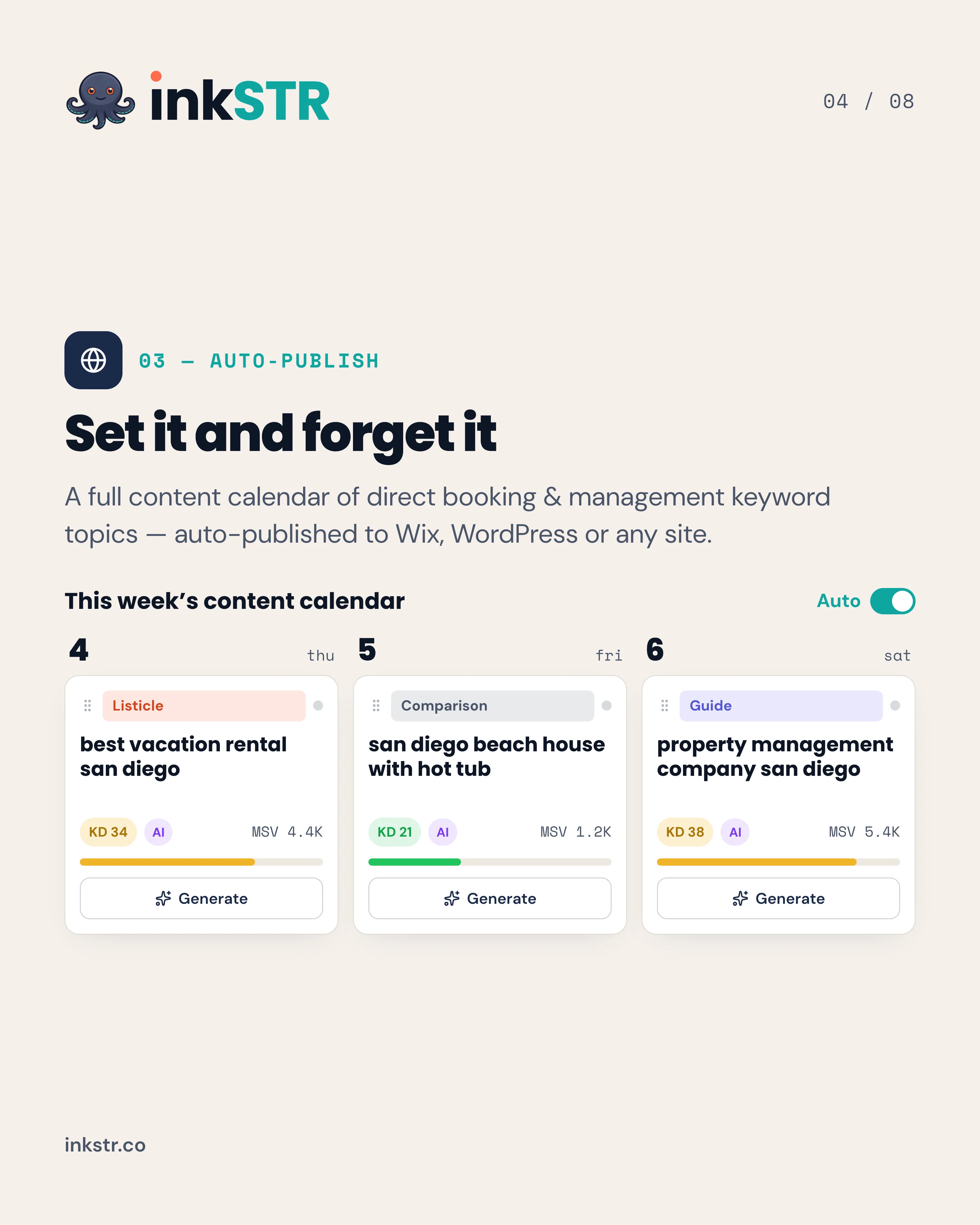
That is why we built the Content Calendar. You open it, drag an article to Tuesday, and the scheduler publishes it on time. Pair it with Auto-Publishing and each finished article goes straight to Wix or WordPress with no copy-and-paste formatting.
For measurement, connect Google Search Console to see which queries your articles earn impressions for, and use Google Analytics to see whether readers reach your booking page. Review the numbers quarterly and favor topics that generate inquiries over topics that only generate pageviews. For a review-based post, check one more thing: whether the phrases you lifted from guest reviews, such as "girls' weekend" or "trailhead parking," appear in the Search Console query list. If they do, your review coding is finding real demand.
We have seen the compounding effect of steady, property-grounded publishing. Hemlock Hills, a Smoky Mountains cabin management company, ran a continuous inkSTR pipeline of articles built on real property data, and its monthly Google Search clicks grew from 788 to 5,195 in 11 months, measured in Google Search Console. That pipeline was not review-specific, so treat it as evidence for the publishing cadence, not for reviews alone. Reviews feed the same pipeline as a topic source.
Which Is Better for Review-Based Content: Doing It Manually or Automating It?
Manual repurposing works for a single listing with a few reviews and a lot of free time, while automation wins once you want steady publishing across many themes or many properties. The deciding factor is rarely skill; it is whether you will still be doing this in month four.
| Factor | Manual workflow | inkSTR workflow |
|---|---|---|
| Writing time per post | 3 to 5 hours of research and writing | Draft generated automatically; you review and edit |
| Cost per post | $300 to $700 if you hire a freelance travel writer | Included in $99 per month |
| Keyword validation | Spreadsheet and manual SERP checks | Built-in keyword research and competitor analysis |
| Publishing | Copy, format, upload, and schedule by hand | One-click publishing to Wix or WordPress |
| Multiple properties | Separate documents and logins for each | Independent project pipelines per property or brand |
Among content marketing tools for vacation rental hosts, the right pick depends on whether you want a writing assistant or a full pipeline. Writing tools help with sentences. A pipeline handles research, drafting, scheduling, and publishing together. We built inkSTR as the second kind, specifically for short-term rentals, and you can see the current plan on the pricing page.
A ranking blog article can keep driving organic traffic for 2 to 5 years. Compare that to a freelancer invoice you pay once and a social post that vanishes in a day. If you manage several properties, multi-project support keeps each one's reviews and brand voice separate.

How Do You Repurpose Airbnb Reviews Into Blog Content Step by Step?
You repurpose Airbnb reviews into blog content by following seven repeatable steps, from capturing the source text to measuring the results. Use this as a quick-reference checklist each time you work through a new batch of reviews.
- Collect your reviews in one working file and treat each published review as a fixed record.
- Confirm consent, trim quotes, and remove anything that identifies a guest.
- Code each review into themes: occasions, local activities, amenities, questions, and constructive feedback.
- Validate each theme as a keyword and keep only those with real search demand.
- Outline one article per theme, separating property-specific praise from destination advice.
- Draft the article around a search question, add one or two permissioned quotes, and link to your booking page.
- Schedule, publish, and review performance in Google Search Console and Google Analytics each quarter.
Avoid these mistakes: quoting a guest without permission, publishing only positive reviews so the content reads as an ad, stuffing a page with quotes and no search intent, and writing one huge article instead of several focused ones. For a broader view of how this fits the rest of your marketing, read our guide on how to create content for Airbnb hosts.
Frequently Asked Questions
How do guest reviews help vacation rental SEO?
Guest reviews contain natural, specific language about activities, seasons, and amenities that matches how future guests search. Turning those phrases into focused articles gives you pages for long-tail queries your listing page cannot cover. Reviews alone do not rank, but they guide what you write.
Ask the guest for permission, quote only the relevant line, and remove last names and identifying details. Check the current platform terms and your local privacy rules before publishing. If a guest declines, use the theme without their words.
What is the difference between a content refresh and a rewrite?
A refresh updates an existing article while keeping its URL, structure, and main argument, for example by adding new review themes or current details. A rewrite replaces most of the content, usually because search intent changed or the article no longer answers the query. Refresh when the foundation is sound; rewrite when it is not.
For broad searches like a city name plus "vacation rentals," large platforms are very hard to beat. For specific, long-tail queries tied to your area, property type, and guest occasions, a well-built blog can earn visibility. Expect months of consistent publishing, and no one can guarantee rankings.
What tools automate the content pipeline from keyword research to WordPress publishing?
inkSTR covers that pipeline for short-term rental operators: keyword research and competitor analysis, AI article generation, a drag-and-drop content calendar, and one-click publishing to Wix or WordPress. Google Search Console integration handles ranking and opportunity tracking. See how inkSTR works for the full workflow.
Can AI-written articles based on guest reviews rank on Google?
They can, when you edit them, ground them in real property and guest details, and match a real search query. Generic AI text tends to underperform because it says nothing specific. Quality scoring and pre-publish validation in inkSTR help catch weak content before it goes live.
Does inkSTR publish directly to Wix and WordPress?
Yes. inkSTR supports one-click publishing to both Wix and WordPress, and the scheduler publishes on the dates you set in the content calendar. You can also run a separate pipeline for each property or brand.
What Should You Do Next to Repurpose Your Airbnb Reviews Into Blog Content?
Start with your ten most recent reviews, code them into themes, and pick the three that also show up as real searches. That is enough to publish your first review-based articles this month. In 2026, with AI search favoring specific, experience-backed answers, your own guests' words are an advantage competitors cannot copy.
The repeatable part is where most hosts stall, and it is where we can help. If you would rather not do every step by hand, inkSTR's AI Content Writer and Content Calendar draft, schedule, and publish search-optimized articles so you can focus on your guests. You can start your free trial of inkSTR or get started here. If you manage a portfolio and want owner leads as well, see our property management page.

Content powered by inkSTR.co
Enjoyed this article? Share it:
Get more of inkSTR in Google Search
Add inkstr.co as a preferred source and our articles show up more in Top Stories, AI Overviews, and AI Mode — with a “Preferred” badge.
Get more guides like this
New SEO and AI-search guides, straight to your inbox. No spam, unsubscribe anytime.