AutoSEO for Vacation Rentals: What It Is and Why It Matters
AutoSEO is the automation of search engine optimization tasks using software and AI instead of manual work by a person. For short-term rental operators, autoseo means your blog gets researched, written, scheduled, and published to your website without you touching a keyboard.
Key Takeaways
- AutoSEO combines keyword research, AI content generation, and automated publishing into one pipeline, replacing the manual steps most vacation rental operators skip because they run out of time.
- Writing a single quality blog post manually takes 3-5 hours of research and drafting, and freelance travel writers typically charge $300 to $700 per post, costs that compound fast across a content calendar.
- A ranking blog article can drive organic search traffic for 2 to 5 years, making autoseo a long-term asset rather than a one-time expense.
- inkSTR runs autoseo built specifically for short-term rentals, starting at $99/month, versus general-purpose autoseo tools not designed for vacation rental search intent.
- As of September 2026, articles published through inkSTR customer projects have secured 1,198 verified AI-search citations, tracked in inkSTR's production database.
- inkSTR's AI Content Writer and Auto-Publishing tools handle the entire autoseo pipeline for rental operators who don't have a marketing team.
If you run a vacation rental business, you've probably heard "autoseo" thrown around in Facebook groups or SaaS ads promising traffic overnight. In 2026, autoseo has become the umbrella term for any tool that automates the grind of ranking a website.
The problem is that most autoseo tools on the market were built for e-commerce stores or generic small businesses. They don't understand that "pet-friendly cabin with hot tub near the trailhead" is a different search intent than "dog-friendly hotel downtown." At inkSTR, we built our autoseo pipeline around short-term rental terminology and the pillar-and-cluster structure that earns direct bookings instead of just page views.
This guide covers what autoseo does, what it costs, whether it's worth using, and how to tell a legitimate autoseo platform from a generic content spinner wearing an SEO label.
What Is AutoSEO?
AutoSEO refers to using software and AI models to execute SEO tasks that used to require a person doing them by hand. For a vacation rental site, that means the system finds what guests search for, writes content around it, and posts it without your daily involvement.
The concept splits into two categories. Monitoring automation flags problems (a page dropped in rankings, a redirect chain got too long) but still requires a human to act. Execution automation does the work itself: researching, writing, and publishing content with limited human review. Most vacation rental operators need execution automation because they don't have time to act on alerts even when a tool sends them.
Autoseo for short-term rentals typically includes keyword research tied to traveler intent, AI-generated long-form articles, scheduled publishing to platforms like Wix or WordPress, and basic technical checks like metadata and internal linking. That's a different job than autoseo built for a plumbing company or law firm, where the search intent and content structure look nothing alike.
This is the gap inkSTR was built to close. General autoseo tools apply the same content templates to every industry. Our Keyword Research tool is built around traveler search patterns: destination-plus-amenity queries and seasonal booking windows. Generic keyword tools surface search volume; ours surfaces booking intent.

How Much Does AutoSEO Cost Per Month?
AutoSEO pricing in 2026 varies widely depending on scope, ranging from roughly $89 to $150 or more per month for tools that handle article generation and basic publishing, with add-ons for backlink campaigns pushing costs higher. The exact figure depends on how much of the pipeline is automated versus how much requires you to still do manual work.
Some platforms charge per website, which gets expensive fast if you manage multiple properties under different domains. Others bundle keyword research, article generation, and publishing into one flat monthly fee, then charge separately for backlink outreach or technical audits. Before you commit, check whether the price includes publishing to your actual site or just delivers a document you still have to upload yourself.
Without autoseo, the manual math looks like this: a freelance travel writer typically charges $300 to $700 per post, and writing one quality post yourself takes 3-5 hours of research and drafting. Publish two posts a month manually and you're either spending $600-$1,400 outsourcing it or burning 6-10 hours of your own time every month, indefinitely.
inkSTR's autoseo pipeline runs at $99/month, and that fee covers the full pipeline: keyword research, AI-generated articles, scheduling, and one-click publishing to your site. There's no per-post fee stacking on top, and no separate charge to get the content live on your domain. Compare that to hiring even one freelance writer for two posts a month, and the math tips toward automation almost immediately.
Is Auto SEO Any Good?
Auto SEO works when it's built for your specific industry and paired with human oversight on brand voice and factual accuracy. It becomes a liability when it's a generic content spinner producing thin, inaccurate, or duplicate pages. The quality gap between these two outcomes determines whether autoseo helps or hurts your site.
The risk with fully automated SEO is real: scaled AI content without editorial review can produce inaccurate claims, duplicate structure across pages, or content that reads as manipulative rather than useful. Google's helpful content systems are built to catch exactly this pattern. If your autoseo tool has no quality-control step before publishing, you're gambling with your domain's reputation.
The fix isn't avoiding automation, it's choosing a platform with built-in guardrails. inkSTR includes quality scoring and pre-publish validation on every article before it goes live, plus a research chat for pulling accurate, current keyword and competitor intelligence rather than relying on stale training data. We also integrate directly with Google Search Console, so you can see real indexing and click data instead of guessing whether the automation is working.
In practice, the results back this up. A Smoky Mountains cabin rental brand running inkSTR's content pipeline grew monthly Google Search clicks from 788 to 5,195 in 11 months, with search impressions climbing from 130,000 to 450,000 over the same period, and generated $309,775 in attributed direct booking revenue in the first 14 months. That's what good autoseo looks like when it's built for the right niche and monitored against real search data.

What Is the Best Automated SEO Tool for Vacation Rentals?
The best automated SEO tool for vacation rentals is one built specifically for short-term rental search intent, not a general-purpose autoseo platform retrofitted for hospitality. General tools understand keyword volume; niche-specific tools understand that a guest searching "lakefront cabin sleeps 10 with dock access" is closer to booking than one searching "vacation rentals near me."
Generic autoseo platforms are built to serve every industry: dentists, law firms, and e-commerce stores all get the same content templates and generic keyword suggestions. That approach misses the location-based, amenity-driven search patterns that drive vacation rental bookings. It also misses PMS integrations that matter to this niche specifically, like Hospitable and OwnerRez, and the pillar-and-cluster content architecture that supports multi-property portfolios.
inkSTR was built specifically for the short-term rental and hospitality niche. Our How inkSTR Works page walks through the full pipeline: from keyword research grounded in traveler intent, through AI-generated articles that reference real property details, to scheduled publishing on your content calendar. We also run a content strategy wizard that builds pillar, cluster, and conversion pages around direct-booking intent, not generic blog topics that get traffic but never convert into a reservation.
A five-market luxury cabin brand running 114 inkSTR articles over four months went from averaging 26 monthly Google search visits to 1,924, with GSC impressions climbing from 38,145 to 173,131 between May and July 2026, and closed its first commission-free direct bookings in that window. That result comes from autoseo tuned to how travelers actually search, not from volume alone.
| Feature | Generic AutoSEO Tools | inkSTR |
|---|---|---|
| Built for short-term rental search intent | Not typically, general industry templates | Yes, purpose-built for STR terminology and traveler intent |
| Publishing | Varies by vendor, often WordPress-only | Wix, WordPress, or custom site publishing |
| Content pipeline scope | Article generation only in some plans, publishing sold separately | Keyword research through generation to scheduled publishing, one platform |
| Multi-property support | Often priced per website, adds up fast for portfolios | Multi-project support with independent pipelines per property |
| Starting price | Roughly $89 to $150+/month depending on vendor and scope | $99/month |
Why Isn't Your Vacation Rental Getting Direct Bookings From Search?
Your vacation rental isn't getting direct bookings from search because your site likely has little to no ranking content targeting the specific queries travelers use when they're close to booking. A homepage and a few property pages don't have enough content depth to compete against Airbnb listings, OTA pages, or competitor sites publishing consistently.
Without a content strategy, most guests find you only through Airbnb or VRBO, where combined host and guest fees run 17-19% of every booking. On a $2,500 stay, that's $425-$475 handed to the platform for a guest who might have booked direct if they'd found your site first. Multiply that across a season and the fee drain becomes one of the largest line items in your business you never chose to pay.
Publishing random blog posts about "top 10 things to do near [town]" generates traffic but rarely converts, because it doesn't target buying-intent searches. inkSTR's content strategy wizard maps your entire site around direct-booking intent: pillar pages for your core markets, cluster articles answering the specific questions guests ask before booking, and conversion pages tied to your actual availability. Our Direct Bookings framework is built around this exact architecture, not generic destination content.
If you want a deeper breakdown of what's actually blocking your rankings right now, our guide on why your vacation rental website isn't ranking on Google covers the technical and content gaps most operators miss.
How Do You Compete With Big Property Management Companies in Search?
You compete with larger property management companies in search by publishing consistently and targeting longer-tail queries than they bother covering, not by trying to outspend them on broad keywords. Larger companies often have more domain authority but publish generic content across dozens of markets; specificity is your advantage.
Big management companies frequently run boilerplate content across their entire portfolio: the same "best time to visit" post reused with a find-and-replace city name swap. That's a content gap you can exploit. A guest searching "3 bedroom cabin near Gatlinburg with mountain views and hot tub" wants specificity a templated corporate page rarely delivers.
This is where automated, scheduled publishing matters more than raw budget. inkSTR's Content Calendar keeps articles publishing on a set schedule automatically, so a solo host or small portfolio manager can maintain the same publishing cadence as a company with a marketing department, without hiring one. Consistency, not company size, is usually the deciding factor in who ranks first over a 12-month period.
For multi-unit operators specifically, our guide on must-have tools for short-term rental managers scaling up breaks down the operational stack that supports this kind of consistent output across a growing portfolio.
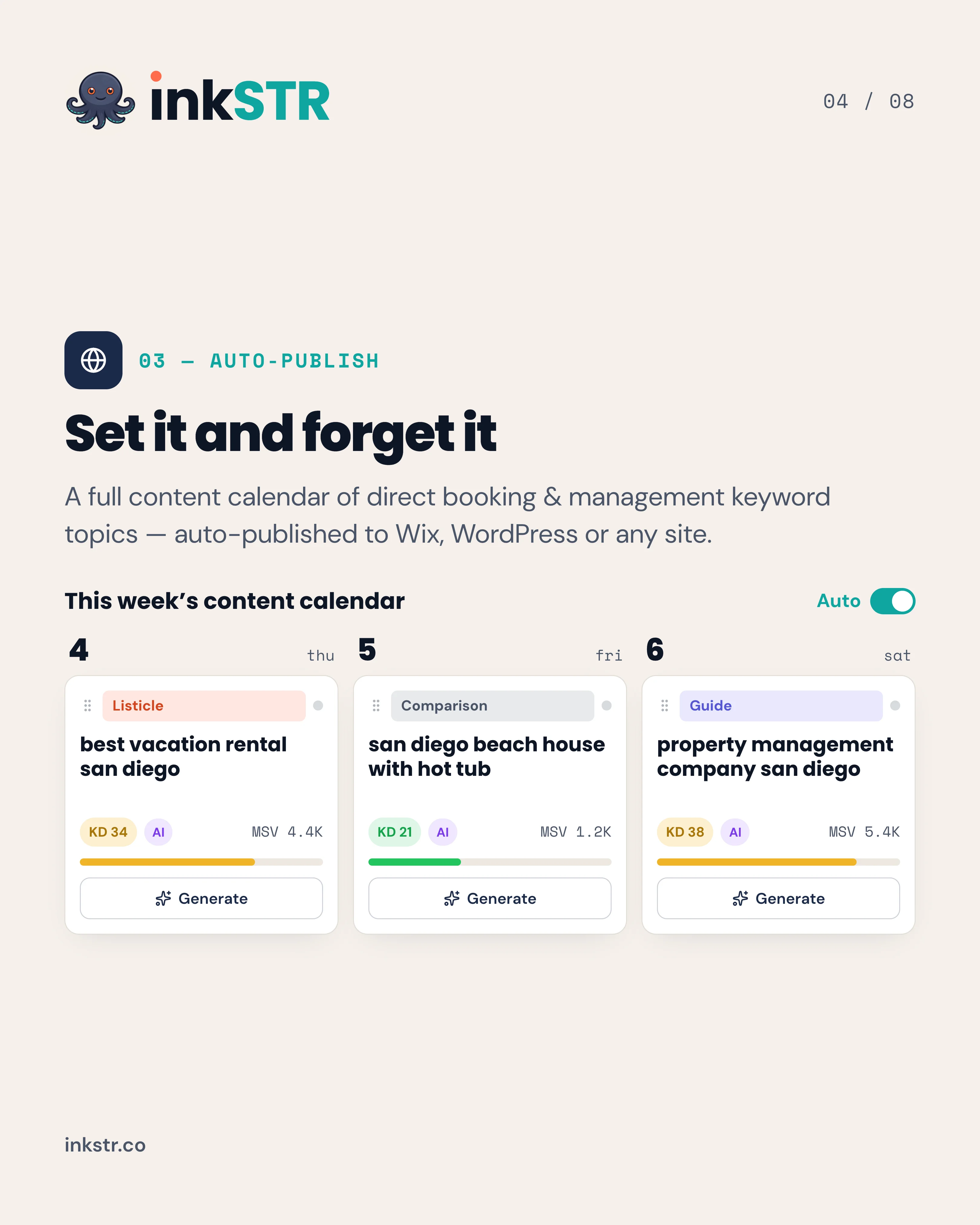
Ready to automate your content marketing?
inkSTR handles keyword research, content strategy, article writing, and publishing, all on autopilot.
What Should You Blog About If AI Is Writing It For You?
What you blog about matters more than the fact that AI wrote it. Content built around traveler search intent and real property details performs regardless of who typed the first draft. Generic, keyword-stuffed AI content fails for the same reason generic human-written content fails: it doesn't answer a specific question well.
The mistake most operators make when they try autoseo for the first time is letting the tool generate whatever topics it wants without grounding them in real property data. A post about "10 things to do near the lake" that never mentions your actual property's dock, its distance to the boat launch, or its specific bedroom count reads as filler to human readers and to Google's helpful content systems alike.
inkSTR's articles are grounded in your actual property and market details rather than generic destination filler, which is part of why our customer sites have secured 1,198 verified AI-search citations as of September 2026, tracked in inkSTR's own production database. That means AI search tools are actively pulling and citing this content, not just crawling it. Our guide on vacation rental blog topics that actually drive bookings covers the specific content categories that convert versus the generic ones that just generate pageviews.
What's the Real Cost of Doing SEO Manually vs Automating It?
The real cost of manual SEO includes both the direct cost of freelance writers, typically $300 to $700 per post, and the opportunity cost of your own time, since writing one quality post takes 3-5 hours of research and drafting that most operators don't have to spare. Automating the pipeline removes both costs at once rather than trading one for the other.
Run the math on a modest publishing schedule: two posts a month, outsourced, lands you between $600 and $1,400 monthly, before you've paid anyone to publish the content or track whether it's ranking. Do it yourself instead and you're looking at 6-10 hours a month that could go toward guest communication, cleaning coordination, or pricing strategy, the parts of the business that only you can do.
A ranking blog article, once it's live and performing, can drive organic search traffic for 2 to 5 years, which means the upfront cost of getting quality content published is a multi-year investment, not a monthly expense you re-pay from zero every time. That math only works in your favor if the content actually ranks, which is why the automation needs to be paired with real keyword research and quality control, not just volume.
inkSTR replaces the writer fee and the time cost with one flat rate: $99/month for the full pipeline, keyword research through publishing. If you're currently paying a freelancer per post or spending your own weekend hours drafting content, the comparison isn't close once you account for both the cash outlay and the hours you get back.
AutoSEO Data and Evidence: What the Numbers Actually Show
Evidence for autoseo's effectiveness in the vacation rental niche comes down to publishing consistency and search-intent accuracy, not raw volume of content. The results below are drawn from real inkSTR customer projects, measured through Google Search Console and platform analytics.
| Metric | Before | After | Timeframe |
|---|---|---|---|
| Monthly Google Search clicks (Smoky Mountains cabin brand) | 788 | 5,195 | 11 months |
| Monthly search impressions (same brand) | 130,000 | 450,000 | 11 months |
| Direct booking revenue attributed | $0 | $309,775 | First 14 months |
| Monthly Google search visits (5-market cabin brand) | 26 | 1,924 | 4 months |
| Distinct search queries ranking (same brand) | Minimal | 5,939 | 4 months |
| Property-owner leads from AI search (STR management company) | 0 | 4 | First month |
As of September 2026, inkSTR customer projects have collectively published more than 4,100 articles, with 69 active projects running content pipelines and 22,738 Google Search clicks across connected sites in the trailing 90 days. These figures come from inkSTR's own production database and update daily as new projects publish.
Practical Guidance: How to Evaluate an AutoSEO Platform Before You Commit
Evaluating an autoseo platform correctly means checking whether it covers the full pipeline end to end, from research through actual publishing, rather than just one piece of it wrapped in broad marketing language. Skipping this step is how operators end up paying for a tool that generates content they still have to manually format and upload.
- Check whether publishing is included. Some tools only generate a document; you still do the manual work of uploading, formatting, and scheduling it on your site.
- Confirm the tool understands your niche. Ask whether the keyword research is built around travel and hospitality search intent, or whether it's generic volume data applied to any industry.
- Look for a quality control step. A platform with no pre-publish review or validation risks putting thin, inaccurate, or duplicate content on your domain.
- Verify multi-property pricing. If you manage more than one listing or market, find out whether pricing scales per website or covers your whole portfolio under one plan.
- Ask about CMS compatibility. Confirm the tool publishes directly to the platform you already use, Wix, WordPress, or a custom site, without requiring a rebuild.
- Review reporting integration. A platform that connects to Google Search Console gives you real click and impression data instead of vendor-reported claims.
Don't judge a tool purely on traffic promises without asking for methodology. Don't assume more articles automatically means more bookings if the content ignores search intent. And don't sign a per-website contract if you're planning to scale to multiple properties within the year. For a deeper look at keeping brand voice consistent while automating, see our guide on article automation without losing your brand voice.
Frequently Asked Questions
What is autoseo in simple terms?
AutoSEO is the use of software and AI to handle SEO tasks that a person would otherwise do manually. For vacation rentals specifically, it means your blog content gets researched, drafted, and published to your site on a schedule without daily manual involvement.
How much does autoseo cost per month?
AutoSEO pricing generally ranges from around $89 to $150 or more per month depending on the platform and how much of the pipeline is automated. inkSTR's full pipeline, covering keyword research, AI-generated articles, and automated publishing, is priced at $99/month.
Is auto SEO any good for a small vacation rental business?
Auto SEO works well for a small vacation rental business when the platform is built for hospitality search intent and includes quality control before publishing. It becomes a problem only when the tool produces generic, unreviewed content with no niche understanding, which risks thin or duplicate pages on your domain.
What is the best automated SEO tool for a short-term rental site?
The best automated SEO tool for a short-term rental site is one purpose-built for vacation rental search intent rather than a general-purpose platform applied to hospitality. inkSTR was built specifically for this niche, covering keyword research, article generation, and publishing in one pipeline starting at $99/month.
Can AI-generated content actually rank on Google and get cited by AI search tools?
Yes, AI-generated content can rank on Google and get cited by AI search tools when it's grounded in real, specific information and structured with clear, answer-first sections. As of September 2026, articles published through inkSTR customer sites have secured 1,198 verified AI-search citations, tracked in inkSTR's production database.
How long does it take to see results from autoseo?
Most autoseo campaigns take several months of consistent publishing before meaningful ranking movement shows up, rather than days or weeks. A Smoky Mountains cabin rental brand on inkSTR grew monthly clicks from 788 to 5,195 over 11 months, showing that steady output compounds rather than producing instant results.
Do I need autoseo if I already have a direct booking website?
Yes. A direct booking website with no ongoing content generates no search visibility on its own. AutoSEO fills that gap by consistently publishing content targeting the queries travelers search before they book, which is what drives traffic to a direct booking site.
Conclusion: AutoSEO Only Works When It's Built for Your Niche
AutoSEO is the automation of keyword research, content writing, and publishing, and it works when the platform behind it understands the specific search behavior of your industry. For vacation rental operators, that means content grounded in traveler intent and property specifics, not generic destination filler recycled across every market.
The manual alternative costs real money and real time: $300-$700 per freelance post, 3-5 hours of your own time per article, and 17-19% of every booking handed to Airbnb or VRBO when you have no direct booking traffic to offset it. AutoSEO built for this niche removes those costs while a ranking article keeps working for 2-5 years after it's published.
Heading into the rest of 2026, the operators who benefit most from autoseo will be the ones who treat it as a long-term content engine, not a one-time traffic hack. inkSTR was built to run that engine for short-term rental operators, from keyword research through scheduled publishing, without requiring a marketing team.
If keeping up with keyword research and blog publishing across your properties feels impossible right now, inkSTR was built to automate exactly this. Start a free trial and see your first content plan today.
Content powered by inkSTR.co
Enjoyed this article? Share it:
Get more of inkSTR in Google Search
Add inkstr.co as a preferred source and our articles show up more in Top Stories, AI Overviews, and AI Mode — with a “Preferred” badge.
Get more guides like this
New SEO and AI-search guides, straight to your inbox. No spam, unsubscribe anytime.