Get More Direct Bookings: The Content Playbook for 2026

To get more direct booking traffic, you need three things working together: a website that ranks for guest search terms, a booking flow that converts once travelers arrive, and a content system that keeps producing keyword-targeted pages month after month. Most vacation rental operators have zero of these running consistently, which is why Airbnb and VRBO still control the majority of their bookings and take 17 to 19 percent off the top of every reservation.
Key Takeaways
- Direct bookings mean a guest reserves through your own website or a direct phone or email inquiry, bypassing OTA commission structures entirely.
- Combined Airbnb host and guest fees run 17 to 19 percent per booking, and a single direct reservation is typically worth $1,000 to $4,000 in recovered revenue.
- Industry data shows 38 percent of vacation rental traffic comes from organic search, 32 percent from direct, and only 16 percent from paid search, according to a 2026 CUFinder analysis, meaning search visibility is the largest single traffic driver.
- Direct traffic converts at 3 to 5 percent for vacation rentals, compared to under 1 percent for social media traffic, per hostAI's 2026 data, so where your traffic originates matters as much as how much of it you get.
- Writing one quality blog post manually takes 3 to 5 hours, and freelance travel writers charge $300 to $700 per article, a cost that scales badly across a content calendar.
- inkSTR automates the keyword research, drafting, and publishing pipeline that ranks direct booking websites on Google, so you build this traffic engine without adding hours to your week.
If you're reading this, you've probably already built a direct booking website. Maybe you paid a designer, wrote a property description you're proud of, and set up a booking calendar. Then you waited for traffic that never came.
That's the pattern we see across almost every operator we talk to at inkSTR. The website exists. The content strategy behind it doesn't. And without content that targets what travelers actually search, a direct booking site sits invisible on page five of Google while your Airbnb listing keeps eating commission on every stay.
In 2026, the vacation rental market is valued at roughly $101 to $109 billion globally depending on the research firm, and it keeps growing every year. That growth means more competition for the same searches. This guide breaks down what direct booking actually means, the real math behind why it matters, and the specific tactics, backed by industry data, that move the needle. We'll also show you where content production becomes the bottleneck, and how we built inkSTR specifically to remove it.
What Does Direct Booking Mean?
Direct booking means a guest reserves your property through a channel you control, typically your own website, a phone call, or a repeat-guest email, rather than through a third-party platform like Airbnb or VRBO. The defining feature is that no OTA commission gets deducted from the reservation.
For most independent hosts, direct booking specifically means the reservation happens on a website you own, whether that's built on WordPress, Wix, or a custom platform. You handle payment processing, guest communication, and the booking confirmation without a third party sitting between you and the traveler.
Here's why the distinction matters financially. Airbnb host and guest fees combined run 17 to 19 percent of every booking. On a $2,000 stay, that's roughly $340 to $380 gone before you see a dollar. A direct booking of the same value keeps that money in your business. Multiply that across a full season and the gap becomes the difference between a marginal year and a genuinely profitable one.
Industry benchmarks suggest strong direct-booking operators achieve 25 to 40 percent of annual reservations through direct channels in competitive markets. Getting there requires more than a website. It requires content that ranks for the searches travelers actually run, which is the exact gap inkSTR's AI Content Writer was built to close for operators who don't have time to write that content themselves.
What Is the 75/55 Rule in Airbnb?
The 75/55 rule refers to guidance some experienced hosts and revenue managers use when balancing occupancy against rate: aim to keep base occupancy targets and rate positioning calibrated so you're neither underpricing to chase bookings nor overpricing to the point of vacancy. It's less an official Airbnb policy and more an operator heuristic for pricing discipline. The concept matters here because pricing strategy and direct booking strategy are connected. If your Airbnb listing is priced aggressively to win the algorithm, you have less room to offer direct-booking discounts that make your own website competitive. Many operators solve this by pricing direct bookings 5 to 10 percent below OTA rates, since you're not absorbing the 17 to 19 percent platform fee anyway.
This is where rate strategy and content strategy intersect. A pricing page or blog post explaining "why direct booking rates on our site are lower" gives travelers a concrete reason to skip Airbnb search entirely. Without that messaging published somewhere Google can index, no one finds it. Most operators never write that page because, frankly, most operators are running the property, not running a content calendar.
At inkSTR, we regularly see hosts who understand this pricing logic intellectually but never get around to publishing it. That's a content production problem, not a strategy problem. Our Content Calendar schedules and publishes pages like this automatically, so the pricing advantage you've already built into your rate structure actually reaches the traveler searching for it.
How to Increase Hotel Direct Booking?
Increasing direct bookings requires optimizing three layers at once: a fast, mobile-first website with a simple booking flow, keyword-targeted content that ranks on Google, and incentives that make booking direct genuinely better than booking through an OTA. Skipping any one layer caps your results.
Start with the booking engine itself. Research shows every additional booking step beyond three reduces conversion by roughly 10 percent, so a date-then-room-then-payment flow outperforms anything longer. Site speed matters just as much: with 70 percent of travel searches happening on mobile, a mobile load time slower than 3 seconds risks losing the booking entirely.
Next, layer in direct incentives. Length-of-stay discounts, such as 15 percent off for stays of three nights or more, and a documented best-rate guarantee both give travelers a reason to book direct instead of defaulting to Airbnb search habits. Listings with recent photos also see up to 42 percent more clicks, so refreshing your gallery monthly is not optional if you're serious about conversion.
But none of this matters if no one finds your site. Direct traffic converts at 3 to 5 percent, the highest of any channel, yet organic search still drives 38 percent of total vacation rental traffic industry-wide. That means the content ranking your site on Google is doing more work than your booking engine ever will on its own. This is exactly the problem inkSTR was designed to solve: our Keyword Research tool identifies what your specific market is searching, then our platform drafts and schedules the articles that answer those searches.
The Manual Alternative Is Expensive and Slow
Without a system, this looks like: 3 to 5 hours writing a single blog post, or $300 to $700 per article if you hire a freelance writer instead. Do that twice a month and you're looking at real monthly costs, plus the time spent briefing the writer, editing drafts, and manually publishing to your CMS. Most operators simply stop after two or three posts. That's why so many direct booking websites go quiet after a strong launch.
Is It Better to Book Through Airbnb or Direct?
Booking direct is financially better for both host and guest in most cases, since it eliminates the 17 to 19 percent combined host and guest fee that Airbnb charges on every reservation. For the host, that fee reduction alone can represent hundreds of dollars per stay. For the guest, hosts who pass along even part of that savings can offer a lower effective rate than the same listing on Airbnb.
Airbnb still wins on discovery for travelers who are early in their search and don't yet know which property or destination they want. If someone is comparison-shopping five cities, Airbnb's aggregated search is genuinely useful. But once a traveler has stayed with you once, or found your property through a Google search for something specific like "pet-friendly cabin near Gatlinburg with hot tub," direct booking is almost always the better path for both parties.
This is also where repeat guests matter most. A returning guest who books direct instead of through Airbnb saves you the commission a second time, and email marketing to past guests remains one of the most cost-effective ways to generate those repeat direct bookings. Segmenting your guest list into recent stays, lapsed guests, and high-value repeat visitors, and emailing each group differently, consistently outperforms a single generic newsletter.
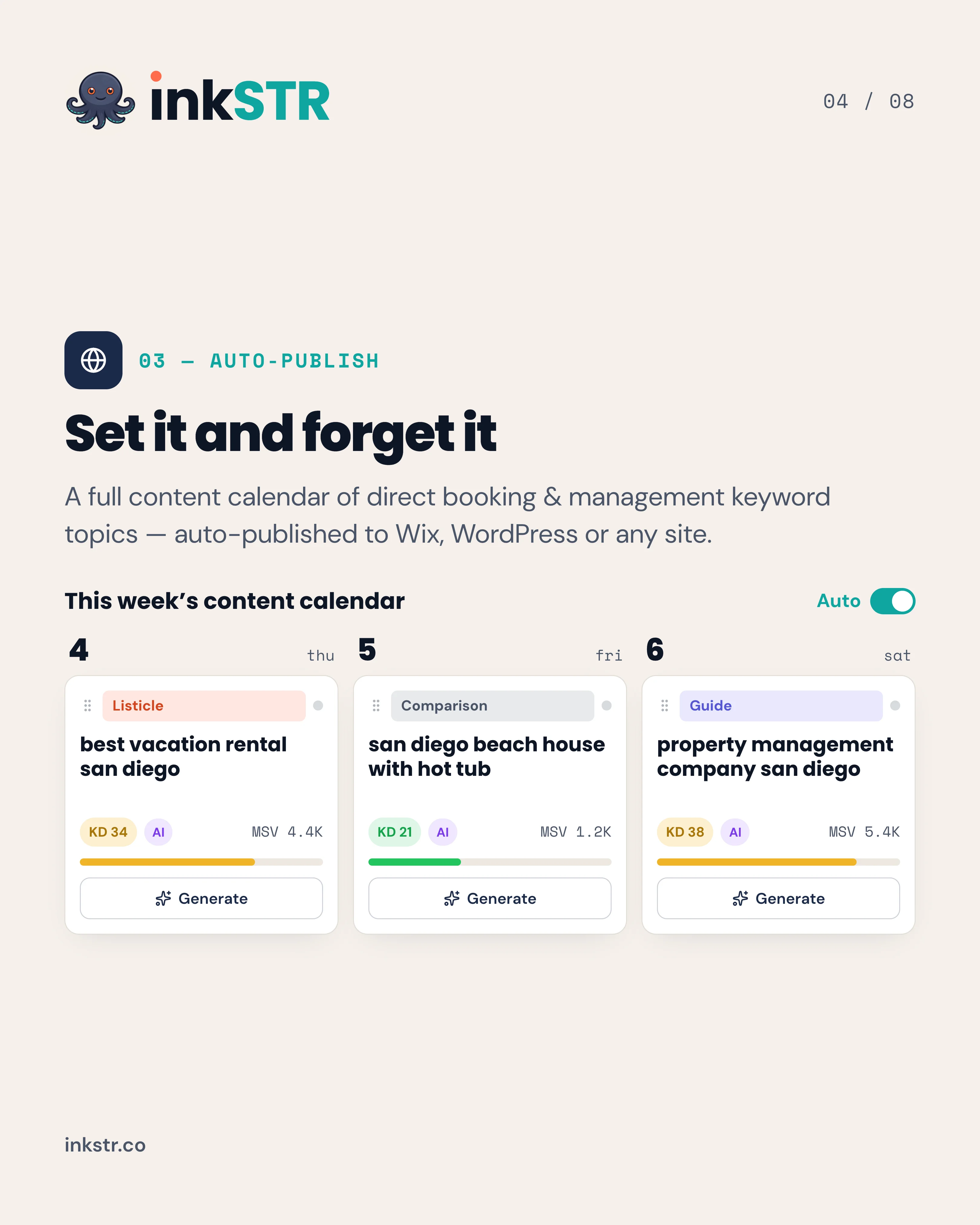
We tell operators the same thing every time this comes up: direct booking isn't about convincing every traveler to abandon Airbnb. It's about capturing the travelers who are already searching for exactly what you offer, on Google, before they ever open the Airbnb app. That's the traffic inkSTR's Auto-Publishing feature is built to capture, publishing content straight to your Wix or WordPress site without you touching a CMS dashboard.
Why Is My Vacation Rental Not Getting Direct Bookings?
Most vacation rental websites fail to generate direct bookings because they have no published content targeting the specific searches travelers run before choosing a property. A polished homepage and a booking calendar are not enough if Google has no reason to rank your site above a hundred competing listings.
Think about what a traveler actually types into Google: "3 bedroom cabin with hot tub near Pigeon Forge" or "pet-friendly beach house Gulf Shores weekly rental." If you haven't published a page that answers that exact query, with that language, in that structure, your site simply doesn't exist for that search. Meanwhile, competitors publishing consistent, keyword-targeted articles climb past you month after month. Our team at inkSTR regularly audits direct booking sites that get decent traffic to the homepage but almost nothing to interior pages. The pattern is always the same: no blog, no local area guides, no content answering the specific questions travelers ask before booking. It's not a design problem. It's a content gap, and it's the single most common reason we see for stalled direct booking growth.
Fixing this requires publishing consistently, not in a single burst. A site that publishes two to four targeted articles a month for six months builds a completely different search footprint than one that publishes five posts and stops. That consistency is exactly what our Content Calendar automates, scheduling articles so your publishing cadence never depends on whether you had a free afternoon that week.

How Do You Compete With Bigger Property Management Companies in Search?
Competing with larger property management companies in search results means out-publishing them on specificity, not matching their budget. Large management companies often run generic content across dozens of properties, while a smaller operator who publishes hyper-specific, location-accurate content can out-rank them for long-tail searches. For example, a large company might publish one generic "Smoky Mountains cabin guide" covering an entire region. An independent host who publishes a detailed guide to a single trailhead, a specific neighborhood's parking situation, or the exact walk time to a specific attraction from their property answers a narrower, higher-intent search far better. Google increasingly rewards that specificity, and so do the AI systems now summarizing search results.
The real barrier isn't strategy, it's volume. A management company with a marketing team can publish content every week. A single host writing posts themselves at 3 to 5 hours each simply can't keep pace, which is exactly the gap we built inkSTR to close. Related reading on this exact challenge is available in our piece on how to rank your vacation rental website on Google, which walks through the mechanics in more depth.
Direct Booking vs. OTA Booking: A Side-by-Side Look
The table below compares direct bookings against OTA bookings across the factors that actually affect your bottom line as an STR operator in 2026.
| Factor | Direct Booking (Your Website) | Airbnb / VRBO Booking |
|---|---|---|
| Commission fees | None (excluding payment processing) | 17 to 19 percent combined host and guest fees |
| Average conversion rate | 3 to 5 percent (highest intent traffic) | Varies by listing quality and search ranking |
| Guest data ownership | You own email, phone, and preferences | Platform controls most guest contact data |
| Repeat booking ease | Direct email marketing to past guests | Guest must re-search platform each time |
| Discovery for new travelers | Requires SEO and content investment | Built-in marketplace discovery |
| Typical revenue per booking recovered | $1,000 to $4,000 depending on stay length | Reduced by platform fee before payout |
Neither channel needs to be abandoned entirely. Most successful operators run both, using Airbnb for discovery and their own site, built on consistent content, to convert repeat and referral traffic into direct, commission-free stays.
Ready to automate your content marketing?
inkSTR handles keyword research, content strategy, article writing, and publishing, all on autopilot.
What Content Actually Moves the Needle for Direct Bookings?
The content that moves the needle for direct bookings is specific, keyword-targeted, and published consistently, not generic travel writing. Local area guides, comparison posts between your property and nearby options, and FAQ-style pages answering booking-specific questions consistently outperform broad "top 10 things to do" content that any travel blog could publish. Specifically, three formats convert best for STR operators. First, local area guides tied to a specific attraction or neighborhood near your property, which capture high-intent, near-decision search traffic. Second, comparison content that explains what makes your property different from nearby alternatives. Third, direct answers to logistical questions like parking, check-in flexibility, or pet policies, since these questions are exactly what stalls a booking decision at the final step. If you want a deeper breakdown of which formats perform best, we've written extensively on vacation rental blog topics that actually drive bookings and on turning local area guides into bookings. Both build on the same principle: specificity beats volume, and volume beats nothing at all.
Consistency is what separates content that ranks from content that doesn't. A ranking blog article can drive organic search traffic for 2 to 5 years once it's indexed and earning authority, which is a return no paid ad campaign can match. That long tail is precisely why we built inkSTR around a publishing calendar rather than a one-time content sprint. Our platform keeps the cadence going even during your busiest booking season, when you have zero time to sit down and write.
What Mistakes Cost STR Operators the Most Direct Bookings?
The mistakes that cost STR operators the most direct booking revenue are inconsistent publishing, ignoring mobile site speed, and failing to make the financial case for booking direct anywhere on the website. Each mistake compounds the others. Here's a practical checklist to audit against:
- Publishing in bursts, then stopping. Five posts in one month followed by six months of silence teaches Google your site isn't a reliable, active resource. Consistency signals authority.
- Ignoring mobile load speed. With most travel searches happening on mobile, a slow-loading site loses bookings before a traveler even sees your rates.
- Never explaining why direct booking is better. If you don't publish a page explaining your rate advantage, cancellation policy, or guest perks for booking direct, travelers have no reason to leave Airbnb search habits behind.
- Skipping keyword research entirely. Writing about what you think is interesting instead of what travelers actually search wastes the time you did invest in content.
- Treating your email list as an afterthought. Segmented, regular email outreach to past guests is one of the least expensive ways to generate repeat direct bookings, yet many operators never build the list at all.
Avoiding all five requires a system, not willpower. This is the exact list of failure points our How inkSTR Works page addresses directly, mapping each mistake to the specific workflow step that prevents it.

Is the ROI of Content Marketing Worth It for Short-Term Rentals?
The ROI of content marketing for short-term rentals is measured in avoided OTA commission, not just traffic volume. A single direct booking is typically worth $1,000 to $4,000 in revenue, and avoiding the 17 to 19 percent Airbnb fee on even a handful of bookings per year covers the cost of a content system many times over. Run the math on a real scenario. inkSTR starts at $99 a month, or roughly $1,188 a year. If content marketing generates just one additional direct booking a year at the low end of $1,000, you've already broken even. Anything beyond that first booking is straightforward margin, and most operators who publish consistently for six months or longer see well beyond one direct booking driven by organic search. Compare that to the manual alternative: a freelance writer charging $300 to $700 per article, publishing twice monthly, runs $7,200 to $16,800 annually before you've spent a minute on keyword research or scheduling. That math doesn't work for most independent hosts or small property management companies, which is exactly why we priced inkSTR the way we did, and why the platform handles the keyword research, drafting, and scheduling as one workflow instead of three separate expenses. Full Pricing details are on our site if you want to run your own numbers.
How Do You Actually Get Started Increasing Direct Bookings?
Getting started with a direct booking content strategy means prioritizing three actions in order: publish a rate-comparison or "why book direct" page first, then commit to a monthly publishing cadence of at least two articles, and finally build an email capture on your site to start collecting repeat-guest contacts immediately. Don't try to fix everything simultaneously. Trying to overhaul your booking engine, rebuild your website, and launch a content calendar all in the same month is how most operators burn out and quit after week three. Sequence the work instead.
- Week one: audit your current site speed and booking flow steps. Fix anything taking more than three steps to complete a reservation.
- Week two: publish one page explicitly stating your direct booking advantage, whether that's a rate discount, flexible cancellation, or a guest perk.
- Weeks three through twelve: publish consistently, two to four articles monthly, targeting real search terms your guests use.
- Ongoing: segment your email list and send targeted outreach to past guests before peak booking windows.
The step most operators abandon is the third one, because it requires sustained output over months, not a single weekend project. That's the exact reason inkSTR exists: we generate, schedule, and publish articles automatically on a set schedule, so step three runs whether or not you had time to sit down and write this week. If you're also curious how this connects to broader search visibility, our post on why your vacation rental website is not ranking on Google covers the technical side in detail.
Frequently Asked Questions
How long does it take to see results from direct booking content?
Most vacation rental sites see meaningful organic traffic movement after four to six months of consistent publishing, since a ranking blog article can then continue driving traffic for two to five years. Results compound the longer you sustain the publishing cadence, which is why inconsistent posting rarely works.
Do I need a blog for every property I manage, or can I combine them?
You can run one blog covering multiple properties if they're in the same market, but properties in different regions generally rank better with separate, location-specific content pipelines. inkSTR's multi-project architecture supports independent content pipelines per property, so you're not forcing unrelated markets onto a single content calendar.
Can AI-generated content actually rank on Google for competitive vacation rental keywords?
Yes, when the content is specific, well-structured, and targets real search intent rather than generic travel language. inkSTR's content passes through quality scoring before publishing specifically to catch the generic, low-value patterns that keep AI content from ranking.
What is the difference between optimizing an Airbnb listing and optimizing a direct booking website?
Optimizing an Airbnb listing means working within Airbnb's own ranking factors, like response rate and review volume, inside their platform. Optimizing a direct booking website means targeting Google's ranking factors instead, primarily through keyword-relevant content, site speed, and backlinks, since the two systems reward entirely different signals.
How many blog posts do I need before I see organic traffic to my direct booking site?
Most sites begin showing measurable ranking movement after 12 to 20 published articles targeting a mix of destination and long-tail booking keywords. inkSTR's content calendar automates that publishing volume so you reach that milestone without manually tracking every deadline yourself.
Is it worth publishing local content if my market already gets heavy tourist traffic?
Yes, because heavy tourist traffic means heavy search competition too. Generic content won't rank in a saturated market; hyper-specific content tied to a particular neighborhood, trailhead, or amenity is what actually differentiates your site from every other listing in a popular destination.
What's the fastest way to find which keywords my competitors already rank for?
Running a keyword gap analysis against competing direct booking sites in your market shows exactly which search terms they capture that you don't. inkSTR's Keyword Research tool automates this comparison so you can prioritize content around the gaps instead of guessing.
Bringing It All Together
Getting more direct bookings in 2026 comes down to a simple equation: rank for the searches travelers actually run, give them a clear reason to book direct instead of through Airbnb, and keep publishing long enough for that content to compound. The math is straightforward. One avoided OTA commission on a $1,000 to $4,000 booking pays for a year of consistent content production several times over. The operators who pull this off aren't the ones with the biggest marketing budgets. They're the ones who solved the production bottleneck, publishing consistently instead of in scattered bursts. If you take one action from this article, make it this: commit to a publishing schedule you can actually sustain, even if that means automating the parts you can't do yourself. inkSTR handles the research, drafting, and scheduling so that commitment doesn't rest entirely on your own free time.
If content production is the reason your direct booking site has stalled, start your free trial with inkSTR and see the keyword research, drafting, and publishing workflow running on your own market within minutes.
Content powered by inkSTR.co
Enjoyed this article? Share it:
Get more of inkSTR in Google Search
Add inkstr.co as a preferred source and our articles show up more in Top Stories, AI Overviews, and AI Mode — with a “Preferred” badge.
Get more guides like this
New SEO and AI-search guides, straight to your inbox. No spam, unsubscribe anytime.