Build an STR Content Calendar That Actually Gets Used

A content calendar for a short term rental is a scheduled plan that maps out what blog posts, local guides, and social content you publish, and when, so your property shows up consistently in Google search and on Instagram or TikTok instead of sporadically. Most hosts fail at this not because they lack ideas, but because they have no system to keep publishing once the initial burst of motivation fades.
- A working content calendar needs a defined posting cadence (most STR guidance recommends 3 to 5 posts per week across social channels, plus 2 to 4 blog articles per month), a content mix, and a repurposing plan for existing photos and video.
- Content should split roughly 30 to 50% property-focused, 30 to 50% local experience content, and 10 to 20% direct promotion, based on standard STR marketing frameworks.
- In the vacation rental industry, 38% of traffic comes from organic search, 32% from direct, and 16% from paid search, according to CUFinder, which means a blog calendar built around search intent captures the single largest traffic channel available to you.
- 37.5% of short-term rental operators generated more direct bookings in 2026 than the prior year, per Maverick Strategies, a trend tied directly to consistent, keyword-targeted content publishing.
- Writing one quality blog post manually takes 3 to 5 hours of research and drafting, which is the single biggest reason most host-built calendars collapse within 60 to 90 days.
- inkSTR builds and runs this calendar automatically, generating, scheduling, and publishing SEO-optimized articles on a set cadence so the plan you build on paper actually survives contact with your real workweek.
If you manage a short term rental, you have probably built a content calendar before. A spreadsheet with columns for date, platform, and topic, maybe color coded, maybe even filled in for a full quarter. And then, three weeks later, it stopped. Not because the plan was bad, but because nobody had four extra hours a week to actually write and shoot the content the plan demanded.
That gap between planning and publishing is the real problem in short term rental content marketing, not idea generation. In our experience working with STR operators, the hosts who show up consistently on Google for "cabin rental near [destination]" or "beachfront condo [city]" searches are not the hosts with the best writing skills. They are the ones who solved the production problem before they worried about the creative problem.
This guide walks through how to build a content calendar for your short term rental that survives past month one: the right cadence, the content mix that actually converts, how to repurpose a single photo across five platforms, and how to sync your calendar with your booking dips instead of ignoring them. We will also cover where inkSTR fits into this system, because at some point in this process, most operators realize manual execution does not scale, and that is exactly the moment a tool needs to take over.
What Is a Content Calendar for a Short Term Rental, Exactly?
A short term rental content calendar is a scheduled, recurring plan covering what you publish across your blog, Instagram, TikTok, Facebook, and Pinterest, mapped to specific dates and tied to your booking goals. It is not a list of ideas. It is a production schedule with deadlines, formats, and a clear owner for each piece.
Specifically, a working calendar answers four questions before you write a single word: what platforms are you actually going to use, how often will you post on each, what percentage of content is property versus local versus promotional, and who (or what) produces the content on schedule. Skip any one of these and the calendar becomes decoration rather than infrastructure.
Most STR-specific guidance recommends choosing one to three core platforms rather than spreading thin across five. Instagram, TikTok, Facebook, and Pinterest are the most commonly recommended for rental hosts, each pulling a different traveler intent: Instagram and Pinterest skew toward planning and inspiration, TikTok skews toward discovery, and Facebook still drives strong local and repeat-guest engagement in many markets.
The blog side of your calendar is where direct booking traffic actually compounds. A ranking blog article can drive organic search traffic for 2 to 5 years, which is a fundamentally different asset than a social post that disappears from feeds within days. That is why we always recommend building the blog cadence first and treating social as amplification, not the other way around.
How Often Should You Post to Keep a Content Calendar Consistent?
Posting cadence for short term rentals typically runs 3 to 5 social posts per week combined with 2 to 4 blog articles per month, based on current STR marketing frameworks. Frequency, not perfection, is the metric that determines whether a calendar survives past the first month.
One widely cited approach for rental hosts recommends 3 to 4 posts weekly, mixing feed posts, Reels, and Stories, with an emphasis on short 20 to 30 second property tours and point-of-view walkthroughs. Another common framework pushes slightly higher, at 4 to 5 posts weekly, blending property, local, and guest-generated content, with paid promotion layered in during the two to three months before peak season.
A third benchmark sets the floor even more concretely: a minimum of three posts per week, one to five Stories per day, and several Reels monthly, treating regularity itself as the success metric rather than any single post's performance.
Here is where most solo hosts get the math wrong. Three to five social posts weekly sounds manageable until you calculate the actual time cost: shooting, editing, captioning, scheduling, and responding to comments. Add two blog posts a month, each taking 3 to 5 hours to research and write manually, and you are looking at 8 to 10 hours monthly just on blog production, before social even enters the picture.
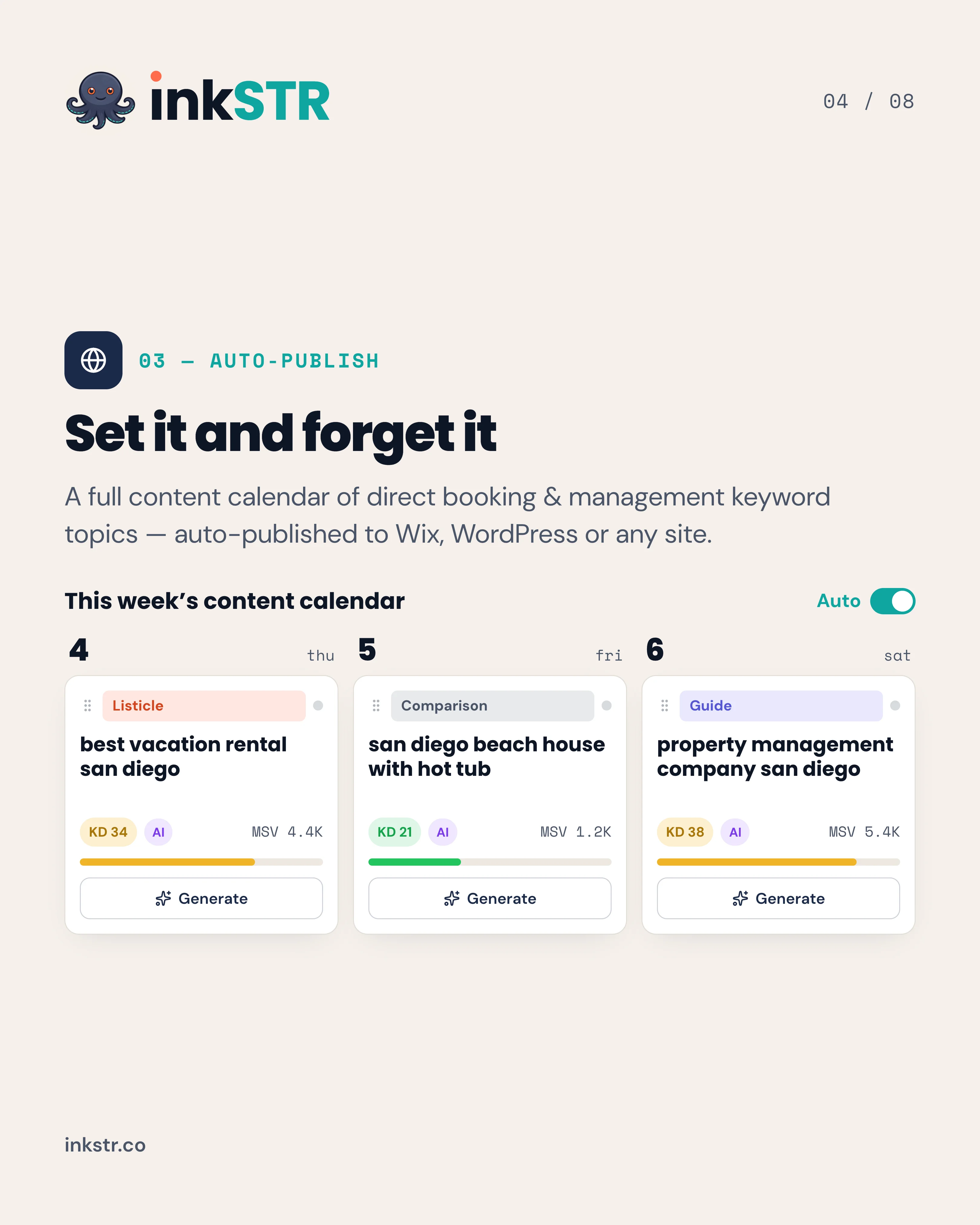
This is exactly why cadence, not creativity, is the first thing to systemize. inkSTR's Content Calendar feature schedules and manages blog publishing on autopilot, so the 2 to 4 monthly articles that drive your long-term organic traffic happen on a fixed schedule without you manually tracking due dates on a spreadsheet.
What Should Your Content Mix Actually Look Like?
A working STR content mix splits into three buckets: 30 to 50% property-focused content, 30 to 50% local experience content, and 10 to 20% direct sales or promotional content. This ratio prevents your feed and blog from reading as a nonstop advertisement, which is the fastest way to lose follower engagement and search relevance alike.
Property-focused content includes interior tours, seasonal styling updates, amenity highlights (a hot tub, a fire pit, a fully stocked kitchen), and guest testimonials. Local experience content covers restaurants, hiking trails, seasonal events, and neighborhood guides, the exact kind of content that captures search intent from travelers who have not decided where to stay yet. Promotional content is your direct booking pitch, off-season discounts, or last-minute availability.
| Content Type | Recommended Share | Primary Purpose |
|---|---|---|
| Property-focused | 30 to 50% | Builds desire and showcases amenities |
| Local experience | 30 to 50% | Captures organic search traffic and planning-stage travelers |
| Promotional | 10 to 20% | Converts interest into direct bookings |
Notice that local experience content ties directly for the largest share alongside property content, and for good reason: over 60% of high-ranking travel content now aligns with informational or navigational intent rather than pure transactional intent, according to Citedy. Travelers search "things to do near [destination]" long before they search a specific property name.
Building local guides consistently, at scale, across property, blog, and social, is tedious manual work when done one article at a time. inkSTR's AI Content Writer generates these local-intent blog articles automatically, matched to your specific destination market, whether that is a mountain retreat corridor or a beach town, so the local guide bucket of your calendar fills itself instead of becoming the section you keep pushing to "next month."
How Do You Build a Calendar Template for Different Property Types?
A content calendar template should be customized by property type, not copied generically, because a ski cabin, a beachfront villa, and an urban pied-a-terre attract fundamentally different search intent and traveler decision timelines. Most competing guidance treats "short term rental" as one undifferentiated category, which is a real gap in how this topic gets covered.
For a mountain cabin or ski property, your calendar should weight heavily toward seasonal shoulder-period content: snow forecasts, trail conditions, and shoulder-season value messaging, since demand swings dramatically between peak winter and mud season. For a beachfront villa, content should lean into event-driven timing: hurricane season transparency, summer booking windows, and off-peak rate messaging for spring and fall.
For an urban apartment or pied-a-terre, the calendar shifts toward business traveler and extended-stay intent: neighborhood walkability, coworking proximity, and public transit access, topics a rural cabin property would never need to cover.
- Week 1: Map a full month of topics against your specific property type and its seasonal demand curve.
- Week 2: Draft 12 to 16 pieces of content (posts, captions, and blog outlines) in a single batch session.
- Week 3: Go live with the first scheduled content and begin publishing on the cadence you set.
- Week 4: Review engagement and search performance, then adjust the following month's mix.
This two to three week launch ramp is fairly standard across STR marketing frameworks. The problem is that most operators complete week one and week two, then never get to week three because batch drafting 12 to 16 pieces manually is a multi-day project on top of running actual guest operations. inkSTR's content workflow compresses that entire ramp: keyword research, drafting, and scheduling happen inside one platform, cutting the launch timeline from weeks to a single sitting.
How Do You Repurpose One Photo or Video Across Your Whole Calendar?
Repurposing means taking a single piece of property media, a sunset shot from your deck, for example, and adapting it into five to seven different formats across platforms instead of shooting new content for every post. This is the single most under-covered tactic in STR content marketing, and it is the difference between a sustainable calendar and content burnout.
Here is a practical repurposing matrix for one sunset clip shot from a rental property:
| Original Asset | Repurposed Format | Platform |
|---|---|---|
| Sunset video clip | 15 second Reel with trending audio | |
| Same clip | Vertical TikTok with on-screen caption | TikTok |
| Single frame still | Pinterest pin with keyword-optimized description | |
| Same still | Blog post hero image with alt text | Direct booking website |
| Full clip | Email newsletter header | Email list |
| Still image | Facebook Story with poll sticker | |
| Clip and still combined | Blog article on best times to visit | SEO content |
One shoot, seven touchpoints. That is the math that makes a 4 to 5 post weekly cadence achievable without a new camera setup every time. But even with repurposing solved, someone still has to write the captions, the alt text, and the blog article that anchors the whole matrix, and that is where manual calendars usually stall again.
inkSTR's image library includes AI-generated alt descriptions and SEO file naming built for exactly this workflow, so the same photo that anchors your Instagram Reel also becomes a properly optimized blog image without you manually writing five different captions for five different platforms.
How Do You Sync Your Calendar With Booking Dips and Pricing?
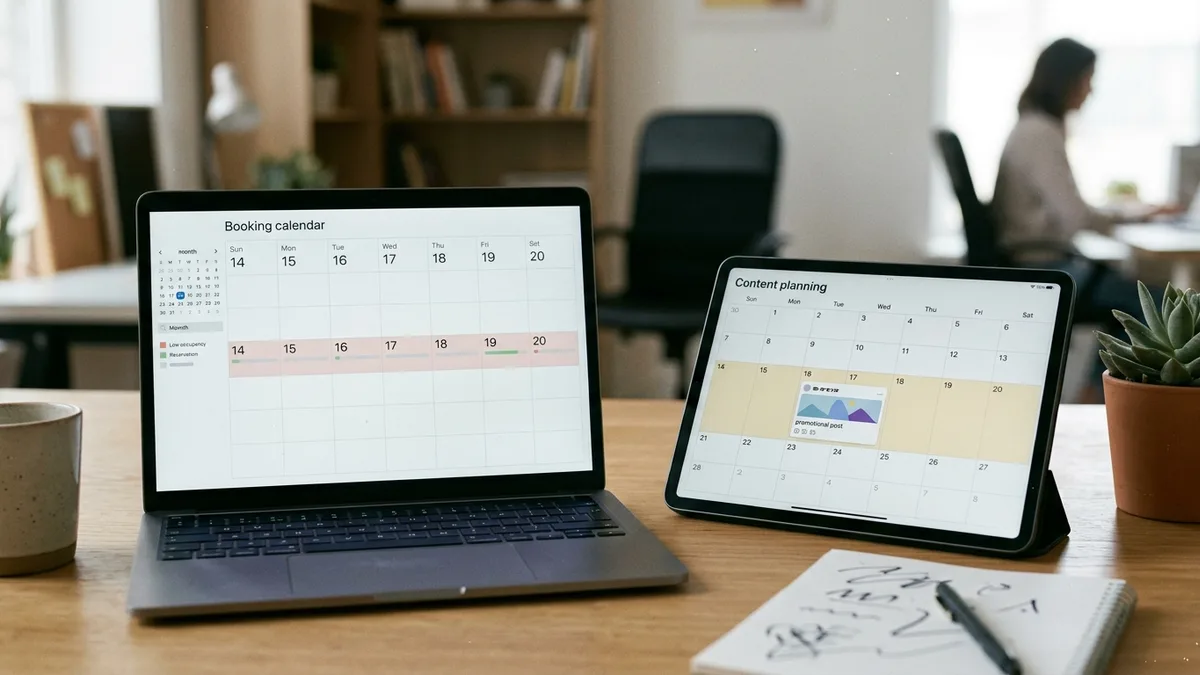
Syncing your content calendar with your booking calendar means triggering specific content, softer sell posts, discount messaging, or local event tie-ins, when your future dates show low occupancy, rather than publishing on a fixed schedule regardless of demand. Almost no existing STR content guidance covers this integration, which makes it a genuine differentiation opportunity for operators willing to build it.
In practice, this looks like checking your booking calendar weekly and flagging any 30 to 60 day window where occupancy sits below your target. When you see that gap, you shift your next scheduled post from a general property showcase to a specific, dated offer: "Three nights left in [property] the weekend of [event]," paired with local event content that gives travelers a reason to book that specific window.
Operators using dynamic pricing tools already adjust rates two to three times weekly based on demand and seasonality. Your content calendar should move on the same rhythm, not a separate, disconnected schedule. A pricing dip without a matching content push wastes the adjustment; a content push without a pricing signal wastes the opportunity to close the booking.
This kind of real-time syncing is genuinely hard to do manually because it requires checking your booking software, then your content queue, then rewriting a post on short notice, every single week. It is also exactly the kind of workflow that benefits from a platform that already knows your publishing schedule and can slot in a timely piece without you rebuilding the calendar from scratch. That is the operational gap inkSTR's scheduling system is built to close, keeping your content queue flexible enough to react to real demand instead of running on autopilot toward an empty week.
What Blog Topics Belong on Your Content Calendar?
Blog topics for a short term rental calendar should split between destination guides, property-specific FAQs, seasonal planning content, and comparison posts that capture travelers still deciding where and when to stay. This blog layer is what separates a calendar built for search traffic from one built purely for social engagement.
Destination guides, "best hiking trails near [property]" or "where to eat near [neighborhood]", capture the informational search intent that drives the largest share of organic traffic in this industry. Property FAQs answer specific booking-stage questions: parking availability, check-in process, pet policies. Seasonal content addresses the exact demand curve your property type experiences, whether that is ski season or hurricane season transparency. Comparison content, "cabin vs. condo rental in [market]," captures travelers comparing property types before they compare specific listings.
We covered a related framework in our guide on vacation rental blog topics that actually drive bookings, and a deeper look at how local content specifically converts in local area guides that sell. Both are worth reading alongside this calendar framework because the calendar only works if the topics filling it are the right ones.
The real bottleneck here is not knowing what to write about. It is the 3 to 5 hours of research and drafting each individual post demands, multiplied across the 2 to 4 posts your calendar calls for monthly. A freelance travel writer charges $300 to $700 per quality blog post, which adds up fast if you are trying to hit even a modest quarterly cadence. inkSTR's Keyword Research tool identifies what your target guests are actually searching before a single word gets written, then the AI Content Writer produces the full article, removing both the research bottleneck and the writing bottleneck from your monthly calendar in one pass.
Ready to automate your content marketing?
inkSTR handles keyword research, content strategy, article writing, and publishing, all on autopilot.
Why Do Most Content Calendars Fail Within Three Months?
Most short term rental content calendars fail within 60 to 90 days because the plan accounts for ideas but not for execution capacity. A calendar built on a Sunday afternoon burst of motivation assumes that same energy will exist every week for the next year, and it will not.
The three most common failure points we see across hosts and property management companies: nobody owns the calendar day to day, the cadence set in week one was unrealistic given the operator's actual time budget, and there is no fallback plan for weeks when guest turnovers or maintenance issues eat the time that was supposed to go toward content.
Property management companies handling 10 or more units run into a compounding version of this problem: content updates across a dozen-plus listings can consume an entire workday, with no single owner and no consistent publishing pattern across properties. What starts as an ambitious multi-property content plan often degrades into whichever property gets attention that week, leaving others invisible in search for months at a time.
Airbnb and VRBO combined charge 17 to 19% in host and guest fees on every booking that flows through their platforms, which is exactly the revenue leak a functioning direct booking content calendar is designed to plug. But a calendar that collapses after ten weeks never gets far enough to move that needle. This is precisely why we built inkSTR's multi-project architecture: independent content pipelines for each property or brand, so a portfolio of 10 or 50 properties runs on the same automated cadence instead of depending on which listing got attention this week. For a broader look at why manual output breaks down at scale, see our guide on article automation without losing your brand voice.
Is It Worth Paying Someone to Manage Your Content Calendar?
Paying a freelance writer or social media manager for a content calendar typically costs $300 to $700 per blog article plus separate social management fees, which for a full monthly cadence of 2 to 4 blog posts and 12 to 20 social posts, can run into the thousands each month. That cost only makes sense if the resulting content reliably converts into direct bookings, and quality varies widely by writer.
Compare that to the value on the other side of the ledger: a single direct vacation rental booking is typically worth $1,000 to $4,000 in revenue, and around 70% of B2B and B2C marketers rely on content marketing as a key tactic, according to SeoProfy. The ROI case for content is strong. The problem most hosts run into is not whether content marketing works, it is whether they can sustain the production cost, in time or in dollars, long enough for it to compound.
This is the exact calculation inkSTR was built around. Starting at $99 a month, inkSTR generates, schedules, and publishes articles automatically on a set schedule, a fraction of what even one freelance-written blog post costs, while running the full monthly cadence your calendar actually needs. You can review the specific plan details on our Pricing page. For hosts weighing DIY against hiring, we go deeper on the tradeoffs in why generic travel content kills conversions, since paying for content does not automatically solve the quality problem either.
Data and Evidence: What the Numbers Say About STR Content Calendars
The vacation rental industry sends 38% of its traffic through organic search, more than direct (32%) or paid search (16%) combined with paid alone, according to CUFinder's 2026 data. That single stat is the clearest argument for building your calendar around search-optimized blog content first, social second.
| Metric | Figure | Source |
|---|---|---|
| Organic search share of STR traffic | 38% | CUFinder, 2026 |
| Operators with more direct bookings in 2026 vs. prior year | 37.5% | Maverick Strategies, 2026 |
| High-ranking travel content matching informational intent | 60%+ | Citedy, 2026 |
| Ranking odds when content matches real user intent vs. keyword tools alone | 3x higher top-10 chance | Citedy, 2026 |
| Combined Airbnb host and guest fees per booking | 17 to 19% | Business Identity data |
Notably, content built around real user search intent has a 3x higher chance of ranking in the top 10 compared to content built purely from keyword tool data, according to Citedy. That reinforces something we say often: a content calendar is not just a scheduling problem, it is a targeting problem. Publishing on schedule with the wrong topics still fails.
Practical Guidance: Building Your Calendar Step by Step
- Pick one to three platforms. Do not spread across five. Instagram or TikTok plus your own blog is enough for most solo hosts.
- Set a realistic cadence. Start at 3 posts weekly on social and 2 blog posts monthly rather than committing to the upper end of every benchmark on day one.
- Apply the 30-50-20 mix. Property, local, promotional. Write this ratio into your calendar template so nobody defaults to constant sales content.
- Build a repurposing matrix for every shoot. One photo session should generate five to seven pieces of content, not one.
- Assign an owner, even if that owner is a tool. A calendar with no accountable party for execution collapses. Automation solves this by removing the human bottleneck entirely.
- Review monthly against booking data. If a 30 to 60 day window shows low occupancy, adjust your next scheduled post to address it directly.
The most common mistake we see: front-loading the calendar with ambition (5 posts weekly, 4 blog posts monthly) in week one, then abandoning it entirely by week six because the time cost was never realistic. Start smaller than feels ambitious. A consistent 3-post weekly cadence beats an abandoned 5-post plan every time.
Frequently Asked Questions
How long does it take for a short term rental content calendar to show results?
Most vacation rental blogs begin showing meaningful organic traffic movement after 12 to 20 published articles targeting a mix of destination and long-tail booking keywords, a process that typically spans four to six months of consistent publishing. Social content tends to build engagement faster, often within four to eight weeks, but rarely drives direct bookings at the same volume as ranking blog content.
How many blog posts should be on my content calendar each month?
Most STR operators should target 2 to 4 blog articles per month as a baseline, paired with 3 to 5 social posts weekly. inkSTR's Content Calendar automates the scheduling piece of that cadence, so hitting 2 to 4 monthly articles does not depend on finding a free afternoon.
Do I need a separate content calendar for each property I manage?
Yes, if the properties differ meaningfully in type or location, a ski cabin and a beach condo attract different search intent and should run on separate calendars with different seasonal timing. inkSTR's multi-project architecture creates independent content pipelines for each property, which avoids blending distinct brand voices or keyword strategies into one confused feed.
Can AI actually write good blog content for a content calendar?
AI-generated content can rank competitively when it is built around real search intent, structured clearly, and includes specific, verifiable details rather than generic filler. inkSTR's AI Content Writer is built specifically for STR terminology and traveler search behavior, which is the differentiator between generic AI content and content that actually converts readers into direct booking guests.
What is the ideal posting frequency for vacation rental social media?
Most STR marketing frameworks recommend 3 to 5 posts per week across your chosen platforms, mixing feed posts, Reels or TikToks, and Stories. Consistency at a lower, sustainable frequency outperforms an ambitious schedule you abandon within two months.
How do I find which keywords my competitors rank for?
Start by searching your destination and property type combinations directly in Google to see which listings and blog articles currently rank, then note the topics and structure they use. inkSTR's keyword research tool automates this competitor gap analysis, surfacing which searches your market's top-ranking sites are winning and where the content gaps sit.
Is it worth publishing local area guides if my market is already saturated with tourist content?
Yes, because saturated markets still reward specificity. Generic "best restaurants in [city]" content underperforms against guides tied to a specific neighborhood, property location, or niche traveler interest, even in heavily trafficked destinations. Our guide on local area guides that sell covers exactly how to angle this content to stand out in a crowded market.
How does a content calendar help reduce dependence on Airbnb and VRBO?
A consistent content calendar drives organic search traffic directly to your own booking website rather than routing every guest through Airbnb or VRBO listings, which carry combined host and guest fees of 17 to 19% per booking. Over time, a library of ranking blog articles becomes a compounding traffic source that reduces how much of your revenue OTA platforms take.
The Bottom Line on Building a Content Calendar for Your Short Term Rental
Building a content calendar for your short term rental comes down to four decisions: pick a sustainable cadence, apply the 30-50-20 content mix, build a repurposing system for your existing photos and video, and assign a real owner for execution. Skip any one of these and the calendar you build this weekend will look identical to the ones abandoned by month three.
The single most important number in this whole framework is the one nobody talks about: 38% of vacation rental traffic already comes through organic search, more than direct and paid search combined. That is the channel a real content calendar captures, and it is the channel that keeps compounding for years after a single article publishes, long after a social post disappears from the feed.
As 2026 continues to push STR marketing further toward search visibility and away from pure OTA dependence, the operators who win are not the ones with the most creative ideas. They are the ones whose calendar survived past week ten. If your last three calendar attempts stalled for the same reason, time, this is the moment to remove that bottleneck rather than draft a fourth spreadsheet.
If your content calendar has stalled before, the issue was never your ideas, it was execution capacity. inkSTR's Content Calendar generates, schedules, and publishes SEO-optimized articles automatically so your monthly cadence runs whether or not you had time to write this week. Start your free trial at inkSTR.co and see your first month of scheduled content built out before you finish your next guest turnover.
Content powered by inkSTR.co
Enjoyed this article? Share it:
Get more of inkSTR in Google Search
Add inkstr.co as a preferred source and our articles show up more in Top Stories, AI Overviews, and AI Mode — with a “Preferred” badge.
Get more guides like this
New SEO and AI-search guides, straight to your inbox. No spam, unsubscribe anytime.