Property Management Blog Software: What STR Teams Need
Property management blog software is a category of tools that generates, schedules, and publishes SEO-optimized blog content for short-term rental and property management websites, replacing manual writing with automated content pipelines. The best tools in this category are built specifically for hospitality search intent, not repurposed generic marketing software.
Key Takeaways
- Property management blog software automates keyword research, drafting, scheduling, and publishing, tasks that manually take 3-5 hours per post according to industry benchmarks on content production time.
- Most general property management systems (the kind that handle rent collection, leasing, and maintenance) treat blogging as an afterthought bolted onto a CMS, not a dedicated content engine.
- A single direct booking is typically worth $1,000 to $4,000 in revenue, while Airbnb host and guest fees combined run 17-19% of every OTA booking, which is the financial gap blog content is built to close.
- A freelance travel writer typically charges $300 to $700 per post; a ranking blog article can then drive organic traffic for 2-5 years once published.
- The global vacation rental software market was valued at approximately $20.14 billion in 2026 and is projected to reach $45.84 billion by 2033, growing at an 8.57% CAGR, reflecting how fast operators are adopting digital tools across the board.
- inkSTR is a property management blog software platform purpose-built for short-term rental operators, generating and auto-publishing keyword-targeted articles on a set schedule starting at $99/month.
If you manage vacation rentals, you've probably noticed that most "property management software" reviews focus on rent collection, tenant portals, and maintenance tickets. That makes sense for long-term residential landlords. But if your business runs on short-term bookings, your biggest operational gap usually isn't rent collection, it's getting found on Google before a guest ever reaches Airbnb.
In 2026, the property management software conversation has split into two distinct paths. One serves long-term residential landlords managing leases and tenant relationships. The other serves short-term rental operators who need consistent, search-optimized content to compete for direct bookings. This guide covers the second path: what property management blog software actually does, how it differs from general PMS platforms, and how to evaluate one for your portfolio.
We built inkSTR because we kept seeing the same problem across STR portfolios of every size: operators had decent websites, sometimes even decent design, but nothing published consistently enough to rank. This article walks through what to look for in a blogging tool built for this industry, using what we've learned running content pipelines across markets from the Smoky Mountains to the Colorado high country.
What Software Do Most Property Management Companies Use?
Most property management companies use a combination of tools rather than a single all-in-one platform: a core PMS for bookings and payments, a channel manager to sync calendars across Airbnb and VRBO, and increasingly, a dedicated content or SEO tool for their direct booking website. Industry data suggests STR operators typically run 3 to 5 separate software tools to manage their operations, which creates real integration friction.
The core PMS handles reservations, guest messaging, and cleaning schedules. That's table stakes. Where most operators fall short is the marketing layer, specifically the website content that's supposed to bring in traffic that doesn't come through an OTA. A general-purpose property management system, the kind built around rent rolls and maintenance workflows, was never designed to write blog posts about neighborhood guides or seasonal event calendars.
That gap is exactly why property management blog software exists as its own category now. It's not trying to replace your booking engine or your PMS. It plugs into the marketing side specifically, generating the content your website needs to rank for searches like "pet-friendly cabin near [destination]" or "best time to visit [region]." inkSTR's keyword research tool identifies exactly which of those search terms your specific market is missing, then builds articles against that gap automatically.
Without a dedicated content tool, most operators either write nothing, post generic AI-generated filler that doesn't rank, or pay a freelancer per article and hope the cadence holds. None of those three paths scale past a handful of properties.
Is There a 2% Rule for Rental Properties?
The 2% rule referenced in real estate investing is a rough guideline suggesting a rental property's monthly rent should equal roughly 2% of its purchase price to be considered a strong cash-flow investment. It applies to residential rental acquisition analysis, not to short-term rental content strategy or blog software, and it has limited relevance to STR operators evaluating marketing tools.
We're including this section because it's a real search that lands on property management content, but it's worth being direct: if you're researching blog software, the 2% rule isn't the framework you need. What actually matters for STR revenue is occupancy, average daily rate, and how much of your booking volume comes through direct channels versus OTAs that take a cut of every reservation.
Where content connects to that calculation is straightforward. Every booking that comes through your own website instead of Airbnb or VRBO avoids the combined 17-19% host and guest fee structure those platforms charge. A single direct booking is typically worth $1,000 to $4,000 in revenue depending on property type and length of stay. That's the number worth tracking, not a rent-to-price ratio borrowed from residential investing.
If you're weighing acquisition math against marketing spend, our guide to revenue maximization for hosts covers pricing and channel strategy in more depth. For content specifically, the math is simpler: what does it cost to produce a post, and how long does that post keep working for you? How inkSTR works is built around that second question, since a published article can keep driving organic traffic for years after it goes live.
What Are the Top Categories of Rental Property Management Software?
Rental property management software falls into distinct functional categories rather than a single "top 10" list, because tools built for long-term residential leasing solve different problems than tools built for short-term rental marketing. Understanding these categories matters more than ranking individual products, since the right stack depends entirely on what type of portfolio you run.
First, core PMS platforms handle the operational backbone: reservations, calendar syncing across Airbnb and VRBO, guest communication, and payment processing. Second, channel managers specifically prevent double-bookings by keeping availability synced across every listing site you use. Third, accounting and reporting tools track owner statements, cash flow, and tax documentation, which matters more for multi-unit portfolios than solo hosts.
Fourth, and this is the category most comparison articles skip entirely: content and SEO platforms built for the direct booking website. This is where property management blog software lives. Fifth, dynamic pricing tools adjust nightly rates based on demand signals, distinct from content tools but often used alongside them.
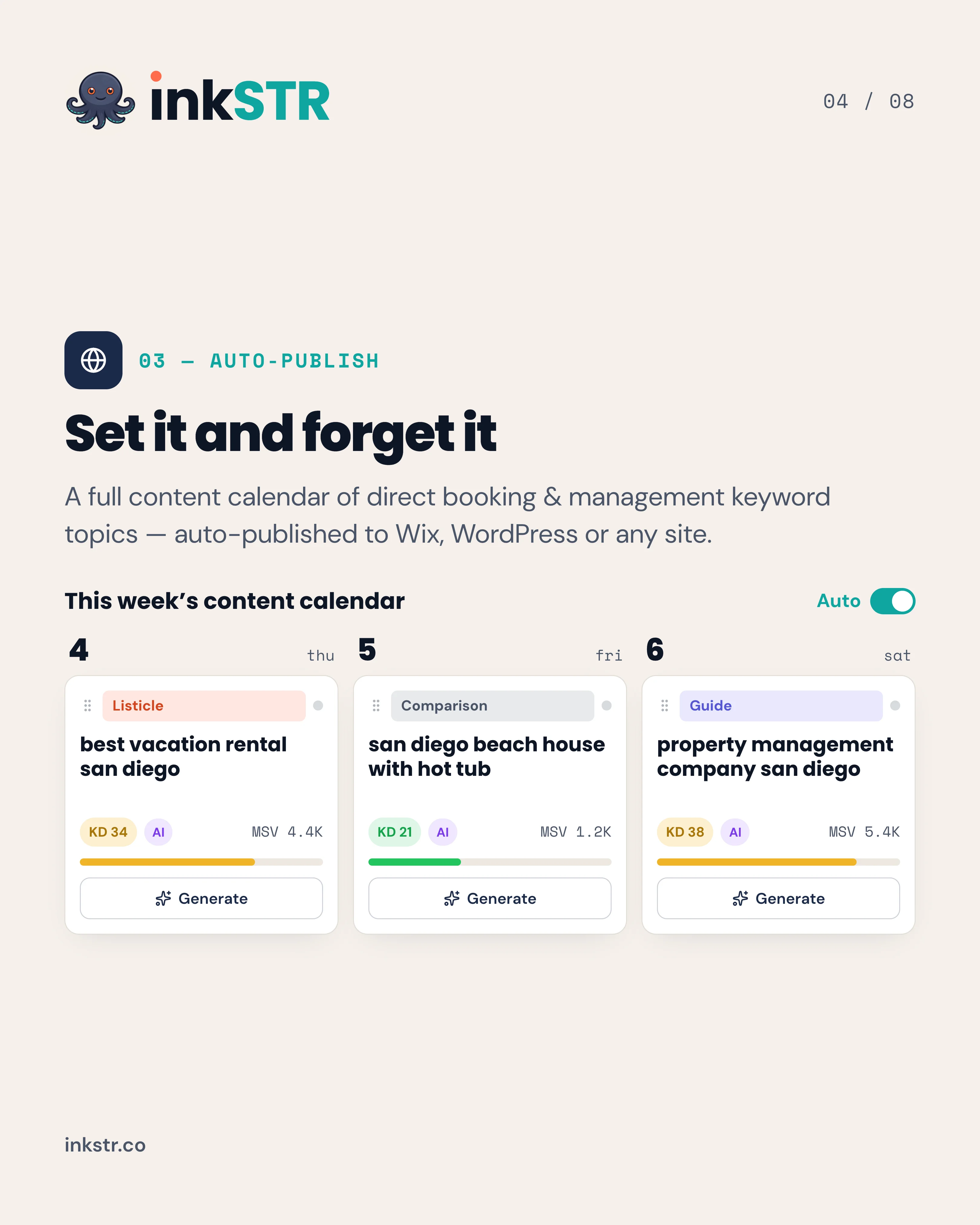
The mistake we see constantly, especially among operators running 10 or more properties, is treating category four as optional. A property manager reviewing a multi-property portfolio dashboard often has a fully built booking stack and zero content strategy for the website that's supposed to convert warm traffic into reservations. inkSTR's Content Calendar exists specifically to close that fifth category gap, scheduling and managing publishing on autopilot so it doesn't fall to the bottom of your priority list every week.

Can You Do Property Management Content Yourself?
Yes, you can write and manage your own property management blog content, but doing it well requires consistent keyword research, a publishing schedule, and enough writing time to produce quality posts, resources most independent hosts and small management companies don't have to spare. Writing one quality blog post manually typically takes 3 to 5 hours of research and drafting, according to standard content production benchmarks.
Here's what the DIY path actually looks like in practice. You research a keyword, maybe using a free tool, draft a 1,500-word post, format it, find or shoot photos, publish it, and repeat that process weekly if you want any real ranking momentum. For a solo host running one or two properties, that's a part-time job layered on top of guest communication, cleaning coordination, and everything else on your plate.
For property management companies running 10, 20, or 50 units, the DIY math gets worse, not better. Each property or market often needs its own local content, meaning the manual workload multiplies with every listing you add. Hiring it out isn't automatically cheaper either: a freelance travel writer typically charges $300 to $700 per post, and that cost recurs every single time, with no guarantee the freelancer understands vacation rental search intent versus general travel writing.
This is the exact problem we designed inkSTR to solve. The AI Content Writer generates SEO-optimized articles based on real keyword research specific to short-term rental search behavior, not generic travel blogging. In one case, a Smoky Mountains cabin rental brand went from 788 to 5,195 monthly Google Search clicks in 11 months running a continuous inkSTR content pipeline, with $309,775 in attributed direct booking revenue in the first 14 months. That's the kind of outcome DIY blogging rarely reaches, simply because the cadence required to get there is hard to sustain manually.
Why Isn't My Vacation Rental Website Getting Bookings?
A vacation rental website typically fails to generate bookings because it has little to no organic search visibility, meaning guests searching for a property in your area never find your site before landing on Airbnb or VRBO instead. Traffic without content is the single most common gap we see across new inkSTR customers before they start publishing.
Think about what a guest actually searches before booking: "dog-friendly lake house near [destination] with a dock" or "best cabins for a bachelorette weekend in [region]." If your site has no content answering those specific, high-intent queries, Google has nothing to rank. Your homepage and listing pages alone rarely target enough long-tail search terms to capture that traffic.
We've also seen the opposite failure mode: sites that publish generic content, "10 Things to Do This Summer" posts with no property-specific detail or local grounding, which don't convert even when they do get traffic. Our piece on why generic travel content kills conversions goes deeper on this exact trap.
What worked for a five-market luxury rental brand across destinations including Breckenridge and the Poconos was pillar-and-cluster content grounded in real property data, not generic filler. That operator went from averaging 26 monthly Google search visits to 1,924 in four months, publishing 114 inkSTR articles across all five markets with content auto-published directly to their Wix site through inkSTR's Auto-Publishing feature. Commission-free direct bookings started closing within that same four-month window.
What Should You Blog About for Your Vacation Rental Website?
The strongest vacation rental blog topics answer specific guest search queries tied to your property type and location, rather than covering generic seasonal listicles that every competing site also publishes. Effective topics include neighborhood guides, seasonal event calendars specific to your area, property comparison content, and pet-friendly or group-size specific searches.
Specifically, content should map to where a guest is in their search journey. Someone typing "best time to visit [destination] for fall foliage" is early-stage research. Someone typing "[property type] with hot tub sleeps 10 near [landmark]" is much closer to booking. Both deserve content, but the second type converts faster and should get priority in your publishing schedule.
For multi-property portfolios, this gets more complex fast. Each market you operate in needs distinct local content, meaning a property manager overseeing five destinations can't reuse the same blog post across all of them without it reading as generic filler. Our guide to local area guides that actually sell breaks down how to structure that content so it converts rather than just fills space.
inkSTR's content strategy engine builds a pillar, cluster, and conversion architecture specific to each property or market, meaning the keyword research isn't guesswork. It's grounded in actual traveler search behavior for vacation rentals, which is different from general travel search intent. That distinction is exactly why a general-purpose blogging tool applied to this niche tends to underperform: it wasn't built to understand the difference between a family searching for a beach house and a business traveler searching for a corporate apartment.

Ready to automate your content marketing?
inkSTR handles keyword research, content strategy, article writing, and publishing, all on autopilot.
How Do You Compete With Big Property Management Companies in Search?
Independent hosts and smaller management companies compete with larger operators in search results by publishing more specific, locally grounded content more consistently than larger competitors can sustain across their broader, less specialized portfolios. Larger companies often have marketing budgets but spread thin across dozens or hundreds of properties, leaving gaps a focused operator can fill.
Specifically, a large property management company managing hundreds of units across multiple states rarely writes deeply local content for every single market. Their blog, if they have one, tends toward broad, generic advice that ranks for competitive head terms but misses long-tail, high-intent local searches. That's the opening for smaller operators.
Consistency is the deciding factor here, not budget size. A ranking blog article can drive organic search traffic for 2 to 5 years once it's live and indexed, which means the operators who publish steadily now build a compounding advantage that's hard for a larger, slower-moving competitor to catch up to later. Our article on ranking on Google for STR-specific factors covers the technical side of this in more detail.
The MyTripify case shows how this plays out for management companies specifically, not just individual hosts. A 50-plus property portfolio management company in the Charlotte and Lake Norman market started an inkSTR content pipeline targeting property-owner acquisition, not just guest traffic, and had four property-owner leads arrive from AI search in the first month alone, with Google impressions running 4.6x higher than the year prior within three months. That's a management company using content to win against larger competitors on owner acquisition, not just guest bookings.
What Data Backs the Case for Blog Content in Property Management?
The case for property management blog software rests on measurable search demand growth and a widening gap between operators who publish consistently and those who don't. The vacation rental property management software market alone was valued at $4,900 million in 2026 and is projected to reach $12,500 million by 2035, an 8.9% CAGR, reflecting how quickly operators are investing in digital tools across every category, including content.
| Metric | Manual / Freelance Approach | inkSTR Property Management Blog Software |
|---|---|---|
| Time per article | 3-5 hours of research and writing | Generated automatically on a set schedule |
| Cost per article (freelance) | $300-$700 per post | Included in $99/month plan |
| Publishing consistency | Depends on operator or freelancer availability | Scheduled and auto-published via Content Calendar |
| Niche specificity | Varies widely by writer's travel background | Built specifically for STR and hospitality search intent |
| Multi-property scalability | Workload multiplies per property/market | Independent content pipeline per property from one dashboard |
Beyond market sizing, our own platform data adds a useful reference point. As of September 2026, articles published across all inkSTR customer sites total more than 4,100, generating over 2.6 million Google Search impressions in the trailing 90 days across connected customer sites. That volume only happens with sustained, automated publishing, not sporadic manual posting.
The trend line matters too. Cloud-based vacation rental software platforms are projected to capture roughly 78.5% of market share by 2034, according to market research on deployment models, underscoring how firmly the industry has shifted toward SaaS tools over on-premises or manual systems. Content tooling is following the same curve.
How Do You Choose the Right Property Management Blog Software?
Choosing property management blog software comes down to matching the tool's specialization to your portfolio type, checking that it publishes directly to your existing website platform, and confirming the pricing model scales with your property count rather than penalizing growth. Generic marketing software applied to a hospitality niche frequently misses vacation rental terminology and traveler search patterns.
Here's a practical checklist for evaluating any tool in this category:
- Confirm it publishes directly to your platform. inkSTR's Auto-Publishing connects to Wix, WordPress, and custom sites without manual copy-paste steps.
- Check whether keyword research is built in or a separate cost. inkSTR's Keyword Research tool surfaces the terms your target guests actually search, specific to vacation rental intent.
- Ask if the tool supports multiple properties or markets independently. A single-property tool forces workarounds once you scale past one listing.
- Review the scheduling and cadence controls. Sporadic publishing rarely builds the compounding search authority consistent publishing does.
- Verify pricing scales reasonably. Check the Pricing page for how plans structure around portfolio size.
- Test for niche understanding. Ask whether the tool differentiates between a beach house search and a mountain cabin search, or treats all rental content the same.
Common mistakes we see operators make: switching tools every few months chasing marginal feature differences, which resets content momentum each time. Publishing inconsistently because content got deprioritized during busy booking season, when search visibility actually compounds most from year-round steadiness. And choosing a general SEO tool that wasn't built for hospitality, then wondering why the content doesn't convert despite ranking. A tool understanding the difference between "corporate housing" search intent and "family vacation rental" search intent produces fundamentally different content, even for the same keyword volume.
Do It Yourself Property Management Software vs. Automated Content Tools: What's the Real Trade-off?
DIY property management content tools, meaning free blogging platforms or manual CMS setups like WordPress you manage yourself, offer full creative control but require you to handle every step: keyword research, writing, formatting, and publishing on your own schedule. Automated property management blog software removes that manual burden by generating and scheduling content against a built keyword strategy.
The honest trade-off is time versus control. Running your own WordPress blog gives you total flexibility over voice and structure, but every post still costs 3-5 hours of your time if you write it yourself, or $300-700 if you outsource it per article, with no guarantee of consistent cadence either way.
Automated tools trade some granular control for scale and consistency. inkSTR generates SEO-optimized drafts, but you still review before publishing, and the Content Calendar gives you full visibility into what's scheduled and when. It's not a black box; it's a faster version of the same workflow, built specifically around hospitality search patterns instead of generic blogging templates.
For a solo host running one property, DIY might genuinely make sense if you enjoy writing and have the time. For anyone managing multiple units, or anyone who's tried DIY and watched the publishing schedule fall apart during peak season, that's exactly the gap automated property management blog software closes. Our guide to must-have tools for STR managers scaling up covers where content automation fits into a broader tech stack.
Frequently Asked Questions
How long does it take for a vacation rental website to rank on Google?
Most sites see meaningful traffic gains within 3 to 6 months of consistent publishing, though this varies by market competitiveness and prior domain history. Established brands sometimes see faster gains: one Smoky Mountains cabin brand went from 788 to 5,195 monthly Google Search clicks in 11 months on a continuous content pipeline.
Do I need a blog if I already have a direct booking website?
Yes, a booking engine alone rarely generates organic traffic since it's built for transactions, not search discovery. Blog content is what gives Google (and guests) something to find before they ever reach your booking page.
What's the difference between SEO for a single listing and SEO for a property management company?
A single listing typically targets one property's local search terms, while a management company needs distinct content for every market and property type it operates across. inkSTR's multi-project support gives each property or market its own independent content pipeline from one dashboard.
How often should I publish new blog content for my vacation rental site?
Consistency matters more than volume; a steady weekly or biweekly cadence typically outperforms sporadic bursts of content followed by long gaps. A ranking article can keep driving traffic for 2 to 5 years, but only if enough consistent publishing built the site's authority in the first place.
Can AI-generated content actually rank on Google and get cited in AI search results like ChatGPT or AI Overviews?
Yes, when the content is structured for both traditional SEO and AI citation, meaning answer-first paragraphs, clear headings, and specific data. As of September 2026, inkSTR has secured over 1,185 verified AI-search citations for customer content across the platform.
How do I get more direct bookings without relying on Airbnb or VRBO traffic?
Direct bookings come primarily from organic search traffic to your own website, which requires content targeting the specific searches guests use before booking. That content also avoids the 17-19% combined host and guest fees OTAs charge on every reservation.
Is content marketing worth it for a small, independent vacation rental host?
Yes, provided the content is specific to your property and market rather than generic. A single direct booking is typically worth $1,000 to $4,000, meaning even a handful of organic bookings a year can offset the cost of a content tool many times over.
How do I find property management leads through content?
For management companies specifically, content can target property-owner search intent ("hire a property manager near me") rather than just guest-facing searches. One 50-plus unit portfolio company generated four property-owner leads from AI search alone in its first month running an owner-facing content pipeline.
Conclusion
Property management blog software closes a gap that general PMS platforms were never built to fill: consistent, search-optimized content for your direct booking website. The operators pulling ahead in 2026 aren't necessarily the ones with the biggest portfolios, they're the ones publishing steadily, grounded in real keyword research specific to vacation rental search behavior, month after month.
Whether you're running one property or fifty, the math is the same. A direct booking saves you the 17-19% OTA fee cut and is typically worth $1,000 to $4,000 in revenue. Content that ranks keeps working for years, not weeks. The question isn't whether blog content matters for your rental business, it's whether you can sustain the publishing cadence needed to see it pay off.
Get started with inkSTR if keeping up with keyword research, writing, and publishing across your properties feels like more than you can sustain manually. Our content pipeline handles that work on a schedule, built specifically for short-term rental search intent, so you can focus on running your properties instead of your publishing calendar.
If your website has been sitting quiet while your competitors publish weekly, this is the tool built to change that. Start with a free trial and see your first content plan generated against your actual market and property type.
Content powered by inkSTR.co
Enjoyed this article? Share it:
Get more of inkSTR in Google Search
Add inkstr.co as a preferred source and our articles show up more in Top Stories, AI Overviews, and AI Mode — with a “Preferred” badge.
Get more guides like this
New SEO and AI-search guides, straight to your inbox. No spam, unsubscribe anytime.