Is inkSTR Worth It? An Honest Breakdown for 2026
inkSTR is worth it for most short-term rental operators because it replaces the $300 to $700 a freelance writer charges per post with a $99 monthly subscription that generates, schedules, and publishes SEO-optimized blog content automatically. The math holds up specifically for hosts and property managers who need consistent content but lack the 3 to 5 hours per post that manual writing requires. Whether it's worth it for you depends on how much you value your own time and how seriously you're pursuing direct bookings in 2026.
Key Takeaways
- inkSTR starts at $99/month, compared to $300 to $700 per post for freelance travel writers, or 3 to 5 hours of your own time per article.
- A single direct booking typically nets $1,000 to $4,000 in revenue, meaning one converted guest can cover months of subscription cost.
- Airbnb and VRBO host and guest fees combined run 17 to 19% per booking, a cost direct traffic sidesteps entirely.
- inkSTR is built specifically for STR terminology and traveler search intent, not generic business copy, which matters for property management and vacation rental content.
- A ranking blog article can drive organic search traffic for 2 to 5 years, making content an asset rather than a recurring expense.
- inkSTR handles the full pipeline, keyword research, drafting, scheduling, and one-click publishing to Wix or WordPress, so the "is it worth it" question comes down to time saved versus subscription cost.
We get asked some version of this question constantly: is inkSTR worth it, or is it just another AI writing tool with a subscription fee attached? Fair question. There's no shortage of horizontal, industry-agnostic content tools competing for your attention, and most of them have no idea what a "self-check-in code" or "shoulder season" means in a vacation rental context.
This article breaks down the actual cost-benefit math, not marketing fluff. We'll walk through what inkSTR replaces, what it costs relative to the alternatives you're already weighing, and where it genuinely falls short. As of 2026, content marketing generates roughly three times more leads per dollar spent than paid advertising for B2B SaaS companies, and that ratio holds for STR-specific content too. But a good ratio doesn't mean much if the tool doesn't fit how you actually run your business.
We built inkSTR because we watched too many capable hosts and property managers get buried by the sheer grind of content production. Here's the honest version of whether it solves that problem for you.
Why Do STR Operators Struggle to Justify a Content Tool Subscription?
Most STR operators hesitate on content tool subscriptions because the return isn't immediate the way a booking confirmation is. You pay $99 this month and might not see a ranking improvement for weeks. That delay makes the value proposition feel abstract, even when the underlying math is straightforward.
Here's the agitation part, and it's real: without a content engine, you're stuck choosing between three bad options. First, you write the posts yourself, burning 3 to 5 hours per article on research and drafting time you don't have between guest turnovers and cleaning coordination. Second, you hire a freelance travel writer at $300 to $700 per post, which adds up fast if you're trying to publish weekly. Third, you skip content entirely, which means your competitors' property management sites keep climbing search results while yours sits flat on page three. We've reviewed hundreds of STR content calendars over the years, and the pattern repeats: sites that post inconsistently, or not at all, lose ground month over month to sites that publish on a schedule.
This is exactly the gap inkSTR was designed to close. The subscription cost isn't competing against "free." It's competing against $300 to $700 per freelance post or 3 to 5 hours of your own unpaid time, every single time you want new content. Once you frame it that way, $99/month for unlimited generation, scheduling, and one-click publishing starts looking less like an expense and more like the cheapest option on the table.
What Does inkSTR Actually Replace in Your Content Workflow?
inkSTR replaces four distinct manual tasks: keyword research, article drafting, image sourcing and formatting, and publishing. Each of these normally requires separate tools or separate hours, and most hosts either skip steps entirely or pay someone else to do them piecemeal.
Consider what the manual version actually looks like. First, you'd research keywords using a tool like Ubersuggest or a paid platform, spending 30 to 60 minutes figuring out what your target guests actually search for. Then you'd draft the article yourself or brief a freelancer, another 3 to 5 hours minimum. Then you'd source and rename property images for SEO, format the post for your CMS, and schedule it manually. That's an entire afternoon, repeated every time you want a new post live.
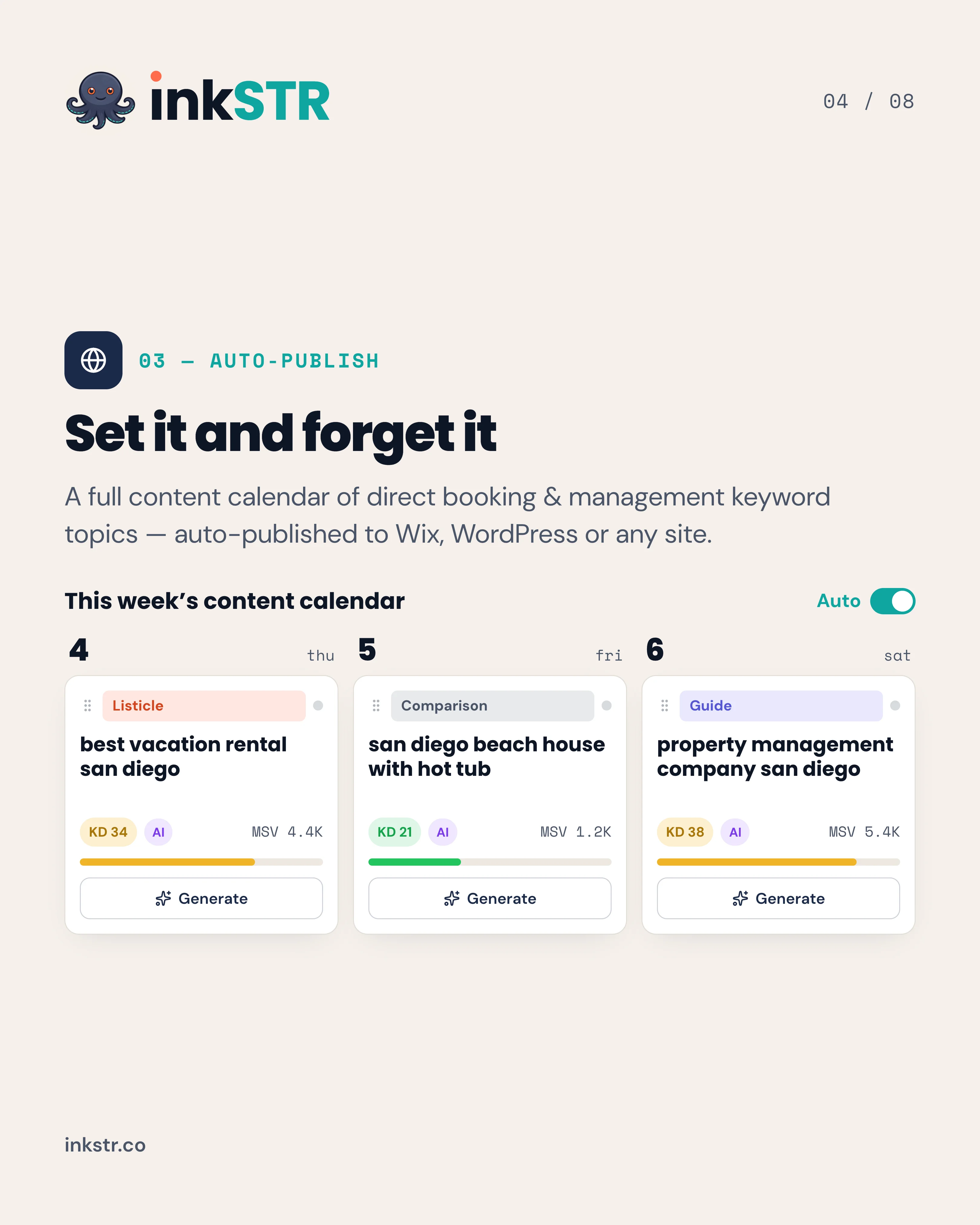
inkSTR's Keyword Research feature finds what your target guests are actually typing into Google, then feeds that directly into the AI Content Writer, which drafts a full 2,500 to 3,500 word SEO-optimized article built around that keyword. The image library auto-generates SEO file names and descriptions for property photos, and the Content Calendar schedules everything on autopilot. What used to be a scattered, multi-tool afternoon becomes one workflow.
Is the $99/Month Price Actually Competitive With SEO Software Alternatives?
Yes, inkSTR's $99/month price sits at the low end of the SEO automation market, where tools range from roughly $19/month for narrow single-function products up to $4,500/month for enterprise all-in-one platforms with rank tracking, backlink monitoring, and reporting suites most STR operators never touch.
Here's the distinction that matters: generic all-in-one SEO platforms like SEMRush or Moz are built for any business in any industry. They're powerful, but you're paying for capabilities like enterprise backlink monitoring across millions of domains that a 20-unit vacation rental portfolio doesn't need. Semrush's own platform reportedly indexes over 28 trillion backlinks and tracks billions of keywords, which is genuinely impressive infrastructure, but it's built for agencies and enterprise marketing teams, not a host managing three cabin listings in a mountain market.
inkSTR is priced and built specifically for the STR use case: content generation, scheduling, and publishing bundled together, with keyword research and Google Search Console integration built in rather than sold as an add-on. Check the exact current tiers on the Pricing page, but the core plan starts at $99/month, positioned to replace freelance writing costs rather than compete with enterprise SEO suites you don't need.
| Option | Typical Cost | Time Required Per Post | STR-Specific Understanding |
|---|---|---|---|
| Writing it yourself | $0 direct cost | 3 to 5 hours | Depends on your own expertise |
| Freelance travel writer | $300 to $700 per post | 0 hours yours, but review time | Varies by writer, often generic |
| Generic AI writing tool | $20 to $100+/month | Editing and fact-checking still required | Usually none, built for any industry |
| inkSTR | $99/month | Minimal, review and approve | Purpose-built for STR terminology and traveler intent |
How Does the ROI Math Work for a Multi-Property Portfolio Versus a Single Listing?
ROI on inkSTR scales differently depending on portfolio size, but the core calculation stays consistent: one direct booking, typically worth $1,000 to $4,000 in revenue, can cover multiple months of the subscription cost outright. For a single-listing host, that means one converted guest from organic search pays for nearly a year of the tool.
For property management companies running 15 or more units, the math compounds. Each property could theoretically run its own content pipeline, targeting local search terms specific to that listing's neighborhood, amenities, and traveler type. Instead of one generic blog covering an entire portfolio, inkSTR's multi-project support lets a manager run parallel content calendars, one per property or brand, without duplicating research or writing effort across each one.
We've seen this pain point specifically among multi-unit managers: they're publishing the same generic content everywhere and wondering why nothing moves. The fix isn't more content, it's differentiated content per property, executed at a scale manual writing simply can't sustain. Since a ranking blog article can drive organic traffic for 2 to 5 years once it's indexed and established, the content itself becomes a long-term asset rather than a monthly line item you're constantly refilling.

What Are the Real Limitations of inkSTR, Honestly?
inkSTR is not a substitute for having a functioning website, a booking engine, or a baseline SEO foundation, meaning technical issues like broken site architecture or missing schema markup won't fix themselves through content alone. It's also not instant. Ranking takes weeks to months regardless of who or what writes the content, since Google's own AI Mode update and traditional ranking systems both weight consistency and domain authority over time, not overnight volume. If your website itself has structural problems, thin location pages, broken internal linking, missing Google Business Profile optimization, no content tool fixes that on its own. We'd point you toward Why Your Vacation Rental Website Is Not Ranking on Google if that's the actual bottleneck, because content is only one piece of the visibility equation.
The other honest limitation: inkSTR generates drafts and manages publishing, but you still need to review output for accuracy on property-specific details, confirm local information is current, and occasionally adjust tone to match your brand voice over time. We built quality scoring and pre-publish validation into the workflow specifically because AI-generated drafts benefit from a review layer, not because the drafts are unreliable, but because you know your property and your guests better than any tool does.
Ready to automate your content marketing?
inkSTR handles keyword research, content strategy, article writing, and publishing, all on autopilot.
How Do You Know If inkSTR Is the Right Fit for Your Property Type?
inkSTR fits best for STR operators who are actively trying to reduce reliance on Airbnb and VRBO listing traffic, where combined host and guest fees run 17 to 19% per booking, and who don't have in-house writing capacity to publish consistently. It's a weaker fit for operators who already have a dedicated marketing hire producing content regularly, since the core value is time savings, not just output volume.
Here's a practical way to evaluate fit. If you're a single-cabin owner in a mountain market losing potential guests because your listing doesn't highlight local attractions the way a bigger competitor's site does, content built around local area guides and location-specific search intent solves a real gap. Check our piece on Local Area Guides That Sell for what that content actually needs to include. If you're a property management company managing dozens of owner relationships and getting no organic lead flow into your management services page specifically, that's a different content angle entirely, one built around attracting owners, not just guests.
Either way, the underlying question is the same: does the 3 to 5 hours per post you'd otherwise spend, or the $300 to $700 per post you'd otherwise pay a freelancer, cost you more than $99/month? For most operators publishing more than one article monthly, the answer is straightforward.
What Should You Expect in Your First 30 to 90 Days Using inkSTR?
In your first 30 days with inkSTR, expect the platform to run a brand audit, surface keyword opportunities through competitor gap analysis, and begin publishing your first scheduled articles, but expect search ranking movement to lag behind publishing by several weeks, which is normal for any new or refreshed content regardless of who wrote it.
Here's the realistic timeline. Weeks one and two: the content strategy wizard maps out your pillar, cluster, and conversion architecture based on your specific property type and market. Weeks three and four: your first batch of articles publishes on the schedule you set through the Content Calendar. Months two and three: Google Search Console integration starts surfacing which keywords are gaining impressions, and you begin seeing which topics resonate versus which need adjustment. This is the same pattern true of any legitimate SEO effort, and it's exactly why relying on a single burst of content, then stopping, fails long-term. Consistency compounds. A stalled content calendar is the single most common reason STR sites plateau after an initial push, and it's the specific problem our Content Calendar and automated scheduling were built to prevent.
How Does inkSTR Compare to Just Using ChatGPT Yourself?
inkSTR differs from using a general AI assistant like ChatGPT directly because it bundles STR-specific keyword research, competitor gap analysis, scheduling, and one-click publishing into a single workflow, whereas a general chatbot only drafts text you still have to research, format, optimize, and publish manually yourself.
ChatGPT and similar tools are genuinely useful for brainstorming headline ideas or getting unstuck on an outline, and we won't pretend otherwise. But drafting is one step in a five-step pipeline: research, drafting, image handling, internal linking, and publishing. A general assistant leaves you doing the other four steps by hand, including the SEO-specific work like internal link structure and Google Search Console tracking that most operators skip entirely because it's tedious. inkSTR's full workflow covers research chat for on-demand keyword and competitor intelligence, internal link management connecting your primary CTAs to secondary blog content, and LLM citation optimization aimed at getting your content surfaced in AI Overviews and tools like Perplexity, not just traditional Google results. That last point matters more in 2026 than it did even two years ago, since AI-driven search referral traffic has grown substantially as more travelers start their research inside conversational AI tools rather than a traditional search bar.
Frequently Asked Questions
How long does it take to see SEO results from inkSTR content?
Most operators see initial keyword impressions within 4 to 8 weeks of consistent publishing, with meaningful ranking movement typically building over 3 to 6 months. Since a ranking article can drive organic traffic for 2 to 5 years once established, the early wait pays off over a much longer window than the initial delay suggests.
Can I use inkSTR if I manage more than one property or brand?
Yes. inkSTR's multi-project support gives each property or brand its own independent content pipeline, so a manager overseeing 15 or more properties can run parallel content calendars without duplicating research or writing effort across each listing.
Does inkSTR work with my existing Wix or WordPress site?
Yes, inkSTR offers one-click publishing directly to both Wix and WordPress, so scheduled articles go live without manual copy-paste work. This is handled through the Auto-Publishing feature.
Is inkSTR worth it compared to hiring a freelance writer?
For most operators publishing more than one article per month, yes. A freelance travel writer typically charges $300 to $700 per post, while inkSTR's $99/month subscription generates, schedules, and publishes articles continuously at a fraction of that per-post cost.
Does inkSTR require existing SEO knowledge to use?
No. The content strategy wizard builds your pillar, cluster, and conversion architecture automatically based on keyword research and competitor analysis, so you don't need prior SEO expertise to get a structured content plan running.
Will inkSTR content actually reduce my dependence on Airbnb and VRBO?
Content alone won't eliminate OTA dependence, but it builds the organic traffic funnel needed to capture direct bookings that bypass the 17 to 19% combined host and guest fees charged on OTA platforms. Internal link management routes readers from blog content toward your direct booking page specifically for this purpose.
What happens if I stop using inkSTR after a few months?
Published articles remain live on your site and continue generating traffic since search rankings aren't tied to an active subscription, though you'd lose the ongoing research, scheduling, and publishing automation for new content going forward.
Conclusion: So, Is inkSTR Worth It?
The honest answer: inkSTR is worth it if you're an STR operator who needs consistent, search-optimized content but doesn't have 3 to 5 hours per post to spare or $300 to $700 per post to pay a freelancer. Starting at $99/month, it's priced to replace those specific costs, not to compete with enterprise SEO suites built for industries that have nothing to do with vacation rentals. What we've seen across the operators we work with is simple: content that runs on a consistent schedule outperforms content that happens in bursts, and inkSTR exists specifically to make that consistency automatic rather than dependent on whether you had a free afternoon this week. As we move further into 2026, with AI-driven search referrals growing and traveler research increasingly happening inside conversational tools, that consistency matters more, not less.

If building content like this manually feels like a full-time job on top of your actual job, inkSTR generates and publishes SEO-optimized articles like this one automatically. Start a free trial and see your first article draft this week.
Content powered by inkSTR.co
Enjoyed this article? Share it:
Get more of inkSTR in Google Search
Add inkstr.co as a preferred source and our articles show up more in Top Stories, AI Overviews, and AI Mode — with a “Preferred” badge.
Get more guides like this
New SEO and AI-search guides, straight to your inbox. No spam, unsubscribe anytime.