Topic Cluster Strategy for a New Vacation Rental Blog
A topic cluster strategy organizes your vacation rental blog around one broad pillar page and a set of focused supporting articles that link to each other. For a brand new site, that means publishing the pillar and its first five or so supporting posts together, so Google sees real depth on one subject before you expand.
Key Takeaways
- A topic cluster is one pillar page plus several narrow cluster articles, all linked in both directions.
- A new vacation rental blog needs one complete cluster before it needs a second topic.
- Each cluster article should target one long-tail search and link back to the pillar near the top.
- Overlapping destination searches deserve separate pages only when the top results answer different questions.
- Measure a cluster by impressions first, then clicks, then booking page visits and inquiries.
- inkSTR automates the pillar-and-cluster plan, the drafting, the scheduling, and the publishing, so you build the cluster without writing every post yourself.
You launched the site, added a blog, and wrote a post about hot tub etiquette. Then one about packing for a mountain weekend. Then nothing for six weeks. Each post stands alone and links to nothing. It competes for no particular search topic.
At inkSTR, we build AI content tools for short-term rental operators, and the question we hear most from new blog owners is where to start. The answer in 2026 is the same as it was before AI search arrived: pick one topic and cover it deeply. Then connect every page. This guide walks through ten parts of that plan, ordered from understanding the model to measuring it.
We ordered the list by sequence, not importance. Read the first three for the concepts, items four through seven to build the plan, and eight through ten to wire it together and track it. Where an example appears, we label it as illustrative, because we have not tied these table examples to a specific customer site.
1. What Is a Topic Cluster Model?
A topic cluster model is a content structure in which one broad pillar page covers a subject at a high level, and a group of cluster articles each cover one narrow subtopic in depth. Links run from the pillar to every cluster article and from every cluster article back to the pillar. The pillar gives readers the overview, and each cluster article answers the question that overview raises.
Without that structure, you publish scattered posts. A freelance travel writer charges $300 to $700 per quality post, and writing one yourself takes 3 to 5 hours of research and drafting. Spend that on ten unrelated topics and you own ten pages that none of the others support. Spend it on one connected cluster and every new page strengthens the ones already live.
| Page type | Scope | Typical searcher | Links to |
|---|---|---|---|
| Pillar page | Broad overview of one subject | Early planning stage, short queries | Every cluster article |
| Cluster article | One narrow question or long-tail query | Researching a specific detail | Pillar page and related clusters |
| Conversion page | Booking or inquiry page | Ready to choose a stay | Booking engine |
We built inkSTR's content workflow around this exact architecture. The strategy wizard maps pillar, cluster, and conversion articles before any drafting starts, so every post has a job before it exists.
2. What Are the 5 Components of SEO?
The five components of SEO are keyword research and on-page optimization, along with technical SEO. The other two are content and link building. Each one touches a topic cluster in a different way, and knowing which ones you control versus which ones your website platform handles saves you from chasing the wrong fix.
- Keyword research: decides which subtopics become cluster articles.
- On-page optimization: titles, headings, and internal links that tell Google what each page covers.
- Technical SEO: site speed, mobile layout, and crawlability. Your Wix or WordPress setup handles most of it.
- Content: the pillar and cluster articles themselves.
- Link building: other sites pointing to yours, which builds authority slowly.
Most new operators spend their first month on technical tweaks and publish nothing. That order is backwards. A fast, clean site with eight pages ranks for nothing, because search engines have little to match against a searcher's question.
inkSTR covers the middle three directly: keyword research, on-page structure, and article generation. You still own the website platform and its speed. We would rather say that plainly than pretend one tool fixes everything.
3. What Are the 3 C's of SEO?
The 3 C's of SEO are content and code, with credibility as the last one. It is one common framing among several. Content is what your pages say, code is how your site is built so search engines can read it, and credibility is the trust other sites and readers place in you.
Framings vary, so treat this as a mental checklist rather than a standard. For a new vacation rental blog, the C's carry uneven weight. Content is the lever you can pull today. Code is mostly decided by your platform. Credibility lags, because a new domain has no history.
That lag is where clusters help. When five articles on one subject link together and each answers a real question, you give search engines and AI assistants a reason to treat your site as a source on that subject. It is the fastest credibility signal a new blog can produce on its own, and our guide on how to rank a vacation rental website on Google covers the supporting signals.
The manual alternative is slow. You publish a post and wait. Then you guess whether it helped. We connect Google's search reporting inside inkSTR so you see which queries your articles earn and where the next opportunity sits.

4. How Do You Audit Existing Content Before Building a Cluster?
Auditing content for a topic cluster means listing every page you already have, grouping each by subject, and checking which subjects have enough supporting pages to count as a cluster. For a brand new blog, the audit is short, and its real value is checking competitors instead.
Established sites follow three steps: export pages and queries from Google's search reporting, group them by topic, and update links among related pages. If you have no blog yet, run a shorter version. List your listing pages and your about page. Add any guest guide you already wrote. Then look at the pages that rank for the searches you want.
Doing this by hand means a spreadsheet, a dozen browser tabs, and a lot of guessing about which gaps matter. It also goes stale the week after you finish.
The brand audit in inkSTR runs a competitor keyword gap analysis, and the research chat answers keyword or competitor questions on demand. You see which subtopics rivals cover and you do not, before you commission a single article.
5. Can You Provide Examples of Topic Clusters for a Vacation Rental Blog?
A vacation rental topic cluster pairs a broad planning pillar with narrow articles on lodging and activities. Logistics gets its own articles, and then readers are pointed to a booking page. The table below shows three illustrative clusters. Swap in your own destination and property type.
| Pillar page (illustrative) | Example cluster articles | Conversion link |
|---|---|---|
| Planning a lake house weekend getaway | Off-season lake activities; what to pack for a cold-water weekend; boat and dock rules for guests | Lake house booking page |
| Pet-friendly mountain cabin stays | Dog-friendly trails near the cabin; fenced yard checklist; cleaning policy for pets | Pet-friendly cabin listing |
| Large group and family reunion rentals | Meal planning for a big group; sleeping arrangements for 10 guests; shoulder season group discounts | Large home booking page |
Notice what each cluster avoids: generic travel content that any blog could publish. Each article ties to something your property actually offers, which is why guests who read it are closer to booking. We cover this more in vacation rental blog topics that drive bookings.
Brainstorming these on a blank page is where most operators stall. inkSTR pulls reviews and photos from Hospitable or OwnerRez, along with guest data. The articles reflect your real property instead of invented amenities.
6. How Do You Build a Topic Cluster Strategy From Zero Content?
You build a topic cluster strategy from zero content by choosing one core topic tied to your property and publishing the pillar page. Then add five or more cluster articles and link everything before expanding. Industry guidance commonly recommends five or more supporting articles per core topic, each aimed at a long-tail keyword.
Here is the minimum viable sequence we recommend for a site with no content and no search data:
- Choose one core topic from the thing that makes your property bookable, such as pet-friendly stays or group retreats.
- Publish the pillar page first so the cluster articles have somewhere to link.
- Publish five cluster articles, each answering one long-tail question.
- Link each article to the pillar and to your booking page.
- Wait for search data, then pick the second topic based on what earned impressions.
If you run a single cabin, one finished cluster may be all you need for the first year. Building three half-finished clusters is the most common mistake we see, and it buys you three topics with no depth. A cabin owner who finishes one cluster of six pages has a stronger site than one with fifteen unconnected posts.
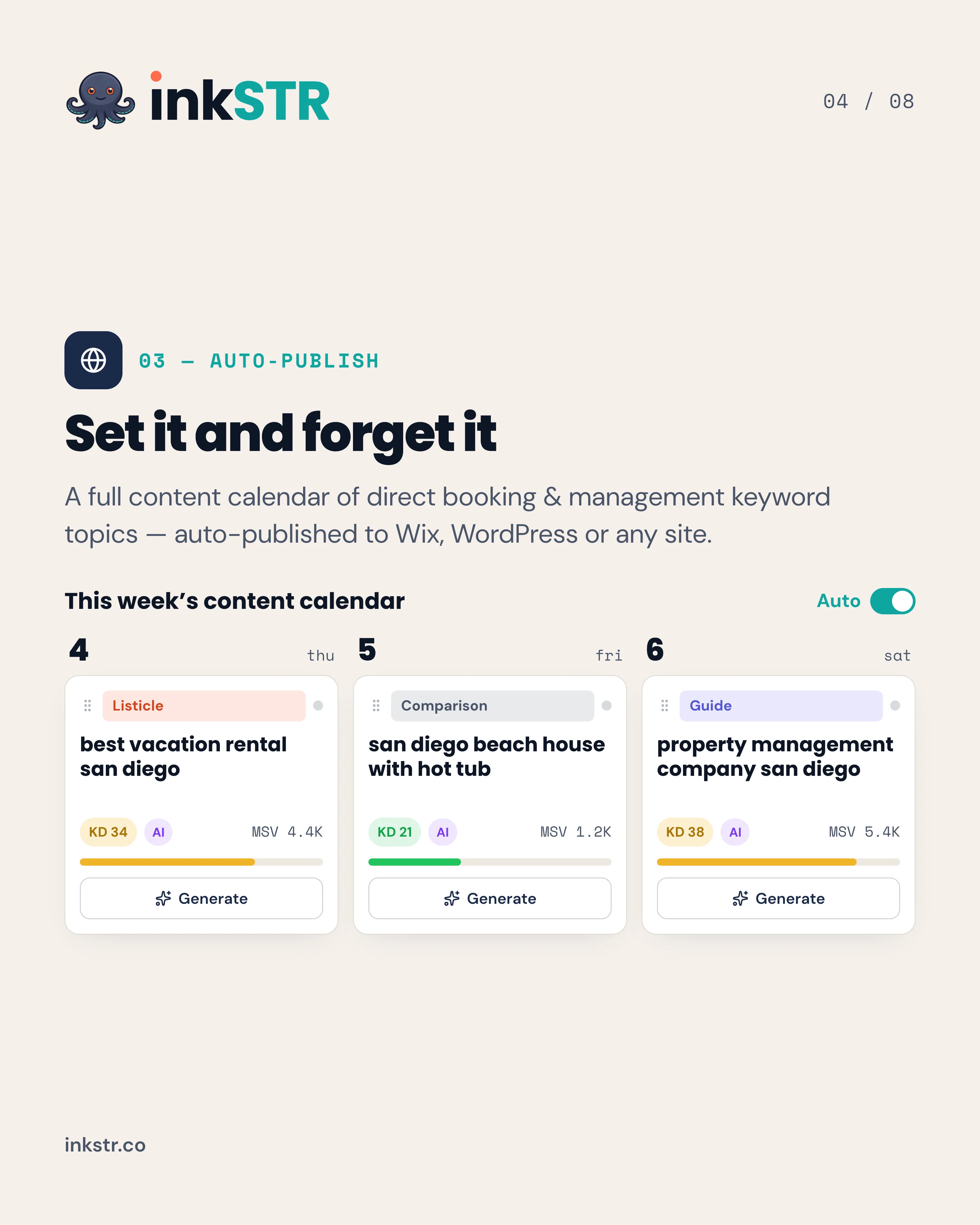
The manual version of this calendar is a weekend of planning and months of missed deadlines. In inkSTR, you drag each article onto a date in the content calendar, and the scheduler publishes it to your site. Plans start at $99 a month; see pricing for details.

Ready to automate your content marketing?
inkSTR handles keyword research, content strategy, article writing, and publishing, all on autopilot.
7. How Do You Choose Keywords for a Topic Cluster Strategy?
Choosing keywords for a topic cluster means starting with one broad head term for the pillar, then finding long-tail variations that each describe a single question a guest might type. Validate each candidate by checking whether the pages currently ranking match the article you plan to write. If the top results are a different kind of page, rethink the angle.
Free starting points work for a first pass: search autocomplete, the related searches at the bottom of results, and the queries in Google's search reporting once you have any. They fall apart at scale. Collecting and sorting dozens of candidates by hand, then guessing which ones a new domain can actually win, eats hours before you write a word.
We built inkSTR's keyword research to find the terms your target guests actually search, then slot them into the cluster plan automatically. Instead of researching keywords manually for hours, you review a keyword plan built around your market and your competitors, and adjust it.
One opinion worth stating: favor specific, winnable queries over big head terms for your first cluster. A new domain rarely outranks established travel sites on a broad term, but it can win a narrow question about your property type.
8. How Should You Link Pillar and Cluster Pages?
Linking a topic cluster means every cluster article links to its pillar near the top, the pillar links to every cluster article early, and closely related cluster articles link to each other. Each page also links to your booking page, so readers have a next step.
Common SEO guidance advises placing the hub link in the introduction or first few paragraphs, and we agree. A link buried in the last paragraph is read by almost nobody. Anchor text should read like part of the sentence, not a keyword pasted in.
Doing this by hand means reopening old posts every time you publish a new one, which is why internal links go stale on most vacation rental blogs. The pillar never learns about the newest cluster article.
inkSTR's internal link management handles it: you set your primary booking and inquiry pages, add secondary blog links, and each draft includes them. For how a blog feeds your own booking page, see how direct bookings work with content, and keep in mind that a single direct booking is typically worth $1,000 to $4,000 in revenue.
9. When Does a Local Subtopic Deserve Its Own Page?
A local subtopic deserves its own page when the top search results for it answer a different question than the results for the neighboring topic. If both searches return the same pages, merge them into one article. If the results differ, write two.
Destination searches overlap constantly. "Easy hikes with kids" and "best hiking trails near the lake house" look similar, yet the first reader wants distance and stroller access while the second wants scenery and trailhead parking. Check the results yourself before deciding.
The mistake we see is splitting every variation into its own thin page, which leaves several weak articles competing against each other. The opposite mistake is one giant guide that answers nothing well. Look at what Google already rewards and follow it.
The research chat in inkSTR gives you that comparison on demand, so you do not open ten tabs per decision. Pair it with our guidance on local area guides that sell to write the pages that earn their place.
10. How Do You Know Your Topic Cluster Strategy Is Working?
You know a topic cluster strategy is working when impressions rise first and clicks follow. After that, visits to your booking page turn into inquiries or reservations. Expect months, not days. Measure in this order so you do not judge a young cluster by bookings it has not had time to earn.
First, watch impressions in Google's search reporting for the queries your cluster targets. Second, watch clicks. Third, track clicks from articles to your booking page. Fourth, count inquiries and direct reservations. Most blog advice stops at traffic, but traffic that never reaches a booking page is only a number.
Two cases show what consistent clusters can do. A Smoky Mountains cabin rental brand grew monthly Google Search clicks from 788 to 5,195 in 11 months on a steady inkSTR publishing cadence. A five-market mountain rental brand published 114 inkSTR articles in four months and went from 26 to 1,924 monthly Google search visits. Both were measured in site analytics and search reporting. Results vary by market and effort, and rankings are never guaranteed.
As of October 2026, we have published more than 5,300 articles across inkSTR customer sites. That volume is why the quality scoring and pre-publish validation exist: they catch weak drafts before they go live. For the AI search side of measurement, our guide to ranking in AI search explains what to track.
What Is the Simplest Way to Start Your Topic Cluster Strategy?
Start with one pillar page and five cluster articles on a single topic tied to your property, link them in both directions, and send readers to your booking page. A topic cluster strategy rewards finishing one cluster over starting several, and you can do it without writing every post by hand.
Pick the topic, publish the pillar, add the cluster articles on a steady schedule, and review your search data before choosing your second topic. That sequence works in 2026 for the same reason it worked before AI search: depth on one subject earns trust. Looking ahead, AI assistants that cite sources will keep favoring sites that answer connected questions clearly.
If you would rather not draft, link, and schedule every article yourself, start your free trial of inkSTR and let it build the pillar-and-cluster plan, draft the articles, and publish them to Wix or WordPress on your calendar.
Frequently Asked Questions
How many articles does a topic cluster need?
Industry guidance commonly recommends five or more cluster articles per pillar page, each aimed at a long-tail keyword. For a new vacation rental blog, five supporting posts plus the pillar is a workable first target. Add more only after your search data shows which questions readers actually search.
How long does a topic cluster take to rank?
Expect months, not days, before a new cluster earns steady traffic. Impressions usually appear first, then clicks. Consistent publishing is the part you control, and inkSTR's automated scheduler keeps that cadence going without daily effort.
What is the difference between a pillar page and cluster content?
A pillar page covers a broad subject at a high level and links to every supporting article. Cluster content covers one narrow subtopic in depth and links back to the pillar. The pillar serves early-stage readers, while each cluster article answers one specific question.
Can I use a topic cluster strategy with only one property?
Yes, and one finished cluster is often enough to start. Choose the topic that makes your property bookable, such as pet-friendly stays or group retreats. A single-property host does not need several clusters in the first year.
Can AI-written articles work in a topic cluster?
They can rank when they are grounded in real property details and optimized for the specific question. inkSTR generates articles of 2,500 to 3,500 words and uses your reviews and photos through Hospitable or OwnerRez. It also runs quality scoring before publishing. Review each draft the way you would review a freelancer's work.
How do I audit existing content for topic clusters?
List your current pages, group them by subject, and check which subjects have supporting pages. If you already have search data, export the queries and pages and look for subjects with many impressions but little supporting content. inkSTR's brand audit adds a competitor keyword gap analysis to that picture.
Does inkSTR publish directly to Wix and WordPress?
Yes. inkSTR publishes finished articles to Wix and WordPress with one click or on a schedule you set in the content calendar. See the auto-publishing feature for details.
Content powered by inkSTR.co
Enjoyed this article? Share it:
Get more of inkSTR in Google Search
Add inkstr.co as a preferred source and our articles show up more in Top Stories, AI Overviews, and AI Mode, with a “Preferred” badge.
Get more guides like this
New SEO and AI-search guides, straight to your inbox. No spam, unsubscribe anytime.