Vacation Rental Brand Building: 10 Moves Guests Remember

Vacation rental brand building is the process of turning a single listing, or a portfolio of listings, into a recognizable identity that guests remember, trust, and search for by name instead of scrolling past on Airbnb or VRBO. It combines a defined visual identity, a consistent guest experience, and a direct booking presence that reinforces all of it. Done right, it reduces reliance on OTA search rankings and pulls guests toward booking with you directly.
TL;DR
- Vacation rental brand building means designing a consistent identity, name, visual system, and guest experience, then reinforcing it across your website, OTA listings, and every guest touchpoint.
- A brand is not a logo. It is the feeling a guest describes to a friend after they leave, built through pre-arrival messaging, on-stay details, and post-stay follow-up.
- Industry data shows 38% of vacation rental traffic comes from organic search, compared to 32% direct and 16% paid, according to CUFinder's 2026 industry analysis, which makes a branded, findable website essential.
- Mobile matters more than most operators plan for: 68.5% of vacation rental website traffic is mobile, per CUFinder, so your brand has to work on a five-inch screen first.
- Portfolio operators can segment properties into sub-brands (eco-luxe, family escape, workcation) to serve different traveler segments without diluting a single brand promise.
- inkSTR automates the blog content, keyword research, and publishing schedule that turns a brand identity into a discoverable, ranking direct booking website, so the brand work you do actually reaches travelers.
Most short-term rental operators think branding means a nicer logo and a matching color palette on Canva. That is a small piece of it, and it is not the piece that drives rebookings. In our work at inkSTR, we consistently see the same pattern: operators with strong brand recall have a direct booking site guests can find, remember, and return to, while everyone else is renting shelf space on someone else's platform.
This matters more in 2026 than it did even two years ago. The vacation rental market is projected to reach somewhere between $106 billion and $109 billion this year, and professional management companies now control an estimated 42% of the roughly 7 million active short-term rental listings worldwide. That is a crowded field. A guest who cannot recall your property's name after checkout will not search for it again, they will just open Airbnb and take whatever the algorithm serves up next.
Below are 10 specific, sequenced moves for building a vacation rental brand that survives past the first stay. Each one names the problem operators actually run into, why the manual version of the fix is painful, and where a tool like inkSTR removes the friction.
1. Define a Sharp Positioning Statement Before You Touch a Logo
Vacation rental brand positioning is the specific promise your property makes to one type of traveler, stated clearly enough that it shapes every decision after it. Most hosts skip this step and jump straight to visuals, which produces a pretty listing with no strategic backbone.
Without a positioning statement, you end up trying to appeal to everyone: business travelers, families, bachelorette groups, remote workers. Your photos, your amenities, and your copy all pull in different directions. Guests sense the confusion even if they cannot name it, and generic listings blur together in a search results page dominated by thousands of similar units.
A workable positioning statement names the traveler, the specific need, and the differentiator. Something like: "A quiet, design-forward retreat for remote workers who need reliable fiber internet and a private workspace, thirty minutes outside a major metro." Guesty's guidance on unique selling propositions points to the same idea: prime location for a specific activity, a standout amenity like a gourmet kitchen, or an eco-friendly angle all work better than trying to be everything to everyone.
This is exactly where content strategy and brand positioning intersect, and it is a gap we built inkSTR to close. Once you have a positioning statement, inkSTR's Keyword Research tool maps the actual search terms travelers use for that specific traveler type in your market, so your blog content and your brand promise point at the same audience instead of working against each other.
2. What Is the 3-7-27 Rule of Branding?
The 3-7-27 rule of branding is a marketing principle describing the average number of exposures a consumer needs before recognizing a brand (roughly 3), trusting it enough to consider it (around 7), and becoming a loyal, repeat customer (approximately 27 touchpoints over time). For vacation rental operators, this rule explains why a single beautiful listing photo will never build brand recall on its own.
Most hosts publish a listing, wait for bookings, and never think about repeat exposure again. That is the painful part: without a system for repeated, consistent touchpoints, a guest sees your property once, books once, and forgets your name by their next trip. You are starting from zero every single time, competing on price and photos against every other listing in the search results.
Applying the 3-7-27 rule to short-term rentals means building recurring touchpoints: a pre-arrival email with your brand voice, an on-property detail guests photograph and share, a post-stay follow-up, and blog content on your direct booking site that shows up in search months after the trip ends. Each exposure compounds. A ranking blog article, for example, can drive organic search traffic for two to five years, giving you far more than 3 touchpoints with the same pool of travelers.
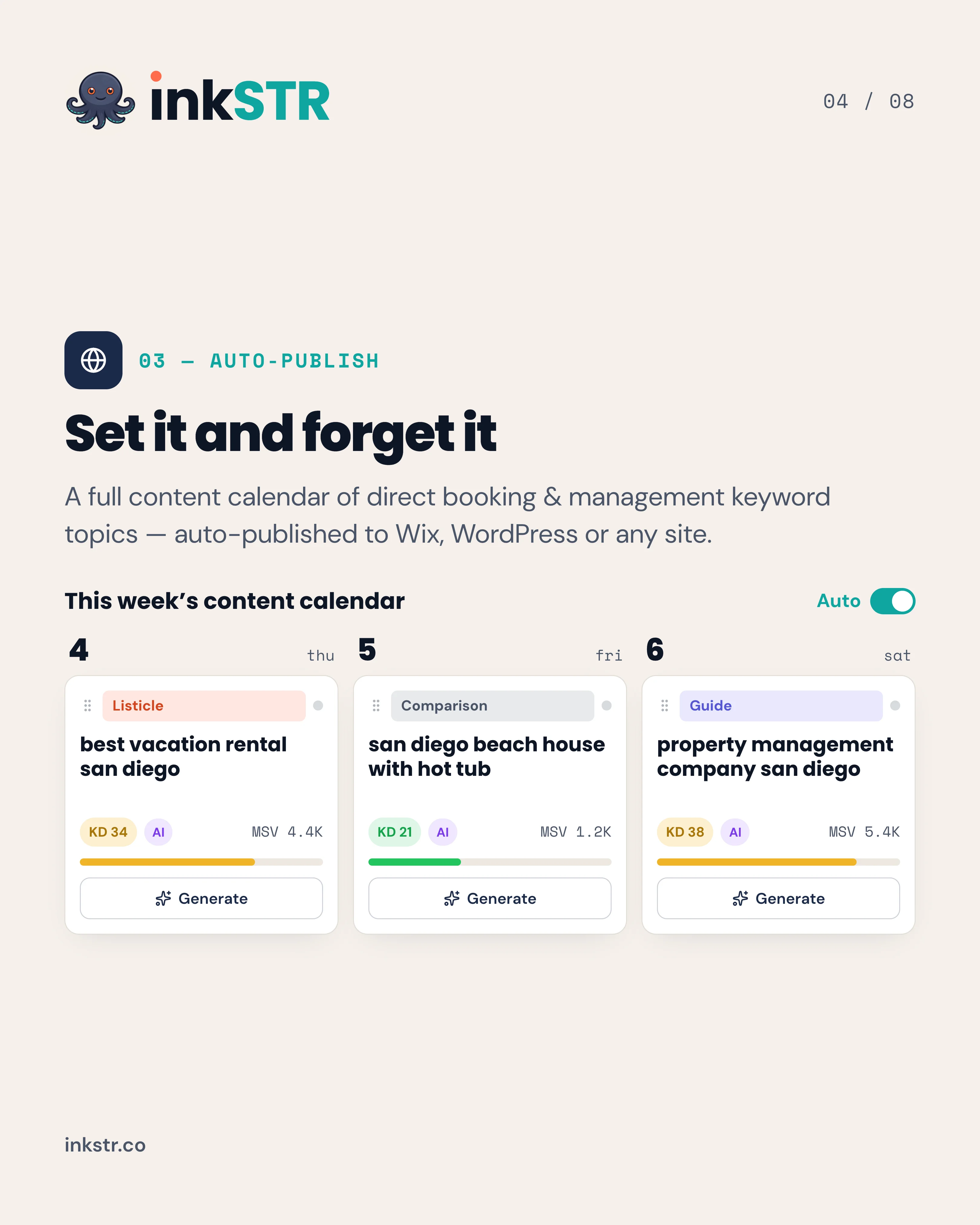
This is precisely the mechanism inkSTR's Content Calendar was built to support. Instead of one-off posts that guests see once and forget, we schedule a steady drumbeat of destination and property content that keeps your brand appearing across the guest's search history, well past the 3-touchpoint minimum and into repeat-guest territory.
3. Build a Name, Logo, and Visual System That Scales
A vacation rental brand identity includes the property name, logo, typography, color palette, and photography style, all chosen to reflect the positioning statement and to remain consistent as the portfolio grows. This is the part most guides call "branding," but it only works when it is built to scale from day one.
Here is the mistake we see constantly: an operator names their first property something cute and hyper-specific, then acquires a second and third property and has no naming convention to fall back on. Now they are managing three disconnected identities, three different photography styles, and three separate reputations to build from scratch. That is three times the brand-building work with none of the compounding benefit.
A scalable naming and visual system solves this before it becomes a problem. Keep the name short, memorable, and expandable, check domain and social handle availability before locking it in, and build a photography style guide that any new property can follow. Consistent colors, fonts, and messaging across your website, your OTA listings, and printed guest materials build recognition faster than a novel name for every unit.
Once that visual system exists, the content built around it needs to stay consistent too. That is why inkSTR's AI Content Writer pulls from your defined brand voice and property details so every published article, whether it is about your first cabin or your fifteenth, sounds like it came from the same company, not a rotating cast of freelancers.
4. Design a Direct Booking Website That Feels Like Home, Not a Booking Form
A vacation rental direct booking website is your brand's central hub, the one property you fully control outside of any OTA algorithm. Most operators build a bare-bones booking engine with a calendar and a few photos, then wonder why nobody stays on the page long enough to book.
The painful reality is that a booking form without a brand story converts poorly. Travelers researching a vacation rental brand for the first time want to see the personality behind the property, not just availability dates. A generic template site does nothing to differentiate you from the thousands of similar listings competing in the same market, and it gives Google nothing to index besides a calendar widget.
The fix is content, not just design. Your direct booking site needs local area guides, a real About page that explains the story and the positioning statement, and blog content that answers the actual questions travelers search before choosing a destination and a property. Specifically, this is where organic search becomes your biggest acquisition channel: industry data shows 38% of all vacation rental website traffic already comes from organic search, more than direct or paid combined.
We built inkSTR because most operators do not have four hours to spend writing a single blog post, and freelance travel writers typically charge $300 to $700 per article. inkSTR's Auto-Publishing feature pushes finished, brand-aligned articles straight to your WordPress or Wix site on a schedule, so your direct booking website keeps growing content without you touching a keyboard. For a deeper look at getting that site to actually rank, see our guide on how to rank your vacation rental website on Google.
5. What Is the 75-55 Rule for Airbnb?
The 75-55 rule is a listing optimization guideline suggesting a host's title should stay near 75 characters and their photo captions or key description elements around 55 characters, keeping listing content scannable on both desktop and mobile search results. For brand building specifically, this rule matters because your listing title and captions are often a traveler's first brand exposure.
Ignore this rule and your brand name gets buried under a long, keyword-stuffed title, or worse, cut off entirely on mobile, where an estimated 68.5% of vacation rental website traffic already happens. Guests scrolling a search results page on their phone never even see the brand name you spent weeks designing, because it got truncated after character 60.
Applying the 75-55 rule means front-loading your property or brand name early in the title, keeping captions tight and benefit-driven, and testing how your listing actually renders on a phone screen before publishing. This is a small, mechanical detail, but it is exactly the kind of detail that determines whether your branding investment ever reaches a guest's eyes.
Brand consistency has to extend past your own website and into every OTA field where your name appears. Our team at inkSTR regularly advises clients that a strong brand strategy is wasted if the OTA-facing content is generic. That is why we recommend auditing every guest-facing field, listing titles, captions, and welcome messages, against your positioning statement at least once a quarter.
6. Turn the Guest Journey Into a Branded Experience, Not Just a Stay
The guest journey is the full sequence of touchpoints a traveler has with your brand, from the moment they search for a property through pre-arrival messaging, the on-property stay, and post-stay follow-up. A vacation rental brand lives in this journey, not just in a logo, and it is reinforced or destroyed at every single step.
Without a designed journey, guests get a generic automated message, a keypad code, and silence. Nothing about that interaction is memorable. Compare that to a competitor who sends a warm, branded pre-arrival email with local recommendations, leaves a small branded welcome detail on arrival, and follows up after checkout with a personal thank-you. One guest forgets you by their next trip. The other guest tells a friend your property's name.
Specifically, the pre-arrival message should reflect your brand voice and answer practical questions before guests ask them. The on-stay experience should include one or two signature details unique to your brand (a local snack basket, a handwritten note, a specific amenity you are known for). The post-stay message should invite a review that mentions your brand name directly, which reinforces search visibility over time.
Scripting this consistently across a growing portfolio is where most operators fall apart, because it becomes another manual task competing for time against actual property management. inkSTR's full content workflow was designed with this exact problem in mind, generating consistent, on-brand messaging templates and blog content so your brand voice does not fray as you add more units. For more on why generic messaging fails, our piece on why generic travel content kills conversions covers the same principle from the content side.
7. Who Is the Largest Vacation Rental Company?
The largest vacation rental companies in terms of listing volume and market reach are the major OTA platforms, Airbnb and VRBO, which together host a significant share of the estimated 7 million active short-term rental listings tracked globally as of early 2026. Independent operators and boutique property managers are competing for guest attention inside an ecosystem those platforms control.
Here is the uncomfortable part: when your brand only exists inside a listing on one of these platforms, you are effectively renting your identity from a company whose algorithm can change overnight, whose fees combined typically run 17 to 19% of every booking, and whose search results bury your property below thousands of similar options. Your "brand" in that context is really just a search ranking, subject to someone else's rules.
Building a real vacation rental brand means you own an asset outside of Airbnb and VRBO entirely: your own domain, your own email list, your own content library that ranks in Google independent of any OTA algorithm update. VRBO alone ranks on the first page of Google for an estimated 94% of the vacation rental markets analyzed in one industry study, and it holds the number one organic spot 24% of the time. That is the search visibility you are up against if your only presence is the OTA listing page.
This is the single biggest reason we built inkSTR the way we did. Rather than competing only inside OTA search results, inkSTR's Keyword Research tool finds the destination and property-type searches where an independent brand can actually outrank OTA aggregator pages, giving your direct booking site a real shot at page one. Our guide on the local signals Google actually cares about in 2026 goes deeper on this exact competitive dynamic.
Ready to automate your content marketing?
inkSTR handles keyword research, content strategy, article writing, and publishing, all on autopilot.
8. What Is the 80-20 Rule for Airbnb?
The 80-20 rule, applied to Airbnb and short-term rental businesses, generally suggests that roughly 80% of your bookings, revenue, or repeat guests come from about 20% of your efforts, listings, or guest relationships. For brand building, this means a small set of high-value, high-loyalty guests and a small set of brand touchpoints likely drive most of your rebooking value.
Most operators spread their branding effort evenly: the same welcome message for every guest, the same generic follow-up email, no segmentation between a one-time weekend traveler and a guest who has stayed three times. That flat approach wastes effort on the 80% of low-leverage activity while under-investing in the 20% that actually produces rebookings and referrals.
Applying the 80-20 rule to brand building means identifying your highest-value guest segment, often repeat travelers or guests who book directly rather than through an OTA, and building your strongest branded touchpoints around them. That could mean a loyalty perk for direct bookings, a personalized note referencing a previous stay, or a dedicated email list segment for guests who have stayed before. A single direct booking is typically worth $1,000 to $4,000 in revenue, so nurturing that 20% of repeat, direct-booking guests carries outsized weight.
Segmenting guest communication like this manually across a growing portfolio takes real time most operators do not have. This is exactly the problem inkSTR was designed to solve on the content side: our platform's multi-project structure keeps content, keyword targeting, and messaging separate for each property or brand pillar, so your highest-value guest segments get the tailored attention the 80-20 rule calls for, without you managing fifteen separate content plans by hand.
9. Segment a Growing Portfolio Into Sub-Brands Without Losing Consistency
Portfolio sub-branding is the practice of dividing a multi-property vacation rental business into distinct brand pillars, such as eco-luxe retreats, family escapes, or workcation-friendly units, each with its own positioning while still rolling up under one parent brand identity. This lets a growing operator serve different traveler segments without diluting any single property's promise.
Without sub-branding, portfolio operators tend to default to one generic message across every property type, which fails every segment a little instead of serving any segment well. A family traveling with kids and a remote worker chasing fiber internet have almost nothing in common as guests, yet many management companies market to both with the same bland "comfortable and convenient" language.
The fix is a tiered structure: a parent brand name and visual system that establishes trust, with sub-brand positioning statements, photography styles, and even slightly different tones of voice for each traveler segment underneath it. An eco-luxe cabin cluster might lean into sustainability messaging and locally sourced amenities, while a workcation-focused urban unit leans into reliable connectivity and a dedicated desk setup.
Running separate content strategies for each sub-brand is exactly where manual content production collapses under its own weight. inkSTR's multi-project architecture keeps each sub-brand's keyword research and content calendar independent, so an eco-luxe property and a workcation property never end up publishing identical blog posts with the wrong tone attached. For more on differentiating a growing portfolio, read our piece on standing out when every host claims to be unique.
10. Track the Metrics That Prove Your Brand Is Actually Working
Vacation rental brand performance is measured through repeat booking rate, direct booking share of total revenue, guest review sentiment, and email list growth, not through vanity metrics like Instagram followers or logo recognition surveys. If you cannot point to a number that moved because of your branding work, you do not yet know whether it is working.
Most hosts invest in a rebrand, a new website, and a content push, then never set up the tracking to know if any of it changed guest behavior. Six months later they cannot say whether direct bookings grew, whether repeat guests increased, or whether the new brand voice resonated at all. That is money and time spent with no feedback loop.
The metrics that matter are trackable through your website analytics and booking software: direct booking percentage versus OTA-sourced bookings, conversion rate on your direct booking site, repeat guest rate, and organic search traffic growth over time. As of 2026, with organic search already responsible for 38% of vacation rental website traffic, tracking your search ranking progress is one of the clearest signals your brand content is compounding.
This is precisely why inkSTR's Content Calendar pairs with ongoing keyword tracking, so you can see which published articles are driving new organic sessions to your direct booking site over time, rather than guessing whether your brand content strategy is paying off.
Vacation Rental Brand Building: A Quick Reference Table
The table below summarizes each brand-building move, the primary manual pain point, and the specific fix, so you can prioritize based on where your current brand is weakest.
| Brand Building Step | Common Manual Pain Point | What Fixes It |
|---|---|---|
| Positioning statement | Trying to appeal to every traveler type at once | Name one traveler, one need, one differentiator |
| Repeated exposure (3-7-27) | One-off listing with no follow-up touchpoints | Scheduled content and messaging across multiple touchpoints |
| Visual identity | Disconnected naming across a growing portfolio | A scalable naming and photography system from day one |
| Direct booking website | Bare booking calendar with no brand story | Local guides, About page, and ongoing blog content |
| Listing optimization (75-55) | Brand name truncated on mobile search results | Tight titles and captions built for mobile-first display |
| Guest journey | Generic automated messaging with no personality | Branded pre-arrival, on-stay, and post-stay scripts |
| OTA dependence | Brand identity limited to a rented listing page | An owned direct booking site ranking independently in Google |
| Guest segmentation (80-20) | Same flat messaging for every guest tier | Tailored touchpoints for your highest-value repeat guests |
| Portfolio sub-brands | One generic message across very different traveler types | Distinct sub-brand positioning under one parent identity |
| Performance tracking | No visibility into whether branding is working | Direct booking share, repeat rate, and organic traffic tracking |

Practical Guidance: How to Prioritize Your Brand Building Work
Start with positioning before visuals. A gorgeous logo attached to a fuzzy positioning statement still fails to convert, because guests cannot tell who the property is for. Nail the one-sentence promise first.
Common mistakes worth avoiding include renaming your brand every time you add a property, chasing visual trends instead of consistency, and treating your direct booking website as an afterthought behind your OTA listings. Each of these dilutes the compounding effect that makes branding worthwhile in the first place.
- Write a one-sentence positioning statement naming your ideal guest and your core differentiator.
- Choose a scalable name, check domain and handle availability, and lock in a simple visual system.
- Build or upgrade your direct booking website with real content, not just a calendar widget.
- Script your pre-arrival, on-stay, and post-stay guest communication around your brand voice.
- Publish consistent, keyword-targeted content on a schedule to build organic search visibility.
- Track direct booking share and repeat guest rate quarterly to confirm the work is paying off.
The trade-off to understand up front: brand building compounds slowly. It is not a 30-day fix, and if you need bookings next week, paid ads or OTA optimization will move faster. But a brand that guests remember, paired with a direct booking site that ranks in Ubersuggest or tools like SEMRush can help you validate, builds an asset that keeps paying off years after the first article is published.
Frequently Asked Questions
How long does vacation rental brand building take to show results?
Most operators see early signals, higher direct booking inquiries, guests mentioning the brand name in reviews, within three to six months of consistent effort. Full compounding results, like organic search traffic and repeat guest rate growth, typically take longer since a ranking blog article can drive traffic for two to five years once it takes hold.
Do I need a separate brand for each property I manage?
Not necessarily. A single parent brand with sub-brand positioning for different traveler segments, eco-luxe, family escape, or workcation, usually works better than fully separate brands, because it lets you build trust once and extend it across the portfolio rather than starting from zero each time.
What is the difference between an Airbnb listing and a vacation rental brand?
An Airbnb listing is a page you rent inside someone else's platform, subject to their algorithm and their fees. A vacation rental brand is an asset you own: a name, a visual identity, and a direct booking website that exists independently of any single OTA and keeps working even if platform rules change.
Can AI-generated content actually support vacation rental brand building?
Yes, when the content is trained on your specific brand voice, property details, and target guest segment rather than generic travel copy. inkSTR's AI Content Writer is built specifically for short-term rental terminology and traveler search intent, which keeps generated content aligned with your positioning instead of sounding like every other listing.
How much does it cost to build a vacation rental brand?
Costs vary widely depending on whether you hire a designer for visuals, a freelance writer for content, and a developer for your website. Freelance travel writers alone typically charge $300 to $700 per blog post, which adds up fast if you need a full content library. A platform approach, like inkSTR at $99 per month, consolidates keyword research, writing, and publishing into one recurring cost.
What keywords should I target for vacation rental brand content?
Target a mix of destination-plus-property-type keywords (mountain cabin rental near a specific park), traveler-intent keywords (family-friendly vacation rental with a pool), and brand-adjacent terms tied to your positioning statement. inkSTR's Keyword Research tool identifies these automatically based on your market and property type.
Is vacation rental branding worth it if I only manage one property?
Yes. Even a single-property host benefits from a clear positioning statement, a direct booking website, and consistent guest messaging, because it reduces the percentage of bookings routed through OTA fees and builds a repeat guest base that books you directly next time instead of searching Airbnb again.
Conclusion
Vacation rental brand building is not a logo project. It is the combination of a sharp positioning statement, a consistent visual and messaging system, a direct booking website that actually ranks, and a guest journey that gives travelers something worth remembering. With the vacation rental market projected to reach roughly $106 to $109 billion in 2026 and management companies already controlling an estimated 42% of active listings globally, the operators who build a real brand identity now will be the ones guests search for by name later, not the ones hoping the OTA algorithm treats them kindly this quarter.
Start with the positioning statement. Everything else, your visual system, your website content, your guest journey scripts, should trace back to that one sentence. As of 2026, the tools to execute on all of it without hiring a full marketing team finally exist.

If your brand story is strong but your direct booking site still is not showing up in search, that is the exact gap inkSTR closes. Get started with inkSTR and let our keyword research, AI content writer, and auto-publishing handle the discovery side while you focus on the guest experience that makes your brand memorable.
Content powered by inkSTR.co
Enjoyed this article? Share it:
Get more of inkSTR in Google Search
Add inkstr.co as a preferred source and our articles show up more in Top Stories, AI Overviews, and AI Mode — with a “Preferred” badge.
Get more guides like this
New SEO and AI-search guides, straight to your inbox. No spam, unsubscribe anytime.