Autoblogger Explained: What It Does and When It Works

An autoblogger is software that automates the blog content pipeline: keyword research, article drafting, on-page SEO, and publishing, without a human writing each post by hand. For short-term rental operators, an autoblogger built for the STR niche can generate location-specific, guest-focused articles on a set schedule and push them live to a website without manual copy-paste work.
Key Takeaways
- An autoblogger automates the full content pipeline, from keyword research through drafting to scheduled publishing, replacing manual blog writing that typically takes 3-5 hours per post.
- Most full-automation autoblogging platforms are priced between $59 and $99 per month, compared to a freelance writer's typical rate of $300-$700 per article.
- Autoblogger tools commonly integrate with content management systems including WordPress, Shopify, Wix, Webflow, and Ghost, and many support up to seven posts per week.
- Generic autobloggers write for any industry; niche-specific tools understand vertical-specific search intent, like how a traveler searches for a lake house rental versus how they search for a mountain cabin.
- Poorly managed autoblogging (unchecked volume, thin content, no editorial review) carries real SEO risk; a disciplined workflow with quality gates avoids most of it.
- inkSTR runs the autoblogging pipeline specifically for short-term rental sites, pairing AI drafting with STR-specific keyword research and direct-to-CMS publishing so hosts get vacation-rental content instead of generic filler.
If you manage a vacation rental website in 2026, you have probably typed some version of "autoblogger" into Google while wondering whether a tool can actually replace the blog writing you never have time to do. The short answer is yes, with real caveats about quality control that most product pages gloss over.
At inkSTR, we build and operate an autoblogging pipeline specifically for short-term rental operators, so this article is written from the inside. We are not reviewing autoblogging as an abstract category. We are explaining how it works, where it breaks down, and what separates a tool that drives direct bookings from one that just adds noise to your site.
This guide covers what an autoblogger actually does step by step, the trade-offs between generic and niche-built tools, the SEO risks nobody talks about openly, and a practical checklist for vetting one before you commit a monthly budget to it.
What Is an Autoblogger and How Does It Work?
An autoblogger is a software platform that automates blog content creation and publishing using AI drafting combined with keyword and SEO data, instead of relying on a human writer for each post. The workflow typically runs in a fixed sequence: keyword input, keyword research and SERP analysis, AI drafting, on-page SEO formatting, then auto-publish on a schedule.
In practice, that means you set a target keyword, like "pet-friendly cabin rentals near Gatlinburg," and the autoblogger researches what's already ranking, drafts a full article with structured HTML, meta tags, and internal links, then schedules it to go live. Most platforms in this category support this end-to-end, which is what separates an autoblogger from a basic AI writing assistant that only outputs raw text. Specifically, an autoblogger differs from a general AI writer because it handles distribution, not just drafting. A tool that stops at generating a Google Doc still leaves you with the manual work of formatting, adding images, and publishing. inkSTR's AI Content Writer generates the draft as part of a pipeline that also includes scheduling and publishing, closing that gap. Without automation, the same process takes a host 3 to 5 hours of manual research and writing per post, according to typical freelance writing benchmarks. That time cost is exactly what pushes most operators toward inconsistent publishing, which is the single biggest reason vacation rental blogs stall out after a handful of posts.
Why Do Vacation Rental Sites Need an Autoblogger Instead of Writing Manually?
Vacation rental sites need an autoblogger because manual blog writing does not scale against the volume of content required to rank for local search terms, and most hosts do not have the time to write consistently. A single host managing one to three properties is also handling guest messages, cleaning coordination, and pricing, which leaves little room for a weekly writing habit.
We see this pattern across nearly every independent host we talk to: the website launches with five or six blog posts, all written in the first excited month, then nothing for the next year. Search engines read that inconsistency as a signal that the site stopped growing. Meanwhile, a property management company competing in the same market that publishes weekly keeps climbing.
Hiring a freelance travel writer to fill that gap costs $300 to $700 per quality post. At that rate, a 52-week content calendar runs into five figures annually, which is not realistic for a single-property host or even a 10-unit portfolio manager watching margins. And that assumes the freelancer understands STR-specific search intent, which most general freelance writers do not. This is exactly the gap inkSTR was built to close. Our Keyword Research feature identifies the exact terms travelers type when searching for a property like yours, in a market like yours, so the content produced actually matches what guests are looking for, not generic travel writing repurposed for a rental site.
How Does Autoblogging Differ for Ecommerce Versus Short-Term Rentals?
Autoblogging for ecommerce platforms like Shopify typically focuses on linking blog content to product pages, using the autoblogger to drive discovery of specific SKUs. Autoblogging for short-term rentals works differently: the goal is capturing traveler search intent tied to a location and property type, then routing that traffic to a direct booking page instead of a product catalog. A Shopify-focused autoblogger optimizes for phrases like "best running shoes for flat feet" and links directly to a product listing. A vacation rental autoblogger needs to understand phrases like "things to do near [lake name] with a dog" or "3-bedroom cabin with hot tub near [ski resort]," then connect that content to a specific listing's amenities and location. This distinction matters because most autoblogging tools on the market, including those built for Shopify, Wix, and general WordPress use, are horizontal by design. They serve any industry with the same generic template. That works fine for a blog about kitchen gadgets. It works poorly for a vacation rental site because the AI has no baked-in understanding of how a traveler searches for a beach house versus how they search for a mountain retreat. We built inkSTR specifically around STR terminology and traveler search behavior, which is why our content differentiates a beach town listing from an urban apartment listing in the actual keyword targeting, not just the surface-level topic. That specificity is the primary reason niche-built autoblogging outperforms horizontal tools for direct bookings.
What Does a Typical Autoblogger Workflow Look Like Step by Step?
A typical autoblogger workflow moves through five stages: keyword input, research and competitive analysis, AI drafting, SEO formatting, and scheduled publishing. Understanding each stage helps you evaluate whether a given tool is doing real work or just skipping steps to look automated.
- Step 1: Define your target keywords and audience. You (or the platform's research tool) identify the search terms your ideal guest uses, along with tone, word count range, and publishing cadence. Skipping this step is the most common mistake; a tool that drafts without keyword grounding produces generic filler.
- Step 2: Run keyword and SERP research. The autoblogger analyzes what's currently ranking for that term, identifying content gaps competitors miss. This is where niche knowledge matters most, since a generic tool cannot tell that a "lake house" search differs meaningfully from a "beach condo" search.
- Step 3: Generate the AI draft. The system writes a full article, typically in the 2,500 to 3,500 word range for informational content, structured with headings, an answer-first opening, and internal links.
- Step 4: Apply on-page SEO formatting. Meta titles, meta descriptions, schema markup, and image alt text get generated alongside the draft, rather than added manually afterward.
- Step 5: Schedule and publish automatically. The finished post goes live on your CMS, whether that's WordPress, Wix, or another platform, on a pre-set schedule rather than requiring you to log in and hit publish.
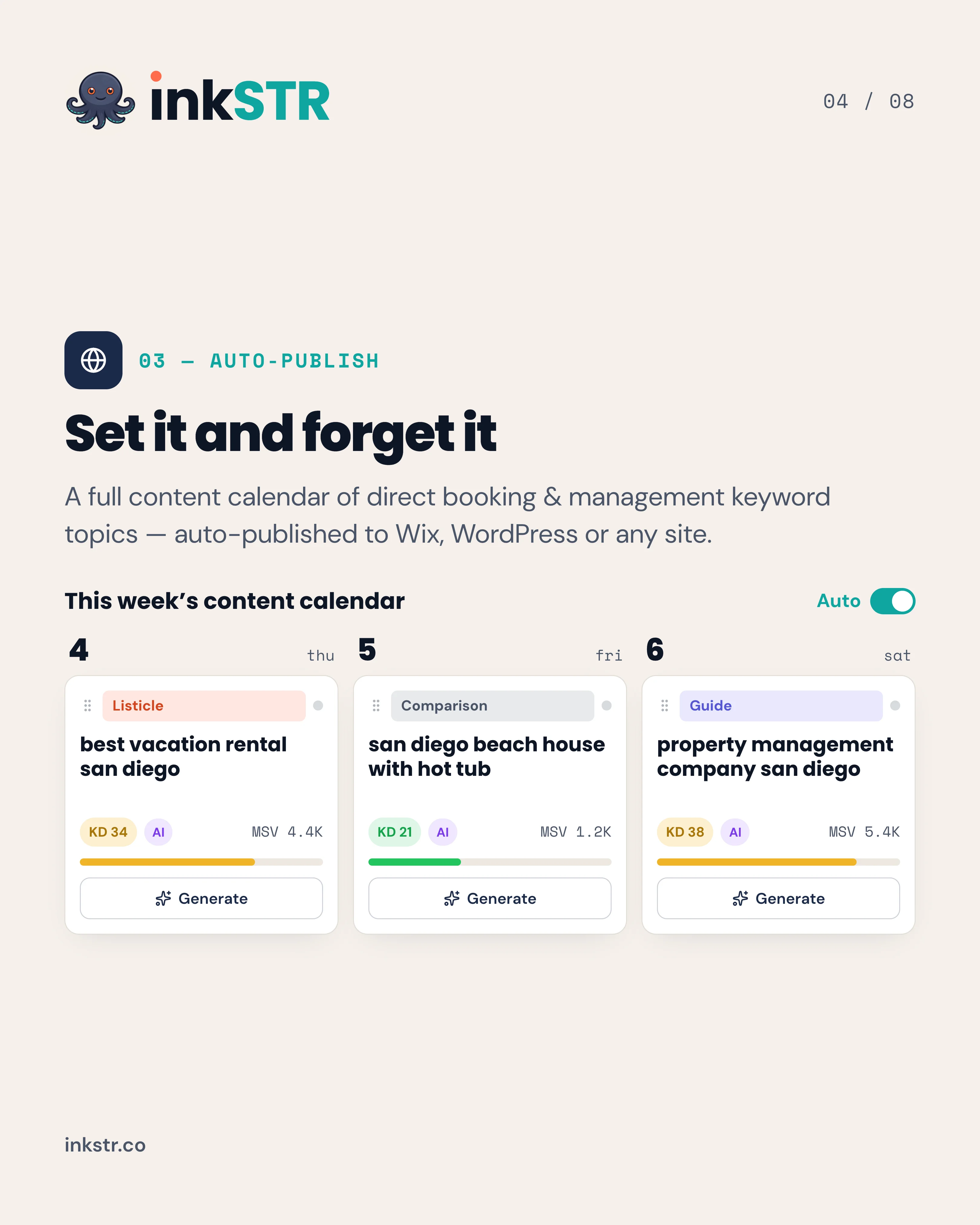
inkSTR's Content Calendar manages that fifth step through a drag-and-drop interface, so you can see every scheduled post across a property or portfolio at a glance, rather than tracking a spreadsheet of publish dates manually.
Can an Autoblogger Actually Get You Penalized by Google?
An autoblogger can contribute to a Google penalty only if it publishes content that fails Google's helpful content standards, meaning thin, repetitive, or search-intent-mismatched articles at high volume. The tool itself is not the risk; the absence of quality control around it is. Most guides on this topic avoid giving a concrete threshold, but the practical risk pattern is consistent: publishing dozens of near-identical, low-value posts in a short window, with no unique data, examples, or local specificity, is what triggers scrutiny. Publishing five well-researched, keyword-grounded, locally specific articles a month carries a completely different risk profile than publishing 30 templated posts a week with no editorial review. For a small team, a sustainable workflow usually means one editor reviewing every AI-drafted post before it publishes, even when the platform includes pre-publish quality scoring. That review does not need to take hours; checking that the content matches your property's actual amenities, that local details are accurate, and that internal links point to real pages on your site takes 10 to 15 minutes per post. inkSTR's quality scoring and pre-publish validation checks are designed to catch generic or off-target drafts before they go live, but we still recommend a human glance at every post, especially early on while you calibrate tone and local accuracy. That habit is what separates autoblogging done responsibly from the reputation the category has earned for spammy output.

How Many Posts Can a Small Team Safely Publish Per Week?
A small team, meaning one to two people managing content review, can typically manage two to four autoblogger-generated posts per week without sacrificing editorial oversight, though some platforms support up to seven posts weekly for teams with more review capacity. The right number depends on your review bandwidth more than the tool's technical limit. If you can only spare 30 minutes a week for content review, publishing one carefully checked article beats publishing five unreviewed ones. As your portfolio grows, so does the case for scaling volume, but the review process needs to scale with it, not disappear. For a property management company running 15 or more units, this is where multi-project support becomes the deciding factor between tools. Each property or market needs its own keyword targeting and local detail, not a single generic feed repurposed across every listing. inkSTR's multi-project structure gives each property its own independent content pipeline, so a manager overseeing multiple markets can run parallel calendars without one property's content bleeding into another's local references. This is also where the difference between horizontal and niche tools shows up clearly. A generic autoblogger treats volume as the goal. A niche tool built for STR content treats accuracy per property as the goal, with volume as a secondary output of a properly configured system.
What Should You Check Before Trusting AI-Generated Blog Posts?
Before publishing any AI-generated post from an autoblogger, check five things: factual accuracy of local details, correct property amenities referenced, working internal links, natural keyword usage without stuffing, and a genuine answer to the search query in the opening paragraph. Use this as a quick scoring checklist for each draft:
- Does the opening paragraph answer the core question directly? If a reader only saw the first two sentences, would they get real value?
- Are local references accurate? Attraction names, distances, and seasonal details need to match reality, not a generic template.
- Do internal links point somewhere useful? A link to a dead page or an irrelevant post hurts more than no link at all.
- Is the keyword density natural? If the primary term appears in every other sentence, it reads as spam to both readers and search engines.
- Does it end with a clear next step? A booking prompt, a related article, or a specific call to action, not a vague sign-off.
This kind of scoring system is missing from most autoblogging guides, which tend to describe the technology without giving operators a practical way to vet the output. Running new drafts through this five-point check takes less time than writing the post yourself and catches the majority of quality issues before they reach your live site.
Ready to automate your content marketing?
inkSTR handles keyword research, content strategy, article writing, and publishing, all on autopilot.
What About Copyright Risk When Autobloggers Pull From RSS Feeds?
Copyright risk with autobloggers rises specifically when a tool pulls content directly from RSS feeds or existing articles and republishes it with light rewriting, rather than generating original content grounded in keyword research and your own property data. Pure AI generation from a keyword prompt carries a fundamentally different risk profile than feed-based aggregation. Some autoblogging tools support pulling from RSS feeds, product catalogs, or sitemap URLs as a content source. That approach can work for aggregation-style sites, but it introduces real legal exposure if the source content is not properly licensed or attributed, and it does nothing for your search rankings since duplicate or near-duplicate content typically gets filtered out of search results entirely. For a vacation rental blog, there is rarely a good reason to source content this way. Your competitive advantage is local knowledge and property-specific detail that no RSS feed contains. An autoblogger that generates original drafts from keyword and property inputs, rather than rewriting existing articles, avoids this risk category entirely and produces content that actually differentiates your site. inkSTR generates every draft from scratch using keyword research and STR-specific data, never by rewriting scraped or syndicated content, which keeps the output both legally clean and genuinely differentiated from whatever else is already published on that topic.
Autoblogger Comparison Framework: What to Look For
The table below compares the core capabilities to check when evaluating any autoblogging platform for a vacation rental or property management website. Use it as a checklist rather than a ranked list, since the right fit depends on your portfolio size and CMS.
| Capability | Why It Matters | What to Ask |
|---|---|---|
| Niche-specific keyword research | Generic keyword tools miss STR-specific traveler search intent | Does it understand location-based hospitality search terms? |
| CMS integration | Manual copy-paste publishing defeats the purpose of automation | Does it publish directly to Wix, WordPress, or your platform? |
| Multi-property support | Portfolios need independent content pipelines per property | Can you run separate calendars for different listings or markets? |
| Quality gates | Unchecked volume is the actual SEO risk, not automation itself | Does it include pre-publish validation or scoring? |
| Content sourcing method | Feed-based rewriting carries copyright and duplicate-content risk | Is content generated from keywords, or rewritten from existing sources? |
| Pricing structure | Full-automation tools typically run $59 to $99 per month | What's included at that price, and what requires an upgrade? |
inkSTR's plans start at $99/month, which you can review in full on our pricing page, and cover the entire pipeline described above rather than a single stage of it. That matters because piecing together separate tools for keyword research, drafting, and publishing usually costs more in aggregate than a single platform built to handle all three.
What Is the Real ROI of Using an Autoblogger for a Vacation Rental Site?
The ROI of an autoblogger for a vacation rental site comes from replacing OTA-dependent bookings with direct traffic, since a single direct booking is typically worth $1,000 to $4,000 in revenue, compared to the 17 to 19 percent combined host and guest fees Airbnb charges on platform bookings. A ranking blog article can drive organic search traffic for 2 to 5 years once it earns a position on page one, which means the content produced today keeps generating direct booking inquiries long after the publishing date. That compounding effect is the actual case for automation: consistency over time matters more than any single post's quality. Run the math on a small portfolio: publishing one autoblogger-generated post per week costs a fraction of a single freelance article at $300 to $700, while producing four to five times the volume. Even if only one post in twenty converts into a direct booking inquiry over its multi-year lifespan, the revenue from a single $1,000 to $4,000 booking covers months of the automation cost. This is the calculation we walk new users through constantly. Content marketing for short-term rentals is not about instant traffic; it's about building a compounding asset that reduces your dependence on Airbnb and VRBO search algorithms you don't control. For a deeper breakdown of that dependency problem, see our guide on increasing direct bookings and our piece on the psychology behind vacation rental booking decisions.
How Do You Choose the Right Autoblogger for Your Portfolio Size?
Choosing the right autoblogger depends primarily on portfolio size and niche fit: a single-property host needs simple keyword targeting and reliable publishing, while a multi-property manager needs parallel content pipelines and portfolio-wide reporting. For a first-time host launching a single listing, prioritize a tool with straightforward keyword research and a clear content calendar over one with enterprise-level dashboard complexity you won't use yet. Our guide to creating content as an Airbnb host walks through what a lean, single-property content strategy should look like in the first 90 days. For a property management company running 10 or more units across multiple markets, prioritize multi-project support and CMS flexibility, since you'll likely need to publish to different websites or subdomains per property or region. Check whether the tool tracks keyword movement over time through something like Google Search Console integration, since that closes the loop between publishing volume and actual ranking results. Common mistakes we see operators make at this stage: choosing a horizontal, industry-agnostic tool because it's cheaper, then discovering the content reads generically and never differentiates their property from a hundred similar listings; and underestimating how much review time multi-property content requires as the portfolio scales. Both mistakes are avoidable by matching the tool's design to your actual portfolio structure before signing up, not after three months of thin content.

Frequently Asked Questions
What is an autoblogger in simple terms?
An autoblogger is software that writes and publishes blog posts automatically using AI, based on keyword research and SEO rules, rather than a human drafting each post manually. For vacation rentals, the better tools also understand traveler search intent for specific property types and locations.
How much does an autoblogger cost per month?
Most full-automation autoblogging platforms cost between $59 and $99 per month, depending on volume and features included. That compares to $300 to $700 per single post when hiring a freelance writer directly, making the monthly cost roughly equivalent to one or two freelance articles for a full content calendar.
Can autoblogger content actually rank on Google?
Yes, autoblogger content can rank on Google when it is grounded in real keyword research, structured with genuine answers to search queries, and reviewed for accuracy before publishing. Content that skips research and publishes generic, high-volume drafts is the version that struggles to rank or triggers quality concerns.
Does an autoblogger work with Wix and WordPress?
Most autoblogging tools integrate directly with major content management systems including WordPress, Wix, Shopify, Webflow, and Ghost. inkSTR's Auto-Publishing feature connects directly to Wix, WordPress, or a custom website, so posts go live without a manual export-and-upload step.
Is autoblogging worth it for a single vacation rental property?
Autoblogging is worth it for a single property when the operator lacks time to write consistently, since even one well-targeted post monthly beats an inconsistent manual schedule. A single direct booking is typically worth $1,000 to $4,000, which makes even modest content output financially justified against a $99/month tool cost.
What's the difference between autoblogging and using a generic AI writing tool?
A generic AI writing tool produces a single draft that still requires manual formatting, SEO optimization, and publishing. An autoblogger automates that entire pipeline, from keyword research through scheduled publishing, without those manual intermediate steps.
Can autoblogging hurt my site's SEO if I use it wrong?
Yes, autoblogging can hurt SEO if used without quality control, specifically by publishing high volumes of thin or repetitive content with no local specificity or genuine search intent match. A disciplined workflow with editorial review and quality-gated publishing avoids this risk while still capturing the time savings automation provides.
Conclusion: Is an Autoblogger Right for Your STR Content Strategy?
An autoblogger makes sense once manual blog writing has become the bottleneck between your website and consistent direct bookings, not before. The technology itself is neutral; the difference between a tool that grows your traffic and one that produces spam comes down to keyword grounding, niche specificity, and whether someone reviews the output before it publishes.
Restated plainly: automation replaces the 3 to 5 hours per post that manual writing demands, at a fraction of the $300 to $700 freelance rate, while a ranking article keeps working for 2 to 5 years after it publishes. As of 2026, the operators pulling ahead in local search are the ones publishing consistently with STR-specific targeting, not the ones publishing the most.

If building content like this manually feels like a full-time job stacked on top of running your rental, inkSTR generates and publishes SEO-optimized, STR-specific articles automatically, without you writing a single post yourself. Start a free trial and review your first draft this week at inkSTR.
Content powered by inkSTR.co
Enjoyed this article? Share it:
Get more of inkSTR in Google Search
Add inkstr.co as a preferred source and our articles show up more in Top Stories, AI Overviews, and AI Mode — with a “Preferred” badge.
Get more guides like this
New SEO and AI-search guides, straight to your inbox. No spam, unsubscribe anytime.