Automated Blog Writing Software: The 2026 STR Guide
Automated blog writing software is a category of AI-driven tools that research keywords and draft full-length articles on a schedule, without a human writing each post manually. For short-term rental operators, the best versions are built specifically for hospitality search intent, not repurposed general-purpose writing tools.
Key Takeaways
- Automated blog writing software generates, optimizes, and often auto-publishes SEO content, cutting the 3-5 hours it typically takes to research and write one post manually.
- Generic AI writing tools do not understand vacation rental terminology or location-based hospitality SEO the way a niche-built platform does.
- Freelance travel writers typically charge $300 to $700 per post; a monthly automation subscription can cost less than a single freelance article.
- A single ranking blog article can drive organic traffic for 2 to 5 years, making content one of the few STR marketing investments with compounding returns.
- Across inkSTR customer sites, we have published over 4,000 articles as of September 2026, and one Smoky Mountains client grew monthly Google clicks from 788 to 5,195 in 11 months using this exact model.
- inkSTR automates the full pipeline, from keyword research through scheduled publishing, built specifically for short-term rental operators rather than general blogging.
If you're running a vacation rental business in 2026, you already know content marketing works. What you may not know is how much time it eats. Writing one solid blog post from scratch, then researching keywords, drafting, editing, and formatting for your CMS, takes most people between 3 and 5 hours. Multiply that across a portfolio of properties and a monthly publishing cadence, and it becomes a part-time job you never signed up for.
Automated blog writing software exists to remove that burden. But not all of it is built the same way, and for STR operators specifically, the difference between a general-purpose AI writer and a hospitality-focused platform shows up fast in the results. This guide covers what these tools do, whether blogging still matters in 2026, how to automate the process end to end, and what's replacing traditional blogging for operators who want to stay ahead.
At inkSTR, we built our platform around one specific problem: STR operators need consistent, search-optimized content, but almost none of them have time to write it themselves or budget to outsource it indefinitely. What follows is everything we've learned building and running that system for vacation rental hosts and property managers nationwide.
Which AI Tool Is Best for Writing Blogs for a Vacation Rental Business?
The best AI blog tool for a vacation rental business is one built specifically for hospitality search intent, not a general-purpose writing assistant retrofitted for the niche. General AI writers can produce grammatically correct text, but they don't understand the difference between a guest searching "pet-friendly cabin near the Smokies with a hot tub" and someone searching "corporate housing Charlotte NC."
Here's the practical problem. If you type a keyword like "vacation rental blog topics" into a generic AI writing tool, you'll get generic travel-blog output, listicles about packing tips or "top 10 things to do," content that ranks poorly because it doesn't match what a booking-intent traveler is searching for. We cover why that specific failure mode kills conversions in our piece on generic travel content.
AI writing tools generally split into three categories: full-autopilot platforms that handle the entire pipeline, bulk generators optimized for volume, and AI writing assistants that speed up a human writer's process without removing them from the loop. The right choice depends on your team size and risk tolerance, not the marketing copy on the tool's homepage.
| Tool Type | What It Does | Best Fit | Main Limitation |
|---|---|---|---|
| AI writing assistant | Speeds up drafting; human still edits, formats, and publishes | Solo hosts who enjoy writing but want a faster first draft | Still requires manual publishing and SEO setup |
| Bulk content generator | Produces high volumes of articles quickly, general topics | Sites needing raw volume over precision | Rarely tuned to hospitality search intent |
| Full-autopilot, niche-built platform | Keyword research, drafting, scheduling, and publishing in one pipeline | STR operators and property managers with no in-house writer | Requires trusting the system's quality controls |
That last category is exactly where inkSTR's AI Content Writer operates. It's built specifically for short-term rental terminology, so it writes about ADR, direct booking fees, and PMS integrations the way an operator actually talks, not the way a generic marketing blog does. That's what "best" means in practice for this audience: not the tool with the most features, but the one that understands your traveler's search behavior from the first draft.

Are Blogs Still a Thing in 2026 for Vacation Rental Marketing?
Yes, blogs remain a core direct booking channel in 2026, and arguably a more important one than a few years ago because AI search engines now cite blog content directly in their answers. A well-structured post does double duty: it ranks in traditional Google search and gets pulled into AI-generated responses travelers see before they ever click a link.
The doubt around blogging usually comes from operators who tried it once, posted five articles over a year, and saw nothing. That's not a blogging problem, it's a consistency problem. The global vacation rental market is projected to reach roughly 84.02 billion USD in 2026 and grow to 125.50 billion USD by 2033. That growth means more competitors publishing content, not fewer. Sitting out isn't neutral, it's a decision to let competitors capture the search terms your future guests are typing.
We've watched this play out directly. A five-market luxury cabin brand we work with was averaging around 13 monthly Google visits for fifteen straight months before consistent publishing began. Once the content pipeline ran continuously, monthly Google search visits went from 26 to 1,924 in four months, with 5,939 distinct search queries eventually ranking. That's what sustained publishing does when the underlying content targets real booking-intent keywords.
Blogging in 2026 also looks different structurally. Answer-first paragraphs, question-format headings, and structured data matter more now because AI systems extract and cite specific passages, not entire pages. Most manually-written blogs never adopt that formatting discipline, but it's baked into how inkSTR's AI Content Writer structures every article by default. If you want the deeper mechanics of ranking inside AI answers specifically, we go through it in our guide to ranking in AI search.
How Do You Automate Blog Writing for a Short-Term Rental Website?
Automating blog writing for an STR website means connecting keyword research, drafting, scheduling, and publishing into one system that runs without manual intervention at each stage. Most operators automate only one piece (usually drafting) and still lose hours to the other three.
Here's what the full manual version costs you in time. First, you research keywords: an hour or two guessing what guests search, maybe cross-referencing a free tool. Then you draft: 3 to 5 hours per article, based on typical blogging time investment data. Then you format for your CMS, add internal links, pick images, and schedule the post. Then you repeat that cycle every week if you want to stay competitive. For a solo host running one property, that's unsustainable alongside guest communication and turnovers. For a property manager running fifteen listings, it's impossible without a hire.
A step-by-step automated workflow looks like this instead:
- The system runs keyword research against your market and property type to surface terms guests are actually searching, not guesses.
- An AI content engine drafts a full, SEO-structured article built around that keyword, following pillar-and-cluster architecture rather than a random topic list.
- The draft is scored against quality checkpoints before it ever reaches your site.
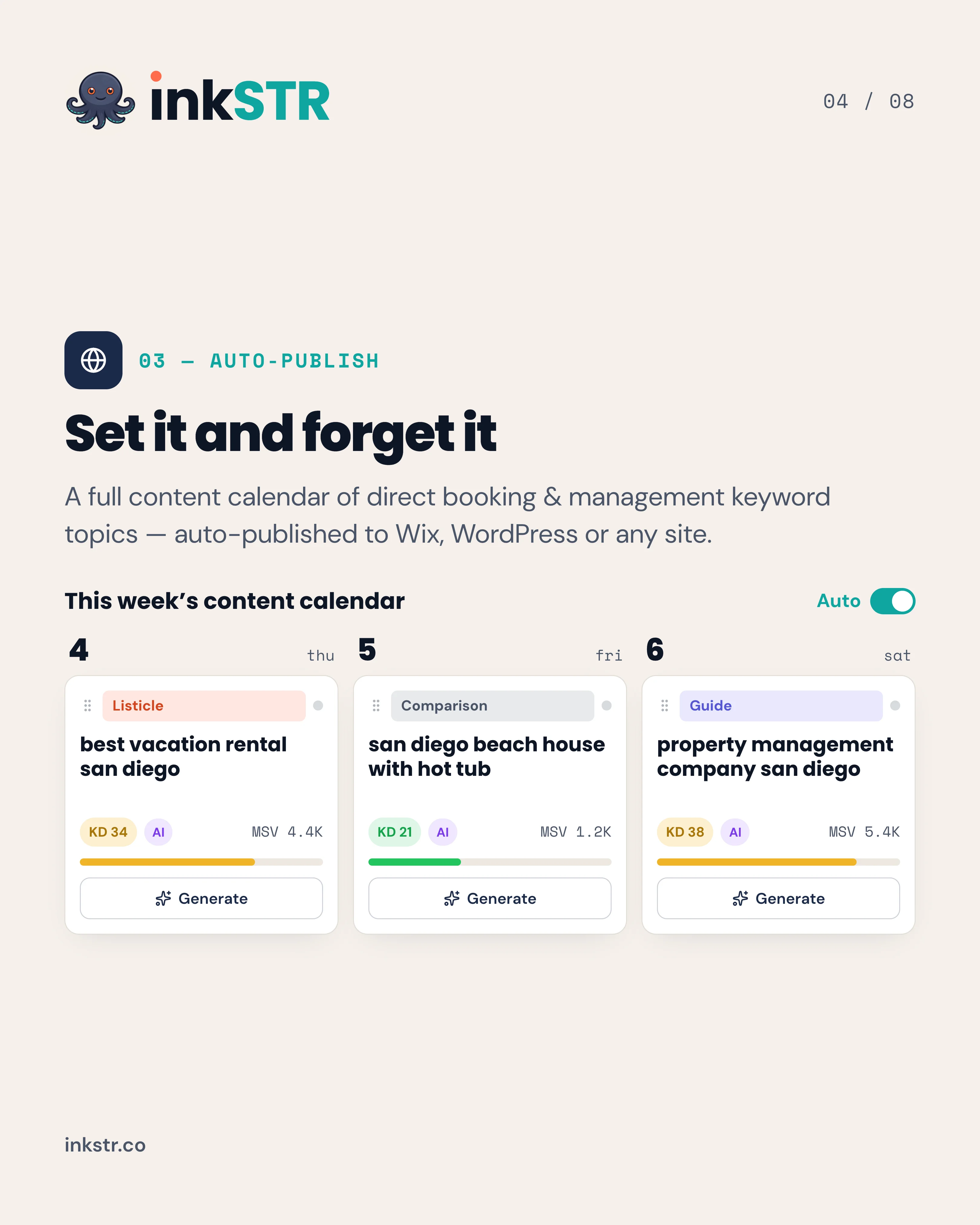
- The article gets slotted into a content calendar on a set publishing cadence, so output stays consistent instead of bursty.
- The post publishes automatically to your CMS through auto-publishing, no copy-paste, no manual formatting.
That's the exact pipeline we built inkSTR around. As of September 2026, articles published across inkSTR customer sites have crossed 4,000, with over 2.6 million Google Search impressions across connected sites in the trailing 90 days alone. Our team regularly hears the same objection from new operators: "I don't trust AI to publish without me checking it." That's a fair instinct, which is why quality scoring and pre-publish validation exist as a checkpoint, not an afterthought. See the full mechanics on how inkSTR works end to end.
What Is Replacing Blogging for Vacation Rental Marketing in 2026?
Nothing is fully replacing blogging in 2026, but the format is evolving alongside it: short video and AI-search-optimized answer content are supplementing traditional posts rather than replacing them. The underlying need, ranking for booking-intent search terms, hasn't gone away. The delivery format is just diversifying.
What's actually changing is where content gets consumed. AI referral traffic to websites grew sharply year over year, meaning more travelers now discover properties through an AI assistant's answer before they ever hit a search results page. That shift rewards content built for extraction: clear definitions and direct answers, exactly the format AI systems favor when choosing what to cite.
It also means the operators who think blogging is "over" are usually the ones who never adapted their format. A blog post written as a rambling narrative doesn't get cited by AI search engines. A blog post structured with answer-first paragraphs, comparison tables, and FAQ sections does. That's a content-structure problem, not proof blogging is dying.
Property managers we work with increasingly ask about a related concern: how do they compete with larger management companies that already dominate page one for their market's core keywords? The honest answer is that consistent, well-structured content is still the most reliable lever, because larger competitors rarely publish as frequently as their site size suggests. We break down that specific competitive dynamic in our guide to ranking your vacation rental website on Google. inkSTR's keyword research tool is built to surface exactly the gaps bigger competitors leave open in a given market.
Why Is My Vacation Rental Not Getting Direct Bookings From My Blog?
Your vacation rental blog isn't driving direct bookings most commonly because of inconsistent publishing, generic topics that don't match booking intent, or a content strategy with no internal linking back to your booking page. Traffic without conversions is almost always a content-strategy problem, not a photography or pricing problem.
Consider what "inconsistent" looks like in practice: five posts published in January, then nothing until a burst in June, then silence again. Google and AI search systems reward publishing cadence and topical depth. A scattered schedule signals a low-priority site, and it ranks like one. Meanwhile, those platform fees stack up every month: Airbnb and VRBO host and guest fees combined typically run 17 to 19% of every booking. That's revenue you're handing over that a direct booking channel would keep.
Topic selection matters just as much as cadence. A post titled "Top 10 Things to Do Near Our Cabin" targets a traveler already deep in vacation-planning mode, but rarely one ready to book your specific property. Posts built around booking-intent keywords, like "pet-friendly cabin rentals with hot tub near [region]" or "how far in advance to book a lake house for summer," convert at a meaningfully higher rate because they match a searcher closer to the decision.
This is exactly the architecture problem inkSTR's content strategy wizard was designed to solve: it maps pillar, cluster, and conversion content around your specific property types and booking funnel, not generic destination topics. One of our management company clients in Charlotte and Lake Norman, North Carolina, started this exact approach at the end of April 2026 and had four property-owner leads arrive from AI search within the first month, with Google impressions running 4.6 times higher than the year prior within three months. If you want a deeper look at what to actually write about, our guide to vacation rental blog topics that drive bookings covers the specific angles that convert.
How Much Does It Cost to Write Blog Content Manually vs. Automate It?
Manual blog content typically costs $300 to $700 per article if you hire a freelance travel writer, plus 3 to 5 hours of your own time if you write it yourself. Automated blog writing software replaces that recurring per-article cost with a flat monthly subscription, often less than the price of a single freelance post.
Run the math on a realistic publishing schedule. If you want four articles a month, a modest cadence for competitive markets, freelance costs alone run $1,200 to $2,800 monthly before you factor in editing, formatting, and publishing time. Every month you delay consistent publishing is also a month a competitor's site compounds its own search authority instead.
Compare that to inkSTR, which starts at $99 a month, less than a single freelance article, and includes keyword research, drafting, scheduling, and publishing in that price. The ROI case gets stronger when you factor in what a single direct booking is worth. A single direct vacation rental booking typically generates $1,000 to $4,000 in revenue, and a ranking blog article can keep driving that kind of traffic for 2 to 5 years after it's published. One article that converts even a handful of direct bookings over its ranking lifespan can cover years of subscription cost many times over.
| Approach | Typical Cost | Time Investment | Consistency Risk |
|---|---|---|---|
| DIY manual writing | Your time only | 3-5 hours per article | High, easy to fall behind under operational demands |
| Freelance travel writer | $300-$700 per article | Editing and publishing still required | Moderate, depends on writer reliability |
| Automated blog writing software (inkSTR) | Starting at $99/month | Minimal, review and approve | Low, scheduled cadence runs automatically |
The strategies that increase direct bookings generally lean on one foundation: consistent, targeted content over time. Automation is what makes that consistency achievable for an operator without a marketing department.
Ready to automate your content marketing?
inkSTR handles keyword research, content strategy, article writing, and publishing, all on autopilot.
What Should You Look for When Choosing Automated Blog Writing Software?
Choosing automated blog writing software for a vacation rental business means evaluating publishing automation depth, quality control before publishing, CMS compatibility, and whether the pricing model scales with your portfolio instead of penalizing growth, on top of basic niche specificity. Most operators default to comparing price alone, which misses the factors that actually determine whether the content ranks.
Niche Specificity Over Generic Capability
A tool trained on general marketing content will produce technically correct but tonally wrong output for hospitality search intent. It won't naturally reference PMS platforms like Hospitable or OwnerRez, won't understand seasonal booking windows, and won't structure content around traveler decision stages. That mismatch shows up as lower rankings even when the writing itself reads fine.
Depth of Automation
Ask whether the tool only drafts, or whether it also handles scheduling and publishing. A tool that stops at the draft still leaves you doing the CMS work manually every time, which is where most manual workflows quietly break down.
Quality Control Before Publishing
This is the gap most reviews skip entirely: what happens between draft and publish? Auto-publishing without any quality check risks factual errors or thin content going live unreviewed. Look for a platform with built-in scoring or validation checkpoints before an article reaches your site, not just a fast draft-to-publish pipeline with no review layer.
CMS Compatibility
Confirm the platform publishes directly to your actual site, whether that's Wix or WordPress, without manual copy-paste. inkSTR's auto-publishing connects directly to Wix and WordPress specifically because those are the platforms most STR operators already run on.
Pricing That Scales With You, Not Against You
Watch for tools priced per-article that punish you for scaling up your publishing cadence just as it starts working. inkSTR's pricing is built to support a single property owner and a multi-property manager running independent content pipelines from the same dashboard, without forcing a switch to a different tool as your portfolio grows.

How Do You Measure Whether Automated Blog Content Is Actually Working?
You measure whether automated blog content works by tracking organic search impressions, click-through traffic, and direct bookings attributed to organic search over time, not just raw traffic volume. Traffic alone is a vanity metric if none of it converts into a reservation.
Start with Google Search Console for impressions and click data, since it shows exactly which queries are surfacing your content and how often people click through. Layer Google Analytics on top to track what those visitors do once they land, whether they browse your booking calendar or bounce immediately.
The results we've measured directly illustrate what real trajectories look like. A Smoky Mountains cabin management client saw monthly Google Search clicks grow from 788 to 5,195 over 11 months, with monthly impressions rising from 130,000 to 450,000 over the same period. That growth translated to $309,775 in attributed direct booking revenue in the first 14 months, measured directly in Google Search Console and Google Analytics, not estimated. Another client, a five-market luxury cabin brand, saw monthly GSC clicks rise from 290 to 1,706 between May and July 2026 alone, with 5,939 distinct queries ranking and over $2,500 in commission-free direct booking revenue in the first four months.
Those numbers didn't come from a single viral post. They came from sustained monthly publishing against a real keyword strategy, tracked consistently. If you're not already tracking impressions-to-clicks-to-bookings as a funnel, start there before investing further in any content strategy, automated or manual.
What Mistakes Should You Avoid With Automated Blog Content?
The most common mistake operators make with automated blog content is publishing without any quality review, treating automation as fully hands-off rather than as a system you oversee. A close second is picking generic, low-intent topics simply because a tool generated them, without checking whether they match what your actual guests search for.
- Skipping quality checks before publishing. Even the best automated system benefits from a quick human review pass, especially for property-specific facts. Choose a platform with built-in validation, not one that publishes drafts unchecked.
- Chasing generic destination topics instead of booking-intent keywords. "Things to do near us" rarely converts. Pillar-and-cluster content built around search terms travelers use when they're ready to book performs measurably better.
- Publishing inconsistently. A burst of ten posts followed by three months of silence signals low priority to search engines. A steady cadence, even a modest one, consistently outperforms sporadic bursts.
- Ignoring internal linking back to booking pages. Content that doesn't link toward your direct booking pages or property listings leaves conversion potential on the table.
- Treating every property the same. A cabin in a mountain market and an urban apartment listing have different guest search behavior. Content built for one rarely transfers cleanly to the other without adjustment.
We built quality scoring and pre-publish validation into inkSTR's content engine directly because of the first mistake on this list. It's the single most avoidable failure point in any automated content pipeline, and it's also the one most competing tools skip entirely.
Frequently Asked Questions
How long does it take for a vacation rental website to rank on Google?
Most sites see meaningful traffic gains within 3 to 6 months of consistent publishing, though this varies by market competitiveness and existing domain authority. Sites that publish sporadically or stop after a few months typically stall out before compounding gains appear.
Do I need a blog if I already have a direct booking website?
Yes. A direct booking website without a blog has no ongoing mechanism to rank for new search terms; it's a static page competing against constantly updated competitor sites. A blog is what lets your direct booking site keep gaining search visibility over time instead of plateauing.
Can AI-generated content actually rank on Google and get cited in AI search results?
Yes, when it's structured properly. Answer-first paragraphs, clear headings, and factual accuracy matter more than whether a human or AI drafted it. Across inkSTR customer sites, we've secured over 1,184 verified AI-search citations as of September 2026, which shows this format works when built specifically for extraction.
How often should I publish new blog content for my vacation rental site?
Consistency matters more than raw frequency; a steady schedule of even two to four posts a month outperforms sporadic bursts of ten posts followed by months of silence. What matters most is that the cadence never stops once it starts, since search engines reward sustained publishing patterns.
What's the difference between SEO for a single listing and SEO for a property management company?
A single listing's SEO focuses on one property's specific amenities and location keywords. A management company needs content architecture across many properties plus owner-acquisition content aimed at prospective property owners, not just guests. inkSTR's multi-project support runs independent content pipelines for each property or brand from a single dashboard.
Is content marketing worth it for a small, independent vacation rental host?
Yes, arguably more so than for large management companies, because a single well-ranking article can offset years of platform fees on just a few converted bookings. A direct booking is typically worth $1,000 to $4,000 in revenue, and a ranking article can keep driving that traffic for 2 to 5 years.
What should a vacation rental blog post actually include to convert readers into bookings?
A converting post answers a specific booking-intent question, includes internal links back to your booking page or property listings, and avoids generic destination filler. We cover the specific structure that converts in our guide to creating content for Airbnb hosts.
How do I get more direct bookings without relying on Airbnb or VRBO traffic?
Building an independent search presence through consistent, booking-intent blog content is the most sustainable path, since it captures travelers before they ever open Airbnb or VRBO. That's the entire premise behind vacation rental booking strategies that reduce platform dependency over time.
Conclusion
Automated blog writing software solves a real, specific problem for STR operators: consistent, search-optimized content without the 3-5 hours per article or $300-$700 per post that manual production demands. The tools that work for this niche are the ones built around hospitality search intent from the ground up, not general-purpose writers stretched to fit a market they weren't designed for.
Heading into the rest of 2026, the operators pulling ahead in search aren't necessarily writing more content than everyone else. They're publishing consistently, targeting booking-intent keywords instead of generic destination topics, and structuring every post so it can be cited by both Google and AI search assistants. That's a system, not a one-time effort.
If keeping up with keyword research and blog publishing across your properties feels impossible right now, that's exactly the gap Get started with inkSTR was built to close, from the first keyword to a published, scheduled article on your own site. See your custom content plan with a free trial.
Content powered by inkSTR.co
Enjoyed this article? Share it:
Get more of inkSTR in Google Search
Add inkstr.co as a preferred source and our articles show up more in Top Stories, AI Overviews, and AI Mode — with a “Preferred” badge.
Get more guides like this
New SEO and AI-search guides, straight to your inbox. No spam, unsubscribe anytime.