How to Automate Blog Posts as a Property Manager

Automating blog posts as a property manager means using AI content platforms to research keywords, draft articles, and publish them on a schedule, without a human writer producing every word from scratch. For short-term rental operators, the right automation setup can turn a neglected blog into a consistent traffic source in the time it used to take to write a single post manually.
- Manual blog writing costs $300 to $700 per post when outsourced to a freelance travel writer, and 3 to 5 hours of research and drafting time when done in-house.
- Airbnb and VRBO fees run 17 to 19% of every booking, which is the ongoing cost of not having a direct booking channel that ranks on Google.
- A single direct booking is typically worth $1,000 to $4,000 in revenue, making blog content one of the few marketing channels with a clear, calculable payoff.
- A ranking blog article can drive organic traffic for 2 to 5 years after publication, unlike a paid ad that stops working the moment you stop paying.
- Property management companies managing 15-plus properties often lose entire workdays to manual content updates across listings, with no dedicated writer to own the process.
- inkSTR automates the full pipeline, generating, scheduling, and publishing keyword-targeted articles so property managers get consistent content without hiring a writer or blocking off hours every week.
If you manage vacation rentals, you already know the blog on your website has been sitting untouched since sometime last year. Maybe longer. You know content matters for search visibility. But between guest messages, turnover scheduling, and pricing adjustments, sitting down to write 2,000 words about your market rarely makes the priority list.
This is exactly the problem we built inkSTR to solve. We work with short-term rental operators and property management companies across the country, and the pattern is consistent: the businesses generating steady direct booking inquiries are the ones publishing content on a schedule, not the ones with the best-designed website. Design gets you a nice-looking site. Content gets you found.
In 2026, the gap between operators who automate content production and those who don't is widening fast, especially as AI search engines like ChatGPT and Google AI Overviews start pulling answers directly from well-structured blog content. This article walks through exactly how property managers can automate blog posts without ending up with generic, unusable copy, including where automation genuinely works and where it still needs a human eye.
What Does It Mean to Automate Blog Posts as a Property Manager?
Automating blog posts means using software to handle the repetitive parts of content production, keyword research, drafting, formatting, scheduling, and publishing, so a property manager isn't manually writing and posting every article by hand. As of 2026, the most effective tools combine AI writing with hospitality-specific keyword targeting rather than generic content templates.
For a property manager overseeing multiple listings, the manual alternative looks like this: research keywords in a spreadsheet, draft an article in a word processor, format it for the CMS, find or create images, schedule a publish date, and repeat for every property in the portfolio. Each cycle eats 3 to 5 hours, according to industry time-investment data on blogging. Multiply that by 15 or more properties and you've lost your entire week to content instead of running the business.
Full automation removes the manual steps but keeps the strategic decisions where they belong: with the operator. inkSTR's AI Content Writer generates SEO-optimized drafts based on keyword research specific to short-term rental search intent, not generic blog templates built for unrelated industries. That distinction matters more than most operators realize when they first start comparing tools.
Why Is Manual Blog Writing Failing Most Property Managers?
Manual blog writing fails at scale because it depends entirely on one person's available time, and that time is the first thing to disappear during peak booking season. Most property managers start strong with a blog, publish two or three posts, then stop once guest turnover and maintenance calls pile up.
This isn't a discipline problem. It's a bandwidth problem. Writing one quality blog post manually takes 3 to 5 hours of research and drafting. If you're managing a portfolio instead of a single listing, you need that output multiplied across every property, each with its own local market, amenities, and target guest profile. Hiring it out doesn't necessarily solve the problem either: a freelance travel writer typically charges $300 to $700 per post, and most freelancers don't understand short-term rental search intent or OTA-versus-direct-booking dynamics without significant onboarding. We've seen management companies try a rotating cast of freelancers to keep costs down, only to end up with inconsistent voice, inconsistent quality, and inconsistent publishing, which is worse for search rankings than publishing nothing at all.
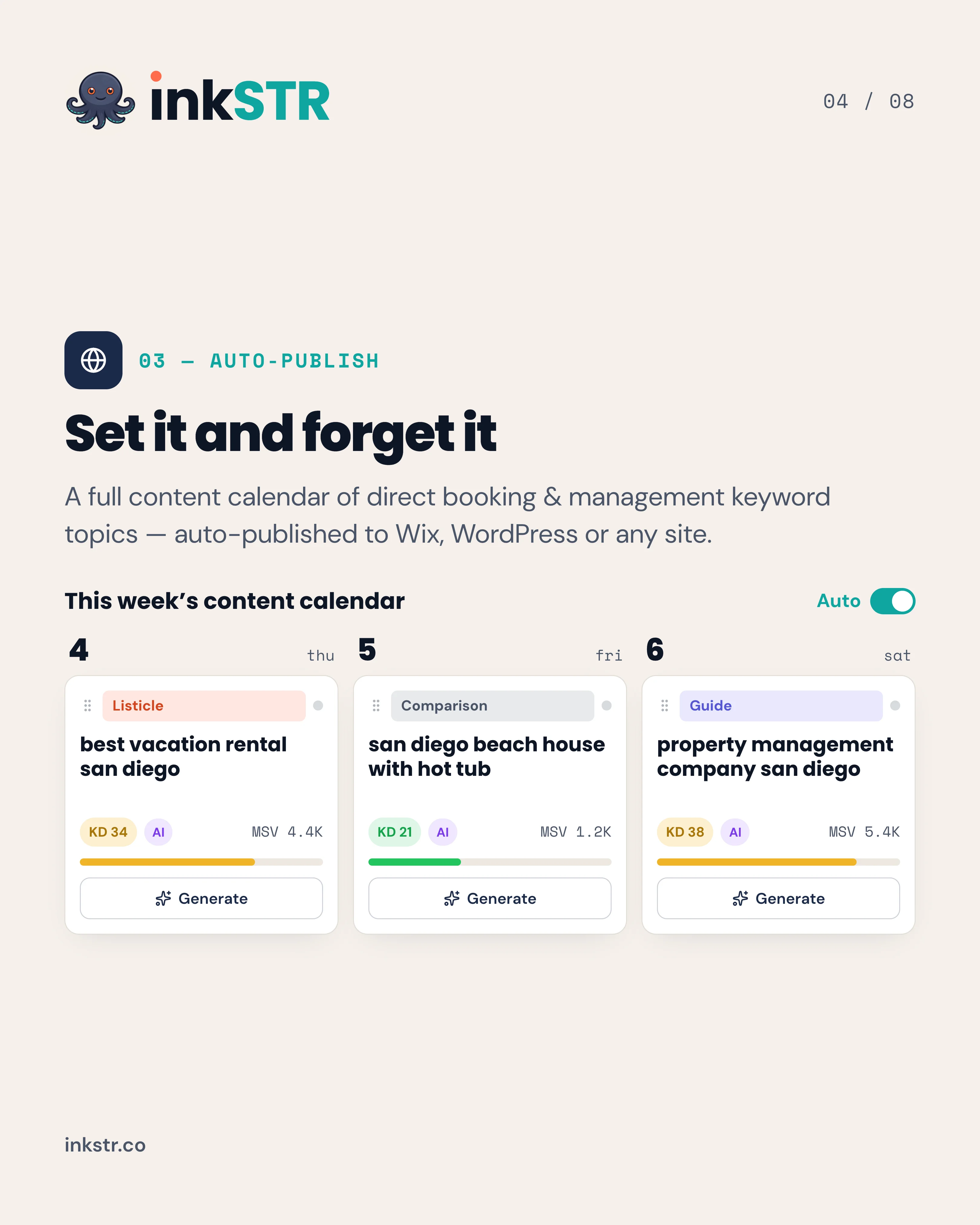
That inconsistency is precisely what inkSTR's Content Calendar was built to eliminate. Instead of depending on whoever has free time this week, the calendar schedules and manages blog publishing automatically, so your content cadence doesn't collapse the moment your operations team gets busy. A consistent publishing schedule is one of the clearest signals we've seen correlate with organic traffic growth over a multi-month period.
Can AI Actually Write Good Blog Content for a Vacation Rental Business?
Yes, AI can produce publishable, search-ranking blog content for vacation rental businesses, provided the AI model is trained on hospitality-specific language and paired with real keyword research, not generic prompt templates. The quality gap between generic AI content and niche-specific AI content is significant, and it's the single biggest factor determining whether AI-written posts actually rank.
Generic AI writing tools produce copy that reads like it could describe any business in any industry. That's the tell readers and search engines both pick up on. A vacation rental blog post that never mentions occupancy trends, guest search behavior, or location-specific travel patterns reads as thin, and thin content underperforms in Google's ranking algorithm as well as in AI Overview citations. inkSTR's content engine is built specifically for short-term rental terminology: it understands the difference between a beach town booking pattern and a mountain retreat's seasonal demand, and it writes accordingly. That's a structural advantage generic AI writing assistants don't have, because they weren't built for this niche in the first place.
We're not going to pretend AI content requires zero human oversight, because it doesn't. Every article inkSTR generates passes through quality scoring before publication, and we still recommend a quick operator review before the first few posts go live, mainly to confirm your property's voice and specific amenities are represented accurately. Once that calibration happens, the drafts require minimal editing going forward.
How Do You Automate Keyword Research for a Vacation Rental Blog?
Automating keyword research means using software to identify what your target guests are actually typing into Google, rather than guessing at topics based on assumption. For property managers, this typically means combining destination-specific terms (like "cabin rental near Gatlinburg") with intent-specific modifiers (like "pet friendly" or "with hot tub").
Doing this manually requires cross-referencing search volume tools, checking competitor rankings, and mapping terms to buyer intent, a process that easily eats an afternoon per property before you've written a single word. Tools like Ubersuggest or SEMRush can surface volume data, but you still need to manually translate that data into a content calendar, which is where most operators lose momentum. inkSTR's Keyword Research feature finds the specific terms your target guests search, mapped directly to your market and property type, then feeds those keywords into the content pipeline automatically. You're not exporting spreadsheets between tools. The research becomes the article.
If you want a deeper breakdown of how search visibility actually works for STR websites specifically (not generic SEO advice repurposed from other industries), our guide on ranking on Google for STR-specific factors covers the ranking signals that matter most in 2026.
How Do You Automate Publishing Across Multiple Vacation Rental Properties?
Automating publishing across multiple properties means running separate, independent content pipelines for each listing or brand, so keywords, voice, and scheduling don't get tangled together. This is one of the biggest operational headaches for portfolio-level property managers, and it's rarely solved by generic content tools built for a single website.
Without automation, managing content across 15 or more properties means juggling separate spreadsheets, separate login credentials, and separate publishing schedules for each listing, often across different platforms like Wix and WordPress. One missed deadline and your content calendar falls out of sync across the whole portfolio. We've talked with management companies where an entire quarter of planned content simply never got published because no single person owned the coordination. That's an expensive gap. A ranking blog article can drive organic search traffic for 2 to 5 years, so every quarter without publishing is a quarter of compounding traffic you never build.
inkSTR's Auto-Publishing feature connects directly to Wix, WordPress, or your custom website and pushes content live without manual upload steps. Combined with independent content pipelines per property, a management company running ten listings can maintain ten distinct publishing schedules without ten separate manual workflows. That structural separation is what keeps voice and strategy from bleeding together across properties with very different guest profiles.
What Should Property Managers Blog About to Drive Direct Bookings?
The blog topics that drive direct bookings for property managers combine destination-specific guest questions with property-specific selling points, not generic travel content that could apply to any rental anywhere. Local area guides, seasonal booking guides, and amenity-focused comparison posts consistently outperform generic "things to do" listicles because they match actual guest search intent.
Most property managers default to generic travel writing because it feels safe: "Top 10 Things to Do in [City]." The problem is that generic version competes against tourism boards, travel bloggers, and every other rental in the market writing the exact same post. Specific content, built around your actual guest questions (booking windows, pet policies, group size logistics, neighborhood comparisons) has far less competition and converts better because it answers the exact question a warm lead is typing into Google.
Our piece on vacation rental blog topics that actually drive bookings breaks down specific formats that convert, and local area guides that sell covers the structure we recommend for destination content specifically. If you're still deciding what to blog about first, inkSTR's content strategy wizard maps out a pillar-and-cluster architecture for your market automatically, so you're not guessing at topic priority. That's a meaningfully different starting point than staring at a blank content calendar wondering where to begin.

Is It Worth Paying for a Blog Automation Tool Instead of a Freelancer?
Paying for a blog automation platform is generally worth it for property managers who need ongoing, consistent content, since the monthly cost typically falls well below a single freelance post while producing far more volume. A freelance travel writer charges $300 to $700 per quality blog post, meaning a modest four-post monthly schedule alone could cost $1,200 to $2,800 every month.
Compare that to inkSTR's Pricing, which starts at $99 per month for the full pipeline: keyword research, drafting, scheduling, and publishing. The freelancer model also carries a hidden cost most operators don't factor in: onboarding time. Every new freelancer needs to be trained on your brand voice, your property specifics, and short-term rental terminology before their first draft is usable, and that ramp-up repeats every time you change writers.
We're not arguing freelancers can't produce great work; some do. But sustainability is the real issue. A freelancer's availability, pricing, and quality fluctuate. A platform's output doesn't. If your goal is 12 to 20 published articles to start seeing meaningful ranking movement (a range widely referenced in vacation rental SEO circles), the math strongly favors automation over per-post freelance spend, particularly for portfolios managing multiple listings simultaneously.
Ready to automate your content marketing?
inkSTR handles keyword research, content strategy, article writing, and publishing, all on autopilot.
What Is the Real ROI of Automating Blog Content for Property Managers?
The ROI of automated blog content comes from compounding organic traffic that reduces reliance on OTA commissions over time, not from any single post generating an immediate spike in bookings. A ranking article can drive traffic for 2 to 5 years after it's published, which means the cost of producing it gets amortized across years of visibility, not a single month.
Here's the calculation that matters most: Airbnb and VRBO combined fees run 17 to 19% of every booking. A single direct booking is typically worth $1,000 to $4,000 in revenue. If a blog article drives even a handful of direct bookings over its multi-year lifespan, and each of those bookings avoids the OTA fee structure entirely, the content has already paid for itself many times over relative to a $99 monthly platform cost. This is the math we walk operators through constantly: content isn't a marketing expense, it's a fee-avoidance mechanism with a long shelf life.
| Approach | Cost | Output Volume | Consistency |
|---|---|---|---|
| In-house manual writing | 3 to 5 hrs per post (opportunity cost) | Low, sporadic | Depends entirely on available time |
| Freelance travel writer | $300 to $700 per post | Limited by budget | Depends on freelancer availability |
| inkSTR automation | Starting at $99/month | Consistent, scheduled | Runs on a fixed publishing calendar |
For a deeper look at how content marketing pays off across a full booking funnel, our article on revenue maximization for hosts covers the counterintuitive strategies that move the needle beyond just blog volume.
How Do You Compete With Big Property Management Companies in Search Results?
Competing with larger property management companies in Google search results requires narrower keyword targeting and more specific, locally detailed content than what big-budget competitors typically publish. Larger firms often rely on paid acquisition and broad brand terms, leaving long-tail, hyper-specific search queries underserved, which is exactly where smaller operators can win.
Big management companies with in-house marketing teams and agency budgets tend to publish generic, high-level content aimed at broad awareness. That leaves an opening: specific neighborhood comparisons, specific amenity combinations, specific seasonal booking windows. A guest searching "3 bedroom cabin with hot tub near the Smokies for a family reunion in October" is a far more qualified lead than one searching "cabin rentals Tennessee," and that longer query has dramatically less competition. Consistency also matters more than budget here. A smaller operator publishing two to four targeted articles a month, every month, will often outrank a larger competitor who publishes sporadically, because Google and AI search engines both reward sustained, structured publishing over one-off content bursts.
This is where automation becomes a genuine competitive equalizer rather than a nice-to-have. inkSTR gives independent operators and small management companies the same publishing consistency that larger firms achieve with full marketing teams, without needing to hire one. If you're curious why your site specifically isn't showing up despite having some content already published, our diagnostic piece on why your vacation rental website is not ranking on Google walks through the most common technical and content gaps we see.
How Do You Maintain Brand Voice When Automating Content Across Properties?
Maintaining brand voice across automated content requires keeping separate content pipelines and voice guidelines for each property or brand, rather than running every listing through one shared template. Without that separation, automated content risks sounding identical across properties that should feel distinct, which undermines the differentiation guests actually respond to. A boutique cabin cluster shouldn't read the same as an urban apartment portfolio, even if both are managed by the same company. The guest expectations, price points, and booking motivations are entirely different, and generic automation tools that weren't built for this niche often flatten that distinction into one bland voice. inkSTR's multi-project architecture keeps each property's content pipeline independent, so a beach town listing and a mountain retreat listing under the same management company don't end up sounding interchangeable. For a full walkthrough of how we approach voice preservation at scale, our guide on article automation without losing your brand voice goes deeper into the specific workflow.
Practical Steps to Start Automating Your Blog Without Sacrificing Quality
Getting started with blog automation works best as a phased rollout rather than flipping every property to autopilot on day one. The following sequence reflects what we've seen work most reliably across property management clients:
- Audit your existing content first. Identify what's already published, what's ranking, and what's outdated before adding new posts on top of a broken foundation.
- Run keyword research per property, not per portfolio. A beach condo and a mountain cabin under the same company need entirely different keyword maps.
- Set a realistic publishing cadence. Two to four posts monthly, sustained consistently, outperforms an aggressive burst that stops after two months.
- Review the first several AI-generated drafts closely. Confirm property details, amenities, and voice are accurate before shifting to a lighter review process.
- Track performance through Google Search Console integration. Watch which keywords are gaining traction and adjust the content calendar accordingly.
- Separate pipelines for each property or brand if you're managing a multi-property portfolio, to avoid voice bleed between distinct listings.
Common mistakes we see: publishing inconsistently after an initial burst of enthusiasm, targeting keywords with no realistic guest intent behind them, and skipping the review step entirely on the first few automated posts. Automation removes the manual labor, not the strategic oversight, at least not until your voice calibration is fully dialed in.
Frequently Asked Questions
How long does it take for automated blog content to start ranking on Google?
Most vacation rental websites begin showing meaningful ranking movement after 12 to 20 published articles targeting a mix of destination and long-tail booking keywords. inkSTR's content calendar automates the scheduling needed to hit that volume without manually tracking every publish date.
Do I need a separate blog for each property I manage?
Not necessarily a separate blog, but you do need separate content strategies and keyword maps if your properties serve different markets or guest types. inkSTR's multi-project architecture keeps each property's content pipeline independent even when everything publishes to one shared website.
Can AI-generated content actually rank for competitive vacation rental keywords?
Yes, provided the content is built around real keyword research and hospitality-specific language rather than generic templates. Thin, generic AI content underperforms regardless of the tool used, which is why niche-specific training matters more than raw AI horsepower.
How many blog posts should a property management company publish per month?
Two to four posts monthly, published consistently, is a sustainable cadence that most operators can maintain without burning out. Consistency over time matters more than publishing volume in any single month.
What is the difference between optimizing a direct booking blog and optimizing an Airbnb listing?
An Airbnb listing is optimized for Airbnb's internal search algorithm, which prioritizes response rate, reviews, and booking history within the platform itself. A direct booking blog is optimized for Google and AI search engines, which reward keyword relevance, content depth, and consistent publishing on your own website.
Is it worth automating blog content if my property is already in a heavily trafficked tourist market?
Yes, because heavy tourist traffic usually means heavier search competition too, and generic content gets buried fast in competitive markets. Specific, long-tail content focused on your exact property type and guest niche still finds an opening even in saturated destinations.
What happens if I stop publishing blog content after a few months?
Traffic gains from published articles don't disappear immediately, since a ranking article can hold visibility for 2 to 5 years, but new keyword opportunities stop being captured. Consistent publishing compounds; stopping just caps the growth curve where it stood.
Conclusion: Automating Blog Content Is a System, Not a One-Time Project
Automating blog posts as a property manager comes down to removing the manual bottleneck, research, drafting, scheduling, and publishing, while keeping strategic decisions about voice and property positioning in your hands. The operators who reduce their dependence on Airbnb and VRBO fees aren't the ones who got lucky with one viral post. They're the ones who built a publishing system and kept it running. If you take one thing from this article: start with a realistic, sustainable cadence rather than an ambitious burst you can't maintain past month two. If you want that system running without doing every piece manually, inkSTR handles the content pipeline, from keyword research to published article, so you can focus on running the properties that actually generate revenue.

If keeping a publishing schedule consistent across your portfolio is the piece you keep putting off, get started with inkSTR and see the content calendar handle scheduling and publishing on autopilot, starting at $99 a month.
Content powered by inkSTR.co
Enjoyed this article? Share it:
Get more of inkSTR in Google Search
Add inkstr.co as a preferred source and our articles show up more in Top Stories, AI Overviews, and AI Mode — with a “Preferred” badge.
Get more guides like this
New SEO and AI-search guides, straight to your inbox. No spam, unsubscribe anytime.