Blog Content Automation: What It Is and Why It Matters

Blog content automation is the use of AI tools to research keywords, draft articles, and publish them to your website on a set schedule, without a human writer producing each post from scratch. For short-term rental operators, it means your direct booking site keeps publishing SEO-optimized content every week even when you're fully booked, mid-turnover, or handling a guest issue at 11pm.
- Blog content automation combines keyword research, AI drafting, and scheduled publishing into one workflow, replacing the manual research-write-publish cycle that takes most operators 3 to 5 hours per post.
- Industry-wide, roughly 80% of bloggers now use AI tools somewhere in their workflow, and AI-assisted posts have been shown to reduce production time from around 8 hours to under 3 hours per article.
- A freelance travel writer typically charges $300 to $700 per quality blog post, a cost that scales painfully fast once you're publishing for multiple properties or a growing portfolio.
- Airbnb and VRBO combined host and guest fees run 17 to 19% per booking, which makes every direct booking driven by organic content worth protecting and repeating.
- A single ranking blog article can drive organic traffic for 2 to 5 years, meaning automation isn't just about saving time today, it's about building a compounding asset.
- inkSTR automates the entire pipeline, keyword research to published article, specifically for short-term rental operators, so your content engine runs whether or not you have an hour to spare this week.
If you manage a vacation rental, a small portfolio, or a property management company website, you've probably heard that "content marketing" is supposed to drive direct bookings. Most operators try it for a month, publish two or three posts, and then life gets in the way. The blog goes quiet. Meanwhile, competitors with a consistent publishing habit keep climbing past you in Google.
Blog content automation exists to solve exactly that failure point. In 2026, the gap between operators who publish consistently and those who don't is wider than ever, because Google and AI assistants like ChatGPT and Perplexity both reward sites with a steady, current stream of relevant content. inkSTR was built around this exact problem: we've watched hundreds of STR operators start strong on content and quietly abandon it within 90 days, not because the strategy failed, but because there was no system keeping it alive.
This guide breaks down what blog content automation actually involves, what it can and can't do for a vacation rental business, and how to think about the trade-off between manual writing, hiring a freelancer, and running the whole thing on autopilot.
What Is Blog Content Automation, Exactly?
Blog content automation is a system that uses AI and scheduling software to handle keyword research, article drafting, formatting, and publishing without manual intervention at each step. Instead of a person opening a blank document, researching a topic, writing for hours, and manually uploading to WordPress, an automated pipeline does all of it on a recurring schedule.
For short-term rental operators specifically, this usually means the tool understands vacation rental search intent: things like "pet friendly cabin near Gatlinburg" or "beachfront condo with pool Gulf Shores" rather than generic blog topics. Most general-purpose content platforms don't have this context built in, so the output reads like it was written for any business, not a vacation rental.
Notably, over 60% of high-ranking travel content now aligns with informational or navigational search intent rather than purely transactional queries, according to industry SEO analysis. That means guests are searching for guides, comparisons, and area information long before they book, and a blog that only talks about your property misses most of that traffic.
inkSTR's AI Content Writer generates full SEO-optimized posts built specifically around this kind of traveler intent, structured to answer the question a guest is actually typing into Google before they ever see your listing.
Why Does Manual Blogging Fail for Most Vacation Rental Operators?
Manual blogging fails for most vacation rental operators because writing one quality post takes 3 to 5 hours of research and drafting, a time cost that's nearly impossible to sustain alongside guest turnovers, cleaning coordination, and pricing adjustments. The result is a blog with three posts from 2026 and nothing since.
We see this pattern constantly. An operator gets motivated, writes two strong posts about local attractions, feels good about it, and then the next guest cancellation or maintenance emergency eats the week. By the time they think about the blog again, a month has passed. Search engines notice. Consistency, not brilliance, is what Google rewards over time.
The freelance alternative isn't much better financially. A freelance travel writer typically charges $300 to $700 per post. Publish twice a month and you're looking at $600 to $1,400 monthly, before you've verified whether that writer understands vacation rental SEO or is just producing generic travel copy that reads like every other blog in your market.
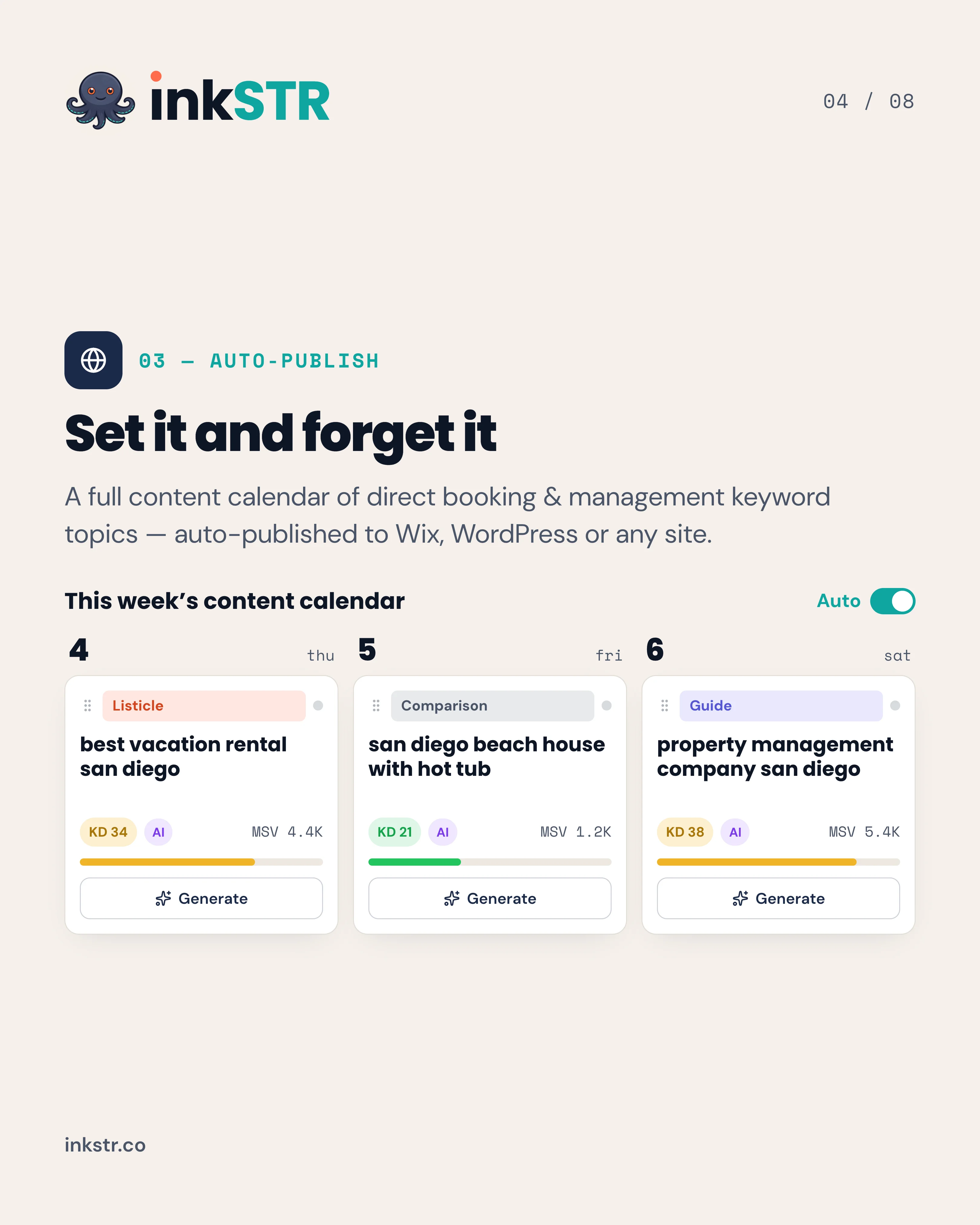
This is precisely the gap how inkSTR works was designed to close: a repeatable pipeline that removes the "when do I have time" question entirely. The Content Calendar schedules posts automatically so your publishing cadence never depends on how busy your week happens to be.
How Do You Automate a Blog Publishing Workflow?
Automating a blog publishing workflow means connecting four stages, keyword research, drafting, formatting, and publishing, into one continuous system rather than four separate manual tasks. Most operators who try to DIY this stitch together spreadsheets, a writing tool, and manual CMS uploads, which breaks down fast.
Here's the realistic sequence:
- Keyword identification. First, identify what your target guests actually search, not just what you assume they search. Generic terms like "vacation rental" are nearly impossible to rank for; long-tail phrases tied to your specific market and amenities convert far better.
- Content planning. Map topics to a pillar and cluster structure so your site builds topical authority around your destination, not a random assortment of unrelated posts.
- Drafting. Generate the article with SEO structure already built in: question-based headings, proper word count, internal linking opportunities.
- Publishing. Push the finished post live on a schedule, formatted correctly for your CMS, with images and metadata attached.
Doing this manually across even 10 posts a month means juggling separate tools for each stage, and most solo operators give up somewhere around stage two. This is the exact workflow inkSTR consolidates: the Keyword Research feature identifies what your target guests are actually searching, and the Auto-Publishing feature pushes finished articles directly to Wix, WordPress, or your custom site without you touching a CMS dashboard.
What Does Blog Content Automation Actually Cost Compared to Manual Writing?
Blog content automation typically costs a fraction of hiring a freelance writer for the same publishing volume, because the pricing is subscription-based rather than per-article. inkSTR, for example, is priced at $99 per month, covering unlimited scheduled articles rather than paying $300 to $700 per individual post.
Run the math on a modest publishing cadence. Two posts a month from a freelancer runs $600 to $1,400 monthly. Four posts a month, which is closer to what actually moves rankings, runs $1,200 to $2,800 monthly. Compare that to a flat $99/month subscription, and the freelance route costs 6 to 28 times more depending on volume and writer rates.
| Approach | Cost per Month (4 posts) | Time Required | Consistency Risk |
|---|---|---|---|
| Writing it yourself | $0 cash, 12 to 20 hours of your time | Very high | High: first thing dropped when busy |
| Freelance writer | $1,200 to $2,800 | Low for you, but requires oversight | Medium: depends on writer reliability |
| Blog content automation (inkSTR) | $99 flat | Minutes for review and approval | Low: scheduled and automated |
Industry research from Moonrank notes that the best SEO automation software now replaces agency retainers of $3,000 or more per month with tools costing under $100/month, a shift that's changed what small operators can realistically afford to compete with property management companies that have marketing budgets.
The financial case gets stronger once you factor in booking value. A single direct vacation rental booking is typically worth $1,000 to $4,000 in revenue. If automated content drives even one additional direct booking a month that you'd otherwise have lost to OTA search, the subscription pays for itself many times over.
What Types of Content Can You Actually Automate?
You can automate nearly every stage of blog content production: topic planning, keyword research, drafting, SEO formatting, image selection, internal linking, and scheduled publishing. What you generally should not fully automate is final review for accuracy on property-specific details and brand voice consistency.
Content types that automate especially well for vacation rental businesses include local area guides, seasonal activity roundups, "things to know before you visit" posts, comparison content between neighborhoods or property types, and FAQ-driven posts answering common guest questions. These formats follow predictable structures that AI handles cleanly.
Content that benefits from more human oversight includes anything referencing specific pricing, safety details, or property-unique claims, since accuracy matters more there than SEO structure. A good automation workflow builds in a review step, not zero human involvement, but far less than writing from scratch.
inkSTR's quality scoring runs every draft through a pre-publish check before it goes live, so you're reviewing a near-final article rather than a rough first draft. That review step typically takes minutes, not the hours a from-scratch draft demands. For a deeper look at keeping automated posts sounding like you instead of a generic bot, see our guide on article automation without losing your brand voice.
How Do You Audit Underperforming Automated Blog Content?
Auditing underperforming automated content means checking three things: whether the post targets a keyword with real search demand, whether it fully answers the search intent behind that keyword, and whether it's thin, meaning it lacks the depth Google's helpful content system rewards. Most competitor guides on this topic skip this step entirely, which is a mistake.
Start by pulling your published posts into Google Search Console and sorting by impressions with low click-through rate. A post with impressions but almost no clicks usually has a weak title or meta description, not a content problem. A post with neither impressions nor clicks usually targeted the wrong keyword from the start.
Next, check for thin content signals: posts under roughly 800 words on competitive topics, posts that read generically without specific market or property detail, and posts with no internal links connecting them to the rest of your site. These are the patterns search engines associate with automation done carelessly, not automation itself.
The fix isn't always a rewrite. Often it's expanding an existing post with more specific detail, adding internal links, and updating the publish date to signal freshness. inkSTR's Keyword Research tool resurfaces new keyword opportunities on existing topics automatically, so refreshing old posts becomes part of the ongoing workflow rather than a separate project you have to remember to do.
How Many Posts Per Week Can One Person Realistically Review?
One person can realistically review and approve roughly 5 to 10 automated blog drafts per week without sacrificing quality, assuming each review takes 10 to 20 minutes for accuracy and brand voice checks. Beyond that volume, review quality drops fast and errors slip through.
This matters because a common automation mistake is generating far more content than a single reviewer can actually check. Publishing 20 unreviewed posts a week might look productive, but if nobody catches a factual error about your check-in process or an outdated amenity list, you're risking guest trust for volume's sake.
For solo hosts, a realistic cadence is 2 to 4 posts a month, reviewed carefully, rather than a flood of unchecked content. For property management companies running multi-property pipelines, splitting review responsibility across a small team, or staggering publish dates across properties, keeps quality consistent as volume scales.
inkSTR's multi-project architecture keeps each property or brand on its own content pipeline, so a property manager overseeing 15 units isn't reviewing everything in one chaotic queue. Each property's schedule and voice stay separate, which makes the review workload predictable instead of overwhelming.

Ready to automate your content marketing?
inkSTR handles keyword research, content strategy, article writing, and publishing, all on autopilot.
What Are the Risks of Over-Automating Your Blog?
The main risk of over-automating a blog is publishing generic, low-specificity content that fails to differentiate your property and reads identically to hundreds of other listings in your market. Google's helpful content systems specifically penalize this pattern, and guests notice it too.
Over-automation shows up in a few recognizable ways: posts that never mention your specific location's actual weather patterns, seasonal events, or neighborhood character; posts stuffed with keywords in awkward phrasing; and content that contradicts itself because nobody checked it against your actual property details or booking policies.
Compliance matters here too. Various jurisdictions now expect transparency when AI-generated content makes up a substantial share of a site's material, and marketing regulations generally require truthful representation regardless of how content was produced. If your automated post claims an amenity you don't have, that's a guest trust problem and potentially a legal one.
The balance we recommend, and the one inkSTR's quality scoring is built around, is treating automation as the drafting engine and keeping a light human review layer on top. Full automation with zero oversight is where quality and trust break down. Automation with a fast review step is where the time savings actually pay off. For more on this, our piece on why generic travel content kills conversions covers the specificity problem in more depth.
How Does Blog Content Automation Help You Rank in Google and AI Search?
Blog content automation helps you rank in both Google and AI search engines like ChatGPT and Perplexity by maintaining the consistent publishing cadence and structural formatting that both systems reward. AI-powered blogs generate meaningfully more organic traffic on average compared to manually written ones, largely because consistency compounds over time.
Google's ranking systems favor sites that publish regularly and build topical depth around a subject, not one-off posts scattered across unrelated topics. AI assistants like ChatGPT and Perplexity pull answers from content structured with clear headings, direct answers, and specific named details, exactly the format automation tools can enforce consistently across every post.
This is a meaningfully different game than it was even two years ago. Ranking used to mean competing for a spot on a Google results page. Now it also means being the source an AI assistant cites when a traveler asks "what's a good pet-friendly cabin near the Smokies." Sites that never adapted their content structure for this shift are losing visibility they don't even realize they've lost.
inkSTR builds every generated article with this dual target in mind, structured for traditional ranking factors and for AI citation extraction simultaneously. If you want a deeper breakdown of this shift, read our guide on ranking in AI search for STR operators in 2026 or our companion piece on ranking on Google factors specific to STR sites.
Data Snapshot: What the Numbers Say About Automated Blogging in 2026
The data below reflects verified industry benchmarks relevant to blog content automation adoption and performance as of 2026. These figures give you a realistic sense of scale rather than isolated marketing claims.
| Metric | Figure |
|---|---|
| Bloggers currently using AI tools in their workflow | Around 80% |
| Time to produce one post, AI-assisted vs. manual | Roughly 2.7 hours vs. 8 hours |
| Traffic lift for AI-powered blogs vs. manual blogs | Approximately 40% more on average |
| Freelance travel writer cost per post | $300 to $700 |
| inkSTR monthly subscription cost | $99/month |
| Typical lifespan of a ranking blog article | 2 to 5 years of organic traffic |
Content based on genuine user search intent has roughly a 3x higher chance of ranking in the top 10 compared to content built purely from keyword tools without intent analysis, a distinction that matters enormously for vacation rental blogs competing against generic travel sites.
How Do You Choose the Right Blog Automation Approach for Your Portfolio Size?
The right blog automation approach depends primarily on how many properties or brands you're managing, since a single-property host has very different volume and voice needs than a company managing 20 units across three markets. Matching the tool to your scale prevents both under-publishing and unmanageable review backlogs.
For a single-property host, prioritize simplicity: one clear content calendar, 2 to 4 posts monthly, and a workflow that doesn't require you to learn complex settings. For a small portfolio of 2 to 5 properties, look for tools that let you separate content by property so each listing keeps its own voice and keyword targeting.
For property management companies handling 10-plus units, the priority shifts to scalability without losing quality: separate pipelines per property, integration with your existing property management system, and a review process that a small team can actually sustain. Trying to run this on spreadsheets and a general-purpose writing tool typically collapses once you pass 5 properties.
Common mistakes at this stage include publishing the same generic content across every property, ignoring keyword cannibalization between listings in the same market, and failing to track which posts actually convert readers into direct booking inquiries. inkSTR's multi-project support keeps each property's pipeline, keywords, and voice fully separate, which is exactly the structural fix portfolio operators need. Our related guide on must-have tools for short-term rental managers scaling up covers this in more operational detail.
Frequently Asked Questions About Blog Content Automation
Is blog content automation the same as AI-generated content?
Not exactly. AI-generated content refers to the writing itself, while blog content automation includes the entire pipeline: keyword research, scheduling, formatting, and publishing. A tool can generate AI content without automating the rest of the workflow, which is why many operators still end up manually uploading AI drafts to their CMS.
Will Google penalize automated blog content?
Google penalizes low-quality, thin, or unhelpful content regardless of whether it was written manually or with automation. The concern isn't the production method, it's whether the finished post genuinely answers a search query with specific, accurate detail. Automated content that goes through quality review before publishing performs the same as well-written manual content.
How long does it take for automated blog content to start ranking?
Most vacation rental websites see meaningful ranking movement after 12 to 20 published articles targeting a mix of destination and long-tail booking keywords, which typically takes 3 to 6 months of consistent publishing. inkSTR's content calendar automates that publishing volume so you reach that milestone on schedule rather than whenever you find time to write.
Can I automate blog content for multiple properties without them sounding identical?
Yes, provided your automation tool supports separate content pipelines per property. Without that separation, most tools default to generic templates that make every listing sound the same, which hurts both SEO (through keyword cannibalization) and guest trust. inkSTR's multi-project architecture keeps each property's voice, keywords, and schedule independent.
Do I still need to review automated blog posts before they publish?
Yes. Automation should handle research and drafting, but a quick human review catches property-specific inaccuracies and brand voice issues that AI can miss. Most reviews take 10 to 20 minutes per post, far less time than writing from scratch, and inkSTR's quality scoring flags issues before you even open the draft.
What's the difference between automating new posts and refreshing old ones?
Automating new posts means generating and scheduling fresh articles on new topics, while refreshing means updating existing published posts with new keyword opportunities, updated information, or expanded detail as search trends shift. Both matter: new posts build volume, refreshes protect rankings on posts that are starting to slip. inkSTR's keyword research surfaces new opportunities on existing topics automatically.
Is blog content automation worth it for a single-property Airbnb host?
Yes, particularly because a single direct booking is typically worth $1,000 to $4,000, and a $99/month subscription costs far less than either your own time or a freelancer charging $300 to $700 per post. Even a modest, consistent posting schedule compounds into meaningful organic traffic over a couple of years.
Can automated blog content actually drive direct bookings, not just traffic?
Yes, but only if the content is built around genuine guest search intent and includes clear paths to your direct booking page, not just informational value. Traffic without conversion intent is a common failure point; the fix is targeting long-tail, decision-stage keywords alongside broader destination content. Our guide on creating content for Airbnb hosts that books direct covers this distinction in detail.
Conclusion: Blog Content Automation Is a System, Not a Shortcut
Blog content automation is a system: consistent keyword targeting, structured drafting, and a publishing schedule that doesn't depend on how busy your week gets. The direct booking gains come from the compounding effect of that consistency, not from any single post going viral. A single ranking article can drive organic traffic for 2 to 5 years, which is the real return on the time you save by automating the process.
If you take one action from this guide, make it this: pick a realistic cadence you can sustain, whether that's 2 posts a month or 8, and commit to a review process that fits your actual available time. Consistency at a lower volume beats an ambitious plan that collapses after six weeks.
As of 2026, the operators pulling ahead in organic search and AI search visibility aren't the ones with the most polished individual posts, they're the ones who never stopped publishing. If you want that system running without doing every piece manually, inkSTR handles the content pipeline so you can focus on the properties that actually earn the revenue.

If keeping your blog updated is the task that keeps sliding to next week, inkSTR's Content Calendar puts your publishing schedule on autopilot so it stops depending on how much free time you have. Start your free trial at inkSTR.co and see your first automated draft this week.
Content powered by inkSTR.co
Enjoyed this article? Share it:
Get more of inkSTR in Google Search
Add inkstr.co as a preferred source and our articles show up more in Top Stories, AI Overviews, and AI Mode — with a “Preferred” badge.
Get more guides like this
New SEO and AI-search guides, straight to your inbox. No spam, unsubscribe anytime.