Why Is My Website Not Ranking Well? The Real Reasons

Your website is not ranking well most often because of one of four issues: pages are not properly indexed, the content does not match what searchers actually intend to find, the site lacks enough backlink authority to compete, or technical problems like slow load times are holding it back. For short-term rental sites, it is usually a combination of the first two.
- Indexing problems silently block ranking: pages marked noindex or blocked by robots.txt never appear in search results no matter how good the content is.
- Search intent mismatch is a top-cited ranking killer: content that does not match what the searcher wants will not rank even when it is technically well optimized.
- Crawling issues account for a meaningful share of ranking problems, with Google Search Console data showing 23% of ranking issues trace back to crawl problems site owners overlook.
- VRBO takes the top organic slot 24% of the time in vacation rental search markets, according to BuildUp Bookings, which shows how much authority OTAs already carry against independent sites.
- Content built around real user intent has a 3x higher chance of reaching the top 10 than content built purely from keyword tools, per 2026 data from Citedy.
- inkSTR fixes the recurring cause behind most STR site ranking failures, inconsistent, non-keyword-targeted publishing, by generating, scheduling, and publishing SEO-optimized articles automatically on a set schedule.
If you manage a vacation rental or a portfolio of properties and your direct booking site sits buried past page two, you are not alone, and it is rarely one single mistake. At inkSTR, we have looked at hundreds of STR websites that get almost no organic traffic despite having decent design and a real property to sell. The pattern repeats: either Google cannot find the pages, the content answers the wrong question, or there simply is not enough of it published consistently to build authority.
In 2026, ranking well requires clearing both the traditional Google algorithm and the newer AI Overview and LLM citation layer that increasingly filters what searchers see first. This article breaks down why your website is not ranking well, what specifically causes low rankings for STR operators, and the fixes that move the needle, not generic SEO platitudes but the diagnostic steps that actually change results.
Why Is My Website Ranking So Low?
Your website ranks low most commonly because of indexing failures, content that misses search intent, or an authority gap versus established competitors like OTAs and established property managers. These three causes explain the overwhelming majority of low-ranking STR sites we review, and they stack: fixing only one rarely moves rankings if the other two remain unaddressed.
Start with indexing. A page blocked by robots.txt or carrying a noindex tag will not show up in search results, period, even if the content is excellent and the page is publicly viewable. This is the single most overlooked reason a brand-new vacation rental site gets zero traffic for months. Check Google Search Console's Page Indexing report first, before touching a single word of copy.
Next, look at relevance. If a page shows as "Indexed" in Search Console but still does not appear for target keywords, including your own domain name, the cause is usually low relevance or authority, not a technical indexing failure. Google has crawled the page. It just does not think the page deserves to rank for that query yet.
Finally, weigh authority realistically. VRBO claims the top organic slot 24% of the time across vacation rental search markets, per BuildUp Bookings research. That is one competitor. Add Airbnb, established property management companies, and travel publishers, and an independent host's new site is competing against domains with years of backlinks and thousands of indexed pages. This is exactly why publishing consistency matters more than a single perfect blog post, and it is the specific problem inkSTR's Content Calendar was built to solve: automated scheduling so your site keeps publishing while you run your property.

How Do I Improve My Website Ranking?
You improve your website ranking by fixing indexing errors first, then rewriting content to match actual search intent, then building topical depth through consistent publishing, and finally earning backlinks from relevant hospitality and local sources. Each step compounds on the last; skipping the diagnostic order wastes time on cosmetic fixes while the real blocker stays untouched.
Step 1: Confirm Every Important Page Is Indexed
Open Google Search Console and check the Page Indexing report for every core page: your homepage, each property listing, and your blog. If pages show as "Discovered, not indexed" or "Crawled, not indexed," that is your first fix, not your content.
Step 2: Audit the Top Ranking Pages for Your Target Keywords
Pull the top three to five URLs currently ranking for your target keyword and compare their content depth, structure, and format against your own page. Most operators skip this step and guess at what Google wants instead of studying what already works.
Step 3: Match Content to Search Intent, Not Just Keywords
Content built around real user intent has a 3x higher chance of ranking in the top 10 compared to content built from keyword tools alone, according to 2026 data from Citedy. If someone searches "cabin rental near Gatlinburg with hot tub," they want a specific property answer, not a 2,000 word history of the Smoky Mountains.
Step 4: Publish Consistently, Not Occasionally
A single blog post rarely moves rankings. Manually writing one quality post takes 3 to 5 hours of research and writing, and a freelance travel writer charges $300 to $700 per post, costs that add up fast if you are trying to publish weekly. This is the exact gap inkSTR's AI Content Writer closes, generating SEO-optimized, STR-specific articles without the per-post freelancer invoice.
Step 5: Build Relevant Backlinks
Reach out to local tourism sites, partner with nearby businesses, and get listed in destination guides. Backlinks remain one of the strongest trust signals Google uses to decide whether your domain deserves to outrank an established OTA listing for local search terms.
Why Isn't My Vacation Rental Website Ranking Even With Good Content?
A vacation rental website with strong writing can still fail to rank because of keyword cannibalization, thin topical coverage compared to competitors, or a backlink profile too weak to compete against high-authority domains. Good prose does not overcome structural SEO problems; Google evaluates the whole site, not just individual sentences.
Keyword cannibalization happens when multiple pages on your own site target the same keyword, confusing Google about which page deserves to rank. If you have a homepage, a listing page, and a blog post all fighting for "beachfront rental Gulf Shores," you are splitting your own authority instead of concentrating it.
Duplicate content is another sneaky culprit. If your property description is copy-pasted across your Airbnb listing, your VRBO listing, and your own site, Google may see near-identical text and dilute relevance across all three URLs instead of rewarding any single one.
Topical depth matters too. Over 60% of high-ranking travel content now aligns with informational or navigational intent, not purely transactional booking pages, per Citedy's 2026 analysis. That means Google increasingly rewards sites that answer traveler questions, not just sites that list a property and a price. If your entire site is a single booking page with no supporting content, you are competing on a much narrower content footprint than sites publishing local guides, packing lists, and destination content. Our deep dive on vacation rental websites that are not ranking covers the property-specific version of this diagnostic in more detail.
Is SEO Dead or Evolving in 2026?
SEO is not dead in 2026, it has evolved to include AI Overviews, ChatGPT, and Perplexity as additional discovery surfaces alongside traditional Google search. Organic search still drives roughly 53% of all website traffic according to SharkPlatform's March 2026 data, meaning classic ranking fundamentals remain the foundation even as the surfaces expand.
What has changed is where the traffic gets discovered. AI systems now surface answers directly, sometimes without a click, which means the content that gets cited needs a different structure: clear definitions, scannable sections, and direct answers near the top of each section. That does not replace traditional SEO, it layers on top of it.
For vacation rental operators specifically, 42% of US leisure travelers say Google Search impacted their travel provider decision on their last trip, and 40% of Google users making regional hotel queries are actually considering vacation rentals, per ShortTermRentalz 2023 data. Those searchers are still typing questions into Google and increasingly into AI assistants. If your content is not structured to answer those questions directly, you are invisible in both places at once.
This is the exact gap inkSTR was built to close for STR operators. Every article inkSTR generates is optimized for both traditional Google ranking signals and LLM citation patterns, meaning you are not choosing between "SEO for Google" and "SEO for AI search," you are covering both with one publishing system. Our guide on ranking in AI search for STR operators goes deeper on the specific structural patterns AI systems favor.
What Is the 80 20 Rule of SEO?
The 80 20 rule of SEO means roughly 20% of your ranking efforts, indexing health, search intent alignment, and core technical fixes, produce roughly 80% of your ranking gains, while the remaining effort spent on minor optimizations delivers diminishing returns. For most STR operators, that 20% is fixing indexing, rewriting for intent, and publishing consistently.
Applying this rule means you stop obsessing over meta description character counts before you have confirmed your pages are even indexed. It means you stop tweaking title tag keyword order before you have checked whether your top three competitor URLs cover a topic your own page ignores entirely.
In practice, the highest-leverage 20% for a vacation rental site usually breaks down like this: confirm indexing in Search Console, audit and rewrite your highest-intent pages (property listings and location guides), and publish new content on a fixed schedule instead of sporadically. Everything else, from schema markup tweaks to internal anchor text variation, matters, but matters less until those three are solid.
This is why inkSTR's Keyword Research tool focuses on finding terms your actual target guests search, rather than generic high-volume keywords you have no real chance of ranking for. Targeting high-competition keywords with a weak backlink profile is a losing bet; pivoting to lower-competition, long-tail terms specific to your property type and market is the higher-leverage move, and it is where most of your 20% effort should go.
How Do I Know If My Site Has a Crawling or Indexing Problem?
A crawling or indexing problem shows up in Google Search Console as pages listed under "Not indexed," "Crawled, not indexed," or "Discovered, not indexed" in the Page Indexing report. Google Search Console data attributes 23% of ranking issues to crawling problems that site owners routinely overlook, making this the first diagnostic stop, not an afterthought.
Check your robots.txt file directly by visiting yoursite.com/robots.txt. If you see "Disallow: /" next to sections of your site, you have accidentally blocked Google from crawling those pages. This happens more often than operators expect, especially after a website redesign or a platform migration.
Also check individual pages for a noindex meta tag in the page source. Some website builders default new pages to noindex until you manually change the setting, which means your beautifully written blog post could be invisible to Google from the day you hit publish.
Submit an updated XML sitemap through Search Console once you have confirmed these issues are fixed. New sites in particular take time to build enough trust and authority for Google to prioritize crawling frequently, so patience combined with a clean technical foundation matters more than any single quick fix.
Ready to automate your content marketing?
inkSTR handles keyword research, content strategy, article writing, and publishing, all on autopilot.
Data & Evidence: Common Ranking Problems Compared
The table below compares the primary causes of poor rankings by how commonly they occur, how they typically get diagnosed, and the fix that resolves each one. Use it as a quick reference before investing time in a full site audit.
| Ranking Problem | How to Diagnose It | Typical Fix |
|---|---|---|
| Indexing failure | Google Search Console Page Indexing report shows "Not indexed" | Remove noindex tags, fix robots.txt, submit sitemap |
| Search intent mismatch | Page ranks poorly despite decent content quality | Rewrite to match what the top 3-5 ranking pages answer |
| Weak backlink profile | Competitor domains show substantially more referring domains | Pursue local tourism and hospitality backlinks |
| Keyword cannibalization | Multiple own-site pages target the identical keyword | Consolidate or differentiate targeting per page |
| Thin or inconsistent publishing | Few blog posts, long gaps between publish dates | Move to a fixed publishing schedule with topical depth |
| Duplicate content | Identical property descriptions across OTA and own site | Rewrite unique copy for the direct booking site |
Note that these problems rarely occur in isolation. In our experience reviewing STR sites, the operators who feel most stuck are usually dealing with two or three of these at once, which is why a single fix often produces disappointing results. inkSTR's quality scoring runs a pre-publish check across search intent and structural signals so operators are not guessing which of these six problems applies to their next article.
What Do High-Ranking STR Pages Do Differently?
High-ranking short-term rental pages consistently do three things low-ranking pages skip: they answer a specific, narrow traveler question rather than describing the property in general terms, they publish supporting content around that question instead of relying on a single page, and they earn backlinks from sources Google already trusts in the hospitality space.
Think about the difference between a page titled "Our Beach House" and one titled "Pet-Friendly Beach Rentals Near Gulf Shores With Private Pool Access." The second answers a real search query. The first describes a product. Google increasingly rewards the former because it maps directly to what a searcher typed.
Supporting content matters more than most operators expect. A single ranking blog article can drive organic search traffic for 2 to 5 years once it earns its position, but it needs siblings: local guides, comparison posts, and seasonal content that reinforce topical authority around your core property pages. One post rarely does the work alone.
Backlinks close the loop. Pages that earn links from local tourism boards, regional publications, or hospitality directories carry trust signals a brand-new page cannot generate on its own. This is also where understanding what a backlink actually does for SEO helps operators prioritize outreach instead of chasing every link opportunity equally.

Practical Guidance: A Step-by-Step Ranking Recovery Checklist
Recovering a poorly ranking website requires working through causes in order of leverage, not in whatever order feels most comfortable. Below is the sequence we recommend to operators who come to us frustrated that their direct booking site gets almost no organic traffic despite months of effort.
- Check indexing status in Google Search Console for every core page, homepage, listings, and blog posts, before touching content.
- Fix robots.txt and noindex issues immediately if found; this alone can resolve zero-traffic situations within weeks of recrawl.
- Audit the top three to five ranking competitors for your primary keyword and note what their content covers that yours does not.
- Rewrite mismatched pages to answer the specific intent behind the keyword, not a generic description of your property.
- Eliminate keyword cannibalization by consolidating pages that compete against each other for the same search term.
- Commit to a fixed publishing schedule, ideally weekly or biweekly, rather than publishing in bursts and going quiet for months.
- Pursue backlinks from hospitality and local sources rather than generic, unrelated directories.
- Recheck Search Console performance data monthly to see which fixes are moving impressions and clicks, not just rankings.
Common mistakes we see repeatedly: obsessing over meta description wording before confirming indexing, targeting broad national keywords with a brand-new local domain, and giving up after four weeks because "SEO isn't working," when meaningful movement for a new site commonly takes three to six months of consistent publishing.
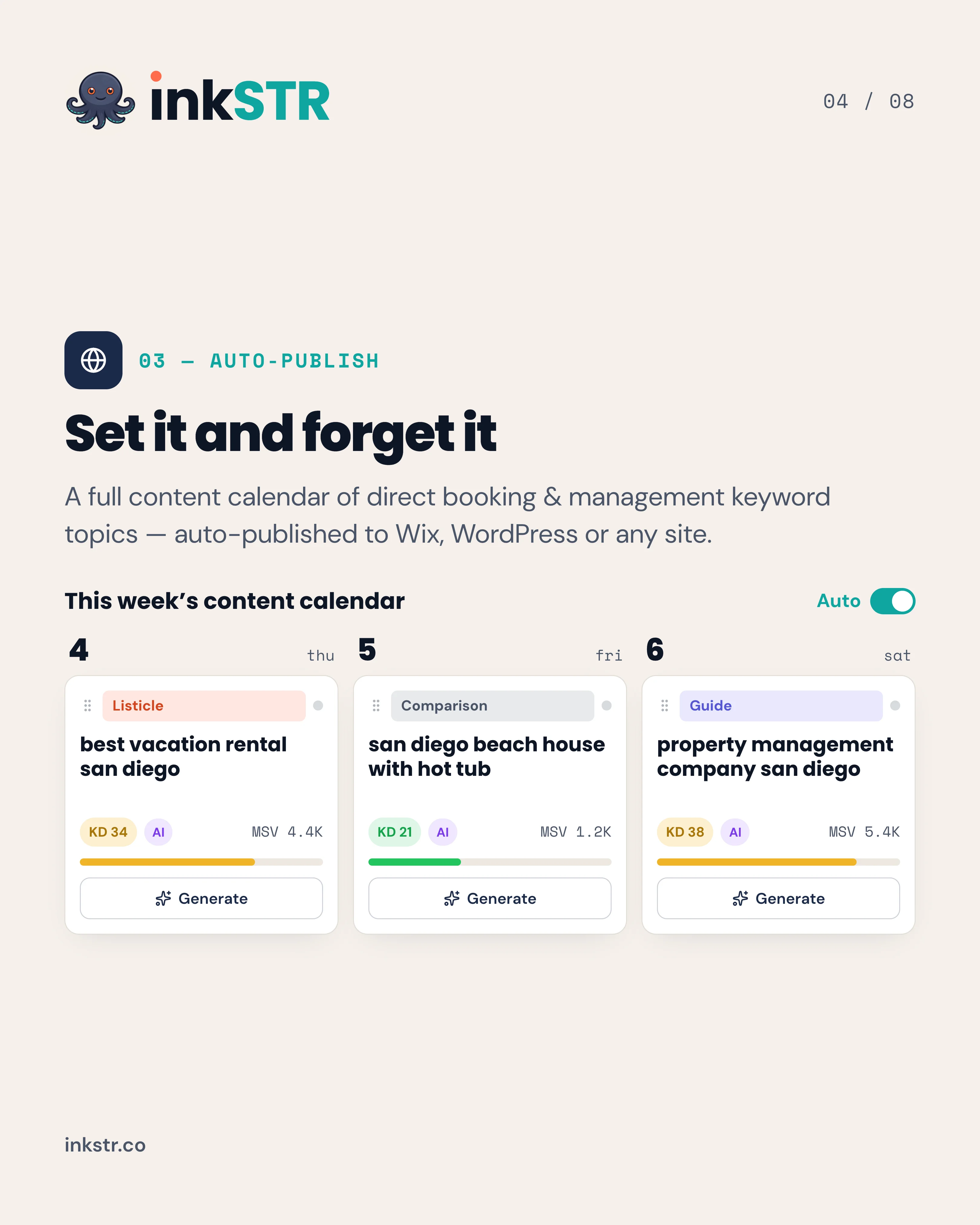
This is precisely the operational gap inkSTR closes. Instead of manually researching keywords, writing drafts, checking Search Console, and publishing on your CMS every week, inkSTR's Auto-Publishing feature pushes content directly to WordPress, Wix, or your custom site on the schedule you set, removing the manual bottleneck that causes most operators to fall off their publishing cadence in month two. See the full pipeline at How inkSTR Works.
What Keywords Should I Target If My Current Ones Aren't Working?
If your current keywords are not working, target lower-competition, long-tail phrases specific to your property type, amenities, and location rather than broad, high-competition terms your domain cannot yet win. Terms like "3 bedroom lake house rental with dock access near [town]" carry lower search volume but far higher conversion intent than a generic term like "vacation rentals."
Targeting high-competition keywords with a thin backlink profile is one of the most common mistakes we see new STR sites make. A brand-new domain competing against Airbnb, VRBO, and established property managers for a broad term like "cabin rentals Smoky Mountains" faces years of accumulated authority it cannot close overnight.
Instead, pivot toward specificity: amenity-based long-tail terms, neighborhood-specific phrases, and question-based keywords that match how travelers actually search when they are close to booking. This is the exact focus of inkSTR's keyword research process, surfacing the terms your target guests search rather than vanity keywords with volume you will never realistically capture.
Frequently Asked Questions
Why is my website not ranking well even after months of SEO work?
The most common reason is that early SEO efforts fixed technical issues but did not address search intent mismatch or publishing consistency. A new site typically needs three to six months of consistent, intent-matched publishing before Google builds enough trust to rank competitively, especially against established OTA domains.
How long does it take for a vacation rental blog post to start ranking?
Most vacation rental blog posts begin showing measurable movement in Google Search Console within four to eight weeks, with fuller ranking maturity often taking three to six months depending on keyword competition. A ranking article can then drive organic traffic for 2 to 5 years once established, which is why consistent publishing compounds over time.
Can indexing problems alone explain why my site is not ranking?
Yes. If pages are blocked by robots.txt or marked noindex, they cannot appear in search results regardless of content quality. Google Search Console data shows 23% of ranking issues trace back to crawling problems, making this the first thing to check before assuming a content or authority problem.
Is it worth paying a freelance writer to fix my ranking problem?
It can help, but freelance travel writers typically charge $300 to $700 per post and take 3 to 5 hours per article, which makes consistent weekly publishing expensive at scale. inkSTR generates comparable SEO-optimized content on a set schedule for a flat $99 per month, making sustained publishing far more affordable for most operators.
Does AI-generated content actually rank on Google in 2026?
Yes, when it is built around genuine search intent and structured with clear, direct answers, not just keyword density. Content aligned with real user intent has a 3x higher chance of reaching the top 10 compared to keyword-tool-only content, according to 2026 data from Citedy, and quality scoring before publishing helps ensure AI content meets that bar.
Why does my competitor rank first for "vacation rental [city]" but I don't?
Usually a combination of longer domain history, a stronger backlink profile, and more consistent content publishing over time. VRBO alone claims the top organic slot 24% of the time across vacation rental markets, so independent sites are often competing against both individual competitors and entrenched OTA authority simultaneously.
What is the fastest fix if I only have time for one thing?
Check Google Search Console's Page Indexing report first. If pages are not indexed, nothing else matters until that is fixed. If pages are indexed but not ranking, rewrite the top pages to directly match search intent using the top three to five ranking competitor pages as a benchmark.
Do I need a separate content strategy for AI search versus Google?
Not entirely separate, but you do need content structured with direct, definition-first answers near the top of each section, since AI Overviews and tools like ChatGPT and Perplexity extract and cite that pattern specifically. inkSTR builds every article to satisfy both traditional Google ranking signals and AI citation structure at once, so you are not managing two separate content systems.
Conclusion: What to Fix First
If your website is not ranking well, start with indexing, confirm every core page is actually crawlable and indexed in Google Search Console before you touch a single word of copy. From there, rewrite mismatched content to answer real search intent, commit to a consistent publishing schedule, and pursue backlinks from relevant hospitality sources. These four levers explain the overwhelming majority of low-ranking STR sites we have reviewed.
Ranking recovery is not instant. Most operators see meaningful movement within three to six months of consistent, intent-matched publishing, and a well-built article can keep driving organic traffic for years afterward. The operators who eventually rank are rarely the ones who found a secret trick, they are the ones who kept publishing while fixing the technical foundation underneath it.
As of 2026, that consistency requirement has only gotten steeper with AI search layered on top of traditional Google rankings. inkSTR exists specifically to remove the production bottleneck that causes most operators to abandon their publishing schedule around month two, generating, scheduling, and auto-publishing SEO and AI-search-optimized content so your ranking recovery does not depend on you finding four extra hours a week.
If indexing, intent mismatch, or inconsistent publishing are the reasons your website is not ranking well, Get started with inkSTR and let the platform's keyword research and auto-publishing handle the schedule while you focus on your property. Plans start at $99 per month, less than a single freelance blog post, and cover the full pipeline from keyword to published article.
Content powered by inkSTR.co
Enjoyed this article? Share it:
Get more of inkSTR in Google Search
Add inkstr.co as a preferred source and our articles show up more in Top Stories, AI Overviews, and AI Mode — with a “Preferred” badge.
Get more guides like this
New SEO and AI-search guides, straight to your inbox. No spam, unsubscribe anytime.