Airbnb Listing Not Getting Views? Here Is the Real Fix

If your Airbnb listing is not getting views, the cause is almost always one of three things: your listing is genuinely brand new and hasn't surfaced in search yet, your pricing or photos are signaling low quality before a guest even clicks, or a technical setting like Instant Book or your calendar sync is quietly suppressing your visibility. Zero views is a search algorithm problem. Views with no bookings is a conversion problem. They require completely different fixes.
- Zero views versus low views are different diagnoses: zero views usually means a visibility issue (new listing, suppressed impressions, or a pricing signal), while views with no bookings points to a conversion or pricing problem further down the funnel.
- Photos matter more than most hosts think: listings with high-quality photography can get up to 24% more bookings, and most guests decide within the first five images in the gallery.
- Pricing that sits 50% or more above local comparable listings can get suppressed in impressions before a guest ever sees the property in search results.
- Airbnb's own ranking signals reward at least 5 reviews at 4.7 or higher, Instant Book enabled, and a 90%+ response rate over the trailing 30 days.
- A stale calendar (not updated in the last 7 days) can actively hurt ranking, even if every other part of the listing is strong.
- inkSTR automates the direct-booking content strategy that reduces how dependent your revenue is on Airbnb's search algorithm in the first place, so a slow week in Airbnb search doesn't sink your entire calendar.
Every short-term rental host has stared at their Airbnb dashboard wondering why the view count won't move. It's one of the most searched frustrations in the entire hosting community, and in 2026, with an estimated 42% of active short-term rental listings globally now managed by professional operators rather than individual owners, the competition for every impression has only gotten tighter. You're not imagining it: the algorithm has gotten harder to win.
At inkSTR, we work with hosts and property managers across the country who treat Airbnb visibility as the whole game, then get blindsided when a single algorithm shift tanks their bookings overnight. This article walks through the exact diagnostic questions to ask, the specific fixes that move the needle fastest, and why building a direct booking presence outside of Airbnb search is the only long-term insurance against this problem.
We're going to work through this using the real questions hosts type into Google when this happens to them, because those questions tell you exactly where to look first.
What Is the 75-55 Rule in Airbnb?
The 75-55 rule is a pricing benchmark some hosts use to describe a healthy range for weekday versus weekend rate spread relative to their base nightly rate, roughly setting weekday rates around 75% of peak pricing and weekend rates closer to full value. It is not an official Airbnb algorithm rule, but a heuristic hosts use to avoid pricing themselves out of weekday search results.
Specifically, the logic behind this kind of rule matters more than the exact numbers. If your nightly rate sits 50% or more above comparable listings in your market for the same property type, your listing can get suppressed in impressions before a guest even sees it in search. That's a visibility problem, not just a conversion problem.
To find your right price range, search your own property type and location for a typical 3-night stay, then set your base rate within 15% of the median for comparable listings. Notably, this changes seasonally: what's competitive in January in a mountain market is often far off from what's competitive in July.
This is exactly why hosts who rely purely on Airbnb's internal search can't just "set and forget" pricing. As a result, the operators we see winning consistently pair dynamic pricing discipline with a direct booking channel, so a temporary pricing miscalculation on Airbnb doesn't wipe out an entire month. That's the gap inkSTR's AI Content Writer is built to close: consistent, keyword-targeted blog content that keeps your own website generating traffic regardless of what Airbnb's search algorithm decides to do with your listing that week.
How Can I Get More Views on My Airbnb Listing?
Getting more views on an Airbnb listing means fixing the specific factor suppressing your impressions, not applying generic advice. First, check whether your problem is truly zero views (a visibility issue) or views with no bookings (a conversion issue), because the fix is completely different depending on which one you have.
Open an incognito browser window and search for your own listing using the filters a real guest would use: your city, your dates, and your bedroom and bathroom count. If your listing doesn't appear at all, you likely have a visibility or settings problem, not a demand problem.
Specifically, check these settings in order:
- Is Instant Book turned on? Listings without it are deprioritized in search.
- Has your calendar been updated in the last 7 days? A stale calendar can actively hurt ranking.
- Does your minimum stay setting exceed 2 nights in low season or 3 nights in high season? Overly restrictive minimums quietly cut off a meaningful chunk of searchers.
- Is your response rate at or above 90% over the last 30 days?
- Do you have at least 5 reviews averaging 4.7 or higher?
The manual alternative here is checking each of these settings by hand, every week, across every listing you manage. If you're running one property, that's tedious. If you're a property management company running 15 or more units, it's a full-time job nobody signed up for.
We built inkSTR because visibility inside Airbnb's algorithm is only half the battle, and it's a half you don't fully control. The other half, your own Google-indexed content presence, is something you can control completely. Our Keyword Research tool finds the exact search terms your future guests are typing into Google right now, so you're not solely dependent on winning inside Airbnb's search results to fill your calendar.
What Is the 80/20 Rule for Airbnb?
The 80/20 rule for Airbnb refers to the idea that roughly 80% of your bookings tend to come from a small set of high-performing factors, typically your photos, your price, and your review score, while the remaining 20% comes from a long tail of smaller optimizations. In practice, this means hosts should fix the big three before obsessing over minor listing tweaks.
Most decisions guests make happen based on the first five photos in your gallery. That's not a minor detail, it's the single highest-leverage thing you can fix this week. Industry data shows listings with high-quality photography can see up to 24% more bookings compared to listings without.
Your recommended photo sequence, after the cover photo, should follow the order a guest would physically walk through the home: main living area, bedrooms, bathrooms, kitchen, amenities, then outdoor space. At least 20 photos covering every room and outdoor space is the standard for a strong listing in 2026, and photos should be shot in natural light without flash or clutter.
Your description matters too, but less than photos and price. The recommended length is 150 to 250 words, leading with who the home is for, then covering logistics. This is where hosts often waste hours rewriting copy that was never the real problem in the first place.
This is precisely the kind of prioritization gap we see property managers struggle with constantly. They'll spend an entire afternoon rewriting a listing description when the actual fix was swapping the cover photo and dropping the price 10 to 15% for 30 days. inkSTR's How inkSTR Works page breaks down how we help operators focus content and marketing effort on what actually converts, rather than guessing at what might.
What Is the 25 Rule on Airbnb?
The 25 rule on Airbnb generally refers to keeping your listing description within roughly the first 25 words delivering the single most important selling point, since Airbnb truncates longer descriptions in search results and guests scan quickly. The core idea: front-load your strongest benefit before it gets cut off.
Specifically, your listing title and the opening line of your description carry disproportionate weight in click-through rate. A benefit-driven title paired with a professional cover photo of your main living space has the most direct effect on whether a guest clicks through at all.
For example, "Cozy Downtown Loft" tells a guest almost nothing. "Sunlit Downtown Loft, Steps to Riverfront, Free Parking" tells them exactly why this property beats the next ten in the search results. That specificity is what separates listings that convert views into bookings from listings that just accumulate impressions.
The manual version of this work means rewriting and A/B testing titles across every property in your portfolio, tracking which variations perform, and repeating that process every season as demand shifts. For a host managing five or more units, that's easily several hours a month just on title testing alone.
This same benefit-forward, guest-intent-driven writing discipline is what makes content rank on Google too, and it's exactly what inkSTR's content engine is trained on for the short-term rental niche. If you want a deeper look at how this principle extends to your own website's blog content, our guide on how to create content for Airbnb hosts covers the same benefit-first framework applied to direct booking pages.
Why Is Your Vacation Rental Not Getting Bookings Even With Views?
Views with no bookings means guests are seeing your listing but choosing a competitor, which is a conversion problem, not a visibility problem. This is fundamentally different from zero views, and hosts frequently misdiagnose one as the other, wasting weeks fixing the wrong thing.
If you're getting meaningful traffic to your listing but conversions stay flat, check your pricing against comparable listings first. Properties with a fully complete listing page can receive up to 18% more bookings than incomplete ones, according to Booking.com Partner Hub data cited by industry analysts. Missing amenities, vague house rules, or an incomplete profile all quietly erode trust at the moment a guest is deciding.
Next, look at your review volume and score. A listing with fewer than 5 reviews, or an average below 4.7, tends to lose the side-by-side comparison against more established competitors in the same search results.
Finally, check your minimum stay settings. A 3 or 4-night minimum in a market where guests typically book 2-night weekend stays cuts off a real segment of demand, even if every other part of your listing is strong.
We've watched hosts spend months chasing more Airbnb traffic when their real problem was that their pricing sat above market and their reviews hadn't caught up yet. That's a pattern our team at inkSTR sees constantly when we audit a host's full online presence, not just their Airbnb listing in isolation.
How Do You Diagnose Zero Views Versus Low Views Using Airbnb's Own Data?
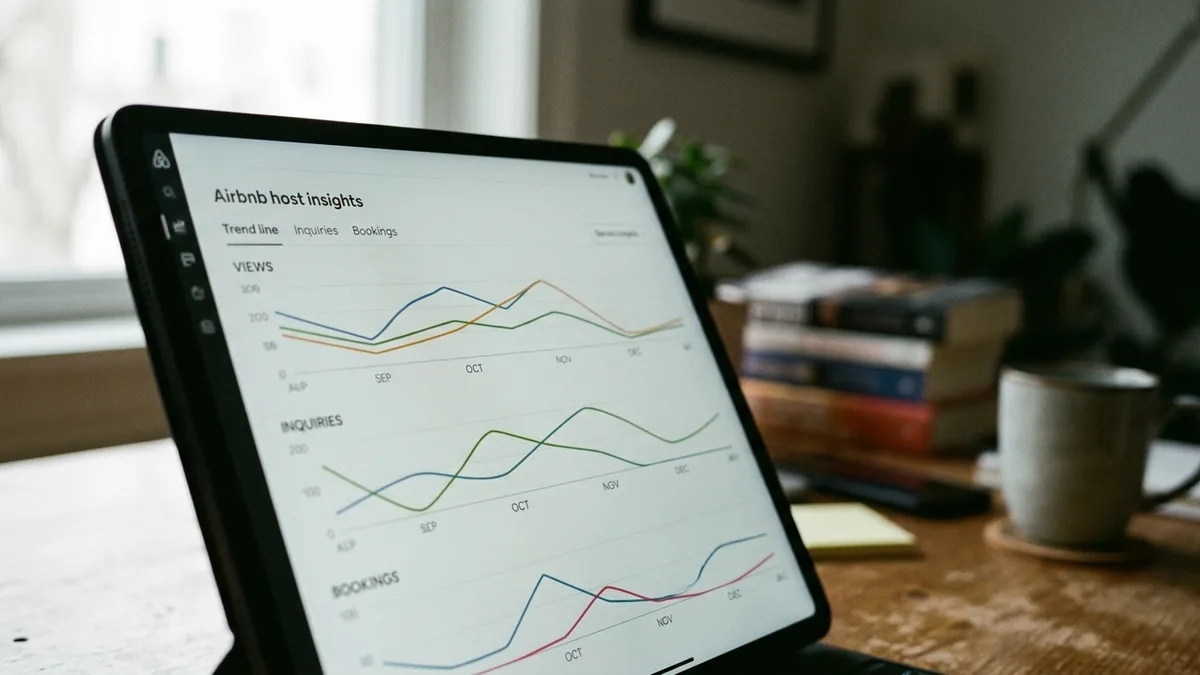
Diagnosing your specific visibility problem starts with Airbnb's Insights and Conversions data, which shows views, inquiries, and bookings trended over time, typically viewable across roughly the last 1.5 years of listing history. This data tells you whether you have a true zero-view visibility problem or a views-without-bookings conversion problem, and the distinction changes everything about what you fix next.
Pull up your Insights page and look at three numbers side by side: total views, inquiry rate, and booking rate. If views are near zero across multiple weeks, the algorithm isn't surfacing your listing at all, likely due to settings, pricing signals, or a new-listing cold start. If views are healthy but inquiries and bookings are flat, guests are seeing you and passing you over.
Specifically, compare your numbers against 3 to 5 comparable listings in your immediate neighborhood, matched for bedroom count, bathroom count, and property type. If a nearly identical property two blocks away is getting substantially more views, that's a strong signal your issue is technical (Instant Book, calendar sync, response rate) rather than about the property itself.
This kind of comparative, neighborhood-level diagnosis is something most hosts never do, mostly because it's tedious to manually track five competing listings over time. It's also exactly the kind of market awareness inkSTR's Keyword Research tool applies to your website's search visibility: understanding what's ranking around you before you decide what to fix.
Ready to automate your content marketing?
inkSTR handles keyword research, content strategy, article writing, and publishing, all on autopilot.
What Technical Settings Silently Suppress an Airbnb Listing?
Technical settings that silently suppress an Airbnb listing include disabled Instant Book, an unsynced or stale calendar, overly restrictive minimum-stay rules, and a response rate below 90%. These factors don't show up as obvious errors, they just quietly reduce how often your listing gets surfaced in search.
Here's a practical checklist to run through, in order of impact:
- Instant Book status: if it's off, turn it on. Listings without it are deprioritized in ranking.
- Calendar freshness: if your calendar hasn't been touched in more than 7 days, update it immediately, even if nothing has changed. Airbnb reads stale calendars as a signal of an inactive host.
- Minimum stay rules: 2 nights for low season, 3 nights for high season is the recommended range. Longer minimums cut off a meaningful share of searchers.
- Response rate and time: maintain 90% or above over the trailing 30 days. Slow or missed responses compound quickly.
- 1-night stay restrictions: limit 1-night bookings to calendar gaps only, which avoids party-risk exposure while still filling awkward open dates.
For a property manager running 15 or more listings, checking all five of these settings weekly, across every unit, is a genuine operational burden. It's the kind of repetitive, low-creativity work that eats a workday and produces nothing you can show an owner at the end of it.
This is a different problem than the one inkSTR solves directly, since we're a content and SEO platform, not a PMS. But in our experience advising operators on their full digital presence, the hosts who treat Airbnb settings maintenance as a checklist, not a guessing game, are the ones who stop losing bookings to preventable technical issues.
Airbnb Search Visibility Data: What the Numbers Actually Show
Airbnb's dominance in Google search results for vacation rental terms is well documented but uneven. According to research from BuildUp Bookings, Airbnb appears on the first page of Google for vacation rental searches in 79% of the top vacation rental markets analyzed, yet Airbnb placed in the top 3 organic results in only 5% of those same markets.
That gap matters enormously for hosts. It means Airbnb often shows up somewhere on page one of Google, but rarely dominates the very top spots, which is exactly the space an individually optimized direct booking website can compete for.
| Factor | Zero Views Problem | Views, No Bookings Problem |
|---|---|---|
| Likely cause | Instant Book off, stale calendar, new listing, price 50%+ above market | Weak photos, incomplete amenities, low review count, high price vs. comparable listings |
| Where to check first | Incognito search + Airbnb Insights views trend | Airbnb Insights inquiry/booking rate + 5 comparable listings |
| Fastest fix | Enable Instant Book, refresh calendar, adjust price | Swap cover photo, complete listing details, drop price 10 to 15% for 30 days |
| Typical timeframe to see movement | 1 to 2 weeks | 2 to 4 weeks (tied to review accumulation) |
The properties with a fully complete listing page can receive up to 18% more bookings than incomplete listings, per Booking.com Partner Hub data. Completeness is a free lever most hosts leave unpulled simply because they never audited it.
Notably, professional management companies now control an estimated 42% of the roughly 7 million active short-term rental listings worldwide, according to industry tracking. That means the individual host competing purely on gut instinct is increasingly up against portfolio operators running systematic pricing and content strategies. This is a big part of why we built inkSTR specifically for the independent host and boutique manager, not just large corporate portfolios: you deserve the same systematic advantage without hiring a full marketing team.
Practical Guidance: The Fastest Three Fixes and the Trade-offs to Know
If you only have an hour this week, the three fixes with the fastest measurable impact are: enable Instant Book if it's currently off, replace your cover photo with your most visually compelling room, and drop your nightly rate 10 to 15% below comparable listings for the next 30 days. These three changes address the biggest visibility and conversion levers simultaneously.
Common mistakes to avoid:
- Rewriting your entire description before checking your photos. Description length (150 to 250 words) matters less than the first five photos guests see.
- Ignoring calendar freshness. A calendar untouched in over 7 days can hurt ranking even if everything else is optimized.
- Setting minimum stays too conservatively. More than 2 nights in low season quietly turns away bookable demand.
- Treating a temporary price drop as permanent. A 10 to 15% reduction for 30 days is a test, not a new baseline; reassess once reviews and momentum build back up.
The trade-off every host has to accept: chasing Airbnb's internal algorithm is a moving target. Airbnb updates its ranking logic periodically, and what worked last quarter can shift without warning. That's the single best argument for building a direct booking presence you actually own.
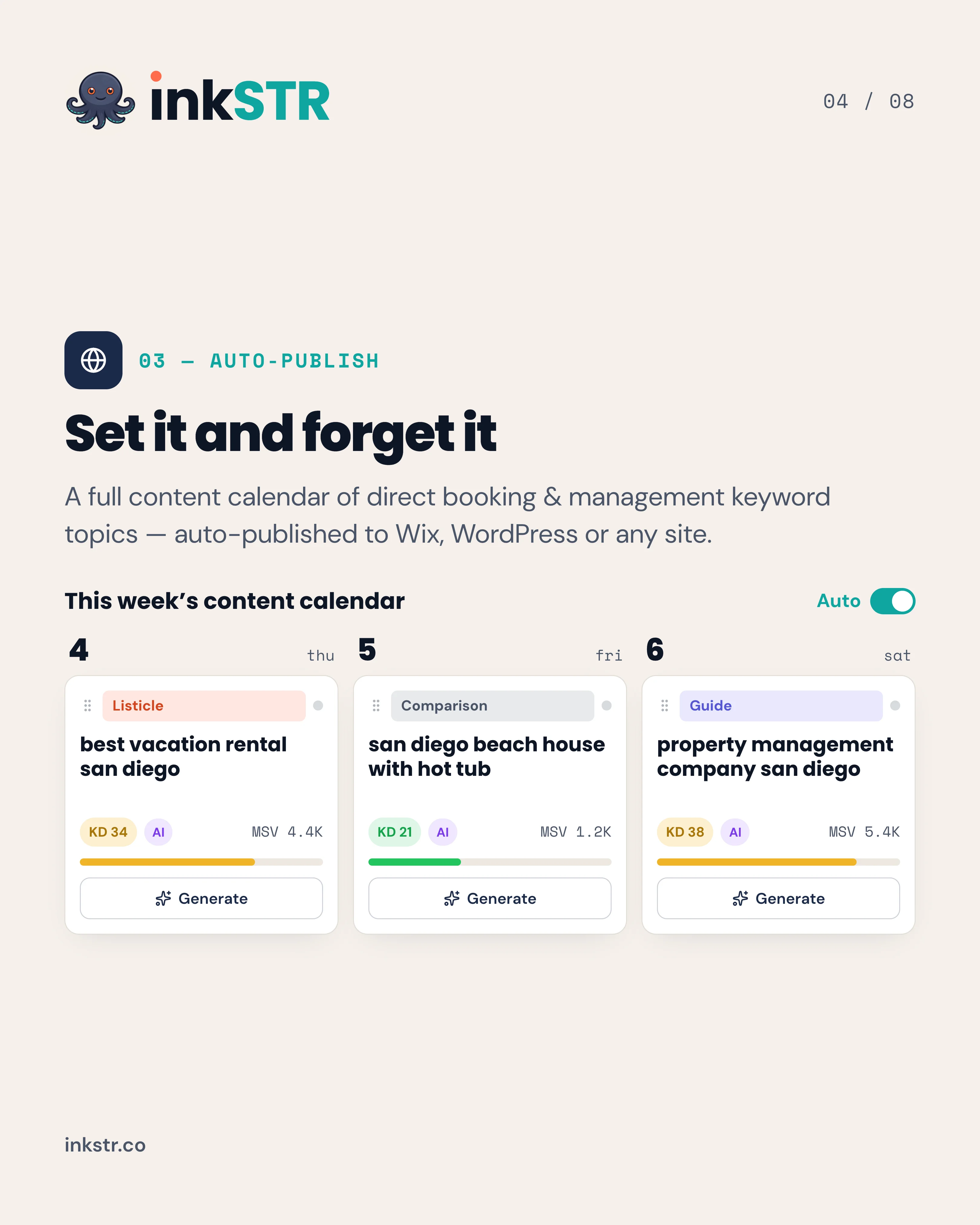
This is where the manual grind really shows up. Writing consistent, keyword-targeted blog content for your own website takes hours of research and drafting per post, and most hosts simply don't have that time between managing turnovers, guest messages, and pricing adjustments. inkSTR's Content Calendar schedules and publishes that content automatically, so your Google presence keeps compounding even during weeks when your Airbnb visibility takes a hit for reasons entirely outside your control.
Why Building Direct Booking Traffic Matters More Than Chasing Airbnb's Algorithm
Direct booking traffic means guests finding and reserving your property through your own website rather than through Airbnb or VRBO search results. It matters because it removes your total dependence on a single platform's algorithm deciding whether you get seen at all.
Airbnb and guest fees combined typically run 17 to 19% of every booking. A single direct booking, by contrast, is commonly worth $1,000 to $4,000 in revenue that you keep without that platform cut. Multiply that across a season, and the difference is not trivial.
A ranking blog article, once published and indexed, can drive organic search traffic for 2 to 5 years without additional ad spend. Compare that to Airbnb visibility, which can evaporate the moment your response rate dips or a competitor undercuts your price. One channel compounds. The other resets constantly.
Writing that content manually takes 3 to 5 hours of research and writing per post, and hiring a freelance travel writer typically costs $300 to $700 per quality article. For a host or property manager already stretched across guest communication, cleaning coordination, and pricing management, that time and cost adds up fast, and most give up on consistent publishing within a few months.
This is exactly the problem inkSTR was designed to solve. Our Auto-Publishing feature pushes content directly to Wix, WordPress, or your custom site without manual steps, and plans start at $99 per month, a fraction of what a single freelance article costs. If you want a deeper look at how this compounds over time, we cover the mechanics in our guide on how to rank your vacation rental website on Google.
Frequently Asked Questions
Why is my new Airbnb listing not getting any views at all?
New listings often start with a "cold start" where Airbnb has no performance history to rank on yet. Combine that with Instant Book being off, an incomplete profile, or pricing set too high relative to comparable listings, and your listing effectively becomes invisible in search for the first few weeks.
How long does it take for Airbnb listing fixes to show results?
Visibility fixes like enabling Instant Book or refreshing your calendar typically show movement within 1 to 2 weeks. Conversion fixes tied to reviews and photos tend to take 2 to 4 weeks, since review accumulation naturally takes time as new guests check out.
Does dropping my price actually increase Airbnb views?
Price alone doesn't directly change your view count, but pricing 50% or more above comparable local listings can get your listing suppressed in impressions before a guest ever clicks. Testing a 10 to 15% reduction below the median for 30 days is a common, low-risk way to see if pricing is the bottleneck.
Should I pause my Airbnb listing and start over if I get zero views?
Starting over usually resets your listing's minimal history without addressing the actual problem, whether that's settings, price, or photos. Diagnose first using Airbnb's Insights data and an incognito search test; in most cases, fixing the specific issue is faster than starting from zero again.
How many photos does an Airbnb listing need to rank well?
At least 20 photos covering every room, the exterior, and outdoor spaces is the general standard for a strong listing in 2026. The first five photos carry the most weight in a guest's decision, so prioritize your best, most naturally lit shots there.
Can content marketing actually replace Airbnb as a booking source?
Content marketing doesn't need to fully replace Airbnb, but it reduces how much your revenue depends on it. A ranking blog article can drive organic traffic for 2 to 5 years, giving you a booking channel that isn't subject to Airbnb's algorithm changes. inkSTR's AI Content Writer is built specifically to make that channel achievable without a full-time writer on staff.
Is AI-generated content good enough to actually rank on Google for vacation rental keywords?
Generic AI content struggles because it lacks the specificity search engines reward, but content built around real keyword research, STR-specific terminology, and consistent publishing cadence performs well. Our take on this is covered in more depth in our article on why your vacation rental website is not ranking on Google.
Conclusion
If your Airbnb listing is not getting views, start by determining whether you have a true zero-view visibility problem or a views-without-bookings conversion problem, since the fixes are entirely different. Check Instant Book, calendar freshness, and pricing first. Then move to photos, reviews, and listing completeness.
But don't stop there. As of 2026, with professional operators controlling a growing share of active listings worldwide, treating Airbnb's algorithm as your only booking engine is a fragile strategy. Building a direct booking content presence that compounds over years, rather than resetting every time Airbnb tweaks its ranking logic, is the more durable path forward.
If you're tired of your booking calendar living or dying by whatever Airbnb's algorithm decides this month, get started with inkSTR and let our AI Content Writer and Content Calendar build the direct booking traffic engine that Airbnb search visibility alone can't guarantee.
Content powered by inkSTR.co
Enjoyed this article? Share it:
Get more of inkSTR in Google Search
Add inkstr.co as a preferred source and our articles show up more in Top Stories, AI Overviews, and AI Mode — with a “Preferred” badge.
Get more guides like this
New SEO and AI-search guides, straight to your inbox. No spam, unsubscribe anytime.