10 Automated SEO Tools That Actually Save STR Operators Time
Automated SEO tools for short-term rental operators are software platforms that handle keyword research, content creation, technical audits, rank tracking, and publishing without requiring you to touch each task manually. The right stack lets a solo host or a property management company with 30 listings compete for Google traffic without hiring a full marketing team or spending 20 hours a week on content.
- Writing one quality blog post manually takes 3 to 5 hours; automated SEO tools collapse that to minutes.
- A single direct vacation rental booking is typically worth $1,000 to $4,000 in revenue, making organic search one of the highest-ROI acquisition channels available to STR operators.
- In 2026, SEO automation covers keyword research, technical audits, content generation, rank tracking, competitor analysis, and publishing scheduling.
- STR-specific automated SEO tools outperform generic platforms because they understand vacation rental terminology, traveler search intent, and location-based queries.
- Airbnb and VRBO combined fees reach 17 to 19% of every booking; direct bookings from organic search keep that margin in your pocket.
- inkSTR automates the entire STR content pipeline from keyword discovery to scheduled publishing, purpose-built for vacation rental operators who need consistent, search-optimized articles without the manual lift.
What Are Automated SEO Tools and Why Do STR Operators Need Them?
Automated SEO tools are software platforms that replace manual, time-intensive SEO tasks with AI-driven workflows. For short-term rental operators specifically, these tools handle keyword research, blog post generation, technical site audits, rank tracking, and competitor monitoring on a scheduled basis, without requiring you to log in and manually execute each step every week.
The problem most STR operators face is straightforward: your direct booking website exists, but Google does not know it is worth sending travelers to it. Without a consistent stream of optimized content targeting the searches your future guests are already running, your site sits invisible while OTA listings dominate the first page.
The manual alternative is brutal. Researching keywords, writing a 2,500-word blog post on "best things to do near [your market]," optimizing it for search, uploading it to your site, and repeating this every week takes somewhere between three and five hours per post at a minimum. Multiply that by 52 weeks and you are looking at a second job, or a freelance bill ranging from $300 to $700 per post if you outsource it.
In 2026, automation has made that tradeoff unnecessary. The tools in this list handle the heavy lifting. Your job is to pick the right ones and point them at the right targets.

How Do You Calculate the Real ROI of SEO Automation?
The ROI of automated SEO tools is calculated by comparing the cost of the tool against the revenue generated from organic traffic it produces, measured against the alternative cost of achieving the same result manually or through paid advertising. For STR operators, the math is unusually favorable because a single direct booking can recoup months of tool subscription fees in one transaction.
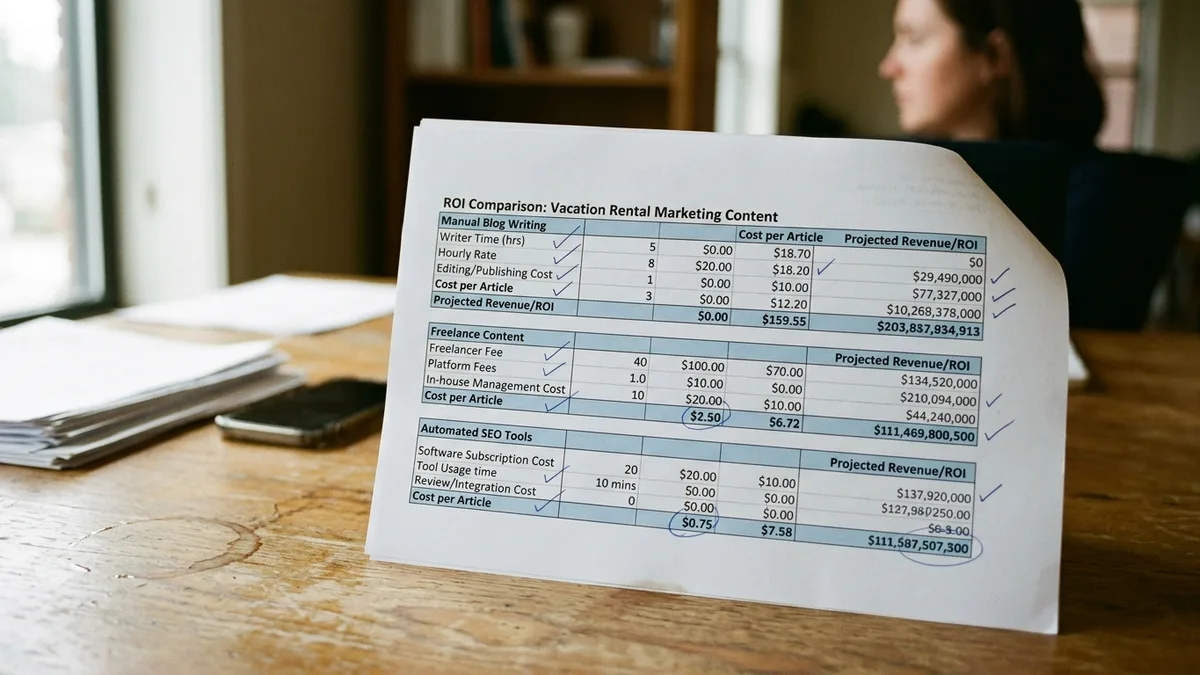
Here is a concrete framework. If a ranking blog article drives organic search traffic for two to five years, and a single direct booking averages $1,000 to $4,000 in revenue, the break-even threshold on an article is low. A $99/month content automation platform that publishes four articles per month costs roughly $25 per article. A freelance writer producing the same quality charges $300 to $700 per piece.
The hidden ROI driver most operators miss is compounding. Each article ranks independently and can generate bookings for years. You are not paying per click the way you would with Google Ads. The asset keeps working.
The honest caveat: results are not immediate. Organic search typically takes three to six months before new content begins generating meaningful traffic. Factor that into your timeline expectations. Tools that promise first-page rankings in 30 days are not being straight with you.
At inkSTR, we designed the platform around exactly this ROI equation: lower per-article cost than freelancers, faster production than manual writing, and a compounding content library that builds month over month. Our AI Content Writer generates 2,500 to 3,500 word SEO-optimized posts specifically targeting vacation rental search intent, which is a different task than writing a generic travel article.
Which Parts of STR SEO Can Actually Be Automated in 2026?
Most of the core SEO workflow for a short-term rental website can be automated in 2026, including keyword research, content generation, on-page optimization, technical audits, rank tracking, competitor monitoring, and publishing scheduling. The areas that still benefit from a human touch are brand voice refinement, local knowledge integration, and strategic decisions about which content angles to prioritize.
Here is the breakdown by task type:
- Keyword research: Fully automatable. Tools can identify what your target guests are actually searching, surface low-competition opportunities in your specific market, and flag keywords your competitors are ranking for that you are not.
- Content creation: Highly automatable when the AI is trained on STR-specific terminology and traveler search intent. Generic AI writing tools miss the nuance; STR-specific platforms understand the difference between "beachfront cottage rental" and "beach house vacation".
- Technical SEO audits: Fully automatable. Crawling for broken links, missing meta descriptions, slow page load issues, and schema markup gaps is exactly what machine-speed tools do better than any manual process.
- Rank tracking: Fully automatable. Monitoring your position for target keywords across Google and AI search results requires no human intervention once configured.
- Publishing: Fully automatable with one-click integrations to Wix and WordPress. Scheduling, uploading, and internal linking can all run on a set cadence without you touching a keyboard.
- Competitor analysis: Mostly automatable. Tools can surface what keywords your competitors rank for, which content performs best for them, and where the gaps are in your market.
The pattern we consistently see with STR operators is that they automate nothing until they automate everything. There is a smarter middle path: start with the tasks that eat the most time (content creation and publishing) and layer in more automation as you get comfortable with the results.
1. How Does an STR-Specific AI Content Writer Save the Most Time?
An STR-specific AI content writer saves the most time because it eliminates the research, drafting, optimization, and upload steps in a single workflow, replacing three to five hours of manual work with a process that takes minutes. The key differentiator from a generic writing tool is context: a platform built for vacation rentals understands traveler search intent, local attraction integration, and the specific semantic structure that drives STR organic traffic.
Generic AI writing tools produce acceptable travel copy. What they do not do is understand why a guest searching "pet-friendly cabin near Asheville" has different intent than someone searching "Asheville things to do." That distinction changes the entire article structure, the call-to-action, and the keywords woven throughout the piece.
inkSTR's AI Content Writer was built specifically for this problem. It generates 2,500 to 3,500 word articles targeting your exact market and keyword, structured around the pillar-cluster-conversion architecture that Google rewards for local search queries. Each post is optimized for both traditional Google rankings and AI-driven search results from platforms like ChatGPT and Perplexity, which in 2026 represent a growing share of the referral traffic reaching vacation rental websites.
The time savings are not marginal. Writing one quality post manually takes 3 to 5 hours. inkSTR produces a publication-ready draft in minutes. For a property manager maintaining a content strategy across multiple listings, that difference is the line between a consistent content calendar and a blog that has not been updated since last spring.
2. Why Does Keyword Research Automation Matter for Vacation Rental Websites?
Keyword research automation matters for vacation rental websites because the searches that drive direct bookings are hyper-local and highly specific, changing by season, traveler type, and micro-destination. Manually researching these terms across a portfolio of properties is not scalable. An automated keyword research tool surfaces the exact queries your future guests are running and identifies which ones you have a realistic chance of ranking for.
Most STR operators guess at keywords. They write about "things to do in [city]" because that feels logical. But the travelers searching "beachfront house rental Outer Banks October" or "lake cabin with boat dock for families" are much further along in the booking decision. Those long-tail queries convert at a higher rate, and they are exactly what keyword research tools are designed to find.
The manual approach means opening three browser tabs, sorting through keyword planners, copying data into a spreadsheet, and then deciding what to write. It takes two to three hours before you have written a single word.
inkSTR's built-in Keyword Research tool automates this entirely. It finds keywords your target guests actually search, analyzes your competitors' ranking content, and surfaces opportunities in your specific market, whether that is a beach town, a mountain retreat, an urban apartment market, or a lakefront destination. You get a prioritized list of content opportunities without opening a spreadsheet.
3. What Is a Content Calendar Tool and Do STR Operators Actually Need One?
A content calendar tool is a scheduling and management system that organizes your blog posts, assigns publication dates, and automates the publishing process so your website receives consistent new content without requiring you to remember to post every week. For STR operators, consistent publishing frequency is one of the clearest signals to Google that your website is an active, authoritative resource.
The problem without a calendar: content creation happens in bursts. You write three posts in January, nothing in February, one in March. Google interprets this as a low-priority site. Consistent monthly publishing, even at a modest cadence of two to four posts, outperforms erratic volume over time.
Managing this manually requires discipline most busy property managers cannot sustain. A single missed week becomes two, then a month, then a site that stopped being updated six months ago and is slowly losing ground to competitors who never stopped posting.
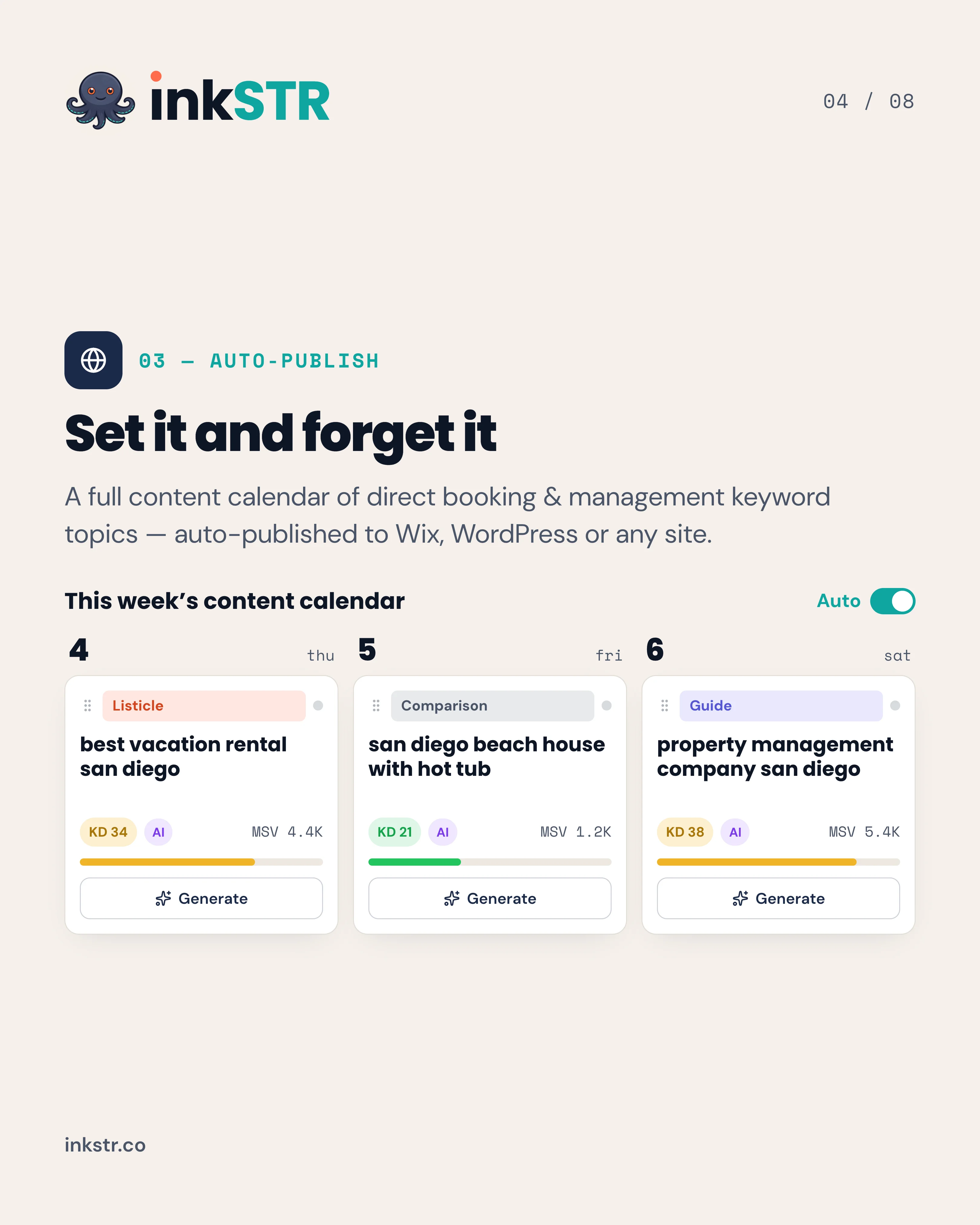
inkSTR's drag-and-drop Content Calendar handles this problem structurally. You set the publishing schedule once; the platform handles the rest. Articles are generated, queued, and published automatically on your defined cadence. For operators managing multiple properties, you can run independent content pipelines per property from a single dashboard, keeping each listing's content strategy distinct and targeted.
4. How Does Auto-Publishing Save Time Compared to Manual Uploading?
Auto-publishing saves time by eliminating the manual steps of logging into your CMS, formatting the article, uploading images, adding meta descriptions, setting categories, and clicking publish for every single post. For a property manager publishing two to four articles per month across multiple websites, this is hours of administrative work that auto-publishing removes entirely.
Manual uploading sounds trivial until you are doing it for a portfolio. Each post involves formatting headings, resizing images, writing alt text, adding internal links, setting the meta title and description, and confirming the post went live correctly. Forty-five minutes per post is a conservative estimate.
inkSTR's Auto-Publishing feature integrates directly with Wix and WordPress, the two platforms most STR operators use for their direct booking websites. Articles are pushed live automatically on schedule, with proper SEO metadata, image alt text, and internal links already embedded. You do not log in. You do not format. You do not upload.
For operators running five or more properties, this feature alone reclaims several hours per month that can be redirected toward guest experience, property optimization, or new acquisition.

5. What Is Technical SEO Automation and Why Should You Care?
Technical SEO automation refers to tools that crawl your website on a scheduled basis, identify structural issues that prevent Google from properly indexing your content, and in some cases apply fixes automatically without requiring developer involvement. For STR operators, common technical issues include missing meta descriptions, broken internal links, slow page load times, and absent schema markup, all of which suppress rankings regardless of how good your content is.
The frustrating reality is that you can publish excellent content and still rank poorly if technical issues are blocking Google's crawlers. A site with fast load times, clean URL structures, and properly implemented schema markup outranks an equally-written site with technical debt, every time.
Tools in this category can flag broken links, audit image alt text completeness, identify pages missing title tags, and surface crawl errors that would otherwise be invisible to you. Some platforms now offer autonomous technical fixes, applying corrections to meta tags, heading structures, and image descriptions without you touching the backend.
In our experience working with STR operators, technical SEO is consistently the most overlooked layer of the stack. Hosts focus on content and ignore the infrastructure. We address this in inkSTR through our quality scoring and pre-publish content validation, which checks every article for technical completeness before it goes live, ensuring your meta titles, descriptions, image alt text, and internal links are properly configured on every post.
6. How Does Rank Tracking Automation Help You Compete Against Bigger Operators?
Rank tracking automation helps smaller STR operators compete against larger property management companies by providing continuous visibility into exactly where your content ranks for target keywords, so you can identify which articles are gaining ground, which are stagnating, and where competitors are outranking you before the gap becomes insurmountable. Manual rank checking is inconsistent and time-consuming; automated tracking surfaces the data daily without any effort on your part.
The challenge for independent operators is information asymmetry. Large property management companies often have dedicated marketing staff monitoring rankings and adjusting content strategy in real time. Solo hosts and small portfolio managers typically check their rankings occasionally, if at all, and have no systematic process for acting on what they find.
Automated rank tracking closes that gap. You see exactly which keywords are moving up, which dropped after a competitor published a competing article, and which new keyword opportunities have emerged in your market. That intelligence drives smarter content decisions.
inkSTR's Google Search Console integration connects your content pipeline directly to your live ranking data. The platform tracks keyword performance, surfaces opportunity detection signals when a keyword is within striking distance of the first page, and feeds that data back into the content strategy. You are not flying blind. You are publishing content based on what is actually happening in your specific market right now.
Ready to automate your content marketing?
inkSTR handles keyword research, content strategy, article writing, and publishing, all on autopilot.
7. Why Does Competitor Analysis Automation Matter for STR Content Strategy?
Competitor analysis automation matters for STR content strategy because it reveals exactly which keywords are driving traffic to competing vacation rental websites in your market, which content formats perform best for them, and where the gaps are that your content can fill. Doing this manually requires hours of research that most operators simply do not have; automated competitor analysis delivers the same intelligence in minutes.
Most STR operators know who their direct competitors are on Airbnb and VRBO. Far fewer know which competing property management websites are ranking on page one of Google for "cabin rental [their destination]" and systematically capturing organic traffic that could be coming to their direct booking site instead.
The manual alternative is opening competitor websites one by one, trying to reverse-engineer their content strategy from what you can see on the surface. You cannot see their traffic numbers, their keyword rankings, or which posts are driving the most bookings. Competitor analysis tools surface that invisible layer.
inkSTR includes a brand audit and competitor keyword gap analysis that identifies the keywords your competitors rank for that your site does not. This is the fastest way to find high-value content opportunities you would not have thought to target on your own. Rather than guessing what to write next, you write directly into the gaps your competitors have left open.
8. What Are the Real Limitations of SEO Automation Tools?
The real limitations of SEO automation tools include the inability to replicate genuine local knowledge, the risk of producing generic content without proper human oversight, the time required to configure tools correctly before they deliver results, and the fact that no automation tool can accelerate Google's indexing timeline. Understanding these limits is what separates operators who get results from those who automate and wonder why nothing is working.
Here is what automated SEO tools cannot do well, and what you should know before building your stack:
- They cannot replace genuine local expertise. An AI that does not know your specific market cannot write with the authority of someone who has spent years there. STR-specific tools narrow this gap significantly, but the most effective content still incorporates your real knowledge of the destination.
- Generic automation produces generic content. A general-purpose AI writing tool has no idea why your mountain cabin appeals to a specific type of traveler. STR-specific platforms are calibrated for this, but operator input on property differentiators still matters.
- Results are not instant. No automated SEO tool changes the fundamental timeline of organic search. Expect three to six months before new content generates meaningful traffic. Automation accelerates production; it does not shortcut Google's evaluation timeline.
- Configuration requires upfront investment. Setting up keyword research parameters, defining your brand voice, connecting publishing integrations, and establishing your content architecture takes real time at the start. The automation pays dividends once it is running, not on day one.
- Over-automation is a real risk. Publishing high volumes of thin, undifferentiated content is worse than publishing nothing. Quality control matters. Tools that include content scoring and validation before publishing, like inkSTR's quality scoring feature, address this directly.
9. How Do You Build an Automated SEO Tool Stack Without Overspending?
Building an automated SEO tool stack for a short-term rental business without overspending means prioritizing tools that handle the highest-time-cost tasks first, avoiding feature overlap between platforms, and starting with the minimum viable stack before adding complexity. For most STR operators, a single all-in-one content automation platform handles more of the workflow than three separate point solutions at a higher combined cost.
The tool market in 2026 ranges from approximately $19 per month for entry-level platforms to $4,500 per month for enterprise-grade solutions. Most STR operators are not enterprise clients. The right benchmark is a platform that covers content creation, keyword research, and publishing automation in a single subscription, because those are the three tasks that consume the most operator time.
Here is the prioritization framework we recommend:
- Content creation and publishing first. This is where time loss is greatest and where automation ROI is clearest. A ranking article that drives direct bookings for two to five years has a measurable return. Start here.
- Keyword research and competitor analysis second. Without a clear content strategy grounded in real search data, even excellent writing misses its target. These tools are most valuable when integrated with your content creation workflow rather than operating separately.
- Technical SEO and rank tracking third. Once content is being published consistently, you need visibility into what is working and what technical issues are suppressing your results. Add these tools once the content foundation is in place.
inkSTR consolidates the first and second layers into a single $99/month platform. See current pricing here. Compared to paying $300 to $700 per freelance post and using a separate keyword tool, the math is straightforward for operators publishing more than one article per month.

10. How Do Automated SEO Tools Handle AI Search Optimization in 2026?
Automated SEO tools in 2026 increasingly include Generative Engine Optimization (GEO) capabilities that structure content for extraction by AI search platforms including ChatGPT, Perplexity, Google AI Overviews, and Claude, in addition to traditional Google ranking signals. For STR operators, this matters because AI referrals to top websites were up 357% year-over-year in June, reaching 1.13 billion, making AI search citation a genuinely significant traffic channel in 2026.
Most automated SEO tools still focus primarily on traditional Google ranking signals: keyword density, heading structure, backlinks, page speed. A growing subset now address GEO specifically, structuring content so that AI systems can extract clean, authoritative answers to cite in their responses.
The distinction matters for STR operators because travelers increasingly ask AI assistants questions like "what is the best vacation rental near the Smoky Mountains for a family of six" rather than typing that into Google. If your content is structured for AI citation, you appear in those answers. If it is not, you are invisible regardless of your Google ranking.
inkSTR builds LLM citation optimization directly into every generated article. The platform structures content with definition-first paragraph openers, self-contained answer blocks, and named entity density patterns that AI citation systems extract preferentially. This is not a feature most general-purpose SEO tools offer. It reflects our specific focus on what drives direct bookings in 2026: both traditional search and AI search visibility working together. For a deeper look at how this works, our guide to ranking in AI search for STR operators covers the mechanics in detail.
What Are the Most Common Mistakes When Using SEO Automation Tools?
The most common mistakes when using automated SEO tools include publishing without human review, targeting keywords that are too competitive for a new site, ignoring technical SEO entirely in favor of content volume, and failing to establish clear success metrics before the campaign begins. Each of these mistakes can produce months of effort with no measurable results.
Publishing Without Any Human Review
Automated content tools are fast. That speed is also a liability if you are not reviewing output before it goes live. A post with inaccurate local information, an awkward brand voice mismatch, or a missing key detail about your property can actively hurt your credibility. Build a lightweight review step into your workflow even when automation handles the heavy lifting. inkSTR's quality scoring feature flags issues before publishing, but a five-minute final read is still worth doing.
Chasing High-Competition Keywords Too Early
New vacation rental websites cannot rank for "beach house rental" on day one. Those keywords are dominated by Airbnb, VRBO, and established aggregators with domain authority built over years. The smarter approach is long-tail keyword targeting: "pet-friendly beach house rental Hilton Head with private pool" is a winnable keyword for a direct booking site. Automated keyword research tools should be filtering for these opportunities, not sending you after terms you have no chance of ranking for in the next six months.
Ignoring the Technical Layer
You can publish 50 articles and still rank poorly if your site has critical technical issues. Page speed problems, missing meta descriptions, uncrawlable URLs, and absent schema markup suppress rankings regardless of content quality. Schedule a technical audit in your first month and re-run it quarterly. Tools that automate this make it genuinely painless.
No Measurement Framework
If you cannot measure it, you cannot improve it. Before you publish your first automated article, define what success looks like: organic traffic to the blog section, keyword rankings for your target terms, direct booking inquiries from content pages. Google Search Console provides the core data you need. inkSTR's integration surfaces that data inside your content dashboard so you see which posts are driving results and which need attention. For a fuller picture of what good ranking on Google means for STR operators, that guide covers the metrics that actually matter.
How Long Does It Take to See Results from Automated SEO Tools?
Automated SEO tools typically begin producing measurable results in three to six months for new content on an established domain, with the most significant traffic growth occurring between six and twelve months after consistent publishing begins. This timeline reflects Google's evaluation process, not the tool's capability. The automation accelerates content production; the ranking timeline is a function of how Google assesses new content authority.
Here is what a realistic timeline looks like for an STR operator starting from scratch:
| Month | What to Expect | Key Actions |
|---|---|---|
| 1 to 2 | Content indexed but minimal traffic. Technical foundation established. | Publish 4 to 8 articles. Run technical audit. Connect Google Search Console. |
| 3 to 4 | Early keyword rankings appear (typically positions 20 to 50). Some organic impressions in Search Console. | Identify which articles are gaining traction. Optimize underperforming posts. |
| 5 to 6 | First page-one rankings for long-tail keywords. Organic traffic visible and growing. | Expand content clusters around high-performing topics. Add internal links. |
| 7 to 12 | Consistent organic traffic. Some posts driving direct booking inquiries. | Maintain publishing cadence. Refresh older posts. Monitor competitor movement. |
| 12 plus | Compounding traffic growth. Ranking articles driving bookings for multiple years. | Scale content production. Target higher-competition keywords. Expand to new market topics. |
The operators who get frustrated and abandon content marketing typically quit at month three, right before results begin to materialize. Consistency of publishing is more predictive of long-term success than any individual article quality metric.
Frequently Asked Questions About Automated SEO Tools for STR Operators
What is the difference between a generic SEO tool and an STR-specific automated SEO platform?
A generic SEO tool handles universal ranking tasks like keyword research and technical audits without understanding your specific industry context. An STR-specific platform like inkSTR is trained on vacation rental terminology, traveler search behavior, and location-based content strategies, meaning the content it generates actually resonates with the guests you are trying to attract. Generic tools produce travel copy; STR-specific tools produce content that converts browsers into direct booking inquiries.
How much do automated SEO tools cost for vacation rental operators?
SEO automation tools range from approximately $19 per month for entry-level platforms to over $4,500 per month for enterprise-grade solutions. For most STR operators, a purpose-built content automation platform handling keyword research, article generation, and publishing sits in the $99 to $200 per month range. That compares favorably to the $300 to $700 per post a freelance travel writer charges for equivalent quality content.
Can automated SEO tools actually write content that sounds like my brand?
Yes, when properly configured. The best platforms allow you to define a brand voice, provide property-specific details, and review output before publishing. inkSTR customizes writing style per project, meaning each property or brand can have distinct content that reflects its specific personality and market positioning rather than generic travel copy. Human review before publishing remains worthwhile even with strong AI output.
How often should I publish new content for my vacation rental website?
Two to four posts per month is the sweet spot for most STR operators. Publishing less than once a month produces minimal compounding benefit. Publishing more than four times per month is only sustainable if you have the content infrastructure to maintain quality. Consistency matters more than volume: a steady cadence of two posts per month outperforms six posts in January and nothing for the next quarter.
Do automated SEO tools work for AI search optimization, not just Google?
In 2026, the best automated SEO tools address both traditional Google ranking signals and Generative Engine Optimization (GEO) for AI search platforms including ChatGPT, Perplexity, and Google AI Overviews. inkSTR specifically builds LLM citation optimization into every generated article, structuring content so AI systems can extract and cite it as an authoritative answer. This dual-search optimization is a meaningful differentiator as AI referral traffic continues to grow.
What is the ROI of content marketing for short-term rental operators?
The ROI depends on your market, content quality, and publishing consistency, but the math is favorable for STR operators because a single direct booking worth $1,000 to $4,000 can recoup months of tool subscription fees in one transaction. A ranking blog article can drive organic traffic for two to five years, meaning the long-term return on each published post compounds over time. Direct bookings also avoid the 17 to 19% combined fees that Airbnb and VRBO charge, which further amplifies the revenue difference between OTA-dependent and content-driven acquisition strategies.
Should I hire a freelance writer or use an automated SEO tool for my vacation rental blog?
For most STR operators, automated SEO tools deliver better ROI than freelancers at the volume needed to build a meaningful content library. A freelance writer charging $300 to $700 per post can produce excellent quality, but the economics break down when you need 24 to 48 posts per year across multiple properties. Automated tools scale without scaling cost. The best approach pairs automation for volume and consistency with occasional human refinement for your most important, highest-visibility content pieces.
What keywords should I target first with automated SEO tools?
Start with long-tail, high-intent keywords specific to your market and property type, not broad terms like "vacation rental" that you have no realistic chance of ranking for against major OTAs. Examples include "pet-friendly cabin rental [your destination]," "family beach house [your market] with private pool," or "best things to do near [landmark]." inkSTR's keyword research tool surfaces these market-specific opportunities automatically and ranks them by the combination of search volume and ranking difficulty, so you can prioritize the ones worth pursuing first.
Ready to Stop Doing This Manually?
The operators who build sustainable direct booking businesses in 2026 are not the ones writing every blog post by hand or paying freelancers $400 a pop. They are the ones who built a content system that runs consistently, targets the right searches, and compounds over time. The automated SEO tools in this list each address a real part of that system, and the ROI math is clear once you do the calculation honestly.
Manual content creation takes 3 to 5 hours per post. A ranking article drives traffic for 2 to 5 years. A single direct booking is worth $1,000 to $4,000 in revenue that stays in your pocket instead of flowing to an OTA. The gap between operators who are building this system and those who are not will be significantly wider two years from now than it is today.
If you manage one property or twenty, the workflow is the same: consistent, targeted, optimized content published on a reliable schedule. The only question is how much of it you are doing manually.

inkSTR handles the content pipeline from keyword research to scheduled publishing, built specifically for short-term rental operators who need consistent search-optimized articles without the manual burden. Get started with inkSTR and publish your first optimized post this week.
Content powered by inkSTR.co
Enjoyed this article? Share it:
Get more of inkSTR in Google Search
Add inkstr.co as a preferred source and our articles show up more in Top Stories, AI Overviews, and AI Mode — with a “Preferred” badge.
Get more guides like this
New SEO and AI-search guides, straight to your inbox. No spam, unsubscribe anytime.