Best SEO AI Writer for Vacation Rental Sites in 2026

The best SEO AI writer for a short-term rental business is not a generic tool that writes about anything for anyone. It is one that understands traveler search intent, local market positioning, and how to turn a blog post into a direct booking instead of just a page view. For STR operators specifically, that means a platform built around vacation rental terminology, not a horizontal writing assistant retrofitted for hospitality.
Key Takeaways
- A general-purpose AI SEO writer produces prose but usually stops short of research, scheduling, and publishing, leaving those steps to you manually.
- According to Ahrefs' analysis of 600,000 pages, 86.5% of top-ranking pages now contain some AI-generated content, so the real differentiator has shifted from "AI or not" to "trained on the right niche or not."
- Writing one quality blog post manually takes 3 to 5 hours of research and writing, and freelance travel writers typically charge $300 to $700 per post.
- A ranking blog article can drive organic search traffic for 2 to 5 years, making content one of the few marketing investments with a genuine compounding return.
- In one documented case, a Smoky Mountains cabin brand grew monthly Google Search clicks from 788 to 5,195 in 11 months and attributed $309,775 in direct booking revenue to the effort.
- inkSTR automates keyword research, drafting, scheduling, and publishing specifically for STR operators, closing the gap between "good SEO strategy" and actually executing it every week.
Every property manager and independent host we talk to has typed some version of "best SEO AI writer" into Google at least once, usually after a freelancer quote came back too high or a general AI tool spit out generic travel copy that could describe any beach town in America. That search has gotten more crowded in 2026. There are now dozens of tools claiming to write SEO content, and most of them are horizontal products built for SaaS companies, e-commerce brands, or agencies with no STR context at all.
This matters because vacation rental SEO is not the same discipline as blogging for a software company. Guests search for "pet-friendly cabin near the Great Smoky Mountains" or "walkable Airbnb downtown Charleston," not generic commercial terms. A writer that does not understand traveler intent, seasonal booking windows, and local geography produces content that reads fine but ranks poorly and converts worse.
We built inkSTR specifically for this gap, so this review is written from inside the STR content space, not as a neutral outside observer. Below, we break down what "best" actually means for a short-term rental operator, cover the categories of tools worth knowing about, and show where niche specificity beats a general AI writer every time.
Which AI Writer Is Considered the Best for Vacation Rental SEO?
The best AI writer for vacation rental SEO is one trained on hospitality search intent, not a general-purpose tool retrofitted with a travel template. Most AI writing platforms on the market in 2026 are built to serve any industry, which means their output defaults to generic phrasing about "cozy getaways" and "unforgettable stays" that says nothing specific about your property or market.
If you have ever pasted a keyword like "3 bedroom lake house rental Michigan" into a general AI writer, you already know the result: serviceable sentences, zero local specificity, and nothing that separates your listing from a thousand others using the same tool. General writers do not know that lake house guests search differently in July than in January, or that mountain cabin searches spike around specific holiday weekends.
Writing that content yourself instead means blocking out 3 to 5 hours per post for research and drafting, based on typical manual blogging timeframes, or paying a freelance travel writer $300 to $700 per article and hoping they understand your market well enough to write something that ranks.
That is exactly the problem inkSTR's AI Content Writer was built to solve. It generates SEO-optimized drafts using vacation rental terminology and location-based search patterns, so a post about a Gatlinburg cabin reads differently than one about a Scottsdale condo, because the underlying model understands the difference between those markets.
Which AI SEO Tool Is the Best for Short-Term Rental Portfolios?
The best AI SEO tool for a short-term rental portfolio is one that scales across multiple properties or markets without multiplying your workload. Most SEO tools on the market are designed for a single website with a single content strategy, which breaks down fast once you manage 10, 20, or 50 units across different cities.
Property management companies feel this pain first. You might manage cabins in one mountain range and beachfront condos in another, each needing distinct keyword targeting, distinct local landmarks, and distinct seasonal messaging. Running that manually means either hiring a content team you cannot afford or letting most of your properties go without any dedicated content at all.
We have seen this pattern play out with multi-market operators directly. One five-market vacation rental brand covering Breckenridge, Whitefish, the Poconos, Fairplay, and Driggs went from averaging 26 monthly Google search visits to 1,924 in four months, publishing 114 articles built around pillar-and-cluster structures for each market. That kind of output is not realistic with a single freelance writer or a generic AI tool without portfolio-level scheduling.
inkSTR's multi-project support gives each property or market its own independent content pipeline, so a manager overseeing 15 properties runs 15 parallel content calendars without duplicating effort. That is the specific gap a horizontal SEO tool, priced and built for single-site use, cannot close.

Which AI Writer Handles Direct Booking Content Best?
An AI writer built for direct bookings should structure content to route search traffic away from OTAs and toward your own booking page, not just generate readable prose. Most AI writers stop at the sentence level. They will write you a blog post about "things to do near your rental," but they will not think about internal linking, calls to action, or funnel structure at all.
That gap costs money. Airbnb host and guest fees combined run 17 to 19% of every booking, and a single direct booking is typically worth $1,000 to $4,000 in revenue. Every guest a blog post routes toward a direct reservation instead of an OTA listing keeps that entire fee percentage in your pocket instead of a platform's.
Without a deliberate content strategy, most hosts end up with disconnected blog posts that rank for nothing in particular and link nowhere useful. We regularly see property websites with a "blog" tab full of posts from years ago, none of them pointing a reader toward an actual reservation.
inkSTR's internal link management automatically routes readers from educational content toward primary booking calls to action, related posts, and relevant pages, building what functions as a self-reinforcing traffic funnel rather than a pile of disconnected articles. If you want the deeper mechanics behind this, our piece on why blog content isn't converting visitors into guests covers the specific structural mistakes that block conversion even when traffic is decent.
What Is the Best AI SEO Agency Alternative for STR Operators?
The best alternative to hiring an AI SEO agency for a short-term rental business is a self-serve platform that replaces the ongoing retainer with a fixed monthly cost you control directly. Agencies typically charge monthly retainers that run well into the thousands, and much of that spend covers account management and reporting rather than content production itself.
For a boutique host or a mid-size property manager, that math rarely works. You are paying agency overhead for research and writing that a specialized platform can automate at a fraction of the cost, while also losing direct visibility into what is actually being published on your site and why.
According to G2's review data from over 10,000 verified reviews across SEO software categories in 2026, the market has shifted decisively toward self-serve platforms that put keyword research, drafting, and publishing in the operator's own hands instead of behind an agency's black box.
inkSTR's pricing starts at $99 a month, which functions as a direct substitute for the agency retainer model. You get keyword research, drafting, scheduling, and publishing in one platform, with a content strategy wizard that builds pillar, cluster, and conversion-page architecture based on your actual market instead of a generic template an agency reuses across clients.
What Should You Actually Compare When Evaluating an SEO AI Writer?
Evaluating an SEO AI writer requires separating four distinct jobs that competing tools often blur together: SERP research, prose generation, on-page scoring, and publishing. Most vendor pages list features without explaining which of these jobs a given tool actually performs, which makes head-to-head comparison difficult.
Some platforms only generate drafts and leave keyword research, scoring, and publishing to you or to a separate tool. Others focus narrowly on scoring existing content against top-ranking pages but do not write anything themselves. Very few cover the entire pipeline from research through live publication.
Pricing comparisons get muddled the same way. Plans get quoted as monthly, annual, per-seat, or credit-based, which makes it hard to calculate what a single published article actually costs you once you account for editing time and any add-ons.
| What You're Evaluating | Question to Ask | Why STR Operators Care |
|---|---|---|
| SERP and keyword research | Does it surface STR-specific search terms, or generic business keywords? | Traveler intent differs from B2B or e-commerce intent entirely |
| Prose generation | Does the draft use correct hospitality terminology and local geography? | Generic phrasing signals thin content to both readers and search engines |
| On-page scoring | Does it compare your draft against actual top-ranking competitor pages? | Scoring without STR context can reward the wrong signals |
| Scheduling and publishing | Does it publish directly to your site, or hand you a document to copy-paste? | Manual publishing is where most content calendars quietly die |
| Total cost per article | What does one published, ready-to-go article actually cost per month? | Determines whether the tool beats a freelancer or an agency retainer |
Our Keyword Research feature is built to answer the first row of that table directly: it finds terms your actual target guests search, mapped to markets like beach towns, mountain retreats, urban apartments, and lake house destinations, instead of generic commercial keywords borrowed from unrelated industries.
How Does Privacy and Data Handling Factor Into Choosing an AI Writer?
Data privacy matters when evaluating an AI SEO writer because your property details, pricing strategy, and guest-facing content represent competitive information you generally do not want reused to train a public model without your knowledge. Most vendor pages barely address this, focusing entirely on feature lists instead.
For a property management company handling client-owned listings, this question gets more serious. If you are producing content on behalf of property owners, you need clarity on how their business details are stored and whether that data ever leaves your account.
Google's own search guidance states that using AI or automation is not inherently prohibited, but using automation primarily to manipulate rankings does violate spam policies. That distinction matters: a tool that generates scaled, low-value content built purely to game search engines risks the opposite of what you want, regardless of whether a human or an AI wrote it.
We built inkSTR around the principle that content has to be genuinely useful to a reader first, which is why the platform includes quality scoring and pre-publish validation before anything goes live on your site, rather than pushing volume for its own sake.
Ready to automate your content marketing?
inkSTR handles keyword research, content strategy, article writing, and publishing, all on autopilot.
How Do You Measure Whether an AI Writer Is Actually Working?
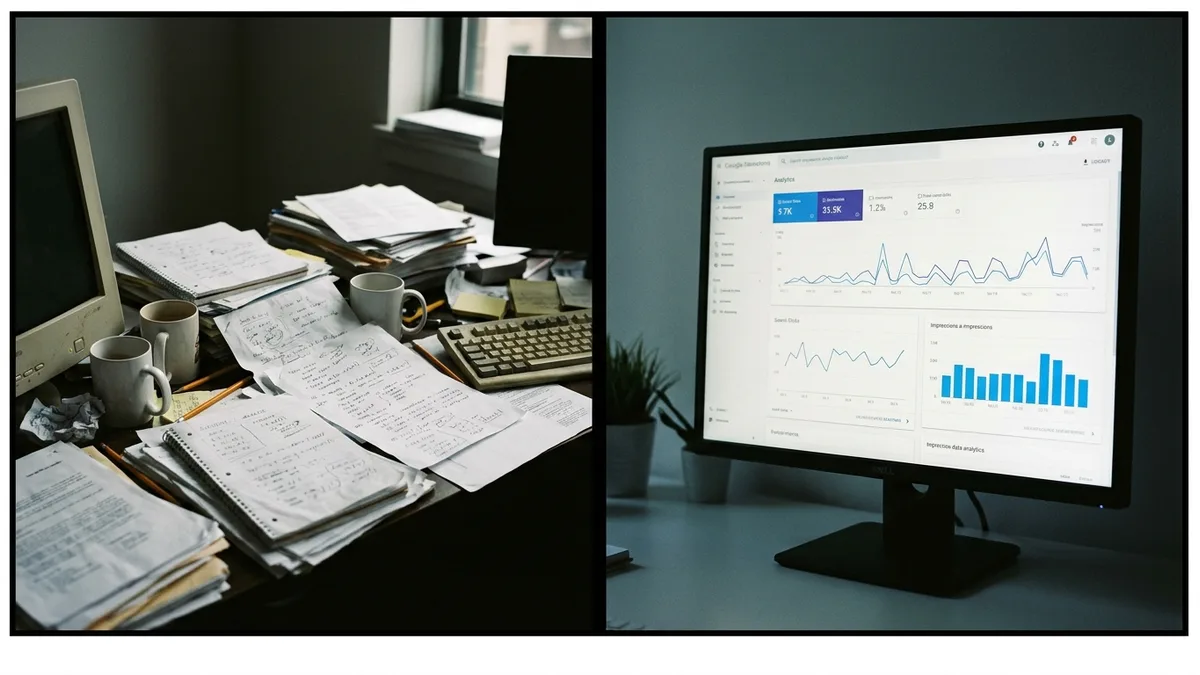
Measuring an AI writer's effectiveness means tracking organic search clicks, impressions, and keyword rankings over time, not just counting how many articles got published. A content calendar full of posts means nothing if none of them show up in Google Search Console data three months later.
Most vendors mention "AI visibility" or "GEO tracking" as a feature without explaining what that actually measures, how often it updates, or which AI engines it covers. That vagueness leaves operators unable to judge whether a claimed citation in ChatGPT or Perplexity reflects real traffic or a one-off mention.
Concrete numbers tell a clearer story. As of August 2026, articles published across inkSTR customer sites have crossed 3,400 total, generating close to 2.4 million Google Search impressions and more than 17,000 clicks across connected sites in the trailing 90 days, with over 900 verified AI-search citations secured for customer content all-time.
A related case worth naming directly: a Charlotte and Lake Norman property management company started on inkSTR at the end of April 2026 and had four property-owner leads arrive from AI search within the first month, with Google impressions running 4.6 times higher than the year-ago level within three months. That is the kind of outcome data that should matter more than a feature checklist.
What Does the Data Say About AI-Written Content Ranking on Google?
AI-generated content already ranks widely on Google, but the data shows quality and specificity matter more than whether AI touched the draft at all. According to an Ahrefs analysis of 600,000 pages across 100,000 keywords, 86.5% of top-ranking pages contained some AI-generated content, while only 4.6% were fully AI-generated with no human editing.
That same research found the correlation between the percentage of AI content on a page and its ranking position sat at just 0.011, essentially no relationship at all. In other words, whether AI wrote a paragraph is not what determines rank. What determines rank is whether the content actually answers a searcher's question better than the alternatives.
A related benchmark found that 93% of marketers review AI-generated content before publication, while only 4% publish it unedited, and companies using AI tools publish a median of 17 articles per month compared to 12 for those that do not. Consistency and editorial review both matter here, not raw AI usage alone.
For STR operators specifically, this means the "best SEO AI writer" question is really a question about specificity. A tool trained on hospitality search intent, publishing consistently and reviewed for quality, will consistently outperform a generic tool producing higher volume with less relevance. That is the entire premise behind how inkSTR approaches ranking on Google for vacation rental sites specifically.
What Mistakes Cause an AI SEO Strategy to Fail for STR Sites?
An AI SEO strategy for a vacation rental site fails most often because of inconsistent publishing, not bad writing. A burst of five posts in one month followed by three months of silence sends a weak signal to search engines and rarely builds the kind of topical authority that ranks for competitive local terms.
The second common mistake is generic keyword targeting. Publishing content around broad terms like "vacation rental tips" instead of specific, high-intent phrases tied to your actual market misses the traveler who is already close to booking. Our guide on vacation rental blog topics that actually drive bookings breaks down which topic types convert versus which just accumulate page views.
Here is a short checklist to avoid the most common failure points:
- Publish on a fixed schedule, even if that means fewer posts per month, rather than in irregular bursts.
- Target specific, local, high-intent keywords tied to your actual property type and market.
- Link every post back to a booking page or a related post, not just to itself.
- Review AI drafts for factual accuracy before publishing, especially local details.
- Track Google Search Console data monthly instead of judging success by article count alone.
inkSTR's Content Calendar exists to solve the first mistake directly. It schedules and manages publishing on autopilot, so your content goes live on a fixed cadence whether or not you have time to think about it that week.
How Should Multi-Property Managers Prioritize Content Automation?
Multi-property managers should prioritize content automation by market and property type before worrying about volume. A portfolio spanning mountain cabins and urban apartments needs distinct keyword sets and distinct local landmarks referenced in each market's content, not one generic template applied everywhere.
Trying to hand-write unique content across 15 or more properties consumes an entire workday for most managers, based on typical manual blogging time commitments, which is why most portfolios end up with either stale content or none at all beyond a handful of flagship listings.
The practical fix is treating each market as its own content project with its own pillar and cluster structure, then letting a scheduling system handle the actual publishing across all of them simultaneously. inkSTR's Auto-Publishing feature pushes content directly to Wix, WordPress, or a custom website without manual copy-paste steps, which is the specific bottleneck that kills most multi-property content plans before they get off the ground.
If you manage properties across multiple booking platforms and want a broader operational view beyond content alone, our roundup of must-have tools for short-term rental managers scaling up covers the adjacent systems worth pairing with a content strategy.
Frequently Asked Questions
What is the best vacation rental SEO tool?
The best vacation rental SEO tool is one built specifically for hospitality search intent rather than a general-purpose SEO platform. inkSTR was purpose-built for short-term rental operators, combining keyword research, drafting, scheduling, and publishing in one pipeline instead of requiring separate tools for each step.
How long does it take to see SEO results from vacation rental blog content?
Most operators start seeing measurable movement in Google Search impressions within a few months of consistent publishing, though timelines vary by market competition and starting domain authority. One documented case saw monthly Google search visits grow from 26 to 1,924 within four months of consistent publishing across five markets.
Can AI actually write good content for a vacation rental business?
Yes, when the AI is trained on hospitality-specific terminology and traveler search patterns rather than generic business copy. According to Ahrefs research, 86.5% of top-ranking pages already contain some AI-generated content, and the correlation between AI usage and ranking position is essentially zero, meaning quality and specificity matter far more than the writing method.
Is it worth paying a content writer for my STR instead of using AI?
A freelance travel writer typically charges $300 to $700 per post and takes days to turn around a draft, while an AI content platform built for STR terminology can produce comparable output on a fixed monthly cost. For operators publishing regularly across multiple properties, the per-article math strongly favors an automated pipeline over per-post freelance pricing.
Does blog content actually reduce dependence on Airbnb and VRBO?
Yes, when the content is structured to route readers toward a direct booking page rather than just informing them. Since Airbnb host and guest fees combined run 17 to 19% per booking, every guest who books directly through search-driven content instead of an OTA listing keeps that entire fee percentage as revenue.
Do I need existing SEO knowledge to use a content automation platform like inkSTR?
No. inkSTR's content strategy wizard builds the pillar, cluster, and conversion-page architecture automatically based on keyword research and competitor analysis, so operators without prior SEO experience get a structured plan rather than a blank page.
Can I use inkSTR if I manage more than one property or brand?
Yes. inkSTR's multi-project support gives each property or market its own independent content pipeline and calendar, which is how one five-market operator managed 114 published articles across distinct locations in four months without duplicating effort.
Conclusion
The best SEO AI writer for a short-term rental business is not the one with the flashiest interface or the longest feature list. It is the one trained on hospitality search intent, capable of handling research, drafting, scheduling, and publishing in a single pipeline, and priced in a way that beats freelance and agency costs over time. Generic AI writers can produce readable sentences, but readable sentences without local specificity and a booking-focused structure rarely turn into direct revenue.
As of 2026, the operators seeing real results are the ones publishing consistently, targeting specific traveler intent, and tracking actual Google Search Console data instead of vanity metrics. That combination is what separates a content calendar that compounds for years from one that quietly stalls after a few months.

If building content like this manually feels like a full-time job on top of your actual job, get started with inkSTR and see your first article draft, scheduled and ready to publish, this week.
Content powered by inkSTR.co
Enjoyed this article? Share it:
Get more of inkSTR in Google Search
Add inkstr.co as a preferred source and our articles show up more in Top Stories, AI Overviews, and AI Mode — with a “Preferred” badge.
Get more guides like this
New SEO and AI-search guides, straight to your inbox. No spam, unsubscribe anytime.