Ghostwriter AI for Vacation Rentals: What It Is and Costs
Ghostwriter AI is software that drafts, rewrites, and polishes text you publish under your own name. For vacation rental operators, inkSTR is the purpose-built version: it researches keywords, drafts full blog posts, and publishes them to your website on a schedule.
Key Takeaways
- A ghostwriter writes content that is published under someone else's name; ghostwriter AI does the same job with software, producing drafts you review and approve.
- Writing one quality blog post by hand takes 3-5 hours of research and writing, which is why most rental blogs stall.
- Freelance ghostwriting is priced per post, while inkSTR is a flat $99/month subscription.
- General AI assistants draft text but leave keyword research, formatting, and publishing to you; an STR-specific platform handles the full pipeline.
- Accuracy, human review, and original local detail matter more than AI detection scores or disclosure debates.
- inkSTR automates keyword research, drafting, scheduling, and publishing to Wix and WordPress, so ghostwritten posts reach your direct booking site without manual steps.
In 2026, ghostwriter AI covers a messy set of products. Search the phrase and you find a phone keyboard assistant and Office add-ins. Book-writing platforms and lyric generators turn up too, all with similar names. If you run vacation rentals, none of that tells you what to use for the blog that earns direct bookings.
At inkSTR, we have watched operators try each route. As of November 2026, we have published more than 5,900 articles across inkSTR customer sites. The pattern is consistent: posts that rank are written around a specific search and real property detail. A generic prompt does not produce them.
This guide defines the term, compares the tool categories, prices human and AI options, covers ethics and copyright, and walks through a workflow for making the output sound like you.
What Is the Definition of a Ghostwriter?
A ghostwriter is a professional writer who drafts articles, books, speeches, or posts that are published under another person's name, with the named author receiving the credit. In vacation rental marketing, that usually means someone else writes the blog posts that carry your brand.
The practice is common wherever busy experts need a voice in print. Executives publish thought leadership drafted by communications staff, and authors hire writers for non-fiction books. For a host, the same logic applies to the blog on your direct booking site: you supply the property knowledge, and someone else handles the prose.
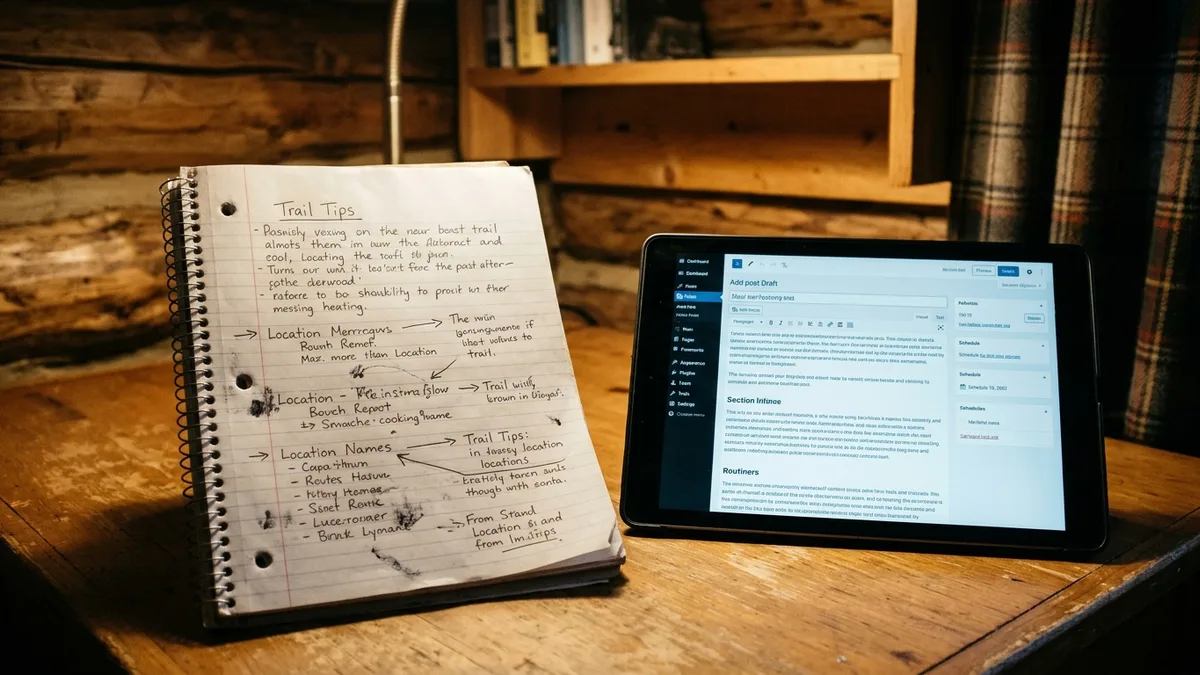
The trouble is the labor. Researching keywords, outlining, drafting, formatting, and uploading one post takes 3-5 hours. If you are also managing guests and cleaners, you rarely find that block twice a week. The blog stays empty while competitors fill page one.
That gap is why we built inkSTR's AI Content Writer. It takes the ghostwriter's seat: you supply property and market context, and it drafts SEO-optimized articles in your project's writing style. You remain the named author, and the platform does the typing.
Is There an AI for Writing?
Yes. AI writing tools fall into four categories: keyboard assistants that draft replies on a phone, document add-ins for word processors, long-form platforms built for books, and creative tools for lyrics or stories. None of them is designed to rank a vacation rental website on Google.
Part of the confusion is naming. Several unrelated products share the Ghostwriter AI label, built by different developers for different platforms. A keyboard assistant polishes a text message in seconds, while a document add-in rewrites a paragraph inside a file. Neither researches what travelers search for, and neither publishes anything to your site.
That leaves you stitching a workflow together by hand. You prompt a general assistant, paste the draft into WordPress or Wix, fix the formatting, hunt for images, add internal links, and schedule it yourself. The writing took minutes; the logistics eat the afternoon.
inkSTR covers the category those tools skip: blog automation built for short-term rentals. Its workflow from keyword to published post runs in one pipeline, so the draft never sits in a folder waiting for you to format it.

What Does a Ghostwriter AI Do for a Vacation Rental Blog?
A ghostwriter AI assembles text from your instructions, either generating a new draft or rewriting existing copy in a different tone. It can change the length or structure as well. For a vacation rental blog, output quality depends less on the model than on the inputs: a target keyword and traveler search intent. Real property details matter as well.
How does it generate text?
The model predicts likely wording from the prompt, so a vague prompt returns vague copy. Ask for a post about your cabin and you get stunning views and cozy charm, the language every competing listing already uses. Our breakdown of why generic travel content kills conversions covers the cost of that sameness.
inkSTR avoids the blank prompt by starting from Keyword Research. It drafts 2,500 to 3,500 word articles around searches your guests make. The Hospitable and OwnerRez integrations can bring real reviews and photos into the content.
How does it rewrite text?
Rewriting runs the same process in reverse: you supply the text, and the model restructures it. Hosts use it to turn a rambling owner note into a clean post or to tighten an older article. The risk is drift, where the rewrite smooths away the one concrete detail that made the passage yours.
Quality scoring and pre-publish validation in inkSTR flag thin sections before a post goes live. A human read for local detail still improves every draft.
How Much Does a Ghostwriter Usually Cost?
A freelance travel writer typically charges $300-$700 per quality blog post, while inkSTR starts at $99/month and generates, schedules, and publishes articles automatically. Book-length ghostwriting is quoted separately and usually costs far more than a single post, so get any quote in writing.
The per-post model gets expensive at the cadence search rewards. One post a week means a new invoice every week, plus briefing time and revision rounds, and a freelancer who has never seen your market still needs your local detail. Free AI tiers remove the invoice, yet the labor stays with you. They exist on most general-purpose tools, with limits that change, so check each provider's current terms.
| Option | Cost structure | Your time per post | Best fit |
|---|---|---|---|
| Freelance human ghostwriter | Per-post fee ($300-$700) | Briefing and revision rounds | One-off cornerstone pieces |
| Writing it yourself | No cash cost | 3-5 hours | Hosts with spare evenings |
| General AI assistant | Free and paid tiers, varies by provider | Prompting, fact-checking, formatting, uploading | Short copy and brainstorming |
| inkSTR | Flat monthly subscription | Review and approve | Steady publishing for direct bookings |
The comparison that matters is against the commission you pay today. Airbnb host and guest fees combined run 17-19% of every booking, and a single direct booking is typically worth $1,000 to $4,000 in revenue. One direct reservation can cover the subscription for many months. You can see current plans on the pricing page.
What Is an Example of Ghost Writing in Short-Term Rental Marketing?
An example of ghost writing is a vacation rental founder publishing a local market guide that a hired writer drafted, or an executive posting on LinkedIn from a draft the communications team wrote. The byline belongs to the owner; the drafting belongs to someone else.
Use cases stretch well beyond books. Management companies ghostwrite owner-facing articles that attract new property owners, and cabin operators ghostwrite seasonal planning posts. Newsletters, owner letters, and FAQ pages fit the pattern too. The same pipeline serves property management companies chasing owner leads as well as hosts chasing guests.
The weak point of freelance ghostwriting is context. A writer hired by the post does not know which trailhead you send guests toward or which month your road gets icy. Those gaps produce thin articles that never earn rankings.
Hemlock Hills, a Smoky Mountains cabin rental brand, ran a continuous inkSTR content pipeline and grew monthly Google Search clicks from 788 to 5,730 in 13 months, measured in Google Search Console. The articles were grounded in real property data and auto-published to WordPress on a steady cadence. For topics that suit this approach, see our list of vacation rental blog topics that drive bookings.
Ready to automate your content marketing?
inkSTR handles keyword research, content strategy, article writing, and publishing, all on autopilot.
What Is the Best AI Writing Tool for Vacation Rental Hosts?
The best AI writing tool for a vacation rental host covers the full content pipeline: keyword research, drafting, scheduling, and publishing to your own site. General assistants handle drafting only, so a short-term rental platform like inkSTR fits hosts pursuing direct bookings.
Match the tool to the job. Picking the wrong category is the most common mistake we see.
- Replies, captions, and quick messages: a keyboard assistant on your phone.
- Rewriting inside a file: a word-processor add-in.
- A memoir or non-fiction book: a long-form book platform.
- A ranking blog that feeds direct bookings: an STR-specific automation platform.
Hosts who choose a keyboard assistant for the fourth job end up with polished text and no traffic. Meanwhile every OTA booking carries host and guest fees of 17-19%. Search traffic to your own site carries no commission, which is the point of building a direct booking channel.
inkSTR handles the fourth job end to end. Auto-Publishing sends finished posts to Wix or WordPress without manual steps, and multi-project support gives each property or brand its own pipeline. If you manage 15 or more properties, each one keeps an independent schedule inside one dashboard.
Is It Ethical to Use an AI Ghostwriter, and Do You Need to Disclose It?
Using an AI ghostwriter is generally accepted when you review the output and verify the facts. You also stand behind the published words as your own. Disclosure rules vary by platform, client, and jurisdiction, so check the requirements that apply to your situation rather than assuming.
The main ethical risk is accuracy. An unreviewed draft can invent an amenity, misstate a drive time, or promise a view your cabin does not have. Guests arrive with those expectations, and the review they leave is public. Publishing in bulk without a read-through turns a time saver into a liability.
Detection is the other worry. AI detection tools give inconsistent results, and chasing a score wastes hours. A better test is whether the post contains facts only you know. Search engines and AI answer systems favor helpful, original pages, a shift covered in this look at how AI Overviews affect brand trust in search.
We built inkSTR with a review step in mind. Quality scoring and pre-publish validation run before anything goes live, and drafts can draw on real guest reviews through the PMS integrations. Final approval stays with you, which is where we think it belongs.

How Do You Make AI Ghostwritten Text Sound Like You?
Making AI ghostwritten text sound like you means setting a writing style once, feeding each draft details only you know, and editing before it publishes. Tone comes from your inputs and your review pass.
Skip those steps and every post reads like every other AI post. Guests cannot tell your cabin from the next listing, and neither can Google. The fix is a repeatable routine you run on each article.
- Write down how you talk about guests, your property, and the surrounding area, then set that as your project writing style in inkSTR.
- Choose a keyword your guests search, and build the post around that intent.
- Add one proprietary detail per section: the trail you send guests toward, the season you would skip, the check-in quirk.
- Read the draft aloud, cut generic adjectives, and verify every factual claim.
- Queue the post on the Content Calendar and let it publish on schedule.
The drag-and-drop calendar means approval takes minutes, not an afternoon. Our guide to article automation without losing your brand voice goes deeper on style settings.
One mistake shows up repeatedly: cross-posting identical text on every channel. It splits attention and builds no channel. A post written for your own site, around one search, outperforms five copies scattered around.
Frequently Asked Questions
What is the best AI ghostwriter?
It depends on the job. Keyboard assistants suit quick replies, document add-ins suit in-file rewriting, and book platforms suit long manuscripts. For vacation rental blog content that ranks and drives direct bookings, inkSTR is built for the task. That includes keyword research and automatic publishing. Our guide to ranking in AI search shows how that content gets cited.
How do I sign up for Ghostwriter AI?
Several products use the name, so sign up through the official store listing or website of the specific product you want, and confirm the developer first. If your goal is automated blog content for a rental business, you can start a free trial of inkSTR instead.
Can an AI ghostwriter write a full book?
Long-form platforms can produce outlines and chapter drafts, and some export to common formats such as EPUB, PDF, and DOCX. A publishable book still needs heavy human editing for consistency and accuracy. Voice needs that work too. For rental operators, blog posts usually return more than a book does.
Does AI ghostwritten content get detected?
Detection tools are inconsistent and can flag human writing as machine-made. Instead of optimizing for a score, add original details, verify facts, and edit for voice. Posts built on real property data and local knowledge stand apart either way.
Is there a free AI ghostwriter?
Free tiers exist on many general-purpose assistants. They usually come with usage or feature limits that change over time. They work for brainstorming and short copy, but you still handle keyword research, formatting, and publishing. inkSTR is a paid platform with a free trial.
Who owns the copyright to AI-ghostwritten content?
Rules for AI-assisted work vary by country and are still changing, so confirm the current position with an attorney. Read your tool's terms of service too, since they set out how output may be used. Substantial human authorship, such as original details and edits, may strengthen your position.
What AI tool writes short-term rental listing descriptions?
General assistants can draft listing copy from a list of amenities, and you should edit it for accuracy. inkSTR focuses on blog articles and website content that drive direct bookings, not the copy inside listing fields. Optimizing a listing on Airbnb or VRBO is a separate job from website SEO.
So, Is Ghostwriter AI the Right Move for Your Rental Business?
Ghostwriter AI is software that drafts and rewrites text you publish as your own. For a rental business it pays off when it covers keyword research and drafting together with publishing. A per-post fee and a DIY afternoon both cap how often you publish. In 2026, as AI Overviews and chat assistants answer more traveler questions, steady, specific, well-structured content decides who gets cited. As of November 2026, we have tracked more than 1,700 verified AI-search citations for customer content. Start with one keyword, add details only you know, and keep the review step.
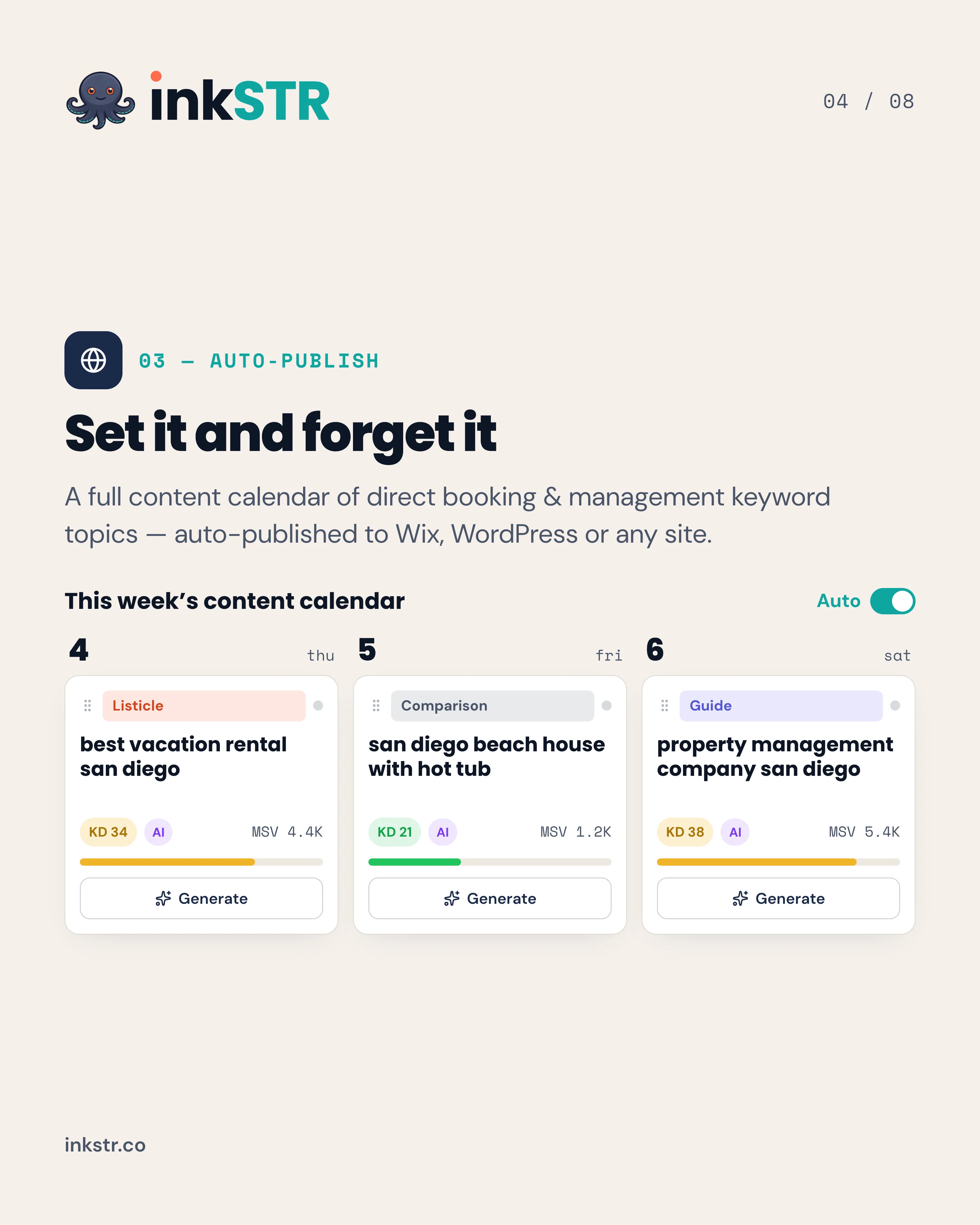
If a single post takes you a full afternoon, a steady blog is impossible by hand. Start Free Trial with inkSTR and the Content Calendar drafts, queues, and publishes articles for your direct booking site on the schedule you set. Pick your first keyword and approve the draft. Let the pipeline handle the rest.
Content powered by inkSTR.co
Enjoyed this article? Share it:
Get more of inkSTR in Google Search
Add inkstr.co as a preferred source and our articles show up more in Top Stories, AI Overviews, and AI Mode, with a “Preferred” badge.
Get more guides like this
New SEO and AI-search guides, straight to your inbox. No spam, unsubscribe anytime.