How to Rank on AI Search Engines in 2026: STR Guide

Ranking on AI search engines means structuring your vacation rental content so tools like ChatGPT, Perplexity, and Google AI Overviews can extract, quote, and cite it directly. That requires answer-first paragraphs, schema markup, and consistent publishing, not traditional keyword stuffing.
Key Takeaways
- AI referral traffic to top websites grew 357% year over year as of mid-2025, according to a widely cited TechCrunch analysis of AI referral data, meaning guests are increasingly finding vacation rentals through AI answers instead of traditional search results.
- Pages refreshed within the last three months receive nearly twice as many AI citations as older content, making publishing frequency a direct ranking lever for short-term rental websites.
- Structured data, especially FAQ and HowTo schema, correlates with up to 40% more appearances in AI Overview-style results.
- Roughly 88% of queries that trigger an AI Overview are informational, meaning STR blog content answering specific traveler questions has an outsized opportunity to get cited.
- Google Search already influences vacation rental bookings directly: 42% of U.S. leisure travelers said Google Search impacted their travel provider decision on their last trip, according to ShortTermRentalz.
- inkSTR builds AI-search-optimized articles with the definition-first structure, schema markup, and publishing cadence AI systems reward, and does it on autopilot for STR operators who don't have hours to spend on formatting.
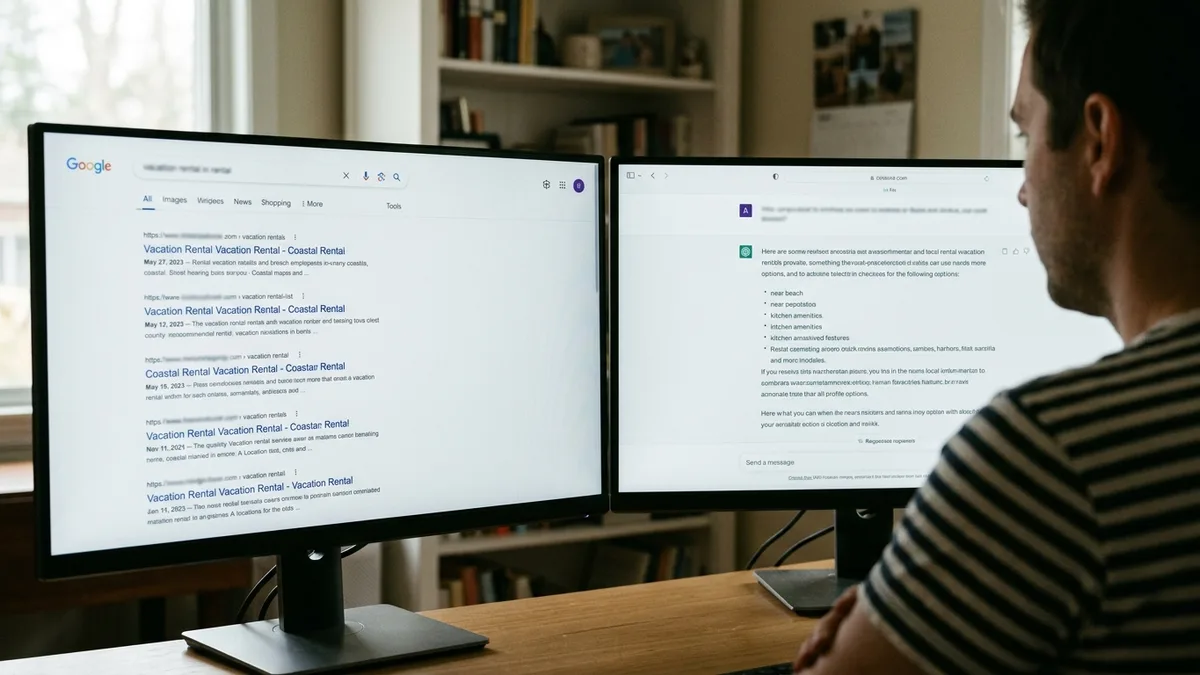
If you manage a short-term rental portfolio, a mountain cabin, or a single beach condo listing, you've probably noticed something changing in how guests search. They're not just typing "best cabin rental Gatlinburg" into Google anymore. They're asking ChatGPT "where should I stay near the Smoky Mountains with a hot tub" or asking Perplexity to compare three properties side by side. If your content isn't structured for those systems to read and quote, you're invisible in a channel that's growing faster than traditional search.
At inkSTR, we've watched this shift closely because it directly affects whether our clients' content gets found at all. Ranking on AI search engines in 2026 isn't a separate discipline from SEO, it's an extension of it, with specific technical and structural requirements layered on top. This guide walks through exactly what those requirements are, why most STR websites fail to meet them, and what a working system looks like when you get it right.
We'll cover the four questions we hear most from property managers and hosts trying to figure this out: how to rank higher on AI searches generally, how to get your specific website recognized by AI systems, how ranking in ChatGPT search differs from ranking in Google, and which AI search engines actually matter for a short-term rental business right now.
How Do You Rank Higher on AI Searches?
Ranking higher on AI searches requires structuring content so large language models can extract a direct answer within the first two sentences of each section, then reinforcing that answer with schema markup, specific data, and named entities. AI systems don't crawl for keywords the way Google's classic algorithm did, they retrieve passages that answer a question completely on their own.
Here's the problem: most vacation rental blog posts are written to tell a story, not answer a question. A typical post opens with "Nestled among the pines, our cabin offers..." That's a dead end for AI extraction. There's no direct answer, no data point, nothing an AI system can lift and cite confidently.
Without a deliberate structure, you're writing content that reads fine to a human skimming for atmosphere but gives an AI system nothing quotable. That means ChatGPT summarizes a competitor's page instead of yours, even if your cabin is objectively a better fit for the traveler's question. You lose the booking before the guest even sees your listing.
The fix is definitional, answer-first writing: open every section with a sentence that could stand alone as a citation. Specifically, that means stating the fact, then explaining it, then supporting it with a number or named detail. This is exactly the gap inkSTR's AI Content Writer was built to close. It generates articles with that answer-first structure by default, so you're not relying on a freelancer who's never heard of generative engine optimization to get the format right.
How Do I Rank My Website on AI Search Engines?
Getting your specific website recognized by AI search engines starts with confirming that AI crawlers, including GPTBot and Perplexity's crawler, can actually access your site through your robots.txt file. Beyond crawlability, you need schema markup, topical depth across multiple related pages, and content that's been updated recently.
Most STR operators have never checked their robots.txt file for AI crawler access. If GPTBot is blocked, whether intentionally or by a default theme setting, none of your content can be retrieved by ChatGPT's search function, no matter how well written it is. This is a five-minute technical check that a huge share of vacation rental websites fail.
Beyond crawlability, AI systems weight topical clusters over standalone posts. A single blog post about "pet-friendly cabins near the Smokies" ranks weaker than that same post sitting inside a cluster of ten related articles covering pet policies, local pet-friendly trails, and nearby vet services. Writing that cluster manually takes weeks. Most hosts publish one post, feel good about it, then stop for three months, which is exactly the freshness gap AI systems penalize.
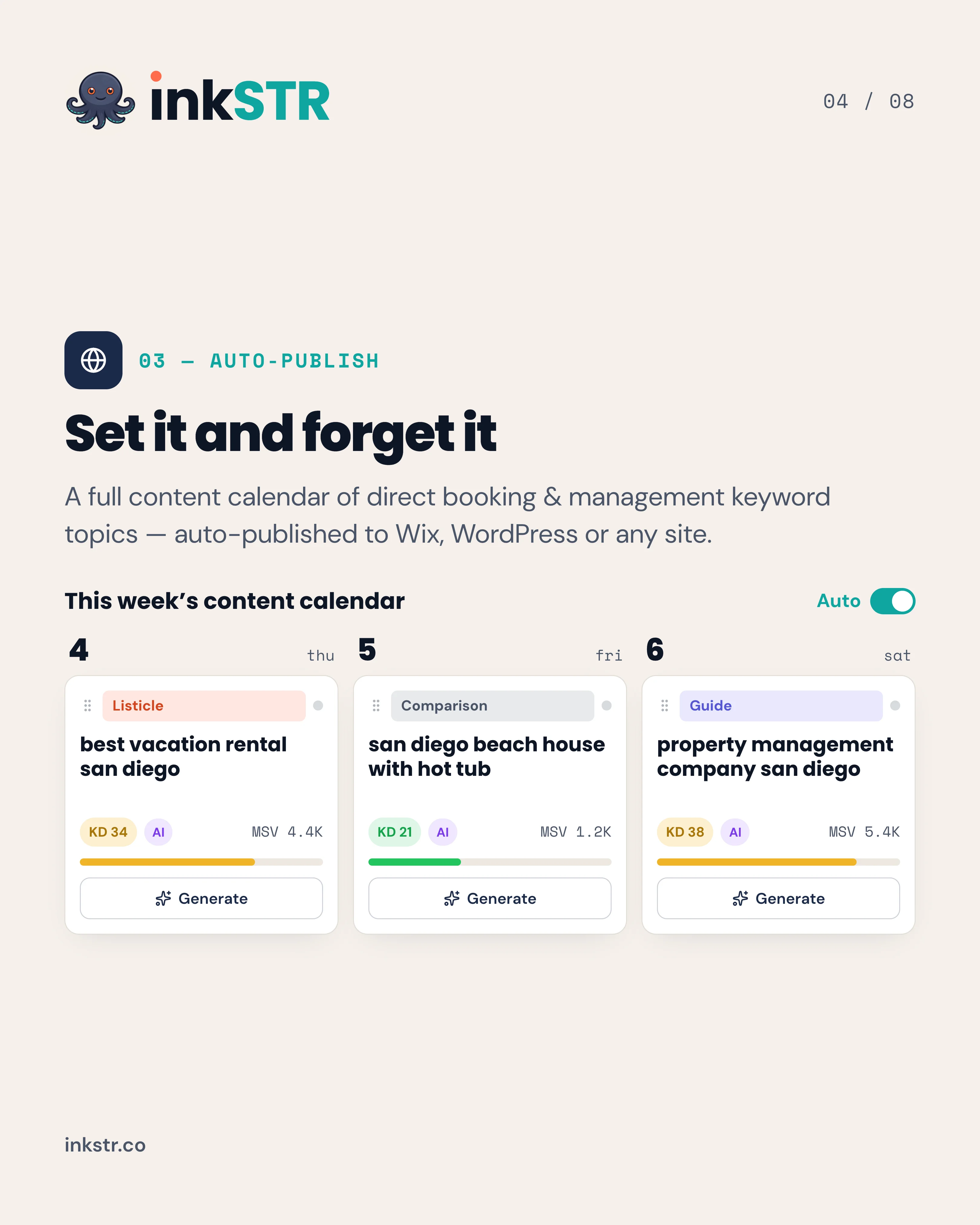
We built inkSTR's Content Calendar specifically because consistency, not a single great post, is what gets a domain recognized as an authority by AI retrieval systems. It schedules and publishes articles automatically on a set cadence, so your site keeps accumulating the topical depth and freshness signals that AI Overviews and ChatGPT search reward, whether or not you have time to think about it that week.

How Do You Rank in ChatGPT Search?
Ranking in ChatGPT search depends heavily on the same signals that drive Bing's traditional rankings, since ChatGPT's search function draws substantially from Bing's index and web crawl. That means classic on-page SEO fundamentals, like clear headings, fast load times, and indexable pages, still matter even though the output looks conversational.
There's a real connection between Bing's ranking factors and what ChatGPT search surfaces, which means STR operators who've ignored Bing Webmaster Tools in favor of Google Search Console are leaving visibility on the table. If your site has never been submitted to Bing, you may be functionally invisible to a meaningful share of ChatGPT search queries.
Beyond the technical index issue, ChatGPT tends to favor content with specific, quotable claims: named numbers, named locations, named amenities. A vague sentence like "our property offers great amenities" gives ChatGPT nothing to repeat. A sentence like "the cabin sits eleven minutes from the national park entrance and includes a private hot tub" gives it an answer it can hand directly to the user.
This is where most manually written STR content falls short, not because the writing is bad, but because it wasn't built with retrieval in mind. inkSTR's Keyword Research tool identifies the exact phrasing travelers use when they ask AI assistants about a destination or property type, so the content we generate matches how people actually query these systems, not just how they type into a Google search bar.
Who Are the Top AI Search Engines to Optimize For?
The top AI search engines relevant to short-term rental marketing in 2026 are Google's AI Overviews and AI Mode, ChatGPT search, Perplexity, and Microsoft Copilot. Each pulls from a different underlying index and weighs freshness, schema, and citation density slightly differently, which means a single optimization strategy needs to satisfy all four rather than picking one.
Google's AI Mode update expanded how the search giant surfaces synthesized answers directly in results, including through multimodal search capabilities that can factor in property images alongside text. If your image alt text and file names are generic, you're missing a channel Google has explicitly built out.
Perplexity, meanwhile, weighs time-decay and freshness more heavily than the others, meaning a cabin rental guide from 2023 that hasn't been touched since will fade from its citation pool even if it once ranked well. Copilot leans on Bing's index similarly to ChatGPT search, reinforcing why Bing Webmaster Tools shouldn't be an afterthought.
Trying to manually track four different AI systems' preferences while also writing content is not a reasonable expectation for a host managing their own bookings. That's precisely why we built inkSTR to bake all four systems' requirements, schema, freshness, structure, and multimodal readiness, into every article by default, rather than asking operators to become AI search specialists on top of running their properties.
What Does an AI-Search-Ready Content Structure Actually Look Like?
An AI-search-ready structure means every section opens with a direct answer of roughly 40 to 60 words, uses semantic HTML5 headings, and includes schema markup for FAQ, HowTo, or Article types depending on the page's purpose. This is a measurable, checkable format, not a vague stylistic preference.
Research into AI citation patterns shows that top-cited pages place close to 44 to 45% of all citations in the first 30% of the page. That means your opening paragraphs carry disproportionate weight. If you bury your best answer three paragraphs down, after a story about how you found your cabin, you've already lost most of your citation potential before the AI system even reaches the useful part.
| Structural Element | Why AI Systems Reward It | Manual Effort Required |
|---|---|---|
| Answer-first paragraphs (40 to 60 words) | Matches retrieval-augmented generation extraction patterns | High, requires rewriting habits built over years |
| FAQ and HowTo schema markup | Correlates with up to 40% more AI Overview appearances | Requires developer knowledge or a plugin |
| Content refreshed within 3 months | Nearly 2x more citations than stale pages | Requires an ongoing publishing calendar |
| Named entities (places, platforms, numbers) | Signals credibility and specificity to LLMs | Requires research per article |
| Semantic HTML5 (article, section tags) | Improves machine readability without JavaScript dependency | Requires template or CMS-level changes |
Building this structure article by article, by hand, is realistically a multi-hour task per post even for an experienced writer. This is the exact workflow gap inkSTR's AI Content Writer automates: it applies the answer-first format, adds the schema hooks, and pulls in named entities relevant to your market, whether that's a beach town boardwalk or a specific ski resort access road, without you touching a template.
Why Isn't Your Vacation Rental Showing Up in AI Search Results Yet?
Your vacation rental likely isn't showing up in AI search results because your content lacks the answer-first structure, hasn't been updated recently, or was never submitted for indexing to Bing and other non-Google crawlers. This is rarely a quality problem, it's a formatting and technical access problem.
We see this constantly with independent hosts and small property management companies: the "About Us" page is well written, the property descriptions are accurate, but nothing on the site answers a specific traveler question directly enough for an AI system to lift and quote. The content exists, but it isn't retrievable in the way these systems require.
The painful part is how much time gets sunk into content that never gets cited. Writing one quality blog post manually takes three to five hours of research and writing, and if you're paying a freelance travel writer instead, that's typically $300 to $700 per post. If that post isn't structured for AI extraction, you've spent real money and real hours on content that AI systems will simply skip past in favor of a competitor's better-formatted page.
Compare that to inkSTR's pricing, which starts at $99 per month for a system that generates, schedules, and publishes AI-search-ready articles automatically. A single direct booking from that traffic is typically worth $1,000 to $4,000 in revenue, meaning one converted guest can cover months of the platform's cost. Our guide on why your vacation rental website is not ranking on Google covers the traditional SEO side of this same underlying problem.
Ready to automate your content marketing?
inkSTR handles keyword research, content strategy, article writing, and publishing, all on autopilot.
How Do Structured Data and Schema Markup Improve AI Citation Rates?
Structured data, specifically FAQ, HowTo, Article, and Organization schema, gives AI systems an explicit, machine-readable map of your content's meaning instead of forcing them to infer it from unstructured text. Industry research shows structured data correlates with up to 40% more appearances in AI Overview-style results, making it one of the highest-leverage technical fixes available.
Most WordPress and Wix themes don't add this automatically. You either need a developer, a specific plugin, or a platform that builds it in as part of the publishing step. For a host managing their own site part-time, this is the kind of task that gets pushed to "someday" and never happens.
Here's a concrete example: an FAQ section formatted as plain paragraph text gets ignored by AI Overview systems looking for FAQPage schema. The exact same content, wrapped in proper JSON-LD markup, becomes eligible for direct citation. The words don't change. The markup does. That distinction is invisible to a reader but decisive to a machine.
inkSTR's Auto-Publishing feature applies this markup automatically when it pushes content live to Wix, WordPress, or a custom site, so you're not relying on remembering to install and configure a separate schema plugin correctly. Our backlink guide covers the authority side of this equation, since schema and backlinks work together to build the trust signals AI systems weigh.
How Often Should You Update Content to Stay Visible in AI Search?
Content should be reviewed and refreshed at least quarterly to maintain strong AI search visibility, since pages updated within the last three months receive nearly twice as many AI citations as older, untouched pages. This freshness weighting is one of the clearest, most operationalizable rules in AI search optimization.
Most STR blogs follow a burst-and-stop pattern. A host gets motivated in January, publishes four posts, then life gets busy with turnovers and guest messages, and the blog goes silent until next winter. That inconsistency is exactly what both Google's traditional algorithm and AI retrieval systems penalize.
Manually committing to a quarterly refresh schedule across an entire property portfolio, updating statistics, checking local attraction links, adding a "last updated" date, is a task most operators simply don't have bandwidth for once you factor in cleaning coordination, guest communication, and actual property upkeep.
This is the exact problem inkSTR's Content Calendar was designed to solve. It keeps a publishing cadence running in the background, generating and scheduling new articles and refreshes automatically, so the freshness signal AI systems reward keeps accumulating whether or not you remember to log in that week. For managers overseeing multiple properties, our guide to must-have tools for scaling STR managers covers the broader tech stack this fits into.
What's the 90-Day Framework for Getting Cited by AI Search Engines?
A practical 90-day framework for AI search visibility breaks into three phases: days 1 through 30 for technical foundation work, days 31 through 60 for content restructuring, and days 61 through 90 for authority building and measurement. This phased approach prevents operators from trying to fix everything simultaneously and giving up.
Days 1 to 30: Technical Foundation
First, confirm AI crawlers like GPTBot can access your site through robots.txt. Check that page load speed is fast, ideally with a server response time under 200 milliseconds. Submit your sitemap to Bing Webmaster Tools, not just Google Search Console, since ChatGPT search and Copilot both draw from Bing's index.
Days 31 to 60: Content Restructuring
Next, rewrite your highest-traffic existing pages to open with answer-first paragraphs. Add FAQ schema to any page already answering common guest questions. Specifically target the questions travelers actually ask, using natural phrasing rather than keyword-stuffed variations.
Days 61 to 90: Authority and Measurement
Finally, track citation frequency and referral traffic from individual AI platforms as a distinct metric, separate from traditional organic traffic. As a result, you'll know whether your restructuring efforts are actually working rather than guessing.
Running this entire framework manually, across technical audits, content rewrites, and ongoing measurement, is a genuinely demanding project even for a marketing team, let alone a solo host. inkSTR's full content workflow was built to compress this 90-day framework into an ongoing automated system rather than a one-time sprint you complete and then abandon.
What Mistakes Cause STR Content to Fail in AI Search Rankings?
The most common mistake is writing content designed to sound appealing rather than to answer a specific question directly, which leaves AI systems with nothing extractable to cite. Other frequent failures include blocked AI crawlers, missing schema markup, and publishing inconsistently after an initial burst of enthusiasm.
- Story-first openings. Starting a post with scene-setting language instead of a direct answer wastes the highest-value real estate on the page.
- No schema markup. Content without FAQ or Article schema is invisible to the structured data patterns AI Overviews prioritize.
- Blocked crawlers. A misconfigured robots.txt file can silently exclude GPTBot or Perplexity's crawler without you ever noticing.
- Inconsistent publishing. A single great post followed by three months of silence signals low authority, regardless of that post's quality.
- Vague, unspecific claims. Sentences without named entities, numbers, or specifics give AI systems nothing quotable to lift.
We regularly see property management companies who assumed their content marketing wasn't working, when in reality it was a formatting and technical access problem the whole time. Our guide to ranking on Google for STR operators covers the traditional SEO mistakes that often overlap with these AI search failures. inkSTR's built-in quality scoring flags these exact issues before an article publishes, so the mistake never makes it live in the first place.
Frequently Asked Questions
How long does it take to start seeing AI search citations for a vacation rental site?
Most sites see initial AI Overview appearances within four to eight weeks of implementing schema markup and answer-first content structure, assuming crawlability isn't blocked. Full authority building, the kind that gets you consistently cited across ChatGPT, Perplexity, and Google AI Overviews, typically takes several months of consistent publishing, similar to traditional SEO timelines.
Do I need existing SEO knowledge to optimize for AI search engines?
No, though understanding basic concepts like schema markup and crawlability helps. Platforms like inkSTR handle the technical implementation, structured data, and answer-first formatting automatically, so operators without an SEO background can still produce AI-search-ready content through the AI Content Writer.
Does ranking in AI search replace the need for traditional Google SEO?
No, the two are deeply connected rather than separate disciplines. Google's own AI Overviews draw from the same indexed pages that rank in traditional search, and ChatGPT search relies substantially on Bing's index, meaning strong traditional SEO fundamentals remain the foundation AI visibility is built on top of.
Can AI write content that actually ranks well in AI search engines?
Yes, when it's built specifically with retrieval patterns in mind, including answer-first paragraphs, schema markup, and named entities. Generic AI writing tools without hospitality-specific training often produce vague, unstructured content, which is why inkSTR was built specifically for short-term rental terminology and traveler search intent rather than as a horizontal writing tool.
How many blog articles does a vacation rental site need before AI systems start citing it regularly?
There's no fixed number, but topical clusters of eight to fifteen related articles covering a subject from multiple angles perform meaningfully better than isolated posts. Depth and consistency across a topic matter more than any single article's word count.
Should I block AI crawlers like GPTBot to protect my content from being used to train AI models?
That's a legitimate business decision, but blocking GPTBot also removes your ability to be cited in ChatGPT search results, since the same crawler often powers both training data collection and live search retrieval. Weigh that tradeoff based on whether AI referral traffic matters more to your booking strategy than training data concerns.
What's the difference between optimizing for Google AI Overviews and optimizing for ChatGPT search?
Google AI Overviews draw from Google's own index and increasingly factor in multimodal signals like property images, while ChatGPT search draws substantially from Bing's index and rewards specific, quotable claims. A well-structured, schema-rich, regularly updated site tends to perform well across both, since the underlying requirements, crawlability, freshness, and answer-first structure, overlap significantly.
The Bottom Line on Ranking in AI Search
Ranking on AI search engines in 2026 comes down to four repeatable actions: confirm AI crawlers can access your site, restructure content around direct answers, implement schema markup, and publish consistently enough to stay fresh in AI systems' citation pools. None of these are one-time fixes, they're ongoing operational habits.
The operators who get this right aren't necessarily better writers. They're the ones who treat content structure as seriously as they treat guest communication or pricing strategy. Given that AI referral traffic to top websites grew 357% year over year as of mid-2025, this isn't a niche channel to experiment with someday, it's becoming a primary discovery path for travelers right now, in 2026.
Getting found on Google and in AI search isn't about publishing more content, it's about publishing the right content, consistently, in the structure both readers and machines expect. inkSTR handles that process end to end, from keyword research to schema-ready publishing, so it happens whether or not you have time to sit down and write.

If building AI-search-ready content on top of running your properties feels like a second full-time job, get started with inkSTR and see your first automatically published, schema-ready article this week.
Content powered by inkSTR.co
Enjoyed this article? Share it:
Get more of inkSTR in Google Search
Add inkstr.co as a preferred source and our articles show up more in Top Stories, AI Overviews, and AI Mode — with a “Preferred” badge.
Get more guides like this
New SEO and AI-search guides, straight to your inbox. No spam, unsubscribe anytime.