How to Write Blog Posts for Rental Property (Zero Experience)

You can write a usable blog post for your rental property in under an hour by answering one real guest question in plain language, adding a specific local detail, and publishing it without waiting for it to feel perfect. That is the entire skill. Everything else in this guide is refinement.
- No writing background required: the fastest path to a working rental blog is turning guest questions you already answer by text message into published posts.
- Consistency beats talent: industry data shows organic search drives 38% of traffic to vacation rental sites, more than direct or paid combined (CUFinder, 2026).
- Mobile matters more than you think: mobile traffic represents 68.5% of all vacation rental website visits, so short paragraphs and scannable formatting are not optional (CUFinder, 2026).
- Search still drives bookings: 42% of US leisure travelers said Google Search impacted their travel provider decision on their last trip (ShortTermRentalz, 2023).
- A ranking blog post keeps working for years, often driving organic traffic for 2 to 5 years after you hit publish, unlike a single social post that disappears in a day.
- inkSTR removes the blank-page problem entirely by generating, scheduling, and publishing keyword-targeted posts for your property automatically, so you never have to stare at an empty draft again.
If you manage a rental property and have never written anything longer than a guest welcome message, you are not alone. Most hosts we talk to at inkSTR assume blogging requires a journalism degree or a natural gift for storytelling. It does not. It requires knowing what your guests actually search for, and answering it clearly.
In 2026, the vacation rental market is more competitive than it has ever been. The global vacation rental market is projected to reach $106.5 billion this year (Grand View Research, 2026), and professional management companies already control an estimated 42% of active listings worldwide (Dataintelo, 2026). That means more polished competitors are fighting for the same search terms your property could rank for.
This guide walks through exactly how to write blog posts for rental property listings when you have zero writing experience: what to write about, how to structure it, how long it should take, and where AI tools like inkSTR fit into a sustainable system instead of a one-time hack.
What Is the 80 20 Rule for Blogging?
The 80 20 rule for blogging means 80% of your results come from 20% of your content, so you should identify which post types actually drive traffic and bookings, then produce more of those instead of spreading effort evenly across every topic idea. For a rental property, that 20% is almost always destination-specific, high-intent content: neighborhood guides, "what's included" posts, and seasonal availability updates.
Generic posts like "5 Reasons to Visit Our Town" rarely rank and rarely convert. Specific posts like "Where to Park Near [Neighborhood] When Staying at Our Cabin" or "What to Pack for a Fall Weekend at [Property Name]" answer a real search intent. According to industry guidance from vacation rental platforms, mixing broad interest posts with narrow, distinctive local content performs best, rather than publishing only generic travel filler.
Writing five unfocused posts a month feels productive but rarely moves the needle. Most first-time bloggers we've seen burn out because they treat every idea as equally valuable, spending three to five hours per post on topics nobody searches for. That's 15 to 25 hours a month with almost nothing to show for it in Google rankings.
This is exactly the problem inkSTR's keyword research tool was built to solve. Instead of guessing which 20% of topics matter, it surfaces the specific search terms your target guests are actually typing, so every post you publish (or every post inkSTR generates for you) targets proven demand instead of hopeful guesswork.
What Is the 50% Rule in Rental Property?
The 50% rule in rental property is a quick financial estimate stating that operating expenses, excluding mortgage payments, typically consume about half of a property's gross rental income. Applied to content marketing, it's a useful mental model: if half your rental income effectively goes to operating costs, every dollar you save on marketing (like OTA commissions) has an outsized impact on your actual take-home revenue.
Here's where this connects directly to blogging. Airbnb host and guest fees combined typically run 17 to 19% of every booking. If you're already operating on thin margins under the 50% rule, losing another fifth of revenue to platform fees compounds the problem fast. A direct booking, driven by an organic search visitor who found your blog post, keeps that 17 to 19% in your pocket.
A single direct booking is typically worth $1,000 to $4,000 in revenue depending on your property type and length of stay. Multiply that by even a handful of direct bookings a month, and the math on content marketing starts to look a lot better than the math on relying entirely on Airbnb or VRBO traffic.
Most hosts never run this calculation. They see blogging as a nice-to-have, not a revenue lever tied directly to their bottom line. We built inkSTR's content workflow specifically because the operators who treat content as a numbers game, not a creative hobby, are the ones who actually reduce their dependence on OTA fees over time.
How Long Does It Take to Make $1000 Per Month Blogging?
Most vacation rental blogs take four to six months of consistent publishing before they generate meaningful organic traffic, and reaching $1,000 a month in attributable direct booking revenue typically requires 12 to 20 published posts targeting a mix of destination and long-tail booking-intent keywords. This is not a get-rich-quick timeline, and any resource that promises faster is overselling.
Here's the math that actually matters. If a single direct booking is worth $1,000 to $4,000, you may only need one or two blog-driven direct bookings a month to hit that $1,000 threshold. That's a very different bar than "build a huge audience." Your blog does not need thousands of readers. It needs the right dozen readers who are already planning a trip to your area.
The problem is that most hosts give up around post number three or four, right when momentum should start building. Writing one quality post manually takes 3 to 5 hours of research and writing. At that pace, reaching 12 posts means 36 to 60 hours of work, roughly a full week and a half of unpaid labor squeezed between check-ins and cleaning schedules.
A freelance travel writer charges $300 to $700 per quality blog post, so outsourcing those same 12 posts could cost $3,600 to $8,400 before you've earned a dollar back. That's a rough trade-off: burn your own time, or burn cash you may not have yet as a new host.
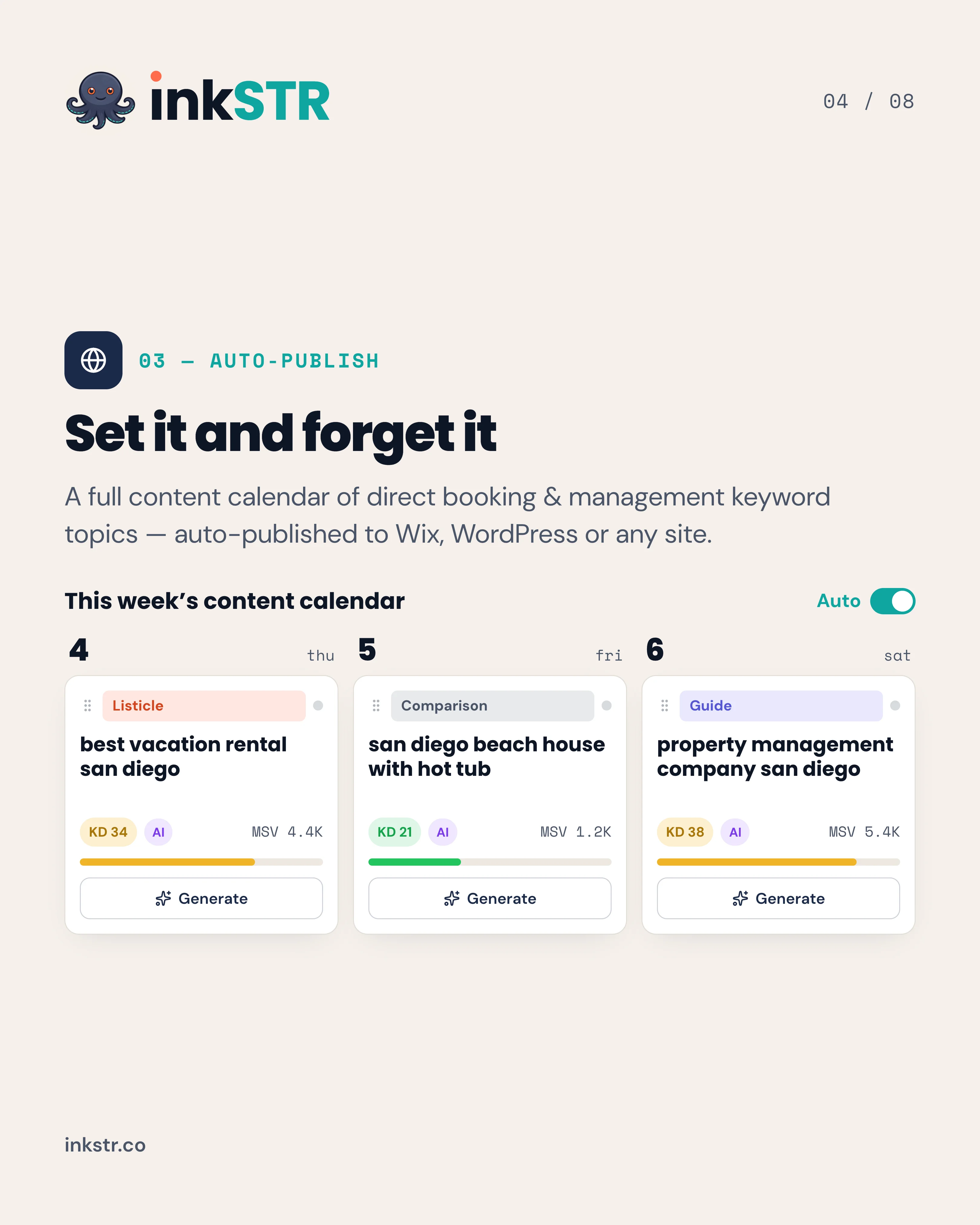
This is the exact gap inkSTR's AI Content Writer was designed to close. It generates SEO-optimized, STR-specific blog posts on a set schedule for $99 a month, a fraction of even a single freelance post, so you can hit that 12 to 20 post milestone without draining your calendar or your budget. Our Content Calendar then keeps the publishing cadence consistent, which matters more than any single post's quality.
| Approach | Cost per Post | Time per Post | Consistency Risk |
|---|---|---|---|
| Write it yourself | $0 cash, high time cost | 3 to 5 hours | High: most hosts stop after 2 to 3 posts |
| Hire a freelancer | $300 to $700 | 0 hours (your time) | Medium: budget often runs out |
| inkSTR automation | $99/month for unlimited scheduled posts | Minutes for review | Low: publishing runs on autopilot |
How to Write a Marketing Description for a Rental Property?
A marketing description for a rental property is a concise, benefit-focused summary that highlights the property's most distinctive features, location advantages, and ideal guest type in 300 to 500 words of specific, location-rich copy. According to Hostfully's 2026 guidance, vacation rental property pages perform best when they avoid vague adjectives and instead describe concrete, verifiable details a guest can picture.
Start with what makes the property genuinely different, not generic claims like "cozy" or "charming" that could describe any listing. Instead, name the actual walk time to the nearest trailhead, the specific view from the deck, or the exact model of amenity that sets you apart, like a wood-fired hot tub versus a standard jacuzzi.
Then address the guest directly. Write "you'll wake up to mountain light through the east-facing windows" instead of "guests enjoy beautiful morning light." Second-person language converts better because it lets the reader picture themselves there, rather than reading about someone else's experience.
Close with a practical detail that removes hesitation: parking availability, check-in flexibility, or proximity to a specific landmark. This is also where a well-written blog post differs from a listing description. Your blog can go deeper into one specific angle (a neighborhood, a season, a type of trip) in ways a 500-word property page cannot.
If you're building out a full site beyond the single property description, our guide on local area guides that sell covers how to expand a single property description into a network of supporting content that ranks for more search terms over time.
What Should You Blog About for Your Vacation Rental Website?
The best vacation rental blog topics answer a specific question a real guest has already asked you, whether by email, text, or during check-in. Industry data recommends starting with a mix: three neighborhood guides, one perfect-weekend itinerary, one packing list, and one seasonal events roundup as your first six posts.
Here's the content gap in beginner blogging advice, and it's a big one. Most guides tell you to "write about local attractions" without ever showing you what a first post from someone with zero writing experience actually looks like. So here's a real template you can copy today.
Template: Turning a Guest Question Into a Blog Post
- Pick a question you've answered at least three times. Example: "Where do we park?" or "Is there cell service?"
- Write the headline as the question itself. "Where to Park at [Property Name]: A Guide for First-Time Guests."
- Open with the direct answer in one sentence. Don't bury it. "Free street parking is available directly in front of the house after 6pm on weekdays."
- Add three supporting details. Nearest paid lot if the free option is full, what happens on event weekends, and one photo of the parking area if you have one.
- Close with a related tip. Mention the nearest coffee shop within walking distance, or a seasonal note about snow clearing.
That's a complete, publishable post. It took the structure of a text message you've already sent guests and turned it into 300 to 400 words of searchable content. Repeat this five or six times using your most common guest questions, and you have a functioning content foundation without writing a single "creative" sentence.
For hosts who want a steady stream of ideas beyond their own guest questions, we cover dozens more starting points in vacation rental blog topics that actually drive bookings. And if you'd rather skip the brainstorming entirely, inkSTR's content strategy engine generates topic ideas automatically based on what guests in your specific market are searching for.
How Do You Rewrite Guest Questions Into Blog Content Without Sounding Robotic?
Rewriting guest questions into blog content means preserving the guest's original phrasing as your headline or opening line, then expanding your usual verbal answer into full sentences with added specifics you wouldn't normally include in a quick reply. The skill isn't creative writing, it's expansion and specificity.
Here's a concrete before-and-after. A guest texts: "Is the hot tub working right now?" You'd normally reply "Yes, just refilled it Tuesday, should be good all week." A blog version becomes: "Yes, the hot tub is fully operational and was refilled and rebalanced this past Tuesday. We service it weekly during peak season, so if you're staying midweek, expect clean, properly heated water from check-in."
Notice what changed. The core fact stayed identical. What got added was the service cadence, the seasonal context, and a reassurance for a specific type of guest (midweek stayers). That's the entire transformation from text message to blog post.
Most first-time bloggers freeze up because they think they need to add personality, jokes, or storytelling flourishes. You don't. Guests searching "is there a hot tub at [town] rentals" want a factual, confident answer, not a personal essay. Write like you're texting a friend who asked a slightly more detailed version of the question.
If turning dozens of guest FAQs into individual posts sounds like more time than you have, that's precisely the workload inkSTR's AI Content Writer absorbs. Feed it your property details and common guest questions, and it drafts the expanded, SEO-structured version for you to review and publish.
Should You Outsource Blog Writing, and How Do You Keep Your Property's Voice?
Outsourcing blog writing for a rental property is worth it when the alternative is publishing nothing at all, but the biggest risk is losing the specific voice and details that make your property distinct from a generic listing. A freelance writer who has never stayed at your property will default to generic vacation rental language unless you give them very specific input.
The fix is a short brief, not a long one. Give any writer, human or AI, three things: the exact amenities that make your property different, two or three phrases you actually use when describing it to guests, and one thing you never want said about it (overly formal language, exaggerated claims, etc).
This is where generic AI writing tools and freelancers both tend to fail STR operators. A freelance travel writer costs $300 to $700 per post and still might not understand vacation rental search intent or your specific market. A generic AI writing tool has never seen an Airbnb listing and doesn't know the difference between a co-host workflow and a standard property management fee.
inkSTR was built specifically for short-term rental operators, so its AI already understands vacation rental terminology, traveler search intent, and location-based SEO for markets like beach towns, mountain retreats, and lake house destinations. That niche focus is the difference between a post that reads like it was written about your property and one that reads like it was written about any property.
Our guide on article automation without losing your brand voice goes deeper into how to keep automated content sounding like you, not like a template.
How Do You Handle Negative Guest Feedback in Blog Content Without Sounding Defensive?
Handling negative guest feedback in blog content means addressing a known concern proactively, in neutral and factual language, before a prospective guest has to ask about it themselves. This is one of the most overlooked blog uses for rental properties: turning a recurring complaint into a page that reassures future guests instead of hiding the issue.
Say your property has gotten occasional comments about street noise on weekend nights. Ignoring it in your marketing doesn't make it disappear, it just means guests find out after booking, which hurts your reviews more than addressing it upfront ever would.
Write a short, factual post: "What to Know About Nighttime Noise Near [Property Name]." State the fact plainly: weekend nights near the downtown corridor can have moderate street noise until around midnight. Then offer the practical mitigation: the bedroom windows face the quieter side yard, or you provide earplugs, or the noise typically stops well before most guests are asleep.
This approach does two things. It sets accurate expectations, which reduces the chance of a surprised, frustrated review. And it signals to Google and to readers that you're a transparent, hands-on operator, not a hands-off listing. Transparency reads as trustworthiness, and trustworthiness converts better than an unrealistically perfect description ever will.
Most hosts never write this kind of post because it feels uncomfortable to acknowledge a flaw publicly. But in our experience helping operators build out content libraries with inkSTR, the properties with the strongest direct booking conversion rates are almost always the ones being upfront about trade-offs, not the ones pretending every stay is flawless.
Ready to automate your content marketing?
inkSTR handles keyword research, content strategy, article writing, and publishing, all on autopilot.
How Do You Structure a Rental Property Blog Post So It Actually Ranks?
A well-structured rental property blog post uses the target keyword in the title and URL, reserves the H1 for the post title alone, and organizes the body with H2 and H3 subheadings that break the content into scannable sections. This structure matters as much for readers as it does for Google's crawlers, especially since mobile traffic represents 68.5% of all vacation rental website visits (CUFinder, 2026).
Keep paragraphs to two or three sentences. A wall of text on a phone screen gets abandoned fast. Add at least one image, ideally a real photo of your property or the specific location you're describing, and always include a working internal link to another page on your site, whether that's your booking page or another blog post.
Bullet points and numbered lists aren't just for readability, they also tend to get pulled directly into Google's featured snippets and AI Overviews when they answer a specific question clearly. If your post is a "how to" or step-based post, format the steps as an ordered list, not a paragraph.
Once you have five or six posts published, check how to rank your vacation rental website on Google for the technical details that matter beyond writing: internal linking patterns, site speed, and how Google evaluates freshness over time.
Manually formatting every post to hit all of these structural requirements adds real time on top of the writing itself. inkSTR's AI Content Writer builds every post with proper heading hierarchy, scannable paragraph length, and internal link suggestions baked in from the first draft, so you're not learning HTML structure on top of learning to write.

How Often Should You Publish, and What Happens If You're Inconsistent?
You should publish at a realistic, sustainable cadence, even one post a month done consistently for a year, rather than an ambitious schedule you abandon after six weeks. Google's ranking system rewards consistency and freshness over sporadic bursts of five posts followed by three months of silence.
Most first-time hosts overcommit. They publish three posts in an excited first week, then nothing for two months once the workload of actually running the property takes over. That stop-start pattern is worse for your search visibility than a slower, steady pace, because search engines interpret abandoned blogs as low-priority content to keep re-crawling.
A realistic goal for a solo host is two posts a month. For a property manager handling multiple listings, that number needs to scale per property or per market, which is exactly where manual writing collapses under its own weight. Managing content updates across ten or more properties can consume an entire workday, every week, with no writer dedicated to the task.
This is precisely why we built inkSTR's Content Calendar around drag-and-drop scheduling and automated publishing. Instead of you remembering to sit down and write on the first of every month, inkSTR generates, schedules, and publishes articles automatically on a set schedule, so consistency isn't dependent on your willpower during your busiest season.
What Keywords Should You Actually Target for a Rental Property Blog?
The right keywords for a rental property blog combine your location with specific guest intent, such as "pet-friendly cabin near [town]" or "[neighborhood] rental with parking," rather than broad, competitive terms like "vacation rentals" that established platforms already dominate. Long-tail, specific phrases have less competition and higher conversion intent.
Consider the search landscape you're competing in. VRBO ranks on the first page of Google for 94% of vacation rental markets analyzed, and sits in the top three results 64% of the time (BuildUp Bookings, 2019). Competing head-on with a term like "[city] vacation rentals" against that kind of established presence is a losing bet for a single property.
Instead, target what VRBO and Airbnb can't own: hyper-specific combinations only your property or your specific street matches. "Where to eat within walking distance of [property name]" or "best time of year to visit [specific trail near your property]" are searches an OTA listing page will never rank for, because that content doesn't exist on their platform.
Manually researching search volume for dozens of these long-tail combinations, one at a time, in a free tool, eats hours you don't have. inkSTR's Keyword Research tool was built to surface these exact opportunities automatically, mapping the specific terms your target guests search in your market so you're not guessing which combination is worth writing about.
Data Snapshot: What the Numbers Say About Rental Property Blogging in 2026
| Metric | Figure | Source |
|---|---|---|
| Organic search share of vacation rental site traffic | 38% | CUFinder, 2026 |
| Mobile traffic share of vacation rental sites | 68.5% | CUFinder, 2026 |
| Leisure travelers influenced by Google Search | 42% | ShortTermRentalz, 2023 |
| Regional hotel searchers considering vacation rentals | 40% | ShortTermRentalz, 2023 |
| Airbnb host and guest fees combined | 17 to 19% per booking | Industry standard |
| Freelance blog post cost | $300 to $700 per post | Industry standard |
| Manual writing time per post | 3 to 5 hours | Industry standard |
The takeaway from this data is straightforward. Organic search already outperforms paid and equals direct traffic combined for most vacation rental sites, and it's overwhelmingly a mobile experience. If your blog isn't formatted for a phone screen and isn't targeting search terms people actually type, you're leaving the largest traffic channel in the industry untapped.
Practical Guidance: Common Mistakes New Rental Property Bloggers Make
- Writing about the destination, not the property. A post that could describe any rental in your town won't outrank an actual tourism board page. Anchor every post in something specific to your property.
- Publishing without a clear headline keyword. If your title doesn't include the phrase someone would actually search, Google has nothing to match it against.
- Ignoring mobile formatting. Long paragraphs, tiny fonts, and missing subheadings drive away the 68.5% of visitors reading on a phone.
- Quitting after two or three posts. Meaningful traffic typically takes 12 to 20 published posts and four to six months of consistency.
- Avoiding known weaknesses. Hiding a noise issue or a steep driveway from your content doesn't prevent bad reviews, it just delays the disappointment until after check-in.
- Trying to do everything manually across multiple properties. If you manage more than two or three listings, manual blogging does not scale without a system like inkSTR's multi-project content pipeline.
Frequently Asked Questions
How long does it take for a rental property blog post to rank on Google?
Most rental property blog posts take four to six months to show meaningful ranking movement, though some long-tail, low-competition posts can rank within weeks. Consistency across 12 to 20 posts matters more than any single post's speed to rank.
Do I need a separate blog for each property I manage?
If your properties serve very different markets or guest types, separate content pipelines often perform better than one mixed blog. inkSTR's multi-project architecture creates independent content pipelines per property so you're not blending unrelated keywords and audiences on a single site.
Can AI actually write good blog content for a vacation rental?
Yes, when the AI is trained on hospitality-specific language and search intent rather than generic business writing. inkSTR's AI Content Writer is built specifically for short-term rental terminology, so its output already understands concepts like co-hosting, occupancy, and direct booking language that generic AI tools miss.
What is the difference between blog content and my Airbnb listing description?
Your Airbnb listing description is confined to the OTA's format and only reaches people already browsing that platform. A blog post lives on your own website, can rank independently on Google, and can go far deeper into one specific topic than a listing description ever could.
How many blog posts do I need before I see organic traffic?
Most vacation rental websites begin showing meaningful ranking movement after 12 to 20 published articles targeting a mix of destination keywords and long-tail booking-intent queries. inkSTR's content calendar automates that publishing schedule so you reach that milestone without manually tracking every post date.
What should my very first blog post be about?
Start with the guest question you've answered the most times by text or email, whether that's about parking, check-in, or a nearby amenity. That question already has proven demand, since real people have asked it, which makes it a safer bet than a topic you're guessing might interest readers.
Is it worth paying for a content writer if I only have one property?
A freelance writer typically charges $300 to $700 per post, which adds up fast if you need 12 or more posts to see results. For a single property, inkSTR's $99 a month plan often delivers a comparable or better volume of STR-specific content at a fraction of that cost.
Conclusion: Your Rental Property Blog Doesn't Need to Be Perfect, It Needs to Publish
Writing blog posts for your rental property when you have zero writing experience comes down to one repeatable move: take a question a real guest has already asked you, answer it completely in plain language, and format it so it's scannable on a phone. That's the system, repeated 12 to 20 times over four to six months, that starts generating organic traffic and direct bookings.
The math favors starting now. A single direct booking is worth $1,000 to $4,000, and a ranking blog post can keep driving that traffic for 2 to 5 years after you publish it. Compared to the ongoing 17 to 19% you lose to Airbnb and VRBO fees on every OTA booking, even a modest content library pays for itself many times over.
If the biggest barrier has been time, not ideas, that's exactly the gap inkSTR was built to close. Start with one post this week using the guest-question template above, then let automation carry the rest of the schedule as your property portfolio grows into 2026 and beyond.

Get started with inkSTR and see how automated keyword research, AI drafting, and scheduled publishing turn a single guest question into a full content library, without you ever having to stare at a blank page again.
Content powered by inkSTR.co
Enjoyed this article? Share it:
Get more of inkSTR in Google Search
Add inkstr.co as a preferred source and our articles show up more in Top Stories, AI Overviews, and AI Mode — with a “Preferred” badge.
Get more guides like this
New SEO and AI-search guides, straight to your inbox. No spam, unsubscribe anytime.