What Is Organic Search Traffic? A Practical Guide for 2026
Organic search traffic is the visits your website earns from unpaid, algorithm-ranked results on search engines like Google or Bing, as opposed to clicks you pay for through ads. For short-term rental operators, it means guests finding your booking website through a Google search rather than through Airbnb or a sponsored listing.
Key Takeaways
- Organic search traffic comes from unpaid, algorithm-ranked results on search engines, not from ads or referral links.
- Google holds roughly 89.85% of global search traffic as of 2026, according to StatCounter, which is why most STR operators focus their content strategy there first.
- In the vacation rental industry, organic search drives about 38% of website traffic, compared to 32% from direct visits and 16% from paid search.
- Organic search leads convert at an average close rate of 14.6%, and cost roughly $31 per lead compared to about $198 per paid search lead.
- You can verify your own organic traffic in Google Analytics 4 under Reports > Acquisition > Traffic acquisition, and in Google Search Console under the Performance tab.
- inkSTR automates the keyword research, article generation, and publishing schedule needed to build organic search traffic without adding hours to your week.
If you manage a vacation rental, you have probably heard that "organic traffic" matters more than paid ads for long-term growth. But most explanations stop at a dictionary definition and never connect it to what you actually do all day: chasing bookings and wondering why your direct booking site barely shows up on page one.
This guide breaks down organic search traffic in the context of vacation rental marketing: what counts as organic, how to measure it correctly, and where most STR operators go wrong trying to grow it. We built inkSTR because manually chasing organic rankings while running a rental business is close to impossible, and we've watched that gap sink otherwise strong properties in competitive markets.
By 2026, the search landscape has added a wrinkle that older definitions of organic traffic never anticipated: AI-generated answers from tools like Google's AI Overviews and ChatGPT. We'll cover where those fit, because the answer isn't as settled as most SEO blogs pretend it is.
What Is an Example of Organic Search?
An example of organic search is a traveler typing "pet-friendly cabin near Gatlinburg with hot tub" into Google, then clicking your blog post because it ranks in the unpaid results below any ads. No money changed hands to earn that click, and no platform charged you a commission for the visit.
Contrast that with a paid example: the same traveler clicks a "Sponsored" listing at the top of the results page that a competitor paid for through Google Ads. That's a paid search click, not organic, even though it appeared on the same results page.
Other organic search examples relevant to vacation rentals include a guest finding your area guide about local hiking trails, or a property owner searching "how to market my Airbnb" and landing on an inkSTR blog post. Each case shares the same mechanic: the search engine's algorithm, not an advertiser's budget, decided which result to show.
This distinction matters financially. Airbnb and VRBO combined typically take 17-19% of every booking in host and guest fees. A guest who finds you organically and books directly through your own site skips that fee entirely. That's the economic case for investing in organic visibility instead of relying on OTA search alone.
Building content that generates these examples consistently is exactly what inkSTR's Keyword Research feature is built for: it identifies the specific phrases travelers type before they book, so your content matches real search behavior instead of guesses.

Is Organic Search the Same as SEO?
Organic search and SEO are related but not identical: organic search refers to the unpaid traffic itself, while SEO (search engine optimization) refers to the practices you use to earn and improve that traffic. Organic search is the outcome; SEO is the process.
Think of it this way: your organic search traffic count in Google Analytics 4 is a scoreboard. SEO is everything you do to move that scoreboard, from writing keyword-targeted blog content to fixing slow page load times.
You can have organic search traffic without a formal SEO strategy. A brand new listing sometimes ranks briefly for its exact address or property name simply because no one else is competing for that term. But that kind of traffic plateaus fast. Sustainable organic growth requires deliberate SEO work: keyword targeting, content structure, and a publishing cadence that search engines can trust.
This is where most independent hosts and even mid-size property management companies fall behind. Writing one quality blog post manually takes 3-5 hours of research and writing, and hiring a freelance travel writer runs $300-$700 per post. At that pace, most operators publish a handful of posts, lose momentum, and their organic traffic never compounds.
We built inkSTR's AI Content Writer to close that gap. It generates SEO-optimized articles based on real keyword research, so the SEO work behind your organic traffic happens on a schedule instead of whenever you find a free evening.
What Is Organic Search Engine Traffic?
Organic search engine traffic is the total number of visits a website receives from unpaid listings across all search engines combined, most commonly Google, Bing, Yahoo, and DuckDuckGo. It excludes paid ads, social media referrals, and direct URL visits.
Google dominates this category. As of 2026, Google holds approximately 89.85% of global search traffic, according to StatCounter, which is why nearly every SEO strategy for vacation rentals treats Google's ranking algorithm as the primary target. Bing and other engines still send meaningful traffic in some markets, but at a fraction of Google's volume.
Within the vacation rental industry, organic search accounts for roughly 38% of total website traffic, more than direct visits (32%) and more than double paid search (16%). That 38% figure is a strong argument for why content marketing deserves a real budget line instead of an afterthought squeezed between guest turnovers.
Organic search engine traffic also converts efficiently. Organic search leads close at an average rate of 14.6%, and cost around $31 per lead versus roughly $198 per paid search lead. For an operator where a single direct booking is often worth $1,000 to $4,000 in revenue, that cost gap compounds quickly across a season.
Multi-property operators feel this math the hardest, since juggling SEO for five, ten, or fifteen listings manually is a full-time job on its own. inkSTR's multi-project architecture runs an independent content pipeline for each property from a single dashboard, which is how a five-market rental brand went from averaging 26 monthly Google search visits to 1,924 in four months after publishing 114 pillar-and-cluster articles across all five markets.
What's the Difference Between Organic Search and Direct Traffic?
Direct traffic is when a visitor arrives by typing your URL directly into their browser, using a bookmark, or clicking a link with no referral data attached, while organic search traffic comes from clicking an unpaid result on a search engine. Analytics platforms track these as separate channels.
The confusion usually starts because both channels feel "free" compared to paid ads. But they represent different guest behavior. Direct traffic often means someone already knows your brand: a returning guest or a booking from a printed brochure. Organic search traffic means a stranger found you through a query they typed, with no prior brand awareness required.
Google Analytics 4 sometimes misclassifies traffic as "direct" when referral data gets stripped, for example when a link is clicked inside certain messaging apps, or when a browser blocks referrer information for privacy reasons. This is a known measurement limitation, not a sign that your organic strategy failed. If your direct traffic spikes unexpectedly, check whether a recent campaign or app-based sharing might be the real source before assuming it's unprompted visits.
For property management companies acquiring new owner clients, this distinction matters for reporting. One STR management company running an owner-facing inkSTR content pipeline generated four property-owner leads from AI search alone in its first month, a channel that shows up separately from both direct and organic search in most analytics setups. That's exactly why segmenting your channels correctly matters before you draw conclusions about what's working.
Should AI Overviews and Chatbot Answers Count as Organic Search Traffic?
Traffic from AI Overviews and chatbot citations occupies a gray zone that most analytics platforms still haven't standardized. Some tools classify these clicks as organic search, others log them as referral traffic, and the inconsistency makes cross-tool comparisons unreliable in 2026. This is one of the least-explained parts of modern search reporting.
When Google's AI Overview cites your page and a user clicks through, Google Search Console generally still counts that impression and click under the standard Performance report, folding it into your organic search numbers. But when ChatGPT or Perplexity cites your article and a reader clicks the source link, that visit typically arrives in Google Analytics 4 as referral traffic from chatgpt.com or perplexity.ai, not as organic search, even though the discovery mechanism feels functionally identical to a Google search. This distinction is why AI-assisted discovery is increasingly discussed as part of the broader organic discovery landscape, even when today's tools still bucket it separately for reporting purposes. If you're only checking your GA4 organic search channel, you're likely undercounting how much AI-driven discovery is actually happening.
Practically, check three places: Search Console Performance for Google-driven clicks including AI Overviews, GA4's Referral channel for AI chatbot citations, and any AI-citation tracking your content platform offers. inkSTR tracks verified AI-search citations directly, and across all customer sites we've secured more than 1,100 verified AI-search citations as of September 2026, a channel most STR operators aren't even measuring yet.
How Do You Diagnose an Organic Traffic Drop Using Search Console?
Diagnosing an organic traffic drop requires segmenting Google Search Console data by query, page, and country rather than staring at the total clicks graph, because a blended number hides whether the drop is algorithmic, seasonal, or isolated to one page or market. Start with the Performance report and compare the affected period to the prior equivalent window.
First, filter by page to identify whether the drop is site-wide or concentrated on specific URLs. If only your area guide pages lost traffic, the issue is likely content-specific, not a site-wide penalty. Second, filter by query to see whether you lost rankings for branded terms (your property name) or non-branded terms (generic vacation rental searches). Branded traffic drops often signal a brand reputation issue, while non-branded drops usually point to ranking or algorithm changes. Third, segment by country if you operate in a market with international guest traffic, since a drop concentrated in one country might reflect a regional algorithm update rather than a global one.
Check priority landing pages at set intervals, commonly around 28, 56, 90, and 180 days after any significant site or content update, so you can attribute changes to the right cause instead of guessing months later. Waiting until traffic craters to start checking means you've already lost the window to isolate the cause.
This kind of diagnostic work is tedious to do manually across dozens of pages, which is one reason property management companies with growing portfolios lean on property management-focused content systems that track performance at the page level automatically rather than requiring a manual Search Console audit every time traffic dips.

How Should You Separate Branded and Non-Branded Organic Traffic?
Branded organic traffic comes from searches that include your property or company name, while non-branded organic traffic comes from generic queries that don't mention your brand at all, such as "oceanfront rental with pool near Destin." Separating the two tells you whether your organic growth is real market expansion or just people who already know you searching your name instead of typing your URL.
Most operators never make this split, and it distorts how they read their own success. A property with strong branded search volume might look like it has excellent organic traffic overall, when in reality almost none of that traffic represents new guest discovery. Non-branded traffic is the number that tells you whether your content strategy is winning new eyeballs. To separate them in Search Console, filter your query report by whether the query contains your brand name or property name, then compare volume and click-through rate for each group separately.
For multi-property operators, this segmentation also reveals which listings are pulling their weight in content marketing versus which ones only get traffic from guests who already found them elsewhere. A management company running content for a 50-plus property portfolio needs this data per-property, not just in aggregate, to know where to invest content resources next.
Non-branded growth is exactly what pillar-and-cluster content is designed to produce. inkSTR's Content Calendar schedules cluster articles that target these generic, high-intent searches on a consistent cadence, which is how one Smoky Mountains cabin brand grew monthly Google Search clicks from 788 to 5,195 in eleven months, growth driven almost entirely by non-branded queries since the brand wasn't previously well known in search.
Ready to automate your content marketing?
inkSTR handles keyword research, content strategy, article writing, and publishing, all on autopilot.
Why Does Organic Search Traffic Matter for Vacation Rental Growth?
Organic search traffic matters because it delivers guests who book directly, bypassing OTA commissions, and because it compounds over time instead of stopping the moment you stop paying for it. A single ranking blog article can drive traffic for 2-5 years with minimal ongoing maintenance, unlike a paid ad campaign that stops the day your budget runs out.
The financial case is direct. Airbnb and VRBO fees typically total 17-19% of every booking between host and guest charges combined. A guest who finds your site through organic search and books directly saves you that entire cut. Multiply that across a season of bookings, and the gap between an OTA-dependent business and one with a real organic presence becomes the difference between thin margins and healthy ones.
Organic traffic also builds durable equity that OTA rankings don't. Your Airbnb listing ranking depends entirely on Airbnb's algorithm and can shift with policy changes you don't control. Your own website's organic rankings belong to you and accumulate authority over years.
This is the core reason we built inkSTR around full automation rather than another dashboard you have to babysit. inkSTR generates, schedules, and publishes articles automatically on a set schedule, so the compounding effect of organic search happens continuously instead of in scattered bursts whenever you find time to write.
Data and Evidence: How Does Organic Search Compare to Other Traffic Channels?
The table below breaks down how organic search traffic compares to the other channels that typically show up in a vacation rental website's analytics.
| Traffic Channel | Definition | Cost Structure | Typical Share of STR Website Traffic |
|---|---|---|---|
| Organic Search | Unpaid clicks from search engine results pages | No per-click cost; requires ongoing content and SEO investment | Approximately 38% |
| Direct Traffic | Visitors typing your URL directly or using a bookmark | No direct cost; reflects existing brand awareness | Approximately 32% |
| Paid Search | Clicks on sponsored ads within search results | Pay-per-click; cost recurs with every visit | Approximately 16% |
| Referral / AI Chatbot Citations | Visits from links on other sites, including AI chatbot source citations | No direct cost; depends on being cited or linked elsewhere | Varies by site; increasingly tracked separately from search |
The lead economics reinforce why organic deserves priority. Organic search leads cost roughly $31 each, compared to about $198 for a paid search lead, and organic leads close at an average rate of 14.6%. Paid search delivers speed; organic search delivers a lower cost basis and traffic that keeps working long after you've stopped actively promoting a specific page.
Paid search still has a place in a vacation rental marketing plan for filling last-minute vacancies or testing new markets quickly. But treating paid as your only acquisition channel while organic search traffic sits at zero means you're paying full price for every guest, indefinitely.
What Factors Influence Organic Search Rankings for Vacation Rentals?
Organic search rankings for vacation rental websites depend primarily on content relevance to the searcher's query, backlink authority from other reputable sites, technical site health, and publishing consistency over time. Google's algorithm weighs all four factors together rather than rewarding any single one in isolation.
Relevance means your content answers what the traveler or property owner typed, in the specific terminology they used. A generic "10 things to do" post rarely outranks a specific answer to "pet-friendly cabin with private hot tub near Pigeon Forge" because specificity signals relevance more strongly than broad coverage. We cover this gap in more detail in our guide on local area guides that sell, since generic destination content is one of the most common ways operators waste content budget.
Backlinks still function as a trust signal, though their weight varies by niche competitiveness. Technical health, including page speed, mobile usability, and clean site structure, determines whether Google can crawl and rank your pages at all, regardless of how good the writing is. Publishing consistency matters because search engines reward domains that demonstrate ongoing topical authority rather than a single burst of content followed by silence.
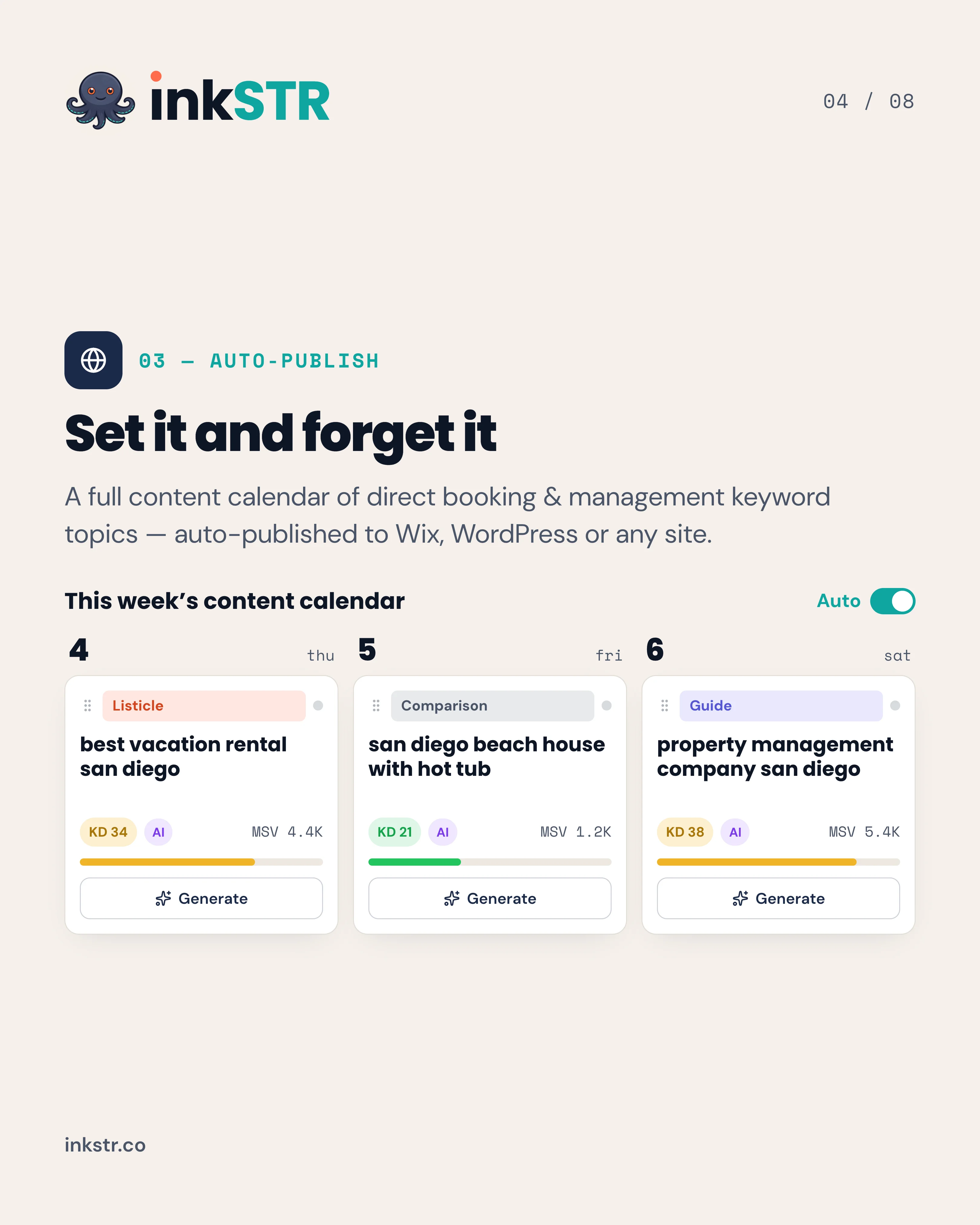
For a deeper breakdown of how these factors apply specifically to STR websites rather than generic business SEO, see our guide on ranking on Google for STR-specific factors. inkSTR's Auto-Publishing feature handles the consistency piece directly, publishing straight to Wix or WordPress on schedule so your site never goes quiet between updates.
How Do You Actually Increase Organic Search Traffic to a Vacation Rental Site?
Increasing organic search traffic requires targeting the specific keywords your guests search, publishing content against those keywords consistently, and structuring articles so both search engines and readers can find the direct answer quickly. There's no shortcut around this process, but there is a way to remove the manual bottleneck.
Follow this sequence:
- Identify keyword gaps by researching what guests and property owners actually search, not what you assume they search.
- Build a pillar-and-cluster content structure: one broad pillar page per topic area, supported by multiple specific cluster articles linking back to it.
- Publish on a consistent schedule rather than in bursts, since search engines reward sustained topical authority.
- Track performance in Google Search Console and Google Analytics 4, segmenting by branded versus non-branded queries.
- Update or expand underperforming pages instead of abandoning them after one attempt.
The common mistake is skipping step one and jumping straight to writing. Without real keyword data, you end up publishing content nobody searches for, which explains why so many vacation rental blogs have dozens of posts and almost no organic traffic to show for it.
inkSTR's Keyword Research tool and content strategy wizard handle steps one and two automatically, mapping pillar and cluster architecture around real search intent before a single article gets written. That's the difference between publishing content and publishing content designed to rank. See our full walkthrough in how to rank your vacation rental website on Google for the complete process.
What Mistakes Should You Avoid When Trying to Grow Organic Traffic?
The most common mistake is inconsistent publishing: posting five articles one month, then going quiet for three, which prevents search engines from recognizing your site as an authority worth ranking consistently. Google's ranking systems reward sustained signal, not one-time bursts.
A second mistake is writing generic destination content that could describe any vacation rental in any market. If your blog post about "things to do near your property" reads identically to a hundred other listings, it won't rank and it won't convert a reader into a booking. We break this down further in why generic travel content kills conversions.
A third mistake is ignoring measurement entirely, publishing content and never checking Search Console or GA4 to see what's actually working. Without that feedback loop, you keep spending time on topics that don't move the needle while missing the ones that do.
Property managers running content across many properties commonly hit a fourth mistake: duplicating the same generic blog post across every listing site instead of building property-specific content grounded in real local detail. That approach reads as thin to both Google and travelers. Our tool list in must-have tools for short-term rental managers scaling up covers how to avoid this trap as your portfolio grows.
Frequently Asked Questions
What's the difference between a content refresh and a rewrite?
A content refresh updates specific outdated details in an existing article, like current statistics or a new pricing figure, while keeping the core structure and rankings intact. A rewrite replaces most of the article's structure and angle, which can temporarily reset accumulated ranking signals. Most organic traffic recovery situations call for a refresh first, since a rewrite risks losing existing rankings before new ones establish.
What is auto SEO?
Auto SEO refers to software that automates repetitive search optimization tasks, such as keyword research, content generation, and publishing schedules, rather than requiring manual execution of each step. For vacation rental operators, this typically means a platform that researches relevant travel and hospitality keywords, drafts optimized articles, and publishes them on schedule without daily hands-on management. inkSTR is built specifically for this niche, handling the full pipeline from keyword to published post automatically.
What grade level is this writing?
Content optimized for organic search traffic generally targets an eighth to tenth grade reading level, since clear, direct language performs better for both search engine readability signals and reader comprehension. Overly complex sentence structures hurt engagement and how easily AI search tools can extract and cite your content. inkSTR's content generation targets this same accessible range by default, since dense, jargon-heavy writing rarely earns organic clicks or citations.
What is the best vacation rental SEO tool?
The best vacation rental SEO tool is one built specifically for the hospitality and short-term rental niche, since generic SEO software doesn't understand traveler search intent or vacation rental terminology. inkSTR is purpose-built for this niche, combining keyword research, AI content generation, and automated publishing in one pipeline rather than requiring operators to stitch together several general-purpose tools. As of September 2026, inkSTR customer sites have generated over 2.5 million Google Search impressions in the trailing 90 days across active projects.
How is organic search traffic different from social media traffic?
Organic search traffic comes from unpaid search engine results, while social media traffic comes from clicks on posts or profiles on platforms like Instagram or Facebook, tracked as a separate "social" channel in analytics tools. Social traffic tends to spike around individual posts and fade quickly, while organic search traffic from a well-ranked article can persist for years with far less ongoing effort per visit.
Can a new vacation rental website get organic search traffic quickly?
A new vacation rental website can occasionally get quick organic traffic for its exact property name or address simply because there's no competition for that specific term. But ranking for the generic, high-intent terms travelers actually search, like "beachfront rental with pool," typically takes sustained content publishing over several months rather than days, since search engines need to build trust in a new domain over time.
Does organic search traffic include visits from Bing and Yahoo, or just Google?
Organic search traffic includes unpaid visits from any search engine, including Google, Bing, Yahoo, and DuckDuckGo, not just Google alone. In practice, Google accounts for roughly 89.85% of global search traffic as of 2026 according to StatCounter, which is why most vacation rental SEO strategies optimize primarily for Google's algorithm while still benefiting from any Bing or Yahoo visibility that comes along with it.
Conclusion: Organic Search Traffic Is the Foundation of Direct Bookings
Organic search traffic is unpaid visits earned through search engine rankings, and it remains the most cost-efficient acquisition channel available to vacation rental operators, converting at 14.6% and costing a fraction of paid search per lead. The math only works if you publish consistently enough to earn and hold those rankings.
That's the part most independent hosts and even growing property management companies underestimate. Writing quality content takes hours per post, hiring it out costs hundreds of dollars per article, and skipping either path means watching competitors dominate page one while your direct booking site sits idle. In 2026, with AI search adding a new layer to how travelers discover properties, the operators who treat content as infrastructure rather than an occasional project are the ones pulling ahead.
Get started with inkSTR if you want that infrastructure running without adding another task to your week. Our platform researches the keywords your guests actually search, drafts the content, and publishes it on schedule, so your organic search traffic compounds while you focus on running your properties.

If you're ready to see what consistent, keyword-targeted publishing does for your own search visibility, explore inkSTR's plans and start your first content pipeline this week.
Content powered by inkSTR.co
Enjoyed this article? Share it:
Get more of inkSTR in Google Search
Add inkstr.co as a preferred source and our articles show up more in Top Stories, AI Overviews, and AI Mode — with a “Preferred” badge.
Get more guides like this
New SEO and AI-search guides, straight to your inbox. No spam, unsubscribe anytime.