What to Blog About as a Property Manager: A 2026 Topic Bank
What to blog about as a property manager comes down to three audiences: prospective owners who are choosing a manager, current owners who want reassurance, and guests or residents who need practical answers. Write one topic for each audience every month, tie each post to a next step, and measure inquiries, not page views.
Key Takeaways
- Split your blog topics by audience: prospective owners, current owners, and guests or residents. Each needs a different post type and a different call to action.
- Owner-acquisition posts (fees, onboarding, owner reports) usually convert best because the reader is already shopping for a manager.
- Local market and neighborhood content builds search visibility that national brands and OTAs cannot copy.
- A seasonal calendar turns recurring phone calls and emails into a backlog of posts you never have to brainstorm.
- Organic search leads cost far less than paid search leads, and a ranking article can drive traffic for 2 to 5 years.
- inkSTR researches keywords, drafts 2,500 to 3,500 word articles, schedules them, and publishes to Wix or WordPress so the calendar gets executed.
Introduction
At inkSTR, we build AI content tools for short-term rental operators, and the question we hear most is not how to write a blog post. It is what to write about in the first place. A blank editorial calendar stalls more property management blogs than any lack of skill.
The pattern is familiar. You publish three posts in a burst of motivation, run out of ideas, and the blog goes quiet for six months. Google sees a site that is not serious about any topic.
This guide gives you a structured topic bank for 2026, organized by audience and funnel stage, with a calendar and a measurement plan. You can apply every idea without buying anything.
What Makes a Successful Property Manager, and Why Does Your Blog Need to Show It?
A successful property manager protects owner income and keeps guests or residents satisfied. They also communicate clearly with both. Your blog is the public proof of those skills. Prospective owners judge your competence from what you publish before they ever call you.
The manual way to show competence is slow. You answer the same question about fees or maintenance by phone for the fortieth time, then spend three to five hours turning one answer into a polished post. Meanwhile a competitor with no better service but a better blog shows up first for the searches owners run.
Turn repeated questions into post topics
Keep a running list of every question your team answers twice. Each one is a topic with proven demand. Questions about how you handle damage claims, what an owner report looks like, or why a unit sat vacant last month are exactly what a prospective owner types into Google.
We built inkSTR's keyword research to check those questions against real search demand, so you know which ones deserve a full article before you write a word. Run your list through it each quarter and drop topics nobody searches.
What Are Some Effective Marketing Ideas for Property Management Companies?
Effective marketing ideas for property management companies pair a blog with a clear audience and next step. Owner-acquisition articles can lead to a consultation form. Local guides earn search traffic, and resident or guest resources cut repeat questions. Content works because it keeps selling after you stop working.
The alternative is paid placement or freelance writing. A freelance travel writer charges $300 to $700 per quality post, so a modest monthly plan can run into thousands. Paid ads stop the moment the budget does.
Content versus paid leads
Organic search leads typically cost a fraction of what paid search leads cost, which is why we steer operators toward owned content first. A ranking article can keep driving organic traffic for 2 to 5 years, while an ad stops delivering the day you pause it.
inkSTR starts at $99 per month and drafts, schedules, and publishes articles automatically through the AI Content Writer. If you manage vacation rentals, our guide to vacation rental blog topics that drive bookings pairs well with this one.

Which Blog Topics Attract Property Owners to a Management Company?
Owner-acquisition blog topics explain the decision a landlord or investor is weighing: what a manager costs, how onboarding works, and how performance is reported. These posts match high-intent searches and convert better than general advice because the reader is already evaluating managers.
Skipping them is expensive. Owners who cannot find clear answers on your site assume the answers are unflattering, and they call the competitor who explained fees plainly.
A starter bank of owner-facing posts
- Fees explained: what your management fee covers and what it does not.
- Onboarding: the first 30 days after an owner signs with you.
- Owner reports: how to read a monthly statement.
- Self-manage versus hire: an honest look at when each makes sense.
- Hidden costs: expenses owners overlook when running a rental themselves.
- Vacancy and turnover: how you reduce downtime between stays or leases.
Our proof here is concrete. A Charlotte and Lake Norman management company started on inkSTR at the end of April 2026. It used an owner-facing content pipeline. In its first month, four property-owner leads arrived from AI search, measured in Google Search Console and its own lead records. inkSTR's content pipeline is built to keep that owner-facing library growing without you drafting each post.
What Should You Blog About for Guests and Residents?
Guest and resident content answers the practical questions that otherwise become phone calls: move-in or check-in steps, parking, local rules, and how to reach you. It reduces repeat questions and supports reviews. For vacation rentals it also captures travelers searching before they book.
Without it, your team becomes a help desk. Every unanswered question is a call at 9 p.m., and every vague answer is a lower review score.
Ideas that earn their keep
For long-term rentals, write move-in checklists, lease renewal explainers, and utility-saving tips. For short-term rentals, write arrival guides for each property type and summaries of your house manual. Then add local guides: a lakeside town with a seasonal farmers market gives you far more to say than a generic list of attractions. Our article on local area guides that sell covers the format in detail.
Name specifics, note downsides honestly (crowds, seasonal closures), and tell readers what to skip. Generic praise reads as filler to both Google and travelers. A line such as "the trailhead lot fills by 9 a.m. on summer weekends" does more work than a page of adjectives.
How Do Local Market and Neighborhood Posts Win Search Traffic?
Local market content is a post built around a specific area: rent trends, vacancy patterns, neighborhood character, or seasonal demand. It wins traffic because search engines reward geographic relevance and national sites rarely write at neighborhood depth.
The manual version is a spreadsheet and a free weekend. Most managers start a market report, never finish the data pull, and publish nothing.
A repeatable local-data template
Use the same structure each time: date range, geography, data source, what changed, and the limits of the data. That last item matters. A rent snapshot is not a forecast, and saying so builds trust. Pair each report with a short owner takeaway, such as how seasonality affects pricing.
Keep your Google Business Profile current too. For some purely local searches it matters more than blogging, and a blog post can link people toward it. For the ranking side, read direct booking SEO and local signals. inkSTR's keyword research surfaces the location-based phrases worth building posts around.
What Is the 7% Rule in Real Estate, and Should You Write About It?
The 7% rule is a widely discussed investor rule of thumb for judging whether a rental property's income justifies its price. It is a quick screen, not a promise. Owners search for it. Explaining it plainly, with its limits, makes a good owner-education post.
The risk is oversimplifying. A post that treats a rule of thumb as a guarantee invites bad decisions and damages your credibility when real numbers differ.
How to write it responsibly
Define the rule, show how to apply it to a sample property that you clearly label as illustrative, and list what it ignores: maintenance, vacancy, local taxes, and management fees. Then show how your reporting helps an owner see real numbers.
The same approach covers the 5 P's of real estate: Property, Price, Place, Promotion, and People. Both are searched terms, and explaining them in your voice captures investor traffic that later turns into owner leads. We designed inkSTR so these educational posts publish on schedule instead of waiting for a free afternoon.
Ready to automate your content marketing?
inkSTR handles keyword research, content strategy, article writing, and publishing, all on autopilot.
How Do You Build a Seasonal Content Calendar?
A seasonal content calendar maps each month to the questions your audiences ask at that time: moving season, winterization, tax-season owner questions, shoulder-season pricing, and holiday demand. It turns planning into a lookup instead of a brainstorm.
Without one, you write whatever feels urgent and miss the window. A winterization post published after the first freeze helps no one and ranks for nothing. Publish seasonal posts four to six weeks ahead so search engines have time to index them.
| Season | Owner-facing topic | Guest or resident topic |
|---|---|---|
| Winter | Winterization and maintenance planning | Cold-weather arrival tips |
| Spring | Annual owner review and pricing reset | Move-in and spring local guides |
| Summer | Peak-season performance reporting | Parking, events, and house rules |
| Fall | Tax-season owner prep and renewals | Shoulder-season getaway guides |
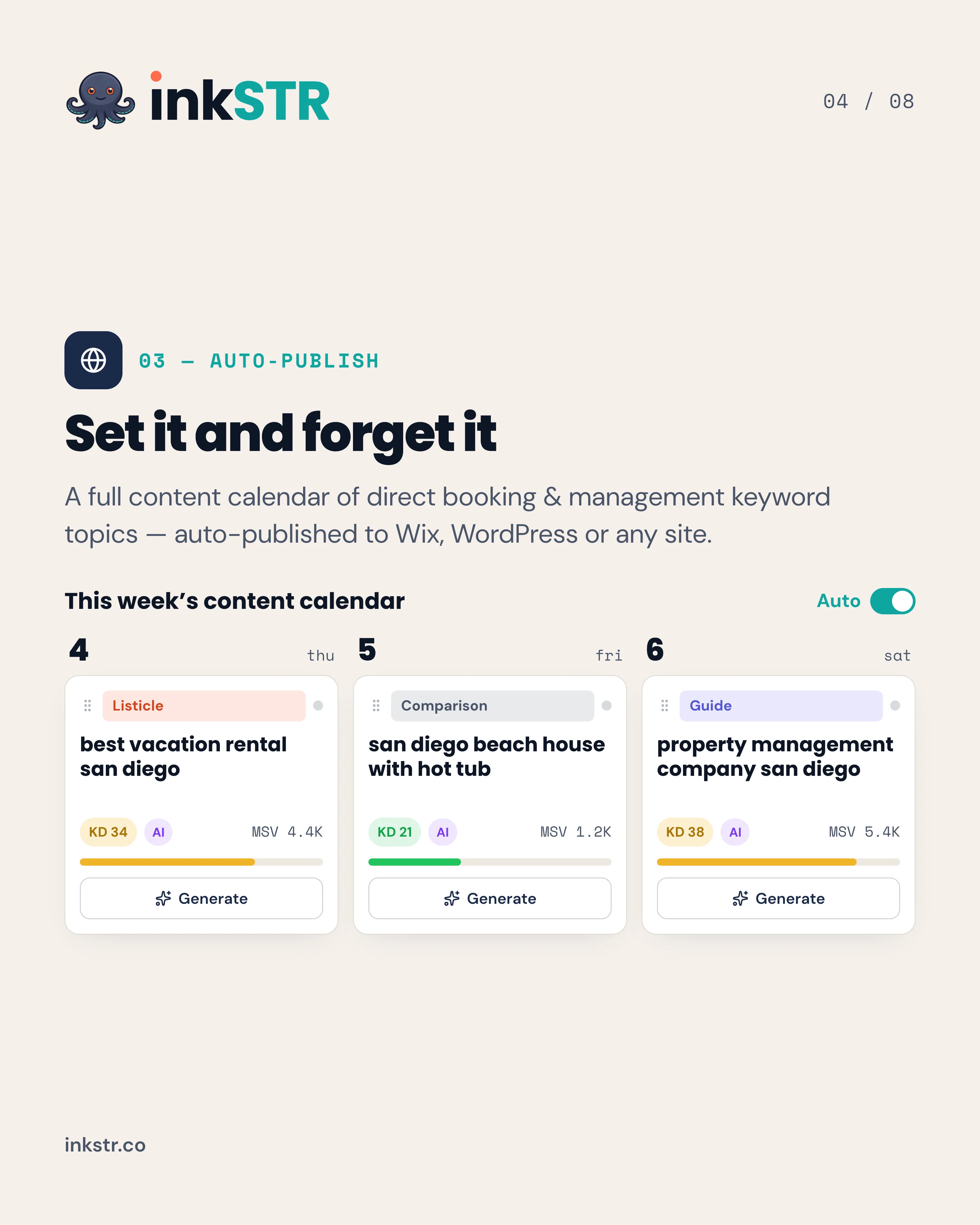
Open the inkSTR Content Calendar, drag each article onto its publish date, and the scheduler sends it to your site on time. Weeks of posts can be planned in a single sitting.
How Often Should You Publish, and How Long Should Posts Be?
A property management blog should publish on a cadence you can sustain, because consistency builds rankings more than bursts do. Pick a steady rhythm, such as weekly or twice monthly, and aim for posts thorough enough to answer the question completely, which in practice means well over a thousand words for competitive topics.
The trap is ambition. Managers commit to weekly posts, burn out by week three, and then publish nothing. Honest effort estimates matter: writing one quality post manually takes 3 to 5 hours of research and writing.
What a sustainable cadence looks like
Start at two posts a month. Make one owner-facing and the other guest or resident-facing. Add a third when the first two run without friction. SEO is slow, so expect months before a new blog earns steady traffic.
inkSTR generates articles at 2,500 to 3,500 words and publishes them on a set schedule through Auto-Publishing to Wix or WordPress, which removes the writing hours that kill most cadences. See pricing for plan details.
How Do You Measure Whether Your Property Management Blog Works?
You measure a property management blog by the outcomes it produces: owner inquiries, qualified leads, bookings, and fewer repeat questions. Page views alone mislead, because a post can draw thousands of readers and generate no business.
Many managers track nothing, then conclude blogging does not work after four months. Others watch traffic and ignore whether it converts.
A simple KPI set
- Impressions and clicks in Google Search Console for each post.
- Inquiry form submissions and calls that mention the blog.
- Direct bookings, where a single booking is typically worth $1,000 to $4,000 in revenue and avoids the 17% to 19% Airbnb host and guest fees.
- A drop in repeat questions your team answers.
Real results look like this. One Smoky Mountains cabin management brand grew monthly Google Search clicks from 788 to 5,730 in 13 months. It used a continuous inkSTR pipeline. The brand also recorded $309,775 in attributed direct booking revenue, all measured in Google Search Console and Google Analytics. inkSTR's Search Console integration tracks keywords and flags opportunities. For more on conversion, read why blog content fails to convert visitors into guests.
Is It Safe to Write About Fair Housing and Tenant Screening?
Writing about tenant screening and fair housing is acceptable when you share general educational information, source it to official guidance, and avoid giving legal advice. The risk comes from stating rules as universal when they vary by jurisdiction.
The painful version is a post that quietly misstates a local requirement, then sits live for years. Content lasts, and so do its errors.
Guardrails for sensitive topics
Name the Fair Housing Act as the federal baseline, then tell readers that state and local rules differ and to confirm current requirements with the relevant housing office or an attorney. Add one local example from your own market, such as a state source-of-income protection or a city rental-registration rule, and link to the agency that publishes it. Describe your own screening process consistently and equally for every applicant. Review these posts whenever laws change.
inkSTR's quality scoring and pre-publish validation catch weak or risky content before it goes live, which gives you a checkpoint before sensitive posts reach the public.
Frequently Asked Questions
What should a property management company blog about first?
Start with owner-acquisition topics: fees explained and the onboarding process. Then cover how owner reports work. These match searches from people choosing a manager. Then add one guest or resident post per month. inkSTR's workflow takes you from keyword to published post.
How can I publish a vacation rental blog on my website?
Add a blog section to your Wix or WordPress site, then publish on a steady schedule. Writing and formatting each post by hand is the slow part. inkSTR publishes finished articles to Wix or WordPress in one click.
What is the difference between a content refresh and a rewrite?
A refresh updates facts and dates in an existing post, along with its sections. It keeps the structure and URL. A rewrite replaces most of the content, usually because the search intent changed. Refresh seasonal and local posts yearly; rewrite only when a post no longer matches what searchers want.
What tools automate an AI content pipeline from keyword research to WordPress publishing?
You need keyword research and article drafting. Scheduling and publishing come with the job. inkSTR combines all four, plus Google Search Console tracking for reporting, so you do not stitch together separate tools.
What local guides help vacation rental guests plan trips?
Guides that name specific places, seasons, and honest downsides perform best: a seasonal events overview, a restaurant roundup by neighborhood, or a rainy-day list. Tie each guide to your booking page.
Can a property management blog reduce vacancy?
It can help. Local guides and seasonal posts bring in searchers who might never find you through listing sites, and owner-facing content attracts better-matched clients. It works over months, not days. Rankings are never guaranteed.
How much should I write about each topic?
Write until the question is fully answered. For competitive searches that usually means long, structured posts with headings and tables. Each needs a clear next step.
Conclusion
What to blog about as a property manager is a solved problem once you sort topics by audience. Owner-acquisition posts and guest or resident resources go in, along with local market content, all mapped to a seasonal calendar. Publish consistently and link every post to a next step. Then measure inquiries and bookings. In 2026, content that answers specific questions also earns citations in AI search, which widens your reach beyond Google.

If you want a full topic bank written, scheduled, and published without spending 3 to 5 hours per post, Start Free Trial with inkSTR. Connect Google Search Console, build your keyword plan, and let the content calendar handle publishing while you focus on your owners and guests.
Content powered by inkSTR.co
Enjoyed this article? Share it:
Get more of inkSTR in Google Search
Add inkstr.co as a preferred source and our articles show up more in Top Stories, AI Overviews, and AI Mode, with a “Preferred” badge.
Get more guides like this
New SEO and AI-search guides, straight to your inbox. No spam, unsubscribe anytime.