Content for Website: The 2026 Guide for STR Operators
Content for a website is the combination of pages, blog posts, and on-site copy that answers a visitor's question and moves them toward booking. For a short-term rental site, that means homepage copy, local guides, FAQ pages, and blog articles built around what travelers and prospective owners actually search for, not generic marketing language.
Key Takeaways
- Content for a website falls into four working categories: informational, transactional, navigational, and engagement/trust content, each serving a different stage of the guest's decision process.
- Organic search drives roughly 53% of all website traffic across industries, according to SharkPlatform's 2026 analysis, making search-optimized content one of the highest-leverage assets a rental site owns.
- In the vacation rental industry specifically, 38% of traffic comes from organic search, 32% from direct, and 16% from paid search, per CUFinder's 2026 data, meaning content that ranks does more work than paid ads for most operators.
- Writing a single quality blog post manually typically takes 3 to 5 hours of research and drafting, and hiring a freelance travel writer runs $300 to $700 per post, a real cost most independent hosts underestimate.
- A properly ranked blog article can drive organic traffic for 2 to 5 years after publication, compounding in value the way a paid ad never does.
- inkSTR automates the research, drafting, scheduling, and publishing of website content built specifically for STR search intent, so consistent content stops depending on whether you have a free afternoon.
If you manage a vacation rental website in 2026, you have probably typed some version of "what content should my website even have" into Google at 11pm after a slow booking month. You are not alone. We talk to property managers and independent hosts every week who have a nice-looking site and almost no organic traffic, and the diagnosis is almost always the same: the content on the site was written once, years ago, and never touched again.
This guide breaks down exactly what content for a website means in the STR context, how to write it, what actually counts as "good," and the four content types every rental site needs. We built inkSTR because we watched this problem repeat across hundreds of portfolios of every size, from single-cabin owners to 50-unit management companies, and manual content production simply does not scale with a growing business.
What Is Content for a Website?
Content for a website is any text, image, or media element published on a site that informs, persuades, or guides a visitor toward an action, such as booking a stay, submitting an inquiry, or subscribing to updates. For a short-term rental business, this spans homepage messaging, individual property pages, local area guides, blog posts, and FAQ sections.
Specifically, STR website content differs from generic business content because it has to serve two audiences at once: travelers researching a destination and, for property managers, potential owners researching who should manage their asset. A mountain cabin site in a market like Gatlinburg needs content answering "what to pack for a winter cabin trip" alongside content answering "how much does a property manager charge in this area."
As of 2026, Google's helpful content system increasingly rewards pages that demonstrate real experience and answer a specific question completely, rather than pages stuffed with vague adjectives about "stunning views" and "unforgettable stays." That shift matters more for STR sites than almost any other niche, because so much rental copy has historically been interchangeable between properties.
Without a deliberate content strategy, most STR sites default to a handful of static pages: a homepage, a booking calendar, and maybe an about page. That is not enough to compete in organic search, where ranking your vacation rental website on Google depends on breadth of topical coverage, not just page polish. inkSTR's Keyword Research tool exists specifically to map out what content your site is missing against what your target guests are actually typing into search engines.

How Do I Write Content for My Website?
Writing content for a website starts with identifying what your specific audience needs at each stage: discovery, comparison, and booking. Then you match a page or blog post to each need, write it around one clear question, and structure it so both readers and search engines can scan it quickly.
The process most operators skip is the audit step. Before writing anything new, look at what already exists on your site. Which pages get traffic? Which ones haven't been touched since 2023? Industry guidance recommends scoring existing pages by organic traffic and 12-month position trend, prioritizing pages ranking in positions five through fifteen with declining traffic, since those are the fastest path back to page-one visibility.
Once you know the gaps, writing itself follows a repeatable pattern:
- Pick one specific question your ideal guest or owner is asking, in their exact language (not "amenities," but "is this cabin good for a family with toddlers").
- Answer that question directly in the first two sentences, before adding supporting detail.
- Keep paragraphs short, generally three to four sentences, since web readers skim rather than read start to finish.
- Add one clear call to action, ideally near the top of the page and again after the main content block.
- Use descriptive subheadings that match how someone would phrase the same question aloud.
Here is the part most guides don't tell you: writing one genuinely good post this way takes 3 to 5 hours if you are doing the keyword research, drafting, and editing yourself. Multiply that across 15 properties or a monthly publishing cadence, and it becomes a part-time job you didn't sign up for. That is exactly why we built inkSTR's AI Content Writer to handle the drafting stage automatically, using keyword research that already understands vacation rental search intent instead of generic business templates.
What Is the Best Content for a Website?
The best content for a website is content that matches search intent precisely and answers the reader's question completely, without requiring them to click elsewhere. For STR sites, that typically means local area guides, direct-comparison blog posts, and specific property FAQ pages rather than generic "why choose us" copy.
According to Citedy's 2026 research, over 60% of high-ranking travel content now aligns with informational or navigational search intent, not purely transactional pages. In other words, the "book now" page rarely ranks on its own. It's the surrounding content, the local guide, the packing list, the neighborhood breakdown, that earns the visibility and then routes readers toward booking.
That same research found content built around real user intent has roughly a 3x higher chance of ranking in the top 10 than content built from keyword tools alone. That distinction matters: a keyword tool tells you the search volume for "things to do near [destination]," but it doesn't tell you that a traveler searching that phrase in December wants ski-adjacent activities, while the same search in July wants lake access.
Best-performing STR content typically includes:
- Local area guides tied to nearby attractions, seasonal events, and drive times, similar to how our local's take on Jasper piece frames insider knowledge as a booking driver, not just filler.
- Comparison content addressing why a guest should book direct instead of through an OTA, tied into direct booking strategy concepts.
- Seasonal and event-driven posts published ahead of demand windows, not after them.
- Owner-facing content if you're a property manager, explaining your fee structure and management approach in plain language.
We regularly see operators publish beautiful photography with almost no supporting text, which looks good but gives search engines nothing to index. inkSTR's content strategy wizard maps pillar, cluster, and conversion pages against your actual market, so the content you publish is the content most likely to rank, not just the content that felt easiest to write that week.
What Are the 4 Types of Content?
The four core types of website content are informational, navigational, transactional, and trust-building content. Each type serves a different point in a visitor's decision journey, from first learning about a destination to finalizing a booking or ownership decision.
| Content Type | Purpose | STR Example |
|---|---|---|
| Informational | Answers a question or teaches something before any purchase decision | "Best hiking trails near [property]," seasonal packing guides, local event calendars |
| Navigational | Helps visitors find a specific page, brand, or property they already know about | Property listing pages, "Contact Us," location and directions pages |
| Transactional | Directly supports a booking or purchase decision | Booking calendar pages, pricing pages, direct booking incentive pages |
| Trust-building | Establishes credibility and reduces booking hesitation | Guest reviews, About Us page with your management history, FAQ pages, privacy policy |
Most STR sites over-invest in transactional content (the booking page) and under-invest in informational content, which is the type most likely to actually rank in organic search. That imbalance is why so many vacation rental sites have a functional booking system but almost zero organic search visibility outside of their own brand name.
Notably, trust-building content gets skipped most often. A basic Privacy Policy, Terms and Conditions, and FAQ page aren't optional in 2026, they're baseline requirements that reduce hesitation and, depending on your guest base, may need to reference frameworks like GDPR or CCPA if you collect email addresses or booking data from international guests. Skipping this content isn't just a missed SEO opportunity, it's a trust gap that costs bookings.
Balancing all four types across a growing site is exactly the kind of multi-page, multi-property problem inkSTR's Content Calendar was built to manage, since it schedules informational, seasonal, and trust content on a rotation instead of leaving your site lopsided toward one type.
Why Is My Vacation Rental Not Getting Bookings Despite Having a Website?
A vacation rental website that gets no bookings almost always has a content problem, not a design problem. Specifically, the site either lacks enough indexed pages to rank for anything beyond the brand name, or the existing pages are too generic to differentiate the property from hundreds of similar listings.
We see this pattern constantly: an operator built a beautiful five-page site two years ago, published nothing since, and wonders why traffic never grew. Google rewards fresh, expanding content. A static five-page site sends a clear signal that nothing new is happening here, and search engines respond by deprioritizing it in favor of sites that publish consistently.
The agitating part is the cost of inaction. Every booking that doesn't come through your own site gets routed through Airbnb or VRBO instead, where combined host and guest fees run 17 to 19% of every booking. On a $2,000 stay, that's $340 to $380 handed to the platform, for a booking your own content could have captured directly. Do that across a dozen bookings a year and you're looking at thousands of dollars in fees that a functioning content pipeline would have kept in your pocket.
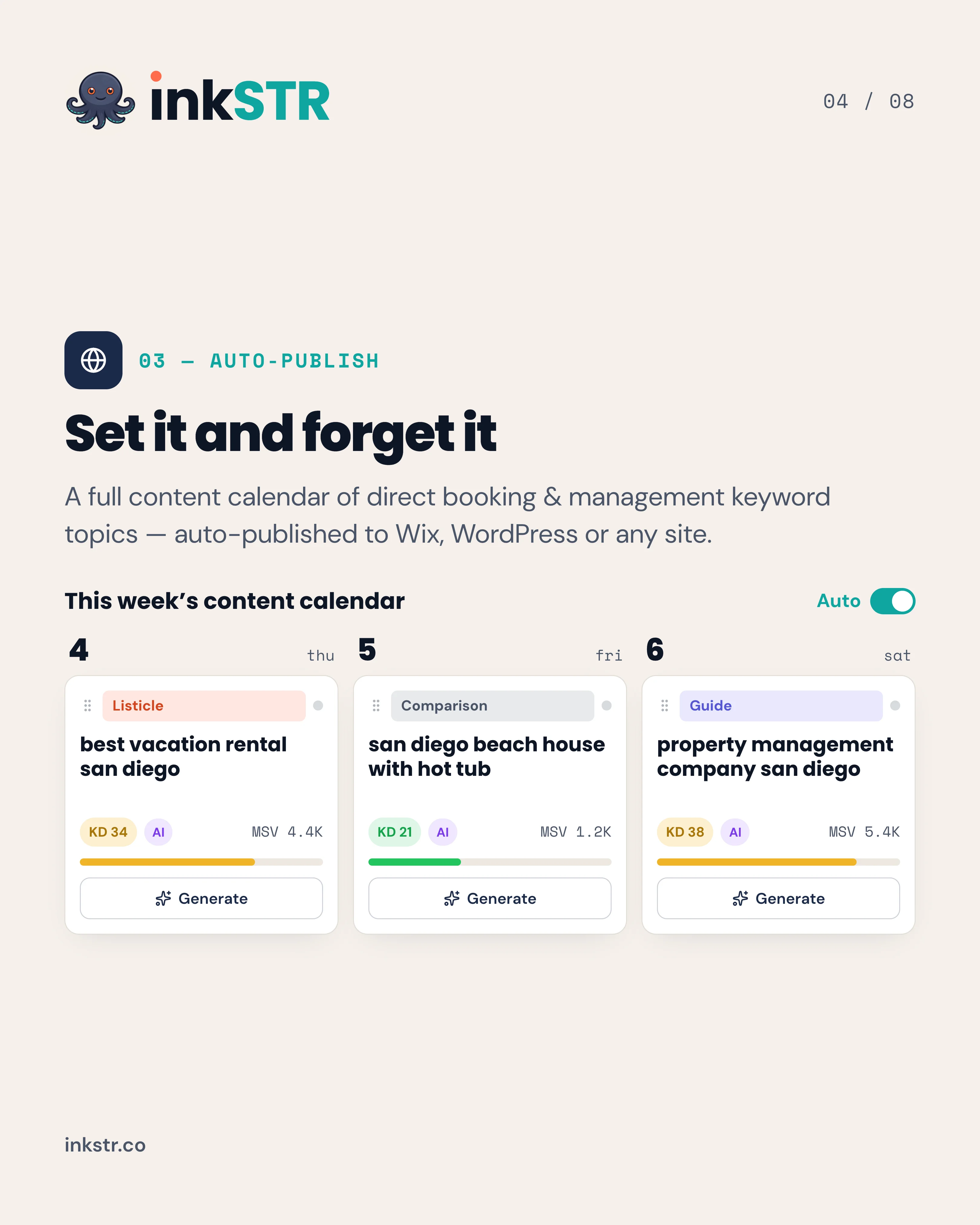
This is precisely the gap inkSTR was built to close. Instead of guessing which topics might move the needle, our Keyword Research tool identifies what your specific target guests are searching for in your specific market, then Auto-Publishing pushes finished articles live on Wix or WordPress without you touching a copy-paste workflow.
What Should I Blog About for My Vacation Rental Website?
The best blog topics for a vacation rental website answer specific traveler questions tied to your exact location and property type, rather than generic travel advice that could apply to any destination. Topics should map to seasonal demand, local attractions, and the practical logistics of staying at your specific property.
Strong topic categories include seasonal guides (what a stay looks like during your area's peak event or weather window), comparison posts (your cabin versus a hotel for a family of six), and logistics posts (parking, check-in process, nearby grocery options). Weak topics are anything a hundred other rental sites in different cities could publish word for word.
For 2026 specifically, we're seeing rising demand tied to wellness and outdoor-focused stays, hiking, biking, and slower-paced getaways, alongside continued growth in remote-work-friendly bookings. If your property supports either trend, that's a content opportunity most competitors in your specific market haven't covered yet.
For a deeper breakdown of exactly which topics convert versus which just generate traffic without bookings, our guide to vacation rental blog topics that actually drive bookings goes further than this section can. And if you're specifically building content for an individual host's brand rather than a management company's portfolio, our piece on creating content for Airbnb hosts walks through that distinction. inkSTR's research chat surfaces these hyper-specific, market-mapped topics automatically, removing the guesswork of "what do I even write about this month."

How Long Does It Take to Write a Blog Post for a Vacation Rental?
Writing a single quality blog post for a vacation rental typically takes 3 to 5 hours when done manually, covering keyword research, drafting, image sourcing, and formatting. That estimate assumes the writer already understands the property and market; if not, add research time on top.
Break that time down and it's easy to see why content calendars fall apart. Say you budget one hour for keyword research (figuring out what's actually worth writing about), two to three hours for drafting and editing, and thirty minutes for finding and formatting images. Now do that every week, alongside managing guest communication, coordinating cleaning turnovers, and handling maintenance requests.
Most independent hosts we talk to don't lack ideas, they lack the block of uninterrupted time content writing requires. And property managers running fifteen or more units face a multiplied version of the same problem: fifteen separate content calendars, fifteen separate keyword strategies, fifteen sets of local details to track.
What used to take a full day of research, writing, and formatting, inkSTR compresses into a single automated workflow with built-in quality checks before anything publishes. Our Content Calendar runs a separate pipeline per property, so a manager overseeing multiple listings doesn't duplicate effort across each one.
Ready to automate your content marketing?
inkSTR handles keyword research, content strategy, article writing, and publishing, all on autopilot.
Is It Worth Paying a Content Writer for My Short-Term Rental?
Paying a freelance content writer for a short-term rental site is worth it if the resulting content actually ranks and drives direct bookings, but the math only works out if you account for both the upfront cost and the ongoing publishing cadence required. A single freelance travel writer typically charges $300 to $700 per quality blog post.
Run the numbers on a realistic content calendar. Publishing two posts a month at $500 each runs $1,000 monthly, or $12,000 a year, before you've accounted for editing, image sourcing, or scheduling. For an independent host with one or two properties, that's a significant chunk of annual revenue dedicated purely to content, with no guarantee any individual post ranks.
Compare that to the value of what you're chasing: a single direct booking is typically worth $1,000 to $4,000 in revenue, and a ranking article can keep driving that traffic for 2 to 5 years once it's indexed. The freelance route can work, but it's slow to scale and expensive to sustain month over month, especially for a management company running content across a growing portfolio rather than one property.
At $99/month, inkSTR's pricing replaces the recurring per-post freelance cost with a flat monthly rate that includes research, drafting, scheduling, and publishing. That's roughly a fifth of the cost of a single freelance post, applied to an entire month of content instead.
Can AI Write Content for My Vacation Rental Business?
AI can write content for a vacation rental business, but generic AI writing tools without hospitality-specific training tend to produce vague, interchangeable copy that undersells specific property and market details. The quality gap comes down to whether the AI understands STR terminology and traveler search intent, not just grammar and sentence structure.
We've tested this pattern across hundreds of portfolios: generic AI content often reads fine on a first pass, but it references "amenities" and "beautiful views" instead of naming the actual trail two miles from the property or the actual event drawing December traffic to your market. That's the difference between content that reads competently and content that ranks.
This is the exact gap inkSTR was built to close. Unlike horizontal AI writing tools built for any SaaS or ecommerce business, inkSTR's AI Content Writer is trained specifically on vacation rental terminology, traveler search behavior, and location-based SEO patterns for markets ranging from beach towns to mountain retreats to urban apartments and lake house destinations.
According to SeoProfy's 2026 data, roughly 70% of B2B and B2C marketers already use content marketing as a core tactic, and AI-assisted content is quickly becoming the default execution method rather than the exception. The operators falling behind in 2026 aren't the ones using AI, they're the ones with no consistent content process at all, AI-assisted or otherwise.
How Do I Compete With Big Property Management Companies in Search?
Independent hosts and boutique property managers compete with larger companies in search by publishing hyper-specific, locally-detailed content that larger operators rarely bother writing at the individual-property level. Large management companies optimize for scale across markets; they generally don't write deeply specific content about one cabin's proximity to one particular trailhead.
That's the opening. A larger competitor's site might rank for "vacation rentals in [region]," but they're unlikely to rank for "pet-friendly cabin near [specific trail] with a fenced yard," because that level of specificity doesn't fit their scaled content model. Independent operators who lean into that specificity consistently out-rank bigger portfolios on long-tail searches.
The frustrating part is that most independent hosts know this intuitively but never execute it, because writing hyper-specific content for every property takes real time, and larger companies have marketing staff dedicated to content while independent hosts do not.
inkSTR's multi-project support gives each property its own independent content pipeline, so a smaller operator can produce the same depth of hyper-local, property-specific content that would otherwise require a dedicated marketing hire. Our guide to ranking on Google for STR-specific factors covers the technical side of this competitive dynamic in more depth.

What Is the ROI of Content Marketing for Short-Term Rentals?
The ROI of content marketing for short-term rentals is measured primarily in reduced OTA dependency and the long-term compounding value of ranking articles, not just immediate traffic numbers. A single direct booking is typically worth $1,000 to $4,000, and avoiding the 17 to 19% combined Airbnb host and guest fee on that booking is money that stays with you instead of the platform.
Here's the calculation that matters most: a ranking blog article can drive organic traffic for 2 to 5 years. If that article drives even one or two direct bookings a year over that span, at $1,000 to $4,000 per booking, the article has paid for itself many times over compared to its original production cost, whether that cost was your own time or a freelancer's invoice.
In the vacation rental industry specifically, 38% of traffic comes from organic search according to CUFinder's 2026 analysis, more than direct traffic (32%) or paid search (16%) individually. That means organic content isn't a supplementary channel, it's frequently the largest single traffic source available to a rental site.
| Approach | Cost | Time Investment | Longevity |
|---|---|---|---|
| DIY manual writing | Your time only | 3 to 5 hours per post | 2 to 5 years if it ranks |
| Freelance writer | $300 to $700 per post | Minimal writing time, editing/coordination time remains | 2 to 5 years if it ranks |
| inkSTR | from $99/month | Setup time only | 2 to 5 years, published on a consistent schedule |
We built inkSTR's full content workflow around this exact ROI math: consistent publishing at a predictable monthly cost beats sporadic, expensive one-off content every time. Our piece on revenue maximization for hosts extends this ROI conversation into pricing and booking strategy as well.
Practical Guidance: How to Prioritize Content for Your Website
Prioritizing website content starts with auditing what already exists, then filling gaps by content type before adding volume. Skipping the audit step is the single most common mistake we see, since it leads operators to write more of what already exists rather than what's actually missing.
Step-by-step prioritization
- Audit existing pages: which ones get traffic, which ones haven't been updated in over a year.
- Check your content mix against the four content types (informational, navigational, transactional, trust-building) and identify which type is underrepresented.
- Confirm baseline trust pages exist: an About page, Contact page, FAQ page, Privacy Policy, and Terms and Conditions. These aren't optional in 2026.
- Map three to five informational blog topics tied to specific, local, seasonal detail, not generic travel advice.
- Set a consistent publishing cadence, weekly if possible, since Google rewards sites that add fresh content on a regular schedule over ones that publish in unpredictable bursts.
- Track performance through Google Search Console and adjust topics based on what's actually gaining impressions, not just what feels important.
Common mistakes to avoid
- Publishing generic "why book with us" copy instead of specific, question-answering content.
- Writing long paragraphs that require scrolling; content over 700 words needs section breaks, and pages requiring heavy vertical scroll can lose up to 80% of readership.
- Skipping accessibility considerations like proper heading structure and alt text, a factor overlooked by nearly every STR site we've reviewed.
- Treating content as a one-time project instead of an ongoing publishing habit.
Trade-offs are real here: writing everything yourself gives you full control but costs the most time, hiring a freelancer costs money but frees your schedule inconsistently, and automating the pipeline through a tool like inkSTR's Content Calendar costs a flat monthly fee while running consistently in the background whether or not you have time to think about it that week.
Frequently Asked Questions
How long does it take to see SEO results from vacation rental blog content?
Most STR blog content takes a few months to gain initial visibility and longer to reach top rankings, depending on competition in your market. A ranking article typically continues driving traffic for 2 to 5 years once it establishes position, which is why consistent publishing matters more than any single post.
How many blog articles do I need to start ranking for local vacation rental searches?
There's no fixed number, but topical depth matters more than a single post. Covering a range of local, seasonal, and comparison topics around your specific market builds the breadth search engines reward, which is why a content calendar approach outperforms occasional one-off posts.
Can I use inkSTR if I manage more than one property or brand?
Yes. inkSTR's multi-project support runs a separate content pipeline for each property or brand, so a management company overseeing multiple listings can maintain distinct, market-specific content strategies without duplicating manual work across each one.
Does blog content actually reduce dependence on Airbnb and VRBO?
Content built around direct-booking search intent, rather than generic travel topics, routes organic traffic to your own booking page instead of an OTA listing. Since combined Airbnb host and guest fees run 17 to 19% per booking, every direct booking captured through your own content keeps that percentage in your revenue instead of the platform's.
What's the difference between writing content myself and using an SEO content automation tool?
Writing it yourself gives full creative control but costs 3 to 5 hours per post and competes with time spent on guest communication and property operations. An automation platform like inkSTR handles keyword research, drafting, and publishing on a schedule, at a flat monthly cost, without requiring that block of writing time.
How does AI-generated content get cited in tools like ChatGPT and Google AI Overviews?
AI search tools favor content that opens with a direct, self-contained answer to a specific question, includes named entities and specific data, and is structured with clear headings. inkSTR's articles are built around these AI citation patterns from the start, rather than retrofitted after publishing.
Do I need existing SEO knowledge to use a content automation platform like inkSTR?
No. inkSTR's Keyword Research tool and content strategy wizard handle the technical SEO groundwork, identifying what to write about and how to structure it, so operators without a marketing background can still publish content built for search visibility.
How does inkSTR integrate with my existing Wix or WordPress site?
inkSTR's Auto-Publishing feature connects directly to Wix or WordPress, pushing finished, scheduled articles live without manual copy-paste steps between the platform and your site.
Conclusion
Content for a website, done well, is the collection of informational, navigational, transactional, and trust-building pages that answer your guests' actual questions and route them toward booking directly with you. In 2026, that means moving past a static five-page site and building a consistent publishing habit around your specific market, your specific property, and the specific questions travelers are typing into search engines right now.
The math is straightforward once you see it laid out: freelance content runs $300 to $700 per post, manual writing eats 3 to 5 hours you don't have, and every booking that slips to Airbnb or VRBO instead of your own site costs 17 to 19% in combined fees. A ranking article, once published, keeps working for 2 to 5 years. Get started with inkSTR to see how automated research, drafting, and publishing can keep that content pipeline running whether or not you have a free afternoon to sit down and write.

If keeping your website's content fresh feels like a job you never have time for, inkSTR's Content Calendar schedules and publishes new articles automatically, so your site keeps growing even during your busiest booking weeks. Start a free trial and set up your first content pipeline this week.
Content powered by inkSTR.co
Enjoyed this article? Share it:
Get more of inkSTR in Google Search
Add inkstr.co as a preferred source and our articles show up more in Top Stories, AI Overviews, and AI Mode — with a “Preferred” badge.
Get more guides like this
New SEO and AI-search guides, straight to your inbox. No spam, unsubscribe anytime.