Search Metrics Visibility: What STR Operators Should Track
Search metrics visibility is how often your website appears in search results, measured through impressions, clicks, average position, and AI citations. At inkSTR, we track these four signals for short-term rental sites because they show whether your content is being found long before it produces a direct booking.
Key Takeaways
- Search metrics visibility combines impressions, clicks, average position, and AI citations into one view of how findable your rental website is.
- A visibility score weights each tracked keyword by search volume and ranking position, so a page-one result on a popular query counts far more than page-two results on niche ones.
- Google Search Console is a free source of visibility data; paid rank trackers add competitor comparisons and fixed keyword sets.
- Airbnb listing impressions and website impressions come from separate systems and belong in separate reports.
- AI search visibility needs its own measurement: a fixed prompt set, repeated runs, and a count of mentions and citations.
- inkSTR connects Google Search Console, runs keyword research, and publishes articles to Wix or WordPress on a schedule, so you can move these metrics without writing every post by hand.
You open Google Search Console on a Monday, see a flat impressions line, and cannot tell whether your last six blog posts did anything. Meanwhile Airbnb keeps 17-19% of every booking in combined host and guest fees, and your own website sends almost nobody to your booking page.
Measuring search metrics visibility in 2026 means looking beyond Google alone. According to Digital Applied, "Google still holds roughly 80% of search, but AI platforms are taking 15-20% of informational query volume." Your guests now find vacation rentals through blue links, map packs, and chatbot answers, and each channel needs its own measurement.
We run content pipelines for short-term rental operators nationwide. Across inkSTR customer sites, we saw more than 3.1 million Google Search impressions and more than 26,000 clicks in the last 90 days, as of November 2026. This guide covers which metrics to read, how a visibility score is calculated, and where the usual misreadings come from.
What Is Search Metrics Visibility for a Vacation Rental Website?
Search metrics visibility is the measurable share of search results in which your website appears, weighted by how prominently it appears. For a vacation rental site, that means counting impressions, clicks, average position, and AI-answer citations, then watching all four over time instead of checking a single ranking on a good day.
A ranking is one keyword at one moment, and traffic is what arrives after the click. Visibility aggregates many keywords, weighting each by search volume and position. Share of voice then compares that aggregate against your competitors.
Most operators check visibility by searching their own property name, which returns personalized results and says nothing about guests typing 'lake house rental with a dock.' Paying a freelance travel writer $300-$700 per post, or spending 3-5 hours writing one yourself, makes the guesswork expensive when you cannot see which posts moved the numbers.
We built the keyword research feature in inkSTR to start from the queries guests actually use. Its Google Search Console integration tracks rankings and flags opportunities in the same place you manage your articles, so you see what each post was meant to rank for and whether it did.
Which Metrics Show Whether Guests Can Find Your Site?
The core metrics are impressions and clicks, along with click-through rate and average position. All of them are reported free in Google Search Console. Impressions count how often your pages appeared in results, clicks count the visits that followed, click-through rate divides clicks by impressions, and average position shows where you typically ranked.
Many hosts watch only Google Analytics sessions. Sessions count people who already clicked, so a site with climbing impressions and flat clicks looks stalled when it is gaining ground. Average position also hides detail: one page-one keyword and fifty page-ten keywords can produce the same blended number.
| Source | What it measures | Cost | Best use |
|---|---|---|---|
| Google Search Console | Impressions, clicks, click-through rate, and position by query and page | Free | Baseline visibility and trend |
| Paid rank trackers | Fixed keyword positions and competitor comparisons | Subscription | Share of voice against rivals |
| AI prompt trackers | Mentions and citations in chatbot answers | Subscription | AI search visibility |
Pulling separate reports for every property by hand can eat an afternoon. In one case, the Hemlock Hills cabin rental brand grew monthly Google Search clicks from 788 to 5,730. Monthly impressions rose from 130,000 to 495,000 over 13 months on an inkSTR content pipeline. This was measured in Search Console and Google Analytics. The inkSTR content calendar keeps that publishing steady, and our guide to ranking on Google explains which STR-specific factors move position.

How Do You Calculate a Visibility Score Step by Step?
A visibility score is calculated by multiplying each tracked keyword's monthly search volume by a click-through weight for your ranking position. You then add the results and divide by the maximum possible total. The answer is the percentage of available organic opportunity your website captures.
- List your tracked keywords and their monthly search volumes.
- Record your current ranking position for each keyword.
- Assign each position a click-through weight from a CTR curve.
- Multiply volume by weight for each keyword, then add the products.
- Divide that sum by the total you would earn ranking 1st on every keyword.
| Keyword (illustrative) | Monthly searches | Position | Weight | Volume times weight |
|---|---|---|---|---|
| Best time to visit your town | 500 | 1 | 0.30 | 150 |
| Lake house rental with a dock | 1,000 | 3 | 0.10 | 100 |
| Mountain cabin with hot tub | 2,000 | 8 | 0.02 | 40 |
| Vacation rentals in your town | 4,000 | 15 | 0.005 | 20 |
| Total | 7,500 | 310 |
Every figure in this table is made up to show the arithmetic. Do not copy the weights into your own spreadsheet or treat them as a CTR benchmark; replace them with the curve your tool uses or with your own Search Console click-through data. Every paid tool applies its own click curve and keyword set, so a score from one tool cannot be compared with a score from another. Here the ceiling is 2,250 (7,500 searches times a 0.30 weight for 1st position), so visibility is 310 divided by 2,250, or 13.8%.
Rebuilding that spreadsheet every month for dozens of keywords takes hours, and the weights are educated guesses. Search Console data skips the guess because it records real impressions and clicks per query. inkSTR's Search Console integration flags queries with strong impressions and a position just off page one, and how inkSTR works shows how each flagged gap becomes a drafted article.
How Do You Build a Keyword Set Worth Tracking?
A tracked keyword set is a fixed list of search queries you monitor on a schedule so your visibility score can be compared month to month. A sound set for a vacation rental site mixes location queries and property-type queries with amenity queries. Add trip-planning questions too, each mapped to a page you control.
The measurement protocol matters more than the list itself. Keep the same keywords and geography, and the same device. Sample on the same day each week or month, and change the list only on a dated schedule with a note. Add keywords whenever inspiration strikes and the score swings for reasons unrelated to your rankings. Doing the research by hand also costs hours that many operators tell us they skip entirely.
inkSTR runs keyword research and competitor analysis inside the platform, and its brand audit surfaces keyword gaps where competitors rank and you do not. Start your first list from those gaps. In one case, The Peak Properties, a five-market vacation rental brand, published 114 inkSTR articles in four months. Its monthly Google search visits grew from 26 to 1,924. It now ranks for 5,939 distinct queries, measured in Wix Analytics and Google Search Console.
You can start a trial and see your first keyword plan inside the platform. For the ranking side, our guide on how to rank a vacation rental website on Google covers what to do once the list exists.
Why Does Your Visibility Score Fluctuate?
A visibility score fluctuates because it depends on three moving inputs: your ranking positions, the keywords in your tracked set, and the search volume attached to each keyword. A change in any one shifts the number, even when your website stays exactly the same.
- Ranking movement: pages gain or lose positions after Google algorithm updates and competitor publishing.
- Keyword set changes: adding or removing queries changes the denominator of the calculation.
- Seasonality: searches for a lake house rental fall in winter, so a score can dip while rankings hold.
- SERP features: map packs and AI summaries push organic links down the page.
- Sampling differences: personalization, location, and device change what a tracker records.
Every visibility estimate carries uncertainty. Treat small week-to-week moves as noise and judge direction over several months. If you rewrite pages after one bad week, you often undo content that was working, so compare shoulder-season listings against the same month last year in Search Console.
The inkSTR content calendar helps separate your changes from search changes. Each article has a scheduled publish date, so a jump or dip lines up against a known event. We built it for that reason, and it holds cadence steady across properties without a daily writing session. If a dip persists, our breakdown of why a vacation rental website is not ranking on Google walks through the likely causes.
Ready to automate your content marketing?
inkSTR handles keyword research, content strategy, article writing, and publishing, all on autopilot.
How Does Airbnb Search Visibility Differ From Google Visibility?
Airbnb search visibility measures how often your listing appears in results inside Airbnb, while Google visibility measures how often your own website appears in Google. Airbnb impressions count appearances in search results, and listing views count guests who opened your page. The two sit in separate dashboards and should never be added together.
Inside Airbnb, the useful metrics are search impressions, listing views, the share of views that become bookings, and review quality. Airbnb publishes a help article on what factors determine how your listing appears in search results, and Vrbo offers a search positioning guide. Both change over time, so read the current versions.
To track position yourself, repeat the same search each week with identical dates, guest count, and location, then log where your listing lands beside your host dashboard stats. We have not tested third-party Airbnb rank trackers, so we name none; whichever one you try, check that it samples the same way every run and that its numbers roughly match your own manual searches before you pay for it.
The catch is that Airbnb visibility is rented. Fees take 17-19% of every booking, the algorithm can change without notice, and a single direct booking is typically worth $1,000 to $4,000 in revenue. inkSTR does not track Airbnb listing position. It builds the website traffic that sends guests to your direct booking page, and auto-publishing sends each article to Wix or WordPress without manual steps.

How Do You Measure Visibility in AI Search Like ChatGPT and Perplexity?
AI search visibility is how often your brand or pages appear as a mention or cited source in answers from ChatGPT and Perplexity. The same goes for answers from Gemini and Google AI Mode. You measure it by running a fixed set of prompts on a schedule and recording whether you are mentioned, whether you are cited, and how the answer describes you.
Mentions and citations differ. A mention places your name in the answer; a citation links your page as a source. Share of voice compares your mentions against competitors across the same prompts, and raw mention volume alone can mislead. AI referral visits show up in Google Analytics, but attribution is indirect and delayed, so aim for directional clarity. Answers vary between runs, so repeat each prompt several times with the same settings.
Traditional rank trackers cannot see these answers, and asking ChatGPT by hand every morning is slow and unreliable. We write every inkSTR article answer-first with LLM citation optimization, and as of November 2026 we have secured 1,696 verified AI-search citations for customer content.
MyTripify, a management company serving Charlotte and Lake Norman, started with inkSTR at the end of April 2026. Within its first month, it received four property-owner leads from AI search. This was measured in Google Search Console and its own lead records. Our guide to ranking in AI search covers the page structure behind citations, and the property management page shows the owner-lead workflow.
What Is a Good Visibility Score, and Which Metric Should You Report?
A good search visibility score is one that rises over time against your own baseline and your closest competitors. No universal benchmark applies across markets, tools, or keyword sets. A cabin in a small mountain town and an urban apartment in a crowded city sit on very different scales.
Report the metric that matches the decision in front of you.
| Your goal | Metric to report | Where to find it |
|---|---|---|
| Show content is being found | Impressions and visibility trend | Google Search Console |
| Show content earns visits | Clicks and click-through rate by page | Google Search Console |
| Win property owner leads | Leads from organic and AI referrals | Lead form or CRM |
| Beat competitors | Share of voice on a fixed keyword set | Rank tracker or keyword gap analysis |
| Win AI answers | Mentions and citations on a fixed prompt set | Prompt tracker or manual log |
For a one-property host, our opinion is plain: Search Console clicks and booking inquiries beat any paid index, and a paid tracker can wait until your content engine is stable. Reporting across a portfolio is where time disappears, which is why inkSTR gives each property or brand its own project pipeline. inkSTR starts at $99/month, less than the $300-$700 a freelance travel writer charges for one quality post, and the pricing page lists current plans.
Frequently Asked Questions
Is inkSTR the best software for AI visibility enhancement?
The best software depends on the job. inkSTR is built for short-term rental operators who need to create and schedule answer-first articles, publish them, and track results through Google Search Console. If you only need to monitor prompts, a dedicated monitoring tool covers that, but most operators need the content first.
Which AI platforms are best for visibility enhancement?
Judge any platform on whether it understands short-term rental search intent, publishes to your CMS, and tracks results afterward. The AI answer engines worth monitoring are ChatGPT, Perplexity, Gemini, and Google AI Mode. inkSTR covers those criteria for STR sites through its AI Content Writer.
Can I track improvement after implementing audit recommendations?
Yes. Record a baseline in Google Search Console before you change anything, note the date of each change, and compare date ranges afterward using the same keyword set and prompt list. Expect months, not days, before changes show up clearly.
Which AI SEO platforms publish directly to a CMS without copy-paste?
inkSTR publishes finished articles to Wix or WordPress with one click, or automatically on a schedule you set in the content calendar. That removes the formatting and upload steps that usually follow drafting.
What is the difference between search visibility and search engine visibility?
The two terms usually describe the same thing: how prominently your site appears in organic results. Search visibility is the broader label in 2026 because it also covers mentions and citations in AI answers, not only Google links.
How do I improve my search visibility?
Publish answer-first articles for the queries guests actually type, then update pages that earn impressions but few clicks. Link each article to your booking page so visits can become direct bookings. Consistency matters more than any single post.
Which tools measure search visibility?
Google Search Console and Google Analytics are free and cover most single-property needs. Paid rank trackers add competitor comparisons, and AI prompt trackers add chatbot mentions and citations. Each tool uses its own keyword set, so compare scores only within the same tool.
What Is the Best Way to Start Tracking Search Metrics Visibility in 2026?
Start with a Search Console baseline, then lock a tracked keyword set and a fixed AI prompt list so every change can be measured. Keep Airbnb listing metrics in their own report. The direct answer stays the same as at the top: search metrics visibility is impressions, clicks, position, and citations tracked together over time.
As AI answers take a growing share of informational searches in 2026, the operators who measure both Google and AI visibility will see where guests are coming from first.
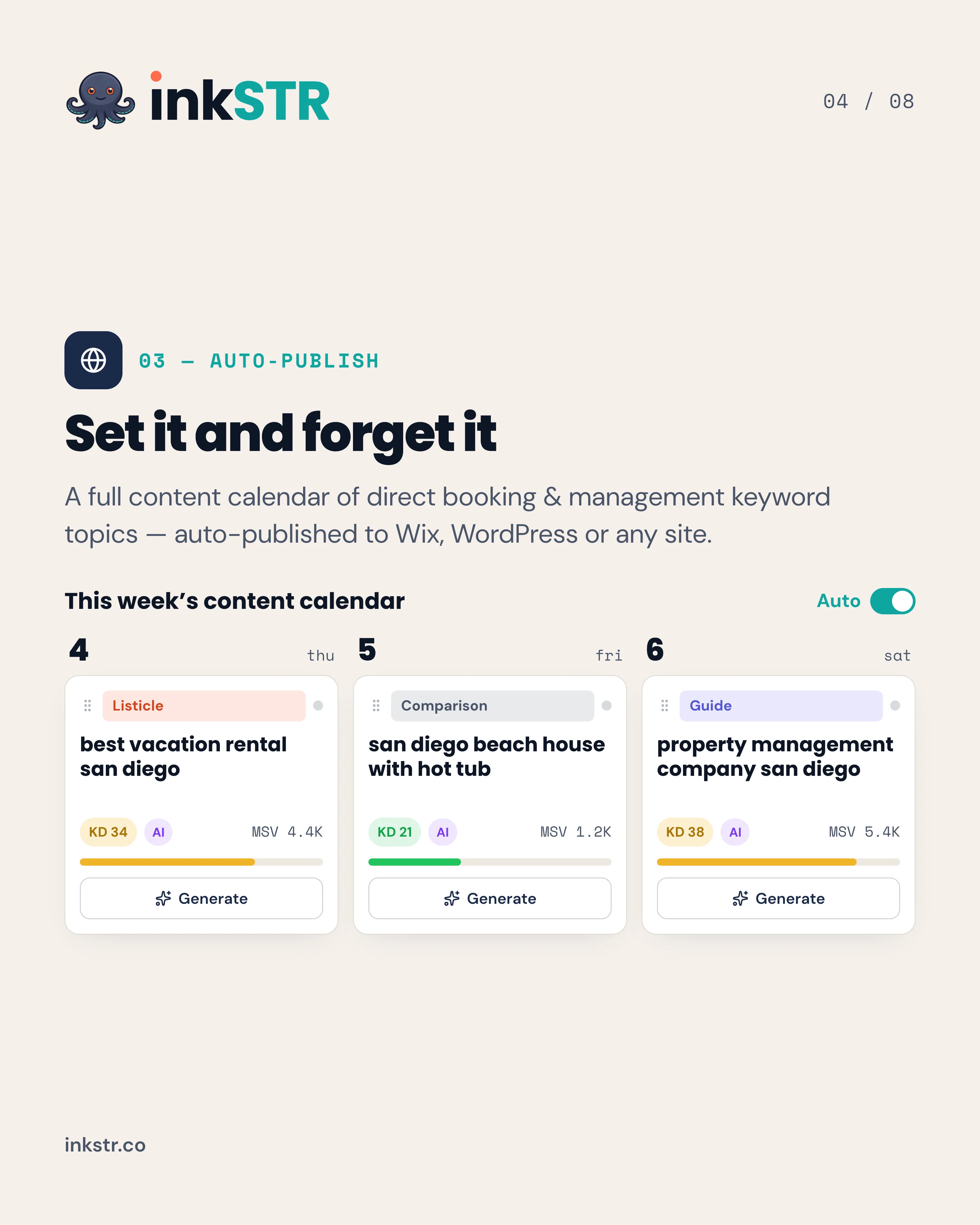
If you want visibility numbers to climb without writing every post yourself, Start Free Trial with inkSTR. Connect Google Search Console to see keyword opportunities for your site, let keyword research build the plan, and let the content calendar publish each article to Wix or WordPress on schedule.
Content powered by inkSTR.co
Enjoyed this article? Share it:
Get more of inkSTR in Google Search
Add inkstr.co as a preferred source and our articles show up more in Top Stories, AI Overviews, and AI Mode, with a “Preferred” badge.
Get more guides like this
New SEO and AI-search guides, straight to your inbox. No spam, unsubscribe anytime.