GEO Audit: How to Check Your AI Search Visibility in 2026
A GEO audit is a structured test of whether AI engines such as Perplexity, Gemini, and Google AI Overviews mention, cite, and describe your vacation rental brand accurately. It measures AI answer visibility, not blue-link rankings, and it ends with a prioritized list of content and technical fixes.
Key Takeaways
- A GEO audit checks brand mentions, citations, and accuracy inside AI-generated answers, while an SEO audit checks rankings, crawl health, and links in traditional results.
- A usable audit needs a fixed prompt set, repeated runs, and written scoring criteria so results stay comparable month to month.
- A GEO audit report should tie every citation or omission to evidence, an owner, a priority, and a follow-up date.
- Technical access matters: robots.txt, crawlability, schema, and machine-readable page structure decide whether AI systems can read your site at all.
- As of October 2026, across inkSTR customer sites we have secured more than 1,250 verified AI-search citations for customer content.
- inkSTR generates, schedules, and publishes answer-first, citation-ready articles for $99/month, so audit findings turn into published content instead of a to-do list.
You are probably here because a guest or a colleague asked an AI assistant for a place to stay or a property manager in your market, and your name did not come up. That is a visibility problem, and it is measurable.
At inkSTR, we build content pipelines for short-term rental operators anywhere in the U.S., and we have watched AI search change which sites get cited. In 2026, ranking on Google is still necessary. It no longer tells the whole story.
This guide covers what a GEO audit measures, how it differs from an SEO audit, what a report should contain, how to run one yourself, and how to choose tooling. It also fills gaps most audit guides skip: repeatable methodology, separating real change from random variation, scoring weights, and data governance.
What Is the Difference Between a GEO Audit and an SEO Audit?
A GEO audit evaluates how generative AI engines mention and cite your brand inside synthesized answers, while an SEO audit evaluates how your pages rank in traditional search results. SEO asks "where do I appear in the list?" GEO asks "am I part of the answer?"
The two overlap. Crawlability, schema, page speed, and quality content help both. But the outputs differ. An SEO audit produces ranking positions, crawl errors, and backlink data. A GEO audit produces a record of which prompts mention you, which sources get cited instead, and whether the AI describes your properties correctly. You need both records to see where guests find you and where they never reach you.
| Area | SEO Audit | GEO Audit |
|---|---|---|
| Core question | Where does my page rank? | Does the AI mention and cite me? |
| Main evidence | Search Console, crawl data, backlinks | Logged AI answers across engines |
| Content focus | Keywords, titles, internal links | Definition-first answers, entity clarity |
| Technical focus | Indexing, speed, canonicals | AI crawler access, schema, machine-readable structure |
| Risk checked | Lost rankings | Omission, wrong facts, competitor citation |
The painful manual version
Running both audits by hand means one afternoon in a crawler, another typing prompts into five AI tools, and a spreadsheet nobody updates. Writing the fix, one quality article, takes 3 to 5 hours of research and drafting, or $300 to $700 from a freelance travel writer.
How inkSTR closes the loop
We built inkSTR's Keyword Research and AI Content Writer so the content fixes an audit surfaces get drafted in the answer-first structure AI engines extract. If you want the traditional side of the picture, our guide on how to rank your vacation rental website on Google covers it.

How Is SEO Different From GEO?
SEO optimizes pages to rank in a list of search results, while GEO (generative engine optimization) optimizes content so AI systems select, quote, and cite it when composing an answer. SEO earns clicks from a results page. GEO earns inclusion in the answer itself.
GEO rewards content that is easy to extract: a direct definition in the first sentence of a section, named entities instead of vague pronouns, and consistent facts across your site and other places your brand appears. Traditional SEO still feeds this, because many AI answers draw on pages that already rank well.
Our opinion: treating GEO as a replacement for SEO is a mistake. Treat it as a second layer on the same content. A guest typing "pet-friendly cabin with a hot tub near a national park" into an AI assistant wants a specific answer, and the page that states that answer plainly gets quoted.
What it costs to ignore the shift
Every guest who gets a recommendation from an AI assistant and never visits your site is a booking you cannot recover. A single direct booking is typically worth $1,000 to $4,000, and Airbnb host and guest fees together take 17-19% of every OTA booking. Missing from AI answers pushes more demand toward the platforms.
Where inkSTR fits
This is exactly the problem inkSTR was designed to solve. Our articles open each section with a quotable direct answer, and our Content Calendar publishes them on a steady cadence. For a deeper read on the tactics, see our practical guide to ranking in AI search.
What Does a GEO Audit Measure?
A generative engine optimization audit measures how often AI engines mention your brand, whether they cite your pages, whether the facts are accurate, how you compare with competitors on the same prompts, and whether your site is technically readable by AI crawlers. Good audits score each of these separately, so a weak result points to one specific fix instead of a vague sense of failure.
Most published audits group their checks into similar categories: prompt mapping, multi-platform visibility testing, competitor benchmarking, technical discoverability, content citability, and offsite brand presence. Some tools publish weights for their composite scores; others keep the math opaque, which makes the number hard to trust.
The five dimensions we recommend scoring
- Visibility: the share of your test prompts where your brand appears at all.
- Citation: whether the AI links or attributes to your own pages rather than a third party.
- Accuracy: whether property types, locations, amenities, and policies are stated correctly.
- Sentiment: how the answer frames your brand relative to alternatives.
- Technical readiness: robots.txt access for AI crawlers, schema markup, clean headings, and indexable content.
Weight them by what matters to your business. A property management company chasing owner leads might weight citation and accuracy highest. A solo host with three cabins might weight visibility on guest-intent prompts.
The manual pain
Nobody has hours to query five engines, copy answers into a sheet, and re-check after every model update. Most operators run it once, feel overwhelmed, and never repeat it.
What inkSTR handles
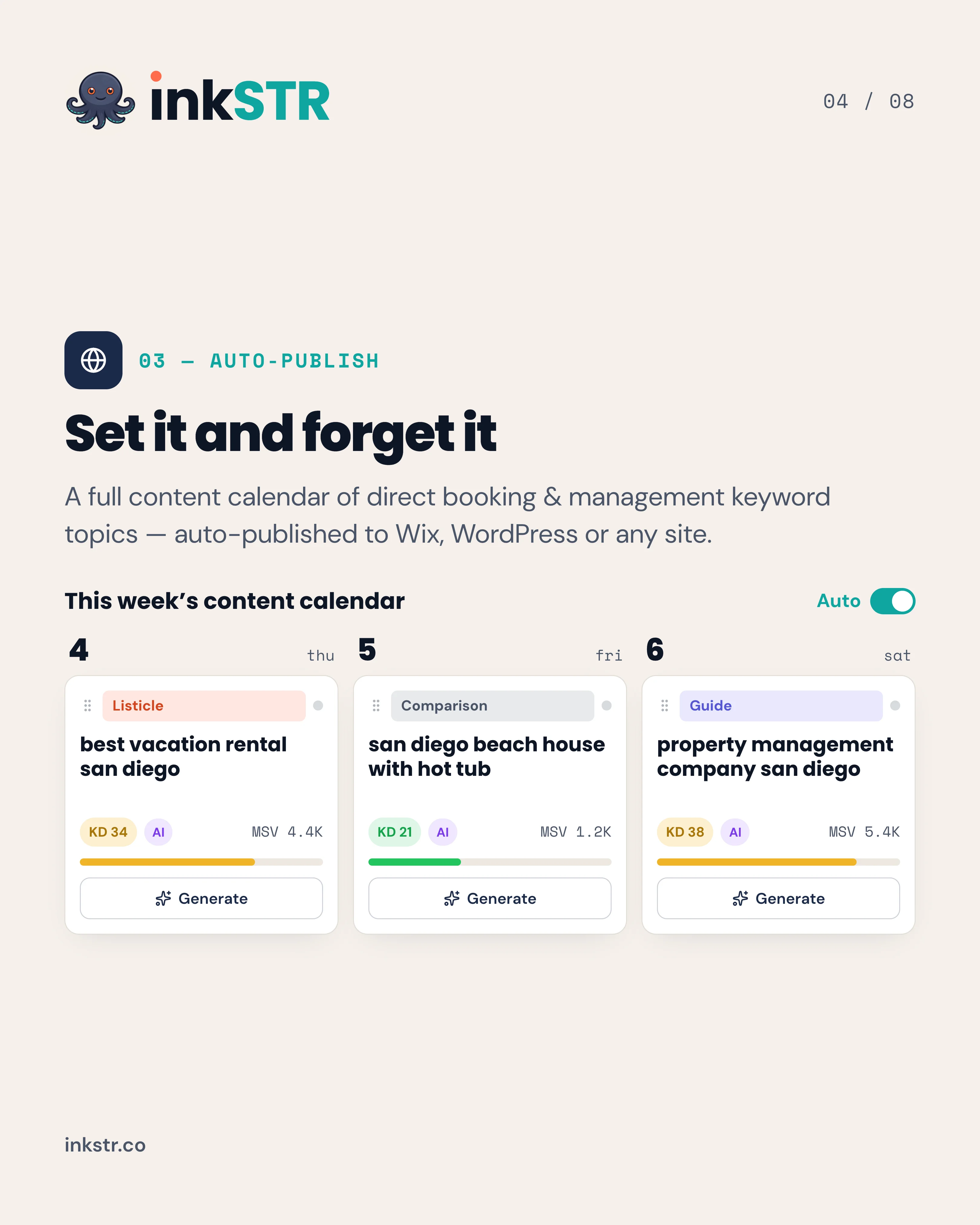
We handle the part that moves the score: publishing. inkSTR's Auto-Publishing sends articles to Wix, WordPress, or your custom site without manual steps, and our content engine includes LLM citation optimization on every article.
What Is a GEO Audit Report and What Should It Include?
A GEO audit report is a written record of your AI search visibility: the prompts tested, the answers logged, the citations and omissions found, and a prioritized fix list. The best reports tie every finding to evidence, an owner, a priority level, and a follow-up measurement date.
Many tool-generated reports stop at a score. A score without evidence cannot be acted on, and it cannot be defended when a colleague asks why it dropped. Use this template instead.
| Report Column | What to Record |
|---|---|
| Prompt | The exact wording tested |
| Engine and date | Which AI system, which run, when |
| Brand mentioned | Yes or no, and position in the answer |
| Source cited | Your page, a competitor page, or none |
| Accuracy note | Any wrong facts, quoted verbatim |
| Root cause | Missing page, weak structure, blocked crawler, thin entity signals |
| Owner | Who fixes it |
| Priority | High, medium, or low |
| Follow-up date | When to re-test |
Why this beats a composite score
A single score hides which prompt failed and why. A citation matrix shows you that you appear for "vacation rental management company" prompts but vanish for "how much do property managers charge." That second gap is a content gap, and a content gap is fixable with one article.
Turning findings into published pages
We built inkSTR so a finding like that becomes a queued article in minutes. Across inkSTR customer sites, we have published more than 4,400 articles as of October 2026, each structured for AI extraction. See how inkSTR works for the full keyword-to-published workflow.

How Do You Conduct a GEO Audit Step by Step?
To conduct a GEO audit, build a fixed prompt set, run it across several AI engines, log every answer, check your technical access, benchmark competitors, score the results with written criteria, and prioritize fixes. Repeat on a schedule so you can compare results over time.
- Define your prompt set. Write 20 to 40 prompts covering guest intent ("pet-friendly cabin with hot tub"), owner intent ("best vacation rental management company"), and brand queries. Freeze the wording.
- Choose your engines. Test at least ChatGPT, Perplexity, Gemini, Claude, and Google AI Overviews. Use the same account state and a logged-out run where possible.
- Run each prompt more than once. AI answers vary. Run each prompt at least three times per engine and record every result.
- Log mentions and citations. Capture brand mention, position, cited source, and any factual errors.
- Check technical access. Confirm robots.txt does not block AI crawlers, pages are indexable, headings are clean, and schema is valid. Tools like Screaming Frog can crawl your site for structural issues.
- Benchmark competitors. Record who gets cited on prompts where you do not, then read those pages to see how they answer.
- Score and prioritize. Apply your written weights, then rank fixes by impact and effort.
- Schedule the re-test. Same prompts, same method, same interval.
The manual burden
Steps 1 through 4 alone can swallow a weekend, and step 8 never happens when bookings get busy.
Where we help
Our Content Calendar runs the recurring part. Once your fixes are queued, publishing continues on autopilot, and our Google Search Console integration keeps the traditional performance data in view next to your audit log.
How Do You Tell Real Changes in AI Visibility From Random Variation?
AI answers vary between runs because of sampling, personalization, retrieval differences, and model updates, so a single changed answer proves nothing. A real change shows up as a consistent shift across repeated runs, multiple prompts, and more than one engine over at least two audit cycles.
This is the gap most audit guides skip, and it matters. If you test once, see your brand appear, and celebrate, you may have caught a lucky run. If you test once, see it vanish, and panic, you may have caught an unlucky one.
Sampling rules we recommend
- Run every prompt at least three times per engine in the same session window.
- Report visibility as a share of runs, not a yes or no.
- Keep prompt wording frozen; change it only in a new, labeled test set.
- Note the date of any known model update and treat results across it as a new baseline.
- Count a change as real only if it persists across two consecutive audit cycles.
Personalization adds noise too. Test logged out where the engine allows it, and record account state when it does not. If the same prompt returns different brands on different days with no change on your side, that is variation, not a verdict.
The manual cost
Disciplined sampling multiplies the work. Forty prompts across five engines at three runs each is 600 answers per audit cycle.
Our approach
We do not ask you to chase every wobble. Publish consistently, re-test on schedule, and judge by trend. That is why inkSTR emphasizes sustained publishing: SEO and GEO results typically build over several months of consistent output, not days.
Ready to automate your content marketing?
inkSTR handles keyword research, content strategy, article writing, and publishing, all on autopilot.
What Is the Best GEO Audit Tool?
The best GEO audit tool is the one that logs raw AI answers, shows its scoring criteria, covers multiple engines, and connects findings to content fixes. For most vacation rental operators, we recommend starting with a DIY prompt log, because it costs nothing and forces you to read the actual answers. Add a free instant scanner for a quick technical look.
Tools in this category fall into four groups: free instant scanners that return a quick report, composite-score platforms with weighted categories, service-led audits delivered by agencies, and DIY prompt logs in a spreadsheet. We will not rank named vendors here, because the right pick depends on your goal, budget, and how many properties you manage. A 3-cabin host and a 50-property manager need different depth.
| Approach | Best For | Watch Out For |
|---|---|---|
| Free instant scanner | A quick technical and structure check | Opaque scores; limited prompt-level evidence |
| Composite-score platform | Ongoing monitoring across engines | Pricing varies by plan; check how the score is weighted |
| Agency-led audit | A one-time deep review with recommendations | Custom pricing; findings still need someone to write the content |
| DIY prompt log | Full control and zero tool cost | Time-heavy; discipline required for repeat runs |
Questions to ask before you pick
- Does it show the actual AI answers, or only a score?
- Are the weights published?
- Which engines does it test?
- What happens to the prompts and data you submit?
That last one is governance. Prompts can contain brand strategy, owner details, or guest information. Check data retention terms, and avoid pasting guest personal data into any third-party AI tool. Platforms handling personal data may also carry privacy obligations such as GDPR and CCPA, so confirm the vendor's policies before you submit anything sensitive.
The gap every audit tool leaves
An audit tool diagnoses. It does not write the article that fixes the gap. For STR operators, that is the expensive half. inkSTR is the fix side: our AI Content Writer drafts 2,500 to 3,500 word, SEO and GEO-optimized articles built on vacation rental terminology and traveler intent, which general-purpose tools are not built around. Pricing starts at $99/month on our pricing page.
What Does a GEO Audit Checklist for a Rental Site Include?
A GEO audit checklist for a vacation rental site covers five areas: prompt coverage, content structure, entity clarity, technical access, and offsite brand presence. Each item should be pass or fail with evidence, so the checklist converts directly into a fix list you can hand to a writer or developer.
Content structure and answerability
- Each major page section opens with a direct, self-contained answer.
- Headings are phrased as the questions guests and owners actually ask.
- Property pages state location type, sleeping capacity, pet policy, and amenities in plain sentences, not only in images or widgets.
Entity clarity and consistency
- Your brand name, service area, and property descriptions match across your site, Google Business Profile, and listing channels.
- Named places, such as the park, lake, or ski area nearby, appear in text, not just in photo captions.
Technical access
- robots.txt does not block AI crawlers you want citing you; some audits also check for an llms.txt file and noai directives.
- Schema markup is present and valid, including FAQ markup on question-based pages.
- Pages are indexable and load fast.
Offsite presence
- Reviews, directory listings, and mentions on other sites describe you consistently. Our explainer on what a backlink is in SEO covers the link side.
Take a mountain cabin brand as an illustration. Its site may rank, yet its pages describe cabins in marketing language with no named trails, no capacity line, and no pet policy in text. An AI engine has nothing concrete to quote. The fix is content: specific, answer-first pages for each buying-intent question.

How Do You Score a GEO Audit Without Trusting a Black-Box Number?
You score a GEO audit by writing your own criteria before testing, assigning weights to each dimension, and recording evidence for every score. Transparent scoring lets you explain a change and defend priorities. It also lets you compare cycles without depending on an opaque composite.
Published tool weights illustrate the range. One public scoring model weights content E-E-A-T at 22%, technical SEO at 20%, AI citability and brand authority at 18% each, platform readiness at 12%, and schema markup at 10%. Weights like these are a design choice, not a law. Adjust yours to your business.
| Dimension | Starting Weight (adjust to your goals) | Evidence to Collect |
|---|---|---|
| Visibility share | Higher for guest-intent businesses | Mentions per prompt across repeated runs |
| Citation quality | Higher for owner-lead businesses | Cited URLs, own vs third-party |
| Accuracy | Always material | Quoted errors with screenshots |
| Technical readiness | Moderate | Crawl results, schema validation |
| Business impact | Tie to direct inquiries | Leads or bookings with an AI-search source |
Business impact is the dimension most audits leave out. Connect it to something real. One management company we work with, a 50+ property portfolio, started on inkSTR at the end of April 2026 and received four property-owner leads from AI search within its first month, measured in Google Search Console and its own lead records.
The proof that content moves the numbers
Content volume and structure matter. A Smoky Mountains cabin brand on inkSTR grew monthly Google Search clicks from 788 to 5,195 in 11 months and attributed $309,775 in direct booking revenue over its first 14 months, measured in Search Console and Analytics. Across inkSTR customer sites, we have also secured more than 1,250 verified AI-search citations as of October 2026. For a related look at conversion, read why blog content fails to convert visitors into guests.
How Often Should You Run a GEO Audit and What Should You Do With the Results?
Run a full GEO audit quarterly and a lighter prompt check monthly, because AI answers shift with model updates and new content. After each audit, turn every finding into a ticketed fix with an owner and a re-test date, then publish the content fixes first.
Most findings land in three buckets. Missing coverage means no page answers the prompt, so write one. Weak structure means a page exists but buries the answer, so rewrite the opening. Accuracy errors mean the AI states something wrong, so correct the source pages and strengthen consistent facts across your presence.
Common mistakes to avoid
- Testing once and treating it as a trend.
- Changing prompt wording between cycles.
- Fixing technical issues while leaving content gaps untouched.
- Publishing generic "top 10 things to do" posts that underperform for direct bookings.
- Skipping the follow-up measurement.
The manual trap
An audit that produces 25 content fixes and a writer budget of $300 to $700 per article means a five-figure backlog. Most operators stall at fix number three.
How inkSTR clears the backlog
This is where we think the economics change. At $99/month, inkSTR generates, schedules, and publishes articles automatically on a set schedule, so the backlog becomes a calendar. One five-market brand we work with published 114 articles in four months and went from 26 to 1,924 monthly Google search visits. Pair that with our guidance on vacation rental blog topics that drive bookings to choose what to publish first, and see direct booking SEO local signals for the traditional layer.
Frequently Asked Questions
What is a GEO audit?
A GEO audit is a structured test of how generative AI engines mention, cite, and describe your brand. It logs answers across engines like Perplexity, Gemini, and Google AI Overviews, checks technical access and content structure, and ends with a prioritized fix list. For rental operators, it shows whether guests and owners asking AI for recommendations see your name.
Is a GEO audit different from an SEO audit?
Yes. An SEO audit examines rankings, crawl health, and backlinks in traditional search results. A GEO audit examines whether AI answers include and cite you, and whether they state your facts correctly. They share technical foundations such as crawlability and schema, so fixing one often helps the other.
How long does a GEO audit take?
An instant scanner returns a technical report in minutes. A thorough manual audit with 20 to 40 prompts across several engines, repeated runs, and a written report typically takes a few days of focused work. Re-testing on a schedule is where most of the long-term effort sits.
How often should I run a GEO audit?
Run a full audit quarterly and a short prompt check monthly. AI answers change with model updates and new content, so a one-time audit goes stale quickly. Keep the prompt set frozen so each cycle stays comparable.
Can AI-generated content get cited by AI engines and AI Overviews?
Yes, when it is specific, accurate, and structured for extraction. Answer-first openings, named entities, and real property details make a page easy to quote. Across inkSTR customer sites, we have secured more than 1,250 verified AI-search citations as of October 2026. See our guide to article automation without losing your brand voice.
Do I need a GEO audit if I already rank on Google?
Probably, yes. Ranking in blue links does not guarantee inclusion in AI answers, and AI engines may cite different sources than the ones that rank. An audit shows the gap on the prompts your guests and owners actually use.
What should a GEO audit report include?
It should include the exact prompts tested, the engine and date, whether your brand appeared, which source was cited, any factual errors, a root cause, an owner, a priority, and a follow-up date. Evidence for every finding matters more than a headline score.
Is it safe to submit company data to AI tools during an audit?
Be careful. Prompts can reveal brand strategy or owner and guest details, and third-party AI platforms have their own retention terms. Review each vendor's data policy, keep personal guest data out of test prompts, and use generic wording where possible.
What Is the Next Step After Your GEO Audit?
A GEO audit tells you where AI engines skip your rental brand; publishing answer-first content is how you close the gap. Start with a fixed prompt set, run it three times per engine, score with written criteria, and re-test every quarter. In 2026 and beyond, the operators who appear in AI answers will be the ones who publish consistently.
If keeping up with the content fixes your audit uncovers feels impossible right now, inkSTR was built to automate exactly this. Our content strategy wizard maps your site around the prompts guests and owners use, and we generate, schedule, and publish the articles for you, anywhere in the U.S. Start a free trial and see your first content plan.
Content powered by inkSTR.co
Enjoyed this article? Share it:
Get more of inkSTR in Google Search
Add inkstr.co as a preferred source and our articles show up more in Top Stories, AI Overviews, and AI Mode — with a “Preferred” badge.
Get more guides like this
New SEO and AI-search guides, straight to your inbox. No spam, unsubscribe anytime.