Automated SEO Tool Risk and ROI for Vacation Rental Portfolios

An automated SEO tool for vacation rental portfolios is software that handles keyword research, content drafting, publishing, or technical auditing without a human completing each step manually. For multi-property operators, the category ranges from tools that only monitor rankings to platforms that run the entire pipeline from research to a published, live blog post.
Key Takeaways
- Automated SEO tools split into two functional groups: monitoring and reporting tools that flag problems, and execution tools that actually research, write, and publish content.
- Industry research from BrightEdge and Forrester shows SEO professionals now automate roughly 58% of SEO tasks, with keyword research automated by 84% of professionals according to SEMrush.
- A single direct booking is typically worth $1,000 to $4,000 in revenue, which changes the ROI math for content tools compared to almost any other software category an STR operator buys.
- Writing one quality blog post manually takes 3 to 5 hours, and a freelance travel writer typically charges $300 to $700 per post, a cost that multiplies fast across a multi-property portfolio.
- The biggest risk in automated SEO tools built for general SaaS or ecommerce is that they don't understand vacation rental search intent, location clustering, or seasonal booking language.
- inkSTR runs the full content pipeline, research, drafting, scheduling, and publishing, specifically for short-term rental terminology and multi-property portfolios starting at $99/month.
If you manage more than one listing, you already know that generic SEO advice falls apart the moment you try to apply it across five, fifteen, or fifty properties. A blog post that works for a single beach condo doesn't automatically translate into a content strategy for a fifteen-unit mountain cabin portfolio with different neighborhoods, different guest types, and different seasonal booking windows.
That's the gap most "best SEO tool" roundups ignore. They compare feature lists built for SaaS companies or ecommerce stores, then expect vacation rental operators to translate the advice themselves. At inkSTR, we've reviewed how these tools actually perform when applied to STR portfolios, and the pattern is consistent: generic automation produces generic content, and generic content doesn't rank for "cabin rental near Blue Ridge Parkway" or "pet friendly beach house Destin."
This article breaks down what automated SEO tools actually do, where the real risk sits when you scale across multiple properties, and how to weigh the ROI honestly before you commit budget to any platform in 2026.
What Is the Best Automated SEO Tool for a Multi-Property Portfolio?
The best automated SEO tool for a multi-property vacation rental portfolio is one that handles execution, not just monitoring, and does so with an understanding of location-based hospitality search intent. Generic platforms built for any industry can audit your site and flag broken links, but they cannot write a blog post that knows the difference between a "beach town" search intent and a "mountain retreat" search intent.
Most automated SEO tools fall into two categories: monitoring platforms that track rankings and flag technical issues, and execution platforms that generate and publish content. Monitoring tools are useful, but they leave the actual work, the researching, writing, and scheduling, entirely on your plate. For a property manager running one property, that's manageable. For someone managing fifteen units across three markets, it's a second full-time job nobody signed up for.
Without execution-focused automation, you're stuck writing every post yourself at 3 to 5 hours per article, or paying a freelance writer $300 to $700 per post who likely has never written about occupancy tax disclosures, cabin amenity comparisons, or lake house seasonal pricing. Multiply that across fifteen properties needing consistent monthly content and you're looking at either dozens of hours a month or a freelance bill that outpaces your marketing budget fast.
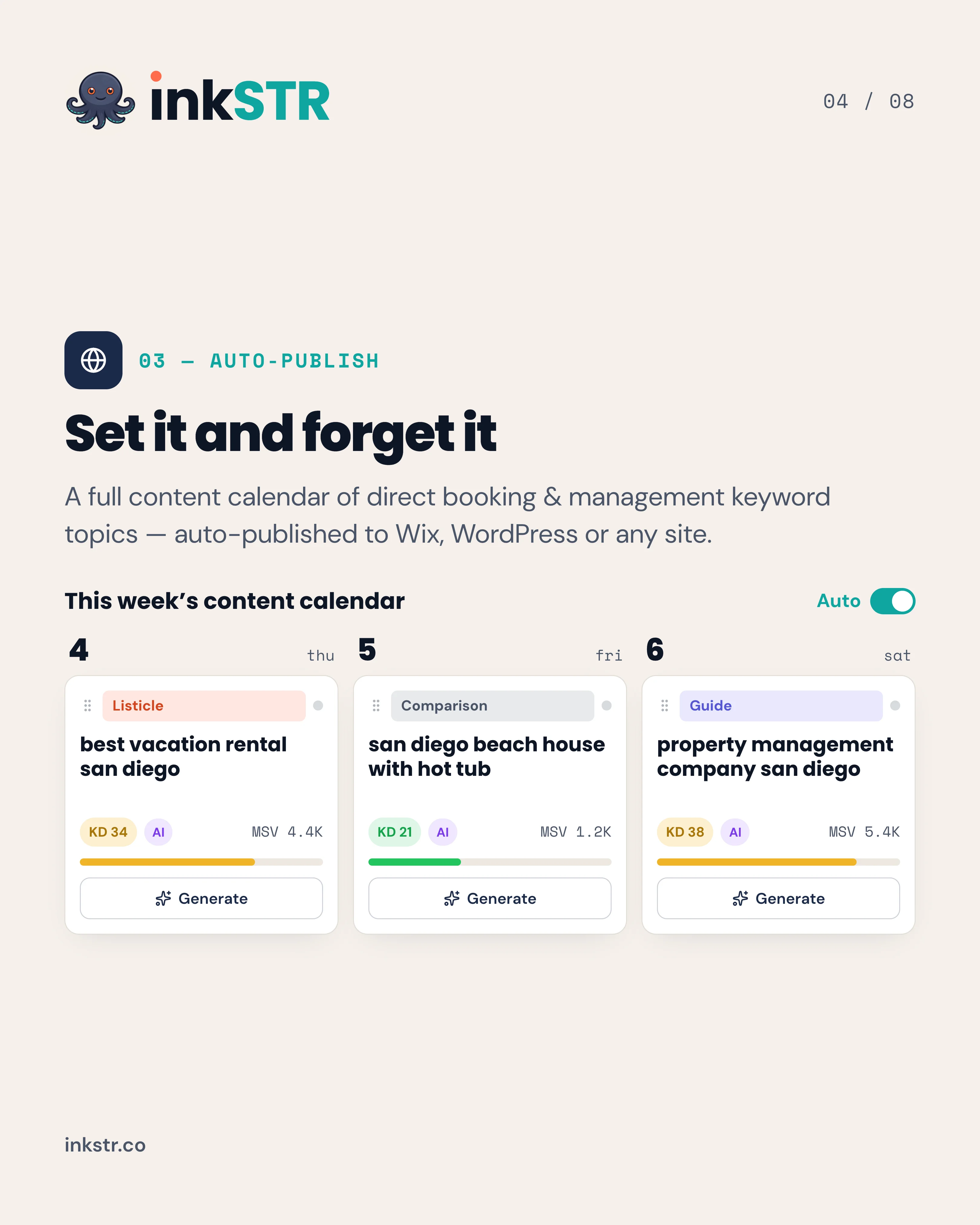
This is exactly the gap inkSTR's content workflow was built to close. The platform generates keyword-targeted articles specific to short-term rental terminology, schedules them through the Content Calendar, and publishes directly to your site without you touching a draft. It's built for the vertical, not retrofitted from a horizontal SaaS tool.
Can You Automate SEO for a Vacation Rental Business?
Yes, you can automate SEO for a vacation rental business, but automation works unevenly across different SEO tasks. Keyword research, content drafting, publishing schedules, and technical audits automate well. Local nuance, brand voice, and regulatory specifics still need human review, at least periodically.
According to BrightEdge and Forrester research, SEO professionals currently automate roughly 58% of SEO tasks, with technical site auditing and sitemap management among the highest-automation workflows. SEMrush data shows keyword research is automated by 84% of SEO professionals, making it one of the most reliably automatable parts of the process. The risk for STR operators is assuming automation means "hands off forever." It doesn't. A fully automated tool that never gets checked can publish a blog post referencing a hot tub the property no longer has, or list local attractions that closed years ago. Automation removes the manual labor of production, not the responsibility of oversight. For a property manager overseeing multiple markets, this distinction matters more than it does for a single-property host. A beach town listing needs different seasonal event references than a mountain retreat. Automating without a system for property-specific and location-specific inputs produces content that's technically published but factually generic. That's why inkSTR pairs automated drafting with a Keyword Research engine tuned to hospitality search intent, so the topics generated actually match what guests search for in each specific market, rather than pulling from a one-size-fits-all keyword database built for retail or SaaS clients.
Can ChatGPT Do SEO for Vacation Rental Content?
ChatGPT can assist with SEO tasks like brainstorming headline ideas, drafting outlines, or generating keyword lists, but it cannot independently research current search rankings, schedule publishing, or maintain a consistent content calendar across multiple properties without significant manual setup.
Operators frequently ask this question because ChatGPT is free or low-cost and feels like an obvious starting point. And for a single blog post, it can genuinely help. Ask it for ten blog topic ideas about a lakefront cabin and it will produce something usable in seconds, at no cost beyond your time.
The limitation shows up at scale. ChatGPT has no memory of what you've already published unless you feed it that context every session. It doesn't know your Google Search Console data, doesn't track which keywords are already ranking, and doesn't publish anything, you're still copying, formatting, and uploading every draft manually. For a fifteen-property portfolio needing four posts a month per market, that's still dozens of hours of manual coordination even with the drafting sped up.
There's also a quality ceiling. Generic AI drafts without STR-specific training tend to produce vague, interchangeable copy: "cozy retreat with modern amenities" could describe almost any rental in the country. That's the exact kind of thin content Google's helpful content systems are built to deprioritize, and it's a pattern we see across property management sites that lean on unedited general-purpose AI output. inkSTR was built specifically to solve this gap. The AI Content Writer generates full drafts trained on vacation rental terminology and traveler search patterns, not general business copy, then routes them through scheduling and publishing automatically. It's the difference between a tool that helps you think and a tool that finishes the job.
Is There an AI Tool for SEO Built Specifically for Vacation Rentals?
Yes, purpose-built AI SEO tools for vacation rentals exist, and they differ meaningfully from horizontal AI SEO platforms built for any industry. A vertical-specific tool understands hospitality terminology, seasonal booking language, and location-based clustering that generic tools have to be manually configured to approximate, if they can at all.
This distinction matters more in 2026 than it did a few years ago. Industry research from Market.us shows the global AI-powered SEO software market reached roughly $3.98 billion in 2026 and is projected to grow at a 23.4% compound annual rate through 2035. That growth has produced a crowded field of general-purpose tools, most of which are not built with hospitality search intent in mind. The practical risk of using a horizontal tool for a vacation rental portfolio is topic drift. A general SEO content tool might suggest blog topics based on generic ecommerce or SaaS keyword patterns, missing the specific phrases actual travelers type, like "dog friendly cabin near Gatlinburg with hot tub" or "walkable Airbnb downtown Charleston no car needed." Those long-tail, intent-rich phrases are exactly what drives qualified direct booking traffic, and they require training data specific to travel and hospitality search behavior. We built inkSTR around this exact gap. Because the platform is purpose-built for short-term rental operators, its keyword research and drafting engine already understands location-based hospitality phrasing, so you're not paying for a generic tool and then doing the translation work yourself. If you want to see the difference this makes for actual rankings, our piece on what STR operators need to know about ranking on Google breaks down the specific factors that matter for this industry versus generic SEO advice.

How Do Automated SEO Tools Actually Compare on Depth and Portfolio Fit?
Automated SEO tools compare most usefully along one axis: automation depth. Monitoring tools track and report; execution tools research, draft, and publish. Portfolio fit is a second axis entirely, since a tool built for single-site SaaS blogs handles fifteen simultaneous property content calendars very differently than a tool designed for that use case.
The table below groups tool categories by what they actually do, not by brand, since the specific vendor matters less than understanding which functional bucket you're paying for.
| Tool Category | What It Automates | Multi-Property Fit | Typical Monthly Cost Range |
|---|---|---|---|
| Technical audit and monitoring tools | Site crawls, broken link detection, rank tracking, reporting | Requires manual content production on top; doesn't scale content itself | Often above $100/month per site |
| On-page optimization tools | Content scoring, keyword density checks, schema suggestions | Improves drafts you already wrote; doesn't generate new topics | Commonly $200 to $300+/month |
| General-purpose content generation tools | Drafts blog posts from prompts across any industry | Requires heavy manual editing for STR terminology and local accuracy | Varies widely by usage tier |
| Full-pipeline execution platforms (general) | Research, writing, publishing, and internal linking end-to-end | Some offer per-site pricing around $99/month, but built for any vertical | Around $99/month per site, common industry benchmark |
| inkSTR (STR-specific full pipeline) | Keyword research, drafting, scheduling, and auto-publishing tuned to hospitality search intent | Built for multi-property content calendars from the ground up | Starting at $99/month, see Pricing |
Notice the pattern: cost alone doesn't separate these tools. Several full-pipeline platforms land near a similar $99/month price point. What separates them is whether the underlying content engine understands that "cabin rental" and "beach house" carry entirely different guest intent, seasonal patterns, and amenity expectations. That's a training data problem, not a pricing problem, and it's the single biggest factor operators overlook when comparing tools on a spreadsheet.
What Are the Real Risks of Adopting an Automated SEO Tool Across a Portfolio?
The real risks of adopting an automated SEO tool across a vacation rental portfolio center on three failure points: generic content that doesn't reflect property-specific detail, publishing schedules that go stale without oversight, and tools that automate monitoring while leaving the actual writing burden untouched.
The first risk shows up fastest. If a tool generates content without property-level inputs, like actual amenities, actual nearby attractions, and actual neighborhood character, you end up with the same problem generic AI drafts create: interchangeable copy that could describe any rental in the country. Search engines increasingly deprioritize this kind of thin content, and readers bounce off it just as fast.
The second risk is subtler. A property management company overseeing fifteen units doesn't fail because they never started a content strategy. They fail because the calendar ran for two months, then stalled when someone got busy with a guest issue. Google's ranking systems reward consistency over bursts, and inconsistent publishing is one of the most common reasons STR sites plateau after an initial ranking bump. The third risk is a mismatch between what a tool promises and what it delivers. Some platforms market themselves as "automated SEO" but only automate the audit and reporting layer, technical crawls, rank tracking, dashboards, leaving the actual research and writing exactly where it always was: on your desk at 11pm. We designed inkSTR's Content Calendar and Auto-Publishing features specifically to close that consistency gap. Once scheduled, articles publish on autopilot to your Wix or WordPress site whether or not you have time to think about it that week. For a deeper look at how AI content risks brand voice if left unmanaged, our guide on article automation without losing your brand voice covers the oversight practices worth keeping even with automation running.
Ready to automate your content marketing?
inkSTR handles keyword research, content strategy, article writing, and publishing, all on autopilot.
What Does the ROI Actually Look Like for Multi-Property Operators?
The ROI of an automated SEO tool for multi-property operators depends on comparing the tool's cost against the manual alternative's true cost, not against zero. Every property already needs content whether you automate it or not; the only question is whether you pay in hours, in freelance invoices, or in software.
Run the math on a modest fifteen-property portfolio needing two blog posts per property per month, a reasonable cadence for a growing content strategy. That's 30 posts monthly. At 3 to 5 hours of manual writing per post, you're looking at 90 to 150 hours a month, more than a full-time job, just on content. Hire a freelance travel writer at $300 to $700 per post instead, and you're spending $9,000 to $21,000 monthly, an unsustainable line item for most independent property management companies. Compare that to a flat-rate tool. inkSTR starts at $99/month, and a single direct booking captured through organic search traffic is typically worth $1,000 to $4,000 in revenue. One converted booking across an entire portfolio's content strategy for the year covers the software cost many times over. And because a ranking blog article can drive organic search traffic for 2 to 5 years once it earns position, the return compounds well beyond the month you published it. There's also the OTA fee angle worth factoring in. Airbnb host and guest fees combined run 17 to 19% of every booking. Every reservation you win through your own site instead of a platform search result keeps that percentage in your pocket instead of paying it out. Multiply that across a portfolio and the case for owned-channel content becomes hard to ignore. If you want a deeper breakdown of this math applied to individual hosts rather than portfolios, our article on revenue maximization strategies that actually work covers additional angles on where content marketing spend pays back fastest.
How Should You Choose Between Monitoring Tools and Execution Tools?
Choosing between monitoring tools and execution tools depends on where your actual bottleneck sits. If your site has technical problems, broken pages, slow load times, missing schema, a monitoring and audit tool solves that. If your bottleneck is a lack of published content, no monitoring tool fixes that; you need an execution platform that produces and publishes new pages.
Most multi-property operators we talk to have already solved the technical basics. Their sites load fine and don't have glaring crawl errors. Their actual problem is a content calendar that hasn't been touched since a launch push over a year ago. For that operator, adding another monitoring dashboard does nothing. What they need is content production that doesn't depend on someone finding four free hours a week.
Here's a practical framework for the decision:
- Audit what's actually broken first. If your Google Search Console shows crawl errors or indexing issues, fix those before investing in content tools; new content on a broken site wastes budget.
- Count your current publishing cadence. If you've published fewer than one post per property in the last quarter, your bottleneck is production, not optimization.
- Calculate your true hourly cost of manual writing. Multiply hours per post by your effective hourly rate or freelance cost, then compare against a flat monthly software fee.
- Check whether the tool understands your vertical. Ask for a sample draft about a specific property type you manage before committing.
- Confirm publishing integration with your actual site. A tool that generates great drafts but can't publish to your Wix or WordPress site still leaves manual work on your plate.
For operators managing content across multiple brands or client portfolios, and not just properties, our guide on must-have tools for short-term rental managers scaling up covers the broader tech stack decision beyond content alone. And if your site currently isn't ranking at all despite having some content published, this breakdown of why vacation rental websites don't rank is worth reading before you invest further.

What Should You Prioritize When Comparing Vacation Rental SEO Tools?
When comparing SEO tools for vacation rental portfolios, prioritize vertical-specific content quality over generic feature counts. A tool with fifty dashboard widgets that produces vague, interchangeable drafts about "cozy getaways" delivers less business value than a simpler tool that writes accurately about property-specific amenities and local search intent.
Common mistakes we see operators make when evaluating tools include:
- Choosing a tool based on brand recognition rather than testing an actual sample draft for their property type.
- Assuming more automation features always means better results, even when the core writing quality is weak.
- Ignoring publishing integration and ending up with drafts that still require manual copy-paste into their CMS.
- Underestimating how long consistent publishing takes to produce ranking movement, then abandoning the strategy after a month or two.
Trade-offs worth understanding upfront: fully automated tools save time but require periodic human review to catch factual drift, like outdated amenities or closed local attractions. Tools with heavier manual controls give you more precision but demand more of your time. There's no version of this that requires zero ongoing attention, only versions that require dramatically less of it. This is where inkSTR's positioning is deliberately narrow. Rather than being a general content tool retrofitted for hospitality, every part of the pipeline, from the Keyword Research engine to the AI Content Writer to Auto-Publishing, was built around vacation rental search behavior specifically. That focus is the actual differentiator, not a longer feature list.
Frequently Asked Questions
How do you pronounce Kiawah Island?
Kiawah Island is pronounced KEE-uh-waw, with emphasis on the first syllable. It's a common question for vacation rental operators writing location-based content about South Carolina's coastal market, since accurate local terminology matters for both reader trust and search relevance in that area.
How long does it take to see SEO results from automated content?
Most vacation rental sites start seeing measurable ranking movement within a few months of consistent publishing, though timelines vary by market competition and existing domain authority. Since a ranking blog article can drive organic traffic for 2 to 5 years once established, the investment compounds well past the initial ranking period.
Can automated SEO tools replace a content strategy entirely?
No. Automated SEO tools execute a content strategy faster and more consistently, but they don't replace the strategic decisions about which markets, property types, and guest personas to target. inkSTR's content strategy framework still requires you to define your properties and target markets before the automation takes over the execution work.
Is it worth paying for a content writer versus using an automated tool?
For a single property publishing occasionally, a freelance writer at $300 to $700 per post can work fine. For a portfolio needing consistent monthly content across multiple properties, the math shifts quickly toward automation, since freelance costs scale linearly with volume while a flat-rate tool like inkSTR does not.
Does automated content actually reduce dependence on Airbnb and VRBO?
Yes, when the content is built around search terms that lead to your own booking page rather than an OTA listing. Since Airbnb host and guest fees combined run 17 to 19% of every booking, every direct booking captured through organic content keeps that percentage as revenue instead of a platform fee.
What's the difference between an automated SEO tool and a general AI writing tool?
A general AI writing tool, like a standalone chatbot, can draft text but doesn't handle keyword research, scheduling, or publishing without manual steps in between. An automated SEO tool built for a specific vertical, like inkSTR for short-term rentals, connects research, drafting, and publishing into one pipeline tuned to that industry's search behavior.
Do I need existing SEO knowledge to use a platform like inkSTR?
No. inkSTR's content workflow is designed so operators without prior SEO experience can still run a consistent content strategy, since the platform handles the keyword research and technical structure automatically rather than requiring you to learn it first.
Conclusion
The best automated SEO tool for a vacation rental portfolio is the one that treats content production as a full pipeline, research, drafting, scheduling, and publishing, rather than stopping at monitoring dashboards or leaving you to finish the work manually. Generic tools built for any industry can help, but they consistently miss the hospitality-specific search intent that actually drives direct bookings. The ROI math is straightforward once you compare real alternatives. Manual writing costs 3 to 5 hours per post; freelance writers run $300 to $700 per post; and a single direct booking captured through content is typically worth $1,000 to $4,000. Against that backdrop, a flat monthly software cost starts to look less like an expense and more like the cheapest option on the table. As the SEO software market continues expanding through 2026 and beyond, the operators who win won't be the ones with the most tools. They'll be the ones running the most consistent, vertical-specific content strategy across their entire portfolio. Get started with inkSTR if you're ready to stop choosing between writing every post yourself and paying freelance rates that don't scale with your portfolio.
If you're evaluating automated SEO tools for a growing portfolio, inkSTR's content calendar gives you a single view of scheduled posts across every property, so nothing stalls after the initial launch push. Start a free trial and set up your first content pipeline this week.
Content powered by inkSTR.co
Enjoyed this article? Share it:
Get more of inkSTR in Google Search
Add inkstr.co as a preferred source and our articles show up more in Top Stories, AI Overviews, and AI Mode — with a “Preferred” badge.
Get more guides like this
New SEO and AI-search guides, straight to your inbox. No spam, unsubscribe anytime.