Content Gap Analysis for Vacation Rental Website: 7 Steps
A content gap analysis for a vacation rental website compares the pages you already have against the searches guests make and the topics competitors rank for, then produces a ranked list of what to publish or fix. At inkSTR, we run it in seven steps, from inventory to measurement.
Key Takeaways
- A content gap is a guest need your site never answers; a keyword gap is a search phrase competitors rank for and you do not.
- Compare yourself against the sites that share your search results, which often include listing platforms and travel guides, not only other managers.
- Map each property and destination to an existing URL before you look at competitor data, so you know what you already own.
- Your own booking inquiries and guest reviews reveal questions that no competitor tool will list.
- Score each gap by search intent and booking value before writing anything, then review results monthly in Google Search Console and Google Analytics.
- inkSTR automates keyword research, competitor keyword gap detection, article drafting, scheduling, and publishing, so closing a gap becomes a scheduled article instead of a freelance invoice.
You open your analytics and see a pattern. Page views climb on a few posts, but direct inquiries stay flat. A search for '[your town] vacation rentals' returns listing sites and travel blogs instead of your pages. The cause is usually a content gap: guests ask questions your site never answers.
In 2026, AI Overviews and chat assistants answer many travel questions directly, so a page has to answer one specific question completely to earn a click or a citation. We build AI content tools for short-term rental operators, and as of November 2026 we have published more than 5,400 articles across inkSTR customer sites. The workflow below comes from that work.
You will get seven steps. Each one covers the manual method, the point where it gets slow, and how to shorten it.
Step 1: What Should a Content Gap Analysis for a Vacation Rental Website Cover?
A content gap analysis for a vacation rental website is a structured comparison between the topics your site covers and the topics your future guests search for. It surfaces missing pages, thin pages, and pages that rank below a competitor's page on the same subject.
Start by choosing one goal: direct inquiries for a specific property, owner leads for a management company, or visibility for a destination. The goal decides which gaps matter. Without one, you chase every missing keyword and publish posts that never touch a booking decision.
| Gap type | What it means | Vacation rental example |
|---|---|---|
| Keyword gap | A phrase competitors rank for and you do not | 'pet friendly cabins near [town]' |
| Content gap | A guest need with no page answering it, even if no tool lists a keyword | A page explaining how self check-in works |
| Domain-level gap | Competitors cover a topic and your site has no page on it | No guide to the nearest lake |
| Page-level gap | Both sites cover a topic, but their page ranks for more phrases | Your amenities page is thinner than theirs |
The manual route is slow. Finding these mismatches means reading rival sites, running dozens of searches, and pasting URLs into a spreadsheet. One quality post already takes 3 to 5 hours by hand, and a freelance travel writer charges $300 to $700 per post. Publishing the wrong topic at that price hurts.
We built inkSTR's keyword research around what your target guests actually type, so you begin with a keyword plan instead of a guess. If you need ideas to seed the list, our vacation rental blog topics post is a good starting point.

Step 2: Which Competitors Should You Compare Against?
Choosing competitors for a gap analysis means picking the sites that share your search results, which often reaches beyond the property managers in your market. You get the fullest picture by comparing direct rivals alongside the listing sites and travel guides that rank for your destination terms.
Most operators name the two or three management companies they already know. But the pages taking your clicks for '[town] vacation rentals' are frequently listing pages on Airbnb and VRBO, plus destination guides from local tourism sites. Those rivals reveal different gaps: listing platforms win on breadth, guides win on local depth.
Checking this by hand means searching each query in a private window and recording who ranks. Then you repeat the process for every market you serve. If your portfolio spans several towns, a full day is gone before you find a single gap.
The how inkSTR works page shows where the brand audit sits in the workflow from keyword to published post.
Pro tip: keep the comparison set small. Most keyword gap tools compare your site with up to four rivals, and four well-chosen rivals beat ten random ones. If you run a management company, add one or two competing management sites, since owner-facing queries have different rivals than guest-facing ones. Our approach to property management content covers that owner-lead side.
Step 3: How Do You Audit What Your Website Already Covers?
A content inventory is a spreadsheet listing each property, destination, and guest question against the URL that answers it, the type of gap, and the next action. It shows what you own before you compare yourself with anyone else.
Many hosts skip this and discover later that they wrote the same pet policy post twice. Pages that overlap compete with each other, and thin pages drag down the pages around them. One common benchmark for property pages is at least 800 words of real detail on location and amenities, plus the guest experience.
| Property or market | Guest question | Existing URL | Gap type | Next action |
|---|---|---|---|---|
| Lakefront house (example) | Does the house allow dogs? | None; one line in listing FAQ | Missing page | Write a pet policy page |
| Mountain cabin (example) | How does self check-in work? | Short blog post | Thin page | Expand with arrival steps and parking photos |
| Beach condo (example) | Is parking included? | Amenities page | Buried answer | Add a dedicated section and internal link |
Building this by hand across 15 or more properties can swallow an entire day, and it goes stale the moment you publish. inkSTR's multi-project support runs each property or brand in its own pipeline, and the Google Search Console integration shows which existing pages already earn impressions.
Step 4: How Do You Run a Competitor Keyword Gap Analysis?
A competitor keyword gap analysis compares the search phrases your rivals rank for against the phrases your site ranks for, filtered down to those that match your properties. The output is a shortlist of queries worth building pages around.
The raw export is the problem. It arrives with thousands of rows, many of them competitor brand names or other destinations. Others are search features that are not standard results. Cleaning it by hand takes an afternoon per market, and the list goes stale as competitors keep publishing.
- Enter your domain plus up to four competitors in a keyword gap tool.
- Filter to main organic positions so image packs and carousels do not pad the list.
- Remove competitor brand names before you export.
- Keep long-tail, location-based phrases such as 'pet friendly lake house near [town]' ahead of broad national terms.
- Sort by intent, with transactional and local comparison queries first.
For tools, the free baseline is Google Search Console, which shows queries where you already earn impressions, plus Google Analytics for landing pages. A paid gap tool adds competitor data. Instead of researching keywords for hours, you get a full keyword plan in one click.
If your pages already show impressions but earn few clicks, the problem may sit elsewhere; see why a vacation rental website is not ranking on Google.

Step 5: How Do You Find Guest Questions Your Competitors Miss?
First-party guest questions are the questions your own guests ask before and after booking, found in inquiries, messages, reviews, and on-site search. They expose content gaps no competitor tool lists, because rivals have never published an answer worth ranking.
Export a season of inquiries and tag them by theme: parking, pets, check-in, noise, distance to attractions. Count the repeats. The questions you answer by message every week are the pages you have not written. Parking and check-in are the usual starting points, and pet policies often follow.
Comparison intent is a second source. Keep claims verifiable: state your own square footage and fees, and avoid quoting a rival listing's price. Our direct bookings approach shows where these pages fit.
Local facts decay. Log a verification date for every restaurant and event in your inventory, and for each seasonal closure. Review each season in 2026, and tell readers to confirm event schedules with the organizer. A guide that lists a closed restaurant costs you trust. Our post on local area guides that sell covers this in more depth.
Writing these pages without help means hours of digging through reviews. inkSTR's PMS integration with Hospitable and OwnerRez pulls reviews, photos, and guest data into drafts, and the AI content writer turns them into full articles grounded in what guests actually said.
Ready to automate your content marketing?
inkSTR handles keyword research, content strategy, article writing, and publishing, all on autopilot.
Step 6: How Do You Prioritize Gaps and Decide What to Create, Update, or Skip?
Gap prioritization is the step where you score each missing topic by search intent, relevance to your properties, and potential to produce a booking inquiry. Then you assign it one of four outcomes: create, update, rewrite, or skip.
Without scoring, the loudest gap wins, and that is usually a high-volume term unrelated to your rentals. You cannot afford to write everything. At $300 to $700 per freelance post, a long gap list becomes a budget problem.
| Situation | Action |
|---|---|
| No page exists and the query is close to a booking decision | Create |
| Page exists but the angle is wrong, overlaps another page, or the search intent changed | Rewrite |
| Topic fits a different market or has no path to your booking page | Skip |
A refresh updates facts and sections while keeping the URL and core structure. Internal links get updated too. A rewrite replaces the angle or structure. Work the high-intent gaps first. If you manage a single cabin, skip the full pillar-and-cluster map and answer the few questions closest to a booking decision.
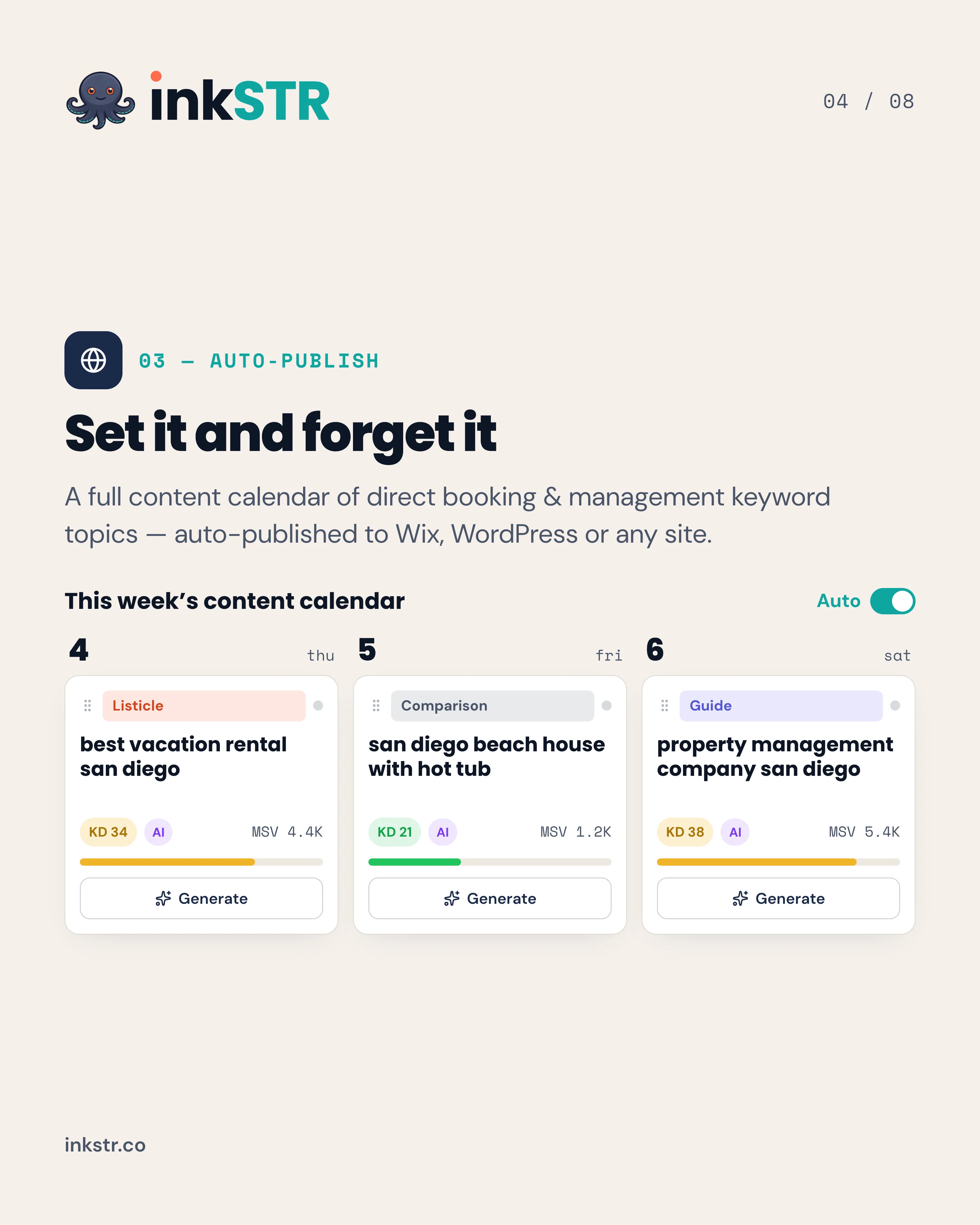
Once you have a priority list, open the content calendar, drag an article to Tuesday, and the scheduler publishes it on your site.
Step 7: How Do You Measure Whether Closing a Gap Produced Bookings?
Measuring a content gap fix means tracking whether a new or refreshed page gains impressions, clicks, qualified visits, inquiries, and direct reservations. You review those numbers monthly and compare them against a baseline recorded before publishing.
Record the baseline in your inventory first. Then use Google Search Console for impressions and clicks per page, and Google Analytics for landing-page behavior. Add a 'how did you hear about us' field to your inquiry form so a booking can be traced to a page. Without that, you cannot tell which article earned the reservation, and SEO takes months, not days, to show results.
The scale of the payoff is real. In one case, a Smoky Mountains cabin rental brand grew monthly Google Search clicks from 788 to 5,195 in 11 months on a continuous inkSTR content pipeline. In its first 14 months, $309,775 in direct booking revenue was attributed to it. In another, a five-market mountain rental brand went from 26 to 1,924 monthly Google search visits in four months after 114 articles. Both were measured in Google Search Console and site analytics, and results vary by market.
A single direct booking is typically worth $1,000 to $4,000, so one booking traced to a gap page covers many months of inkSTR at $99 per month. A ranking article can keep driving traffic for 2 to 5 years. Our post on booking page conversion optimization covers what happens after the click.
inkSTR publishes articles to Wix or WordPress on your set schedule through auto-publishing. See the pricing page or start a trial to try it.
Frequently Asked Questions
What is the difference between a content refresh and a rewrite?
A refresh updates facts, dates, sections, and internal links while keeping the URL and main structure. A rewrite replaces the page's angle or structure because the search intent changed or the page overlaps another one. Refresh when the topic is right but the page is stale; rewrite when the page answers the wrong question.
What tools are available for automating my vacation rental business?
Most operators combine a property management system with a channel manager, then add a pricing tool and guest messaging. For blog content, inkSTR automates keyword research and article drafting. It also handles scheduling and publishing to Wix or WordPress. Each tool covers a different job, so match the tool to the bottleneck.
Can I get a GEO audit for my website and content?
inkSTR's brand audit surfaces competitor keyword gaps. Each article is written for citation by AI Overviews, ChatGPT, and Perplexity. You can also check whether your site answers question-format searches completely. Our guide to ranking in AI search covers the details.
What is the difference between content gaps and keyword gaps?
A keyword gap is a phrase competitors rank for and you do not. A content gap is a guest need your site never answers, even when no tool lists a keyword for it. Keyword gaps come from tools; content gaps often come from your inbox and reviews.
How do vacation rental websites find missing content topics?
Start with a content inventory, then add competitor keyword data and your own guest questions. Compare all of it against your existing URLs. The topics with no matching page are your gaps.
What are the best SEO tools for vacation rental websites?
Google Search Console and Google Analytics are the free baseline. A keyword gap tool adds competitor data. For an STR-specific workflow, inkSTR combines keyword research and competitor gap detection, with Search Console tracking included.
How often should I rerun a content gap analysis?
Run a light check monthly alongside performance reporting and a full pass each season or when you add a property. Competitors publish constantly, and seasonal topics need fresh facts.
Conclusion: Where Should You Start?
A content gap analysis for your vacation rental website is a repeatable loop: inventory what you own, compare against the right rivals, mine your own guest questions, prioritize by booking value, and measure monthly. In 2026, as AI search answers more travel questions directly, pages that answer one specific guest question with verified detail are the ones worth building.
- Define one goal and the gap types that matter.
- Pick up to four rivals that share your search results.
- Build a content inventory mapping properties and questions to URLs.
- Run a keyword gap comparison and clean the export.
- Mine inquiries, reviews, and comparison searches for first-party questions.
- Score each gap and decide whether to create, refresh, rewrite, or skip.
- Record baselines and review Search Console and analytics monthly.
If you want your gap list to end in published pages instead of a spreadsheet, Start Free Trial of inkSTR. Its keyword research and brand audit build a plan around your market and competitors, and the content calendar schedules the articles that close each gap.
Content powered by inkSTR.co
Enjoyed this article? Share it:
Get more of inkSTR in Google Search
Add inkstr.co as a preferred source and our articles show up more in Top Stories, AI Overviews, and AI Mode, with a “Preferred” badge.
Get more guides like this
New SEO and AI-search guides, straight to your inbox. No spam, unsubscribe anytime.