How to Use a DA Checker and Understand Your DA Score
A DA checker is a free online tool that looks up a domain's Domain Authority, a 100-point score from a third-party SEO company that estimates how a site's backlink profile compares with others. It is a comparison metric rather than a Google ranking score, so use it to benchmark competitors and vet link prospects.
Key Takeaways
- A DA checker returns a score on a 100-point scale, and most reports add Page Authority (PA), linking root domains, and Spam Score.
- DA is a third-party estimate, not a Google signal. Scores from different backlink indexes rarely match, so compare sites inside one tool.
- A good score is relative: measure it against the sites that outrank you for your target searches, not against a universal number.
- Check monthly and log the date and tool. Weekly checks mostly record noise from index refreshes.
- Clicks and impressions in Google Search Console tie to bookings. DA is a diagnostic reading, and a single direct booking is typically worth $1,000 to $4,000.
- inkSTR generates, schedules, and publishes SEO articles automatically for $99 per month, building the content that earns links and direct bookings so you do not spend your evenings decoding authority scores.
You typed your direct booking domain into a DA checker, got a number, and now you are wondering whether it is good, bad, or irrelevant. In 2026 the question matters because your site competes for guests against Airbnb, VRBO, and every management company in your market.
At inkSTR, we see this moment constantly, from hosts running one cabin to managers running far larger portfolios: a score gets checked, nobody explains it, and the next move is a guess. This guide walks through ten steps, from reading the report to making decisions with it, in the order we would do it ourselves.
Along the way you will see how scores are calculated, why tools disagree, how often to check, and what DA cannot tell you. Each step also shows how we handle the same job inside inkSTR, so your hours go to the property instead of the spreadsheet.
1. What Does a DA Checker Measure About Your Rental Website?
A DA checker is a lookup tool that returns the Domain Authority of any domain, a score on a 100-point scale that estimates how a site's backlink profile compares with other sites. Most reports also show Page Authority (PA), linking root domains, ranking keywords, and a Spam Score.
That list of metrics is where hosts get stuck. Say you see a DA of 14 and a Spam Score you have never heard of, and nothing in the report says what to do next. So you open three more tabs, compare three more numbers, and an evening disappears. A manual blog post already costs 3 to 5 hours of research and writing; burning that same block decoding scores leaves you with no post and no plan.
A DA PA checker adds the page-level view, which matters for a single booking page or area guide. Still, neither score tells you which searches to target. That gap is why we built inkSTR's keyword research and brand audit. The audit's competitor keyword gap analysis shows which terms rivals rank for that you do not, and a DA number cannot show you that.
2. How Is Domain Authority Calculated, and Why Do Scores Disagree Between Tools?
Domain Authority is calculated by a third-party model that weighs link data, such as the number and quality of linking root domains, and scales the result to 100. Domain Rating (DR) and trust-flow scores come from different backlink indexes, so one website can carry three different numbers in 2026.
The disagreement trips up almost everyone. Imagine your domain reads 14 in one tool and 28 in another. You suspect a bug, or you quote the flattering number in your own reporting. Neither response helps. Each index crawls a different slice of the web, so a gap between tools is expected.
| Metric family | Built from | Best used for | Watch out for |
|---|---|---|---|
| Domain Authority (DA) | One provider's link index, modeled to compare domains | Benchmarking competitors inside the same tool | Scores shift when the index refreshes |
| Domain Rating (DR) | A different provider's backlink index, centered on referring domains | A second opinion on link strength | Not interchangeable with DA |
| Trust and citation flow scores | Link-graph signals from a third index | Spotting low-quality link neighborhoods | Different scale and different meaning |
A side-by-side workflow that works
Run your domain and three competitors through each tool. Record every value in one sheet, then compare rank order instead of raw numbers. If all three tools place you 3rd of four, trust that ordering. If they disagree on order, open the backlink lists and find out why.
inkSTR handles the follow-up that scores never reach. Its Google Search Console integration tracks keywords and flags ranking opportunities, so the step after your benchmark is a target list instead of a guess. You can see how inkSTR works from keyword to published post.

3. What Is the Best Free DA Checker for a Rental Website?
The best free DA checker for a rental website is the report from the owner of the metric, because it uses the index that defines the score. Look for DA, PA, and Spam Score in one report and the ability to compare several domains without a paid plan. Free tiers differ, so judge each one by data source, daily limits, and export options.
Searching 'da checker free' returns dozens of near-identical pages, and the sameness hides real differences. Some tools look up scores from a provider's index instead of crawling your site live, so the data can be cached. Others cap daily reports, and bulk modes cap how many domains you can run at once. You can lose a morning learning those limits one tab at a time.
| Checker type | Data source | Typical limits | Best for |
|---|---|---|---|
| Report from the metric's owner | The index that defines the score | Daily report caps on free accounts | Your baseline DA and PA |
| Third-party bulk DA PA checkers | Lookups against a provider's index | Per-run domain caps; some require signup | Scanning a list of link prospects |
| Browser-extension checkers | Provider data shown on any page | Free allowance varies | Vetting sites while you browse |
| Free tiers of full backlink suites | Their own index and DR-style metrics | Limited rows and projects | A second-opinion check |
If you run one to five properties, one free checker plus Google Search Console covers what you need. A larger suite earns its price only when you vet links in volume. A 20-prospect outreach list, for example, takes minutes in a bulk checker and an hour in a single-domain tool.
Save your money for content that earns links. A freelance travel writer charges $300-$700 per quality post, while inkSTR starts at $99 per month and includes research chat for on-demand keyword and competitor questions. The pricing page lays out the plan.
4. How Do You Run a DA Check Step by Step?
Running a DA check takes six steps: enter your root domain, record the score and supporting metrics, run your competitors, cross-check a second tool, log the date, and review key pages. The goal is a repeatable baseline you can compare month to month.
- Enter your root domain, such as yourbrand.com, instead of a deep URL, so you get a domain-level score. Pick either the www or non-www version and stay consistent.
- Record DA, the homepage PA, linking root domains, and Spam Score.
- Run your three closest search competitors, meaning the sites that appear for your target searches, plus one large platform as a ceiling.
- Run the same list through a second tool and compare the ordering of the sites.
- Log the date, the tool, and every value in one sheet.
- Check PA for the pages you want to rank, such as a booking page or an area guide.
Skip the log and the whole exercise decays. You check in March, check again in June, and cannot remember which tool or which domain version produced which number. The comparison becomes meaningless.
Annotate the sheet with what you published between checks. inkSTR's Content Calendar already holds that history, so you can line up each score against the articles that went live.
5. What Is a Good Domain Authority Score for a Vacation Rental Site?
A good Domain Authority score is one that matches or beats the sites currently ranking for your target searches, because the 100-point scale only means something comparatively. No universal passing grade exists, and a score that is strong for a single-cabin site can look small beside a large OTA or a regional management company.
Two mistakes follow from hunting for a threshold. Some hosts panic at a low number and buy cheap links, which raises Spam Score without moving bookings. Others see a respectable number, relax, and watch a competitor with a lower score outrank them because that competitor published the better page. Newer sites sit low almost by definition, since links accumulate slowly.
Build a peer set instead: the three to five domains that appear for your best-fit searches, plus one big platform you will not catch. In our experience content is the lever. One five-market mountain rental brand averaged around 13 Google visits a month for fifteen months, then reached 1,924 monthly visits four months after we started publishing 114 inkSTR articles for it, measured in Wix Analytics and Google Search Console. Same brand, same properties; the difference was publishing. For the full playbook, read how to rank your vacation rental website on Google.
inkSTR's AI Content Writer generates SEO and GEO optimized articles of 2,500 to 3,500 words, and the content strategy wizard lays out the pillar and cluster plan so each article has a job.

6. Does Domain Authority Affect Google Rankings?
Domain Authority does not directly affect Google rankings, because it is a third-party estimate rather than a Google signal. It tends to correlate with rankings since sites with strong link profiles often have strong content too, which makes it a useful comparison aid and a poor goal.
The risk is optimizing the proxy. You spend months pushing a number while your booking page loads slowly, your area guides are thin, and no page answers the searches guests actually type. Our rule of thumb: if DA rises and Search Console clicks stay flat, the score has told you nothing useful. Google Search Console and Google Analytics hold the numbers that connect to bookings.
Consider Hemlock Hills, a Smoky Mountains cabin rental brand whose monthly Google Search clicks rose from 788 to 5,195 in 11 months, while monthly impressions grew from 130,000 to 450,000. Both figures came from Search Console. The pipeline behind them was continuous pillar-and-cluster publishing, auto-published to WordPress on a steady cadence.
That cadence is what inkSTR's Auto-Publishing automates, with one-click publishing to Wix and WordPress. If your pages are stuck, we explain the usual causes in why your vacation rental website is not ranking on Google. We also cover the STR-specific factors behind ranking on Google.
Ready to automate your content marketing?
inkSTR handles keyword research, content strategy, article writing, and publishing, all on autopilot.
7. How Do Short-Term Rental Websites Improve Domain Authority?
Short-term rental websites improve domain authority by earning backlinks from relevant, credible sites such as local tourism organizations, regional publications, nearby businesses, and other hosts who cite your guides. Publishing pages worth citing comes first; outreach and partnerships follow from that.
Most rental sites start with very few linking root domains, and the inbox fills with offers to sell you links. Buying them is the quickest way to raise Spam Score without earning a booking. Manual outreach is slow too, because each pitch needs a reason for the other site to care.
Four link-earning tactics work well for rentals:
- Original area guides. Pages with first-hand detail get cited by event calendars and local blogs; see local area guides that sell.
- Seasonal planning pages. A fall foliage or ski-season planning page gives local publications something to reference each year.
- Partner mentions. Outfitters, restaurants, and venues near your properties will often link to a page that sends them guests.
- Cross-links between your own sites. If you run several brands, links between them can strengthen each one.
For a deeper primer, read what a backlink is in SEO. Expect patience: most sites see meaningful traffic gains within 3 to 6 months of consistent publishing, and authority scores usually lag behind traffic.
inkSTR covers the content side with AI generation, internal link management for primary CTAs and secondary blog links, and a backlink exchange marketplace between same-owner projects. If you manage several brands or a large portfolio, the property management page shows how independent pipelines per property work from one dashboard.
8. How Often Should You Check Domain Authority?
You should check domain authority about once a month, because providers refresh their link indexes on a schedule rather than in real time, so daily or weekly checks mostly record noise. Update timing varies by provider, so note the date of each check beside the score.
Checking constantly feels productive and does the opposite. A one-point drop after an index refresh sends you hunting for a problem that does not exist, and you lose the hours you needed for the next article. Monthly checks, logged in a sheet, show direction instead of jitter. A quarterly review handles the bigger questions.
Give your weekly attention to Search Console clicks and impressions. Those connect to revenue: a single direct vacation rental booking is typically worth $1,000 to $4,000, so one organic booking outweighs any score movement. You can see how inkSTR approaches direct bookings across the whole content pipeline.
The monthly rhythm gets easier when publishing runs itself. With inkSTR's drag-and-drop calendar and automated scheduler, the record of what went live and when sits right beside the scores you log.

9. What Are the Limits of DA, and Can Anyone Game It?
The main limits of Domain Authority are that it ignores topical relevance, traffic, and page quality, depends on a single provider's link index, and can be inflated with low-quality links that do nothing for real rankings. Treat it as a diagnostic reading rather than a target.
Yes, a score can be pushed up artificially. Link schemes and bought links can lift the number for a while, and the same links can raise Spam Score and invite trouble. The inflated number then misleads you into thinking the site is healthier than it is. Meanwhile your competitor publishes a better area guide.
Mistakes to avoid when reading a DA score
- Chasing a target number instead of a ranking page for a specific search.
- Comparing a score from one tool against a score from another.
- Ignoring Spam Score when you vet a link prospect.
- Judging a link by DA alone, without checking whether the site covers your topic and region.
- Benchmarking a single-property site against OTAs and expecting it to close the gap.
We built inkSTR's quality scoring and pre-publish content validation for this reason: the page itself has to deserve the link. Its LLM citation optimization also targets AI Overviews, ChatGPT, and Perplexity, where DA is not a visible input. Our guide to ranking in AI search for STR operators covers how guests find rentals through those answers in 2026.
10. How Do You Use a DA Score to Make Real Decisions?
Using a DA score for real decisions means pairing it with relevance, traffic, and Spam Score checks across three jobs: benchmarking competitors, vetting link prospects, and tracking progress over time. The score is one input in each, never the verdict. The scenarios below are illustrations, not measured benchmarks.
Benchmarking a competitor
Imagine a management company outranks your 12-cabin brand for a cabin rental search. The DA checker shows them ahead, but check linking root domains and the PA of the specific page that ranks. The gap may come from one strong area guide rather than a stronger domain, and that is a page you can match.
Vetting a link prospect
Imagine a regional events blog offers you a guest post link. Check its DA and Spam Score, then ask whether it ranks for local terms and whether its audience travels to your area. Skip sites that publish about every topic, however good the number looks.
Tracking change over time
Log the score monthly and annotate each entry with what you published. When the number rises after a burst of new articles, that is correlation worth noting, but it is not proof of cause. Search Console clicks tell you whether the work paid off.
A short interpretation checklist
- Is the score compared inside one tool, with the date recorded?
- Does the site have linking root domains from relevant sources?
- Is Spam Score acceptable?
- Does PA for the target page support the page you want to rank?
- Have Search Console clicks moved in the same direction?
If you manage several brands, juggling that checklist per site gets heavy fast. inkSTR's multi-project support gives each brand its own pipeline, and our content workflow keeps research, writing, and publishing in one place.
Frequently Asked Questions
What is domain authority and how is it calculated?
Domain Authority is a score from 1 to 100 produced by a third-party SEO company to estimate how strongly a domain's backlink profile compares with others. It is built from link data such as the number and quality of linking root domains. Google does not use it as a ranking factor.
Is a free DA checker accurate?
A free DA checker is as accurate as the link index behind it. Many free tools look up scores from a provider's data rather than crawling your site live, so values may be cached. Use one tool consistently for comparisons and treat results as estimates.
What is the difference between DA and DR?
DA and DR are authority scores from different backlink indexes, so they measure link strength with different data and different methods. The same domain can score differently on each. Compare sites within one metric and never mix the two in the same comparison.
What does a DA PA checker show?
A DA PA checker shows Domain Authority for the whole site and Page Authority for a single URL. Many reports add Spam Score and linking root domains. Use PA to judge a specific page such as a booking page or area guide.
How often should I check my domain authority?
Check about once a month and log the date and tool. Providers refresh their indexes on a schedule, so more frequent checks mostly show noise. Review Google Search Console clicks and impressions weekly, since they tie more closely to bookings.
Can blog content improve domain authority for a vacation rental site?
Yes, indirectly. Useful pages such as area guides and planning resources earn backlinks over time, and links drive the score. inkSTR's AI Content Writer generates and publishes those articles on a schedule, though results take sustained publishing.
Do I need a bulk DA checker?
You need a bulk DA checker only if you vet many link prospects or track many domains. A host with one to five properties can run a handful of domains in a free single-domain tool. Bulk modes usually cap how many domains you can check per run.
What Should You Do With Your DA Checker Results This Week?
Run one DA checker report for your domain and three competitors, log the results, and set the number aside. DA is a comparison score from a third-party index, so its job is to show who is ahead and where their links come from. The pages you publish for real guest searches decide the rest.
Every booking won through organic search avoids the 17-19% that Airbnb host and guest fees combined take from each reservation, and a ranking article can drive traffic for 2 to 5 years. In 2026, the operators who publish steadily will own that traffic.
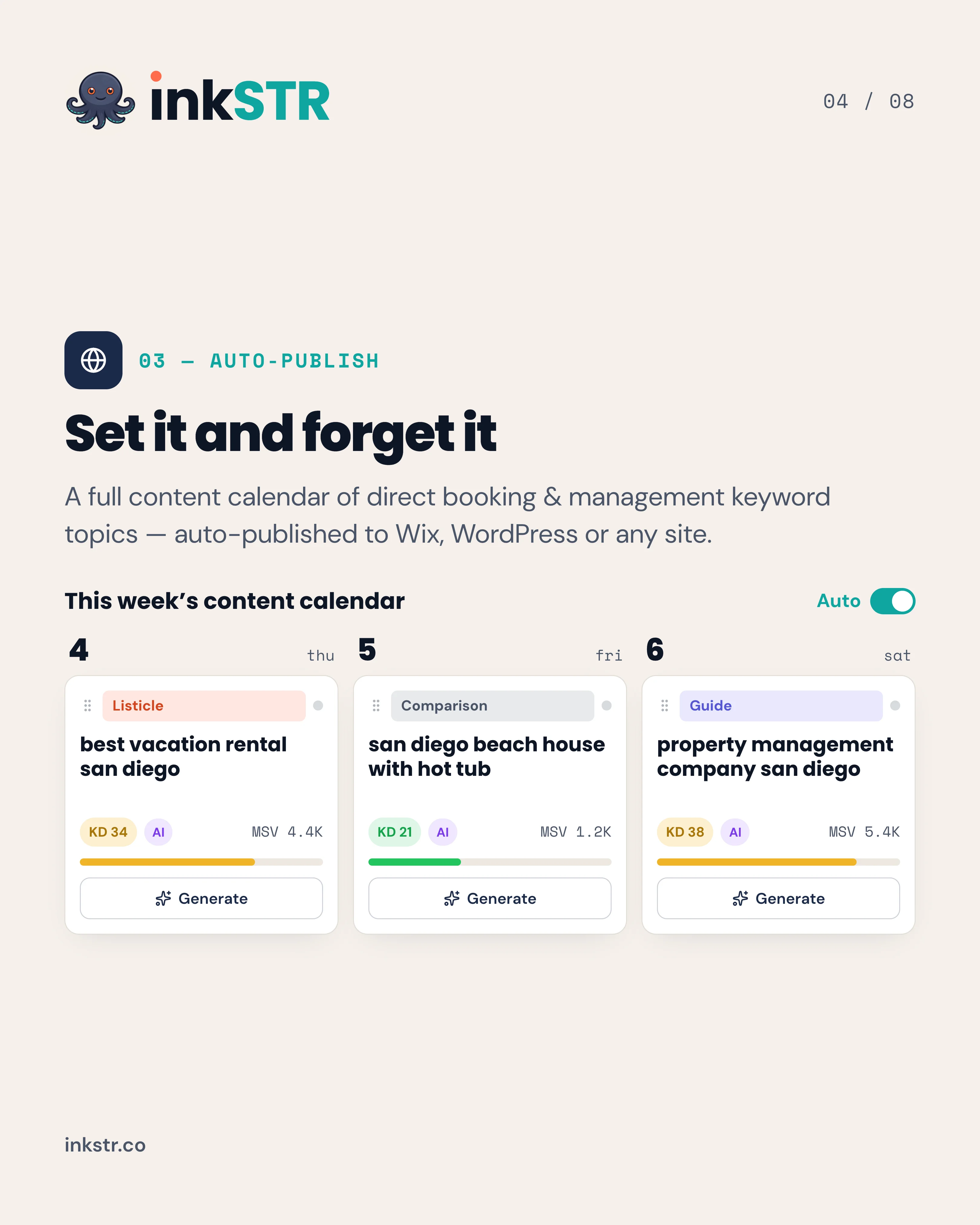
Turning listing traffic into direct bookings starts with content built around what guests search for. Get started with inkSTR and the content calendar will generate, schedule, and publish that content automatically. Start a free trial and see your first content plan.
Content powered by inkSTR.co
Enjoyed this article? Share it:
Get more of inkSTR in Google Search
Add inkstr.co as a preferred source and our articles show up more in Top Stories, AI Overviews, and AI Mode — with a “Preferred” badge.
Get more guides like this
New SEO and AI-search guides, straight to your inbox. No spam, unsubscribe anytime.