How to Get Direct Bookings From Google Search in 2026
To get direct bookings from Google search, you need a fast direct booking website and a verified Google Business Profile. You also need a booking link that shows your own rate next to the online travel agencies. Content that ranks for guest searches brings in the rest.
Key Takeaways
- Google sends direct bookings through four routes: organic search, your Google Business Profile, free booking links, and paid listings such as Google Vacation Rentals, Hotel Ads, and Google Ads.
- A direct booking website with a working booking engine is the prerequisite for every route; without it, Google has nowhere to send guests.
- Free booking links carry no cost per click, but they usually require a booking engine, channel manager, or property management system that supports the Google connection.
- Tracking with Google Search Console, GA4, and UTM tags tells you which pages and links produce reservations.
- inkSTR automates the content side: keyword research, article writing, scheduling, and one-click publishing to WordPress or Wix, so your blog keeps feeding Google without you writing every post.
Most vacation rental websites collect page views and almost no reservations. Google shows the guest an OTA result first, your own site second, and sometimes not at all. In 2026, that gap is fixable, but it takes several pieces working together instead of one magic setting.
This guide covers eight steps in order. They are: understand Google's channels, build the booking site, get indexed, set up free booking links, apply for Google's rental listings, fix your booking link, publish content that ranks, and measure the results. Expect weeks for setup and months for content to build traction. Nobody can honestly promise a ranking date.
Step 1: What Does Getting Direct Bookings From Google Search Involve?
Getting direct bookings from Google search means a guest finds your property on Google, clicks through to your own booking engine, and pays you instead of an online travel agency (OTA). Four routes lead there: organic search, your Google Business Profile, free booking links, and paid listings.
Operators who skip the plan usually depend on a single route or none. A single direct booking is typically worth $1,000 to $4,000 in revenue, so each guest you redirect to your own site is worth real money.
The search landscape is also shifting. According to Digital Strategy Force, AI-powered search now handles over 40 percent of all web queries globally. Your pages need to rank in classic results and read clearly enough for AI answers to quote them.
We built inkSTR for that second half of the job: the ranking content that gets cited. Booking links themselves come from your booking engine, not from a blog tool, and the next steps show where each piece fits. Our direct bookings page covers the wider strategy.
Step 2: How Do You Set Up a Direct Booking Site?
A direct booking site is a website with its own booking engine, so guests see live availability and pay you without leaving. Google can only send traffic to a page that loads quickly on a phone and shows accurate rates. The page also has to let someone finish a reservation without sending an inquiry email.
Many hosts launch a brochure page with a contact form. Guests read it and get impatient. Then they return to the OTA to book. Fixing a leaky checkout after launch costs more time than building it well the first time, and every week of leaks sends guests back to platforms that charge you commission.
Before you move on, check these basics:
- Your booking engine connects to your property management system so calendars never double-book.
- The full booking flow works on a phone, from the property page to payment.
- Direct-only perks, such as late checkout or flexible cancellation, give guests a reason to book with you instead of an OTA discount you cannot sustain.
- Every property page links to one clear booking action.
Our walkthrough on booking page conversion optimization goes deeper on the checkout. Once the site works, inkSTR's Auto-Publishing sends finished articles straight to your WordPress or Wix site, so the blog and the booking engine live in one place.
Step 3: How Do You Get on Google Search Results?
Getting on Google search results means Google has crawled and indexed your pages and verified your Business Profile. Submit your sitemap in Google Search Console, fix any crawl errors it reports, and claim the Business Profile using your real property name, a lodging category, and accurate contact details.
A site Google has not indexed is invisible, and new sites often wait weeks with no signal at all. Stuffing keywords into your business name does not help; use the real name, a phone number that reaches you, and recent photos of each room, the exterior, and the amenities. Keep your name, address, and contact details identical everywhere they appear.
Then give Google reasons to rank you beyond your own name. Our guides to ranking on Google for short-term rentals and the local signals Google cares about in 2026 explain which ones matter most.
inkSTR connects to Google Search Console and tracks your keywords, flagging opportunities where you already appear but sit on page two. That replaces the weekly habit of exporting spreadsheets just to see what moved.

Step 4: Is Google Booking Free?
Google booking links are free of per-click charges: your direct rate appears beside OTA rates in Google results, usually after your booking engine or channel manager connects your rates and availability. Paid Google Ads and Hotel Ads cost money, and the amounts vary by market and competition.
| Organic search and Business Profile | No per-click cost; content takes time | Indexed site, verified profile | Brand and local discovery |
| Free booking links | No cost per click | Booking engine or channel manager that supports the connection | Showing your direct rate next to OTAs |
Paid clicks stack up quickly, and a campaign that points at a weak booking page burns budget while you learn. Organic content costs time instead. A freelance travel writer charges $300 to $700 per post, and writing one yourself takes 3 to 5 hours.
A ranking article can drive search traffic for 2 to 5 years, which is why we price inkSTR at $99 a month on the pricing page. It generates and publishes posts on a set schedule, so the free traffic channel keeps growing while you handle guests.
Step 5: How Do You Apply for Google Vacation Rentals?
Google Vacation Rentals is a listing format that shows rental properties with photos, rates, and booking links in Google search results. You usually connect through a property management system or a channel manager that supports Google. A connectivity partner can also do this, and you then confirm eligibility and current terms in Google's help documentation, since Google changes both.
Applications stall on mismatched rates or thin property data. A missing prerequisite can stall them too. A completed Business Profile alone does not display prices; rates and availability must also flow through a connection. Rate parity, meaning consistent pricing across your site and OTAs, matters here: if guests see a lower rate elsewhere, they book there. Check your OTA agreements, then compete with direct-only perks instead of undercutting yourself.
- Confirm your PMS or channel manager supports the Google connection.
- Complete every property field and upload current photos.
- Compare rates across your site and OTAs before applying.
- Run a test search after approval and verify the price and link.
The Google connection itself runs through your PMS, and inkSTR does not submit listings. Where we help is the content around them: inkSTR's PMS integration with Hospitable and OwnerRez pulls real reviews and photos into articles, so your posts reflect what guests say about your property.

Ready to automate your content marketing?
inkSTR handles keyword research, content strategy, article writing, and publishing, all on autopilot.
Step 6: How Do I Change My Booking Link on Google?
You change a booking link on Google by editing the URL at its source: the website and booking fields in your Business Profile, or the rate feed in your booking engine or channel manager. Changes typically take time to appear, so test the live link after every edit.
Outdated links send guests to dead pages or straight back to an OTA listing. The same weak data explains why OTAs often outrank you: Google shows whoever has the most complete, consistent information.
- Link missing: confirm your rates and availability are connected, since a profile alone shows no price.
- Wrong link showing: check the website field in the Business Profile and the booking engine's Google settings.
- OTAs above you: strengthen your brand name searches with reviews, photos, and a page for every property.
- Tracking gaps: add UTM tags to each booking link so GA4 can attribute the visit.
When you move your booking page, every blog post that linked to the old address breaks. In inkSTR, you set your primary booking URL in internal link management, so new articles point to the current page. That one setting saves you from auditing dozens of posts by hand.
Step 7: How Do You Write Content That Earns Non-Branded Searches?
Non-branded searches are queries from guests who do not know your name yet, such as a pet-friendly cabin for a fall weekend or a lake house with a dock near a specific town. You rank by publishing specific, local articles that answer those questions and link to your booking page.
Doing this by hand drains you. Each post takes 3 to 5 hours, a freelancer charges $300 to $700, and most content calendars fall apart by week two. Meanwhile, competitors with steady publishing own page one.
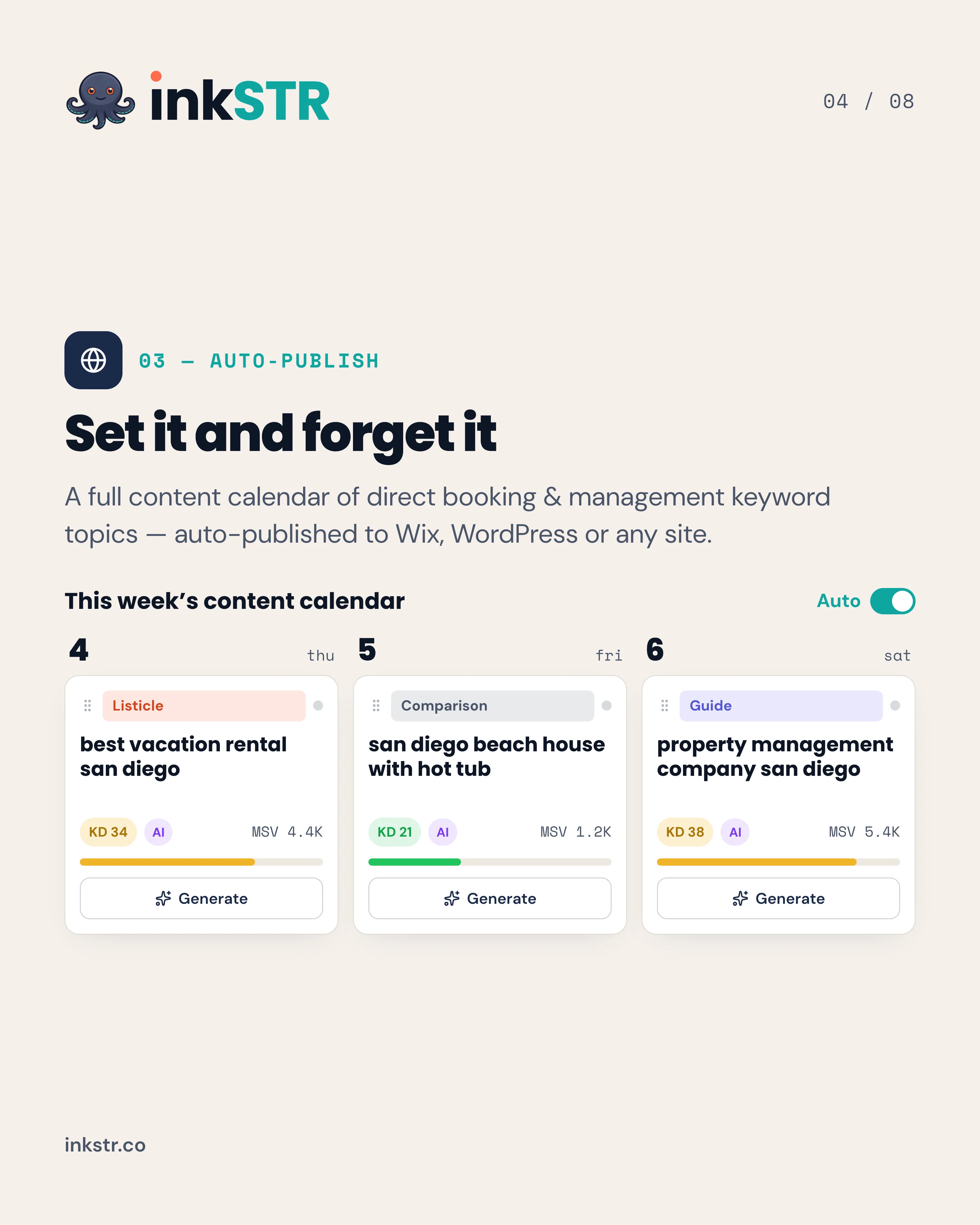
We built inkSTR to remove that grind. Keyword Research finds what guests search, the AI Content Writer drafts 2,500 to 3,500 word articles, and the Content Calendar schedules them. You drag a post to Tuesday and it publishes to your site.
The results can be large. A five-market brand went from 26 to 1,924 monthly Google visits in four months with 114 articles. For topic ideas, see our list of vacation rental blog topics and our local area guides that sell.
Step 8: How Do You Measure Direct Bookings From Google?
Measuring direct bookings from Google means tracking the full path from search impression to completed reservation. Use Google Search Console for queries and clicks, Google Analytics (GA4) across both your website and booking engine, and UTM tags on every booking link.
Without that tracking, you cannot tell whether a reservation came from a blog post or your Business Profile. A branded search could also be the source. You also cannot compare what the channel costs against OTA fees. For illustration, imagine a $2,000 stay: at 17-19% in combined fees, an OTA booking costs $340 to $380 before you pay for anything else.
Set realistic expectations. Free booking links and profile fixes can show movement within weeks once approved, while articles usually need months to build rankings. Review Search Console monthly, and look for pages with many impressions but few clicks; those titles need rewriting.
Inside inkSTR, Search Console data sits beside your content calendar, so you see which published articles are gaining impressions and which topics to write next. Across inkSTR customer sites, we have published more than 5,600 articles as of November 2026.
Frequently Asked Questions
How do you get more direct bookings for a short-term rental or hotel?
Start with a direct booking site that works on mobile, then claim your Google Business Profile and connect free booking links through your booking engine. Add content that ranks for guest searches and offer direct-only perks. inkSTR automates the content step so you publish consistently.
In practice, yes. Google needs a place to send guests, so you need a booking engine or a connected provider that supports the Google connection. Confirm the current eligibility requirements in Google's help documentation before you apply.
Which reservation platform helps boutique hotels increase direct bookings?
Choose a booking engine that connects to your PMS, supports Google's rate feed, and offers a smooth mobile checkout. The platform matters less than whether it keeps rates consistent and exposes your direct link on Google. Pair it with content that brings in non-branded searches.
Google Vacation Rentals is the listing format for rental properties, while Google Hotel Ads is the paid advertising channel for hotels. Costs and eligibility differ, and so do setup paths. Check Google's current help pages for the one that fits your property type.
Why do OTAs show up before my own website?
OTAs have large sites and heavy advertising. Their listing data is also complete. You can close the gap with a verified Business Profile and consistent details. Strong reviews and local content that ranks for guest searches help as well. Brand name searches are usually the easiest place to win first.
What tools automate a content pipeline from keyword research to WordPress publishing and reporting?
inkSTR handles that entire pipeline for short-term rental operators: keyword research, article generation, scheduling in the content calendar, one-click publishing to WordPress or Wix, and Google Search Console tracking. You can see the full workflow on our how it works page.
Profile fixes and booking links can show results within weeks of approval. Content typically takes months to build rankings, and nobody can guarantee a specific timeline. Consistent publishing is the lever you control.
Conclusion: What Is the Fastest Path to Direct Bookings From Google?
The fastest way to get direct bookings from Google search is to fix the foundation first, then publish steadily. A working booking site, a verified profile, a connected booking link, and tracking come before content, and content keeps the channel growing through 2026 and as AI search takes a larger share of queries.
- Understand Google's four routes to direct bookings.
- Build a direct booking site with a mobile-ready checkout.
- Get indexed and verify your Google Business Profile.
- Set up free booking links and know which channels cost money.
- Apply for Google Vacation Rentals or Hotel Ads and check rate parity.
- Keep your booking link current and tagged with UTM parameters.
- Publish local, searchable content on a schedule.
- Measure with Search Console and GA4 every month.
You want guests booking on your own site instead of paying 17-19% in OTA fees. Start your free trial of inkSTR and let it research keywords, draft articles, and publish them to your WordPress or Wix site on a schedule you set in the content calendar. Then spend your time on guests and properties, not on a blank page.
Content powered by inkSTR.co
Enjoyed this article? Share it:
Get more of inkSTR in Google Search
Add inkstr.co as a preferred source and our articles show up more in Top Stories, AI Overviews, and AI Mode, with a “Preferred” badge.
Get more guides like this
New SEO and AI-search guides, straight to your inbox. No spam, unsubscribe anytime.