Most Valuable Keywords for Vacation Rental Websites in 2026
The most valuable keywords for a vacation rental business are search phrases that pair booking intent with competition you can realistically beat, plus a payoff worth the effort. Paid-search CPC hints at value but never defines it. At inkSTR, we score every keyword on intent and on booking value before we write a word.
Key Takeaways
- Keyword value is the revenue a phrase can produce: qualified visits, multiplied by conversion rate, multiplied by what one booking is worth. Search volume alone proves nothing.
- A single direct vacation rental booking is typically worth $1,000 to $4,000, while Airbnb host and guest fees combined take 17-19% of every booking.
- High-CPC lists are dominated by legal, insurance, mortgage, and loan terms. CPC is a proxy for what advertisers will pay, not a score for what your rental site can earn.
- The strongest rental targets are specific, booking-ready phrases (a destination plus a concrete need) and, for managers, owner-lead phrases such as vacation rental management in your market.
- Validate any phrase in Google Search Console and Google Keyword Planner, then read the live results page yourself before you commit to writing.
- inkSTR automates keyword research, drafting, scheduling, and publishing from one pipeline starting at $99/month, so you target the right phrases without paying $300-$700 per freelance post.
Every travel season resets which searches matter. A cabin operator planning for the next peak and an urban host courting weekday business travelers need different phrases. In 2026, more of those searches also end in an AI-generated answer instead of ten blue links.
Search this topic and you land on lists of the priciest Google Ads terms, built for AdSense-era publishers: attorneys, insurance quotes, mortgages. Those lists answer a different question than yours. You want to know which phrases bring guests to book direct, or bring owners to sign a management agreement.
Below we cover how keyword value is calculated and what the popular and high-CPC lists get wrong for rentals. We also explain which phrase types convert and how to find them. Then we look at which tools help and how to time them by season. Along the way we show where inkSTR removes the manual steps.
What Makes a Keyword Valuable for a Vacation Rental Business?
Keyword value is the revenue a search phrase can produce, based on how many qualified visitors it brings, how many of them convert, and what one conversion is worth. For a vacation rental, one direct booking is typically worth $1,000 to $4,000, so a phrase that reliably brings a few ready-to-book guests beats a high-volume phrase that brings browsers.
Most operators skip this math. They open a keyword tool and sort by volume. Then they spend 3 to 5 hours on research and writing around the biggest number on the screen. The post sits on page eight while Airbnb's combined host and guest fees keep taking 17-19% of each booking you still rely on the platform to deliver.
A Simple Way to Score a Keyword
Multiply expected qualified visits by your conversion rate and by the revenue of one booking. As an illustration only, assume a page draws 200 qualified visits a month, converts 1% of them, and each booking is worth $2,000. That is two bookings and $4,000 a month. Those inputs are assumptions for the math, not benchmarks, so swap in your own.
Then discount by ranking odds. A phrase worth $4,000 a month on paper is worth nothing if three high-authority platforms sit above you. We built the strategy wizard in inkSTR around this logic. It plans pillar and cluster articles and attaches a booking or inquiry page to each one. That way every keyword has a conversion path before drafting starts.
What Are the Most Popular Keywords, and Do They Matter for Rentals?
The most popular keywords are the phrases with the highest monthly search volume, such as broad terms like 'vacation rentals' or 'Airbnb'. Popularity measures attention, not buying readiness. In travel, the biggest head terms belong to large booking platforms that an independent host site cannot realistically displace.
Chasing them is the costliest beginner mistake we see. You pay a freelance travel writer $300 to $700 for a post, or lose an afternoon writing it yourself, and the page never leaves the back of the results. The traffic you wanted stays with the platforms you were trying to avoid.
Inside the platforms, ranking is a separate game. Airbnb publishes the factors that determine how a listing appears in its search results, and Vrbo offers its own search positioning guide. Neither earns your own website a Google ranking.
The useful middle ground is a phrase popular enough to send steady traffic yet specific enough for a focused site to win. inkSTR's research chat and competitor keyword gap audit surface those phrases for your market, so you stop guessing which head term to attack.

Which Are the Most Valuable Keywords for Vacation Rental Bookings?
The most valuable keywords for vacation rental bookings are specific, booking-ready phrases that name a destination plus a concrete need, such as a hot tub or a pet policy. They carry high intent because the searcher has already narrowed the decision and only needs a place that matches. For property managers, owner-lead phrases sit alongside them.
| Keyword type | Pattern example | Intent | Best used for |
|---|---|---|---|
| Amenity plus destination | cabin with hot tub near [attraction] | Ready to book | Direct booking pages |
| Group-specific | [town] rental for a family reunion | Ready to book | Property pages and clusters |
| Guest policy | pet friendly [town] cabin | Ready to book | Property pages |
| Trip planning | best time to visit [town] | Early research | Pillar articles |
| Owner lead | vacation rental management in [city] | Hiring a manager | Management company site |
| Owner research | what do vacation rental managers charge in [city] | Comparing managers | Cluster articles |
If you manage properties for owners, you compete in two searches at once. Guest phrases fill your calendar; owner phrases fill your portfolio. Owner phrases usually carry lower volume, yet a management agreement can run for years, which often makes one lead worth more than one stay.
Generic content tools treat both audiences as one. We built inkSTR to plan them separately, so guest-facing clusters feed your direct booking pages without crowding the owner-facing content you publish for hiring decisions.
That second stream supports property management lead generation, which most Airbnb property managers neglect until their guest traffic stalls.
Why Do High CPC Keyword Lists Mislead Vacation Rental Operators?
Cost per click (CPC) is the amount an advertiser pays when someone clicks a paid result, so a high CPC signals strong commercial value to bidders. It does not tell you whether you can rank organically, or whether a click becomes revenue for a rental business.
The popular lists lead with legal, insurance, mortgage, and loan terms, then add business software. They were built for AdSense publishers, and most give no date or country. Most also name no tool or network. A figure that is an average in one list is a top-of-page bid estimate in another, and large databases also contain obscure outliers that nobody actually buys.
Copying one of those lists is how operators end up writing off-niche posts that earn traffic and no bookings. Regional and seasonal swings make it worse: a lake house phrase can behave very differently in the US and Germany, and between peak and shoulder months.
Where CPC Data Still Helps
CPC works as a rough read on how much competitors value a phrase. If advertisers bid heavily on 'vacation rental management in [city]', that tells you owner leads are worth fighting for. Treat it as one input beside intent and ranking odds.
The sharper tool is a keyword gap analysis against real rental competitors in your market. inkSTR runs that comparison through its brand audit, and our guide to SEO competitor analysis tools for STR operators explains what to look for in the results.
How Do You Find the Keywords Travelers Use to Book Rentals?
Finding booking keywords means collecting the exact phrases travelers type or speak before they book, then filtering them by intent and winnability. The most reliable sources are your own Google Search Console queries and your guest reviews, because both reflect real behavior in your market.
Doing it by hand eats evenings: exporting queries, reading reviews, checking autocomplete, opening live results one phrase at a time, then pasting everything into a spreadsheet. By the time the sheet is tidy, you have not written a sentence, and one quality post still needs 3 to 5 hours of research and writing.
- Export the queries you already appear for in Google Search Console and flag phrases that sit just off page one.
- Read guest reviews and booking data for the words guests use to describe why they chose you.
- Check autocomplete and the live results for each candidate, and note whether platforms or independent sites rank.
- Estimate value with the formula above, then discount for ranking odds.
- Group the survivors into one pillar and several supporting cluster articles.
inkSTR's keyword research finds the phrases your target guests search for, its Search Console integration flags opportunities, and the Hospitable and OwnerRez integrations pull real reviews and photos into your content. If you prefer to learn the manual process first, our walkthrough on how to do keyword research for vacation rental sites covers it.

Ready to automate your content marketing?
inkSTR handles keyword research, content strategy, article writing, and publishing, all on autopilot.
What Keyword Research Tools Work Best for Vacation Rental Hosts?
Keyword research tools fall into four categories: free search-engine data, free phrase generators, general SEO suites, and STR-specific platforms. For vacation rental hosts, the best setup pairs free search-engine data with a tool that understands traveler intent and local modifiers, since general-purpose tools treat a cabin and a CRM the same way.
| Category | Example | Strength | Limitation |
|---|---|---|---|
| Free phrase generator | inkSTR's Vacation Rental Keyword Generator | Fast seed ideas with rental terminology | Seeds still need checking against live results |
| General SEO suites | Third-party platforms built for every industry | Broad competitor and backlink data | Rental modifiers and traveler intent need manual work |
| STR-specific automation | inkSTR | Keyword plan, competitor gap audit, Search Console tracking, drafts, and publishing in one place | AI drafts still benefit from a human pass for local detail |
Stacking separate subscriptions for research and writing is the expensive way to do this. Scheduling and publishing add to the bill. Each tool exports to the next one, and nothing connects a keyword to the booking page it should feed. We designed the inkSTR feature set to keep that chain in one pipeline.
Whichever tools you pick, test how your title and description will look before publishing with a Google SERP Simulator, since a well-chosen keyword still needs a snippet worth clicking.
Which Keywords Win in Each Season, and When Should You Publish?
Seasonal keywords are search phrases whose demand rises and falls with travel seasons, holidays, and local events, so their value depends on timing as much as intent. The winning move in 2026 is publishing ahead of each booking window, because a new article needs time to be crawled and ranked before guests start planning.
Operators usually write in season, which is too late. The post goes live as demand peaks and ranks weeks afterward. The shoulder months go quiet because nobody planned content for them.
- Off-season: publish planning and inspiration content, and refresh last year's winners.
- Pre-peak: publish booking-ready phrases while guests are still comparing options.
- Peak: watch Search Console for queries that climb and update the pages that earn them.
- Shoulder: target weekday, long-stay, and event phrases that suit slower months.
A ranking blog article can drive organic search traffic for 2 to 5 years, so a seasonal post that you refresh each year keeps earning. A Smoky Mountains cabin rental brand running a steady inkSTR pipeline grew monthly Google Search clicks from 788 to 5,730 over 13 months, measured in Google Search Console.
The year-over-year shift is AI search. As of November 2026, we have tracked more than 1,700 verified AI-search citations for customer content, which is why we structure every article answer-first; our guide to ranking in AI search for STR operators explains the mechanics.
inkSTR's content calendar lets you drag seasonal topics onto dates ahead of each window and publish them automatically.

How Can You Target Valuable Keywords Without Writing Every Post Yourself?
Blog automation means a platform researches keywords, drafts articles, schedules them, and publishes them to your site on a set cadence while you review instead of write. For a rental operator, it turns a keyword plan into live pages without the 3 to 5 hours of research and writing that one quality post takes by hand.
The manual route is a time sink and a budget line. According to MarketingCharts (November 2026), 51% of small business owners and operators said creating content was among their most time-consuming marketing tasks. That includes writing copy and finding images. A freelance travel writer charges $300 to $700 per quality post, so ten posts would run $3,000 to $7,000.
inkSTR plans start at $99/month; see our pricing for the current plans. The AI Content Writer drafts 2,500 to 3,500 word articles from your keyword plan, quality scoring checks each draft before it goes live, and auto-publishing sends it to Wix or WordPress.
The Peak Properties brand, a five-market mountain rental group, published 114 inkSTR articles in four months and went from 26 to 1,924 monthly Google search visits, measured in Wix Analytics and Google Search Console. You can read more in our case studies. As of November 2026, more than 6,100 articles have been published across inkSTR customer sites.
Frequently Asked Questions
What is the most expensive keyword on Google?
No single keyword holds a permanent title. The costliest terms in Google Ads cluster in legal, insurance, mortgage, and loan categories, and exact bids change with each auction, country, and season. Check current figures in Google Keyword Planner instead of trusting an undated list. For a rental business, a cheaper phrase with clear booking intent usually pays better than an expensive one you cannot rank for.
How is keyword value calculated?
Multiply expected qualified visits by your conversion rate and by the revenue of one conversion, then discount for how likely you are to rank. For a rental site, one direct booking is typically worth $1,000 to $4,000. Track conversions in Google Analytics so your assumptions turn into measured numbers.
How do I find high CPC keywords for free?
Create a free Google Ads account and open Google Keyword Planner for bid estimates and volume ranges. Add your Google Search Console queries for real demand, and use our Vacation Rental Keyword Generator for seed phrases. Remember that CPC measures advertiser demand, not your organic ranking odds.
Are high CPC keywords good for AdSense earnings?
High CPC can raise what an ad click pays, but a vacation rental site gains more from a visitor who books direct than from an ad that sends that visitor elsewhere. Display ads also work against a direct booking funnel. Spend your effort on phrases that lead to a booking or an owner inquiry.
How often do keyword CPC values change?
Continuously. CPC moves with auction competition and season. It also moves with geography, so any figure is a snapshot. Recheck the week you act on a phrase. Record the tool and country beside every number you keep, along with the date.
Can AI find the most valuable keywords for my vacation rental?
Yes, when the tool understands rental terminology and traveler intent. inkSTR builds a keyword plan, runs a competitor gap audit, and tracks results through Google Search Console, and you review the drafts for local detail. Our piece on whether AI-generated content is bad for SEO covers the quality question, and how inkSTR works shows the workflow from keyword to published post.
Do I need a blog to rank for valuable keywords?
Usually, yes. Property pages can target booking-ready phrases, but they rarely capture trip-planning searches or owner research. A blog catches those earlier searches and links readers toward your booking or inquiry pages.
How Do You Pick Your Most Valuable Keywords in 2026?
Your most valuable keywords are the phrases where intent and winnability meet booking value, not the ones with the biggest volume or the highest CPC. Start with Search Console and your guest reviews, score each candidate with the simple formula, and publish ahead of each season. The step most operators never reach is turning that plan into consistent publishing, and that is the part we built inkSTR to remove.
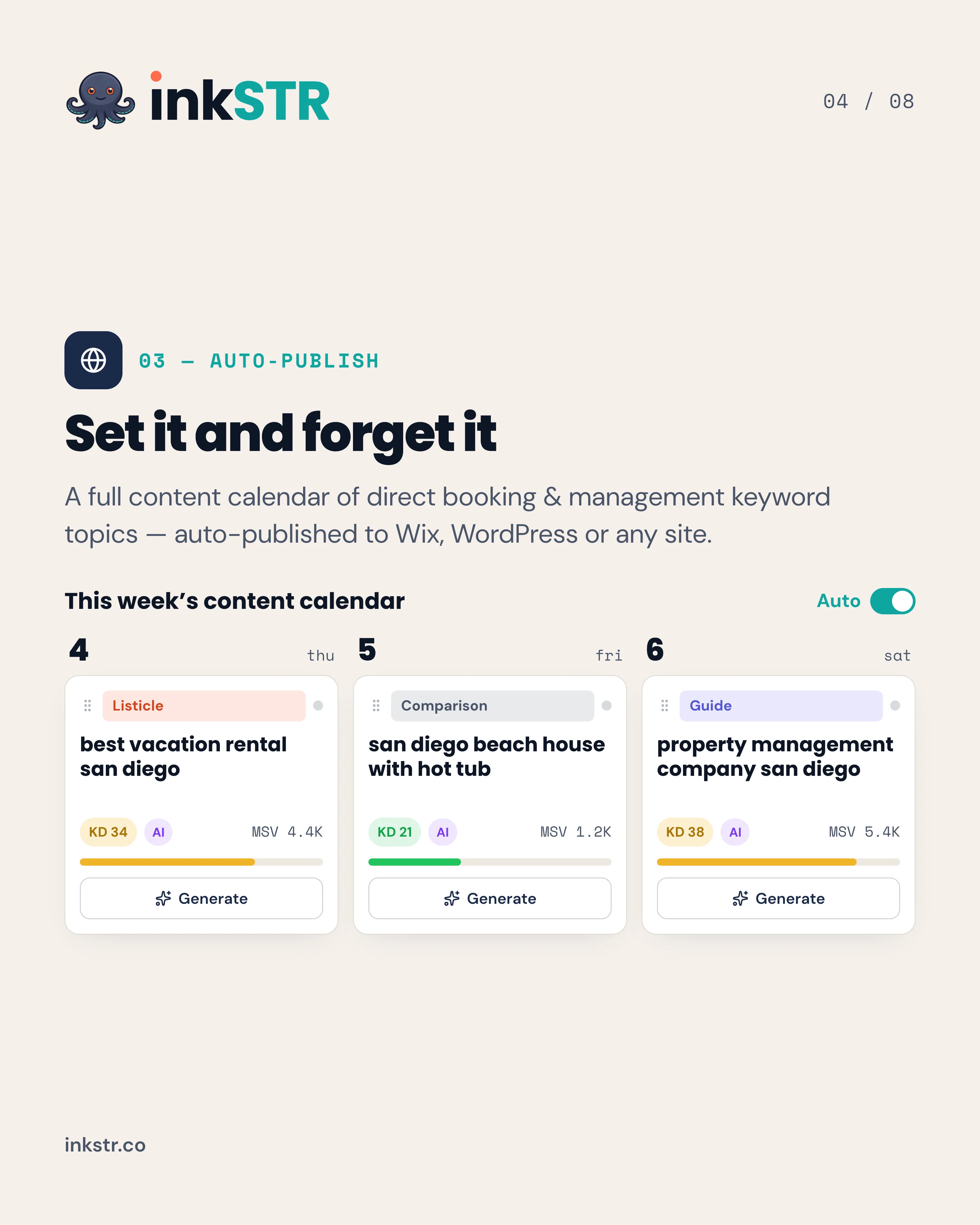
If sorting keyword lists eats your week, inkSTR builds the keyword plan and drafts each article. It also publishes from your content calendar so your best phrases get written on schedule. Run a brand audit to see which keywords competitors already rank for, then let the platform close the gap. Start Free Trial and run your first keyword plan today.
Content powered by inkSTR.co
Enjoyed this article? Share it:
Get more of inkSTR in Google Search
Add inkstr.co as a preferred source and our articles show up more in Top Stories, AI Overviews, and AI Mode, with a “Preferred” badge.
Get more guides like this
New SEO and AI-search guides, straight to your inbox. No spam, unsubscribe anytime.