SEO Competitor Analysis Tools: An Honest STR Operator Guide
The best seo competitor analysis tools for short-term rental operators pair one broad paid platform, such as Semrush or Ahrefs, with free first-party data from Google Search Console. At inkSTR, we connect that competitor data to a keyword gap audit so every finding becomes a scheduled article instead of a spreadsheet.
Key Takeaways
- Competitive analysis in SEO means comparing your rankings, backlinks, content, and traffic sources against the sites that win the searches you want.
- Your real SEO competitors are the domains that appear in the same search results as you, which often include directories and OTAs, not just rival rental brands.
- Semrush, Ahrefs, Moz, Ubersuggest, SpyFu, and Similarweb each lead at a different task; no single tool does everything well.
- Traffic and keyword figures from third-party tools are estimates, so check them against your own Search Console data and live search results.
- A free path exists: Google Search Console, incognito searches, and the free version of Screaming Frog cover the basics.
- inkSTR turns competitor keyword gaps into drafted, scheduled, and auto-published articles for $99/month.
Most vacation rental websites lose search visibility long before a guest ever sees a booking page. A cabin brand may assume its rivals are the cabin company down the road, while Google is quietly handing the same queries to travel directories and OTA landing pages. Bigger management firms get a share too. Competitor analysis exposes that mismatch.
This guide takes the tools in a deliberate order: who your competitors truly are, which platform fits which job, what the data can and cannot tell you, and how to convert findings into content. In 2026, that last step also includes checking whether competitors are being cited in AI answers, not only in blue links.
We built our own keyword and content workflow around the same problem, so we flag honest limits throughout, including the limits of automation.
1. What Is Competitive Analysis in SEO?
Competitive analysis in SEO is the process of comparing your site against the domains that rank for your target searches, looking at keywords, backlinks, page types, and traffic sources, so you can find gaps you can close and strengths you should not waste.
For a rental operator, the output is concrete: a list of queries where rivals appear and you do not, plus the page formats winning those results. A search like "cabin with hot tub near a national park" might be owned by a regional guide, not another cabin brand.
The manual version is slow. Pulling competitor keywords, sorting out which matter, and writing a brief for each gap routinely eats an afternoon, and a freelance travel writer then charges $300 to $700 per finished post. A single quality post written by hand takes 3 to 5 hours of research and drafting before anything is published.
We built inkSTR's keyword research and brand audit around exactly this step. The audit compares your domain against competitor keyword sets and surfaces the gaps, so analysis ends in a content plan rather than a report nobody opens.

2. How Do You Find Your Real SEO Competitors?
Your real SEO competitors are the domains that repeatedly appear in the search results for your target queries, regardless of whether they sell what you sell. Business competitors and search competitors overlap less than most operators expect.
Start with the queries you want. Search each one in an incognito window and note which domains appear, what page types they use (guides, listing pages, comparison posts), and which SERP features show up. Then count how often the same domains recur. Recurring domains are your search rivals. Moz offers a competitor-discovery feature built on this overlap idea. Semrush and Ahrefs have similar reports.
The painful alternative is picking rivals by gut feel. You benchmark against a boutique management company, spend weeks chasing its keywords, and miss that a large directory takes the clicks on your highest-intent queries. A multi-hour tab-juggling session still leaves you with a partial list.
This is why inkSTR's research chat answers on-demand competitor questions inside the same workspace where you plan articles. You can check who ranks for a query and move straight to a draft without exporting anything.
3. Which SEO Competitor Analysis Tools Fit Which Team?
Common SEO competitor tools include Semrush, Ahrefs, Moz, Ubersuggest, SpyFu, and Similarweb. Each leans toward a different job, so the right pick depends on your budget and which question you ask most often.
Semrush is the broadest suite, covering keyword gaps, backlinks, and paid search in one login. Ahrefs has long been favored for backlink and content analysis. Moz is approachable for newer teams and offers competitor discovery. Ubersuggest suits tight budgets and quick checks. SpyFu focuses on search marketing, especially paid keywords. Similarweb is best known for traffic estimates.
My opinion: a one-to-eight property host rarely needs an enterprise suite. Pick one platform and learn it. Then stop collecting logins. Operators who subscribe to three tools usually use a fraction of each.
The costly gap comes after the analysis. A tool tells you what competitors rank for; it does not write or format the answer. It does not publish it either. That handoff is where inkSTR's AI content writer picks up, drafting the article for the gap you found. Our guide to must-have tools for short-term rental managers covers the wider stack.
4. How Do the Main Competitor Analysis Tools Compare?
The main tools differ most on what they do best and how they charge. Their data is weakest in different places too. The table below sticks to qualitative comparisons, because plan prices change often and ranking pages quote different starting prices for the same product. Confirm current pricing on each vendor's site before you buy.
| Tool | Best for | Pricing model | Main limitation |
|---|---|---|---|
| Ubersuggest | Budget keyword and site checks | Free tier and paid options | Shallower data on large domains |
| inkSTR | Turning keyword gaps into scheduled STR articles | $99/month | AI drafts benefit from a human pass for local detail |
Whichever you pick, test it on the same five tasks: competitor discovery, keyword gaps, URL-level analysis, backlinks, and export limits. Comparing tools on identical tasks beats reading feature lists.
5. What Is SpyFu Used For?
SpyFu is used to research a competitor's search marketing, covering the organic keywords it ranks for and the paid keywords and ad copy it runs on Google Ads. It suits teams that care about both SEO and pay-per-click.
For a vacation rental brand, the use case is narrow but real. Its paid-keyword history also hints at which queries a competitor considers worth paying for.
The painful alternative is guessing. Operators who never look at paid activity miss that a rival is spending money to capture the very searches their blog should win for free. Reading competitors' ad strategy by hand means screenshotting search results day after day.
If your budget goes to organic growth, you may not need SpyFu at all. We designed inkSTR around organic content, since a ranking blog article can keep driving search traffic for 2 to 5 years, while paid clicks stop the day the budget does.
6. How Do You Check What Ads Your Competitors Are Using?
You check competitor ads by combining live search results with a research tool. Search your target queries and note the sponsored results. Then use a platform such as SpyFu or Semrush to see paid keywords and ad copy tied to a competitor's domain, along with its landing pages.
Do the manual pass first. Search from different locations if your market is local, since ads vary by area. Capture the headline and the offer. Note the landing page type as well. Direct-booking ads often point to a search-result-style page, while OTA ads point to a destination category.
Doing this by hand every week is tedious, and the pattern only emerges after many observations. That is why most operators check once and feel overwhelmed. Then they never return.
We would rather you spend that attention on content that earns clicks you do not pay for. Once you know which commercial queries rivals pay for, inkSTR's content calendar lets you schedule organic articles against those same queries on a steady cadence. Over time, that builds the owned traffic that our direct bookings approach depends on.

Ready to automate your content marketing?
inkSTR handles keyword research, content strategy, article writing, and publishing, all on autopilot.
7. What Is the Best Free SEO Competitor Analysis Tool?
The best free option is Google Search Console, because it shows your own real queries and clicks. Impressions are there too. Pair it with incognito searches for live competitor results and the free version of Screaming Frog to crawl a competitor's site structure.
Search Console is first-party data, which no estimation tool can match for your own site. Incognito searches reveal page types and content formats. They also show SERP features. Screaming Frog's SEO Spider is free up to 500 URLs, enough to crawl most small rental sites. It shows how rivals structure titles and headings, as well as internal links. You can find the crawler at Screaming Frog.
Free tiers also come with ceilings: limited reports and capped lookups. Backlink data is shallow. Trials of paid tools exist, but terms differ by vendor and change, so check each trial page directly.
The free path costs time instead of money, and time is the scarcest resource most hosts have. Our own Google Search Console integration in inkSTR tracks keywords and flags opportunities automatically, so the free data stays useful without a weekly manual review. Our guide on how to rank a vacation rental website on Google walks through the free checks in more detail.
8. How Accurate Are Traffic and Keyword Estimates?
Traffic and keyword figures from tools like Similarweb and Semrush are modeled estimates, not measurements. They are useful for comparing sites against each other, but they should never be treated as a competitor's actual analytics.
Estimates tend to drift most on small and local sites, where the sample behind the model is thin. A cabin company with modest traffic can look far larger or smaller than reality. Tools also refresh keyword databases on different schedules, which is why two platforms can disagree about the same domain.
Backlink data has a similar problem. Each platform crawls the web differently, so referring-domain counts rarely match. Our primer on what a backlink is in SEO explains why quality beats raw counts.
The practical rule is to use estimates for direction and first-party data for decisions. Compare relative position, such as who is growing and who is flat, then verify with your own Search Console numbers. For example, one Smoky Mountains cabin brand on inkSTR grew monthly Google Search clicks from 788 to 5,730 in 13 months, measured in Google Search Console and Google Analytics, not by a third-party estimator.
9. What Does a Step-by-Step Competitor Analysis Workflow Look Like?
A repeatable competitor analysis workflow runs in five steps: discover real competitors, benchmark them, find gaps, prioritize by intent, and publish content to close them. Run it quarterly, or monthly if your market is crowded.
- Discover: Search your 10 to 15 priority queries in incognito and list recurring domains.
- Benchmark: Compare keywords, top pages, backlinks, and traffic direction for three to five of those domains.
- Find gaps: Pull keywords where rivals rank and you do not, plus weak terms where you sit on page two.
- Prioritize: Favor queries with booking or inquiry intent over general travel curiosity.
- Publish: Write one article per gap, link it to a booking page, and track results in Search Console.
Step five is where nearly everyone stalls. The analysis finishes, the spreadsheet fills up, and nothing ships because there is no time to write. Add AI search to the list: check whether rivals show up in AI Overviews or ChatGPT answers for your queries, and read our guide to ranking in AI search for how to respond.
We built inkSTR so steps three through five run in one place. Gaps become drafts, drafts land on the calendar, and auto-publishing sends them to Wix or WordPress without manual uploads.
10. How Does inkSTR Fit Into a Competitor Analysis Stack?
inkSTR fits at the action end of a competitor analysis stack. It does not replace a large backlink index or a traffic modeler. It takes keyword and content gaps and produces the articles that close them. Those articles are written for short-term rental searches and structured for Google and AI citation.
Its brand audit surfaces competitor keyword gaps, the research chat answers on-demand intelligence questions, and Google Search Console integration shows which posts to refresh. Multi-project support gives each property or brand its own pipeline, which matters when you manage several markets. As of November 2026, we have published more than 5,900 articles across inkSTR customer sites.
The honest downside: AI drafts still benefit from a human review pass for local detail, such as which trails or neighborhoods matter to your guests. Seasonal events count too. Treat the draft as a strong first version, not a final one.
The inkSTR constant across every team size is the same: one workspace for gap discovery, drafting, scheduling, and publishing at $99/month. A solo host and a multi-market manager use the same pipeline, scaled by the number of projects.

Frequently Asked Questions
What are common SEO tools?
Common SEO tools include Semrush, Ahrefs, Moz, Ubersuggest, SpyFu, Similarweb, Screaming Frog, and Google Search Console. They cover keyword research and backlink analysis. Site crawling and rank tracking fall under them too. Most operators need one paid platform plus Search Console, not all of them.
Which competitor analysis tool is best for a small business or beginner?
Beginners usually do best with a approachable platform such as Moz or Ubersuggest alongside free Google Search Console data. The goal is to learn one tool well before adding another. If you want the analysis tied directly to publishing, see how inkSTR works.
Which SEO competitor analysis tools offer free trials?
Several paid platforms offer free trials or limited free tiers, but terms, lengths, and feature access change often. Check each vendor's current trial page before relying on one. Our own entry point is a free trial at inkstr.co/start.
Can I do competitor analysis without paying for tools?
Yes. Google Search Console, incognito searches, and the free version of Screaming Frog cover competitor discovery, SERP review, and site structure. You give up deep backlink data and historical trends, which is an acceptable trade for a small site.
Do AI Overviews show competitor content, and how do I track it?
AI Overviews and answers from ChatGPT or Perplexity often cite competitor pages, so they are worth checking manually for your priority queries. Some paid platforms now report AI-answer citations, though coverage varies. We also track verified AI-search citations for customer content inside inkSTR.
What tools automate an AI content pipeline from keyword research to WordPress publishing?
inkSTR automates keyword research and competitor gap analysis in one workflow. It also handles article drafting and scheduling, plus one-click publishing to WordPress or Wix. Google Search Console integration then tracks results so you know which posts to refresh.
Conclusion
The best seo competitor analysis tools for 2026 are the ones you will actually act on. They include one paid platform for breadth and Google Search Console for truth. They also include a workflow that turns every gap into a published article. Start by identifying who really ranks for your queries, treat traffic estimates as direction, and verify before you decide. The step most operators never reach is writing and publishing the response, which is exactly what we built inkSTR to remove.
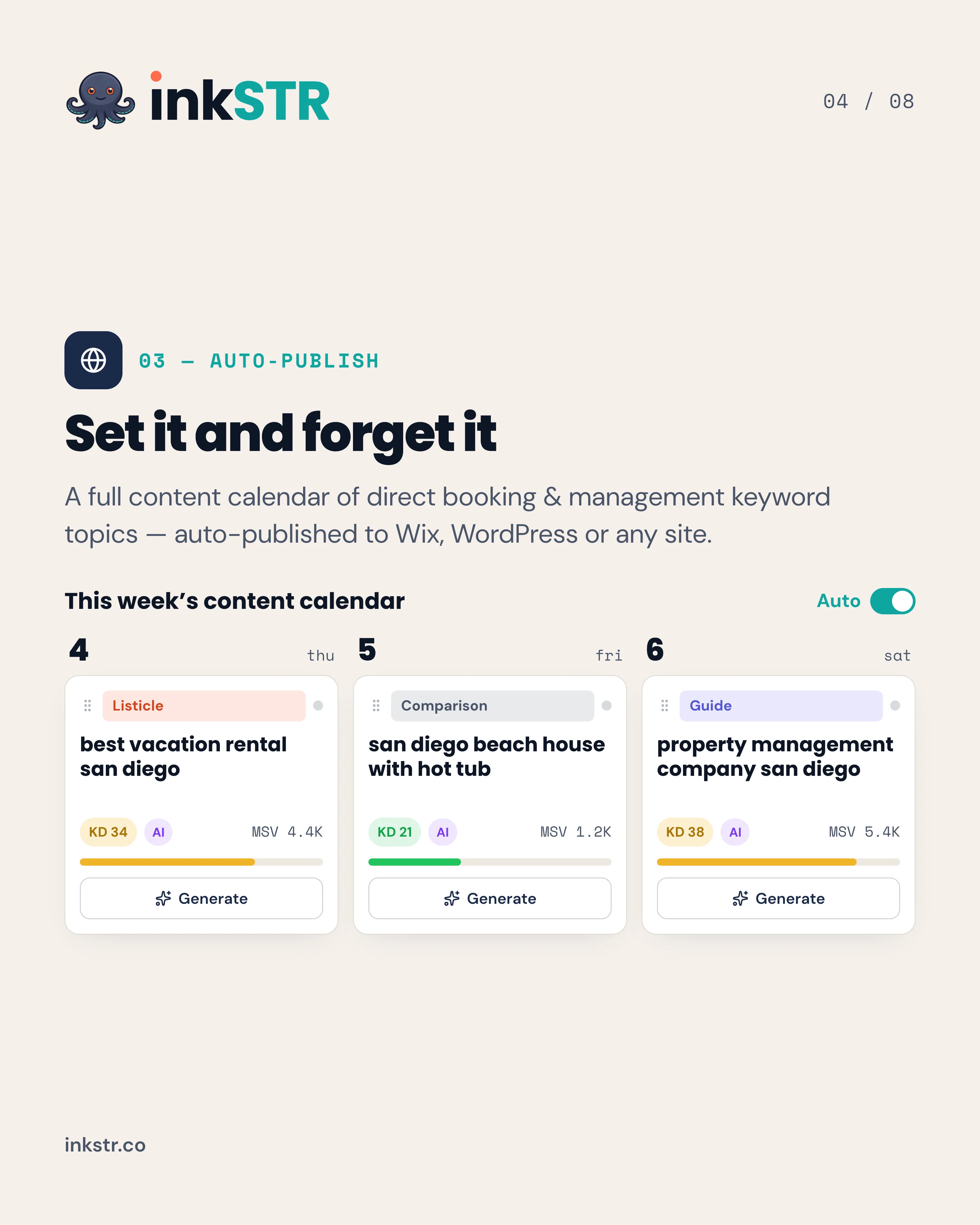
If your competitor research keeps ending in a spreadsheet, inkSTR builds the keyword gap plan, drafts the articles, and publishes them on a schedule from its content calendar. You keep the final review for local detail while the research and publishing run for you. Start your free trial at Start Free Trial.
Content powered by inkSTR.co
Enjoyed this article? Share it:
Get more of inkSTR in Google Search
Add inkstr.co as a preferred source and our articles show up more in Top Stories, AI Overviews, and AI Mode, with a “Preferred” badge.
Get more guides like this
New SEO and AI-search guides, straight to your inbox. No spam, unsubscribe anytime.