Google Alternatives for Vacation Rental Operators in 2026
The best google alternatives for short-term rental operators are Bing and Brave Search for independent indexes and ChatGPT Search and Perplexity for AI answers, with Wix or WordPress replacing Google Sites. Google still drives most discovery, so the practical move is to add channels around it. At inkSTR, we build vacation rental content to be found on all of them.
Key Takeaways
- AI-powered search now handles over 40 percent of all web queries globally (Digital Strategy Force, first quarter of 2026), so relying on one engine leaves discovery on the table.
- Bing, Brave Search, and Mojeek run their own indexes, while Yahoo is Bing-powered and DuckDuckGo and Ecosia lean partly on Bing, so strong Bing visibility carries across several engines.
- ChatGPT Search and Perplexity cite pages that state a clear answer early in each section, which makes answer-first structure the main lever for AI visibility.
- Wix and WordPress are the practical alternatives to Google Sites for a vacation rental website because both support a blog and a direct booking path.
- No alternative replaces Google Search Console as the first-party source of Google ranking data, so keep it even if you switch everything else.
- inkSTR automates keyword research, article drafting, scheduling, and one-click publishing to Wix and WordPress, so a single content pipeline feeds Google and AI answers together.
Searches for google alternatives usually come from two kinds of people. Some want a different search engine for privacy. Operators like you want to be discovered as guests stop typing every question into Google. This guide covers the second group first and touches privacy where it affects your listings.
In 2026, discovery splits across traditional engines and AI answer tools. OTAs also take 17-19% of every booking in combined host and guest fees. A single direct booking is typically worth $1,000 to $4,000 in revenue, which is why an owned content channel matters more than which engine surfaces it.
We built inkSTR for short-term rental operators, so the comparisons below come from the content side. They cover where your articles can be found, which engines depend on Bing or Google results, and what to set up first.
Why Are STR Operators Looking at Google Alternatives in 2026?
Google alternatives are search engines, AI answer tools, and software platforms that cover jobs Google handles today, from finding web pages to hosting a site. Operators look at them in 2026 because guest research no longer ends at the ten blue links. AI-powered search now handles over 40 percent of all web queries globally, up from an estimated 22 percent at the end of 2026 (Digital Strategy Force, 2026).
Most hosts depend on all of them without ever deciding to.
That dependence gets expensive when rankings dip. One quality post takes 3-5 hours of research and writing by hand, and a freelance travel writer charges $300-$700 for the same post. Multiply that by every channel you now need to reach and the budget disappears.
We built the inkSTR AI Content Writer around that math. It generates keyword-targeted, answer-first articles in your project's writing style, so one article can serve Google and AI answers at once.
What Search Engines Are Similar to Google?
Search engines similar to Google include Bing, Brave Search, DuckDuckGo, Startpage, Kagi, Ecosia, and Mojeek. They differ mainly in where results come from: Bing, Brave Search, and Mojeek run their own indexes, Startpage relays Google results, and DuckDuckGo draws mostly on Bing plus its own crawler.
The distinction that matters for your listings is search index versus search interface. An index is the crawled copy of the web; an interface is the box you type into. Many alternatives are new interfaces on top of Bing or Google, so they add privacy without adding a different set of rankings.
Bing visibility reaches further than its own audience suggests. Optimizing for seven engines separately would be a full-time job, so we designed inkSTR's Keyword Research to find the guest searches worth targeting once. The same page then earns visibility on every interface reading from the same index.

What Are the Best AI Search Engines for Getting Your Rentals Found?
The best AI search engines for rental discovery are ChatGPT Search and Perplexity, along with Google's AI Mode. You.com and Kagi are smaller options. Each builds one synthesized answer from several pages, so your content gets cited only when a section states its answer plainly in the first sentence or two.
Google explains how its newer AI Mode works in its own product update. Separately, one analysis traces the connection between Bing ranking factors and ChatGPT search, which is one more reason Bing visibility earns its place on your list.
The manual alternative is slow. A cabin operator who writes 1,500 words of atmosphere and buries the pet policy in paragraph nine gets skipped by an engine looking for a quotable answer. Rewriting every old post into answer-first form takes weeks.
We build that structure into inkSTR's drafts from the start, with definition-first openers and named entities under clean headings. In one case, MyTripify started with inkSTR at the end of April 2026. MyTripify is a Charlotte and Lake Norman management company with a 50+ property portfolio. In its first month, four property-owner leads arrived from AI search. That result came from an owner-facing pipeline built for property management companies. Across customer sites, we have secured more than 1,700 verified AI-search citations as of November 2026, and our practical guide to ranking in AI search shows the structure in detail.
What Apps Can Replace Google for Running a Rental Business?
Apps that replace Google tools cover one job each. Koofr and Filen handle file storage in place of Drive. Memos handles notes in place of Keep, and Mapy.com stands in for Google Maps. No single app replaces the whole Workspace bundle, so expect to run a small mix.
One exception deserves a flat statement: nothing replaces Google Search Console for Google ranking data. It is the only first-party record of which queries show your site on Google and how often people click. Skip it and you are guessing.
Swapping tools has a price. Moving house manuals and checklists off Drive costs an afternoon each, and photo folders cost the same. Photos still named IMG_4021 do nothing for search no matter where they live.
We keep inkSTR independent of your file stack for that reason. Its image library writes AI descriptions and SEO-friendly file names, its Google Search Console integration tracks keywords and flags opportunities, and its Hospitable and OwnerRez integrations pull in reviews, photos, and guest data. You can change storage apps without touching the content pipeline, and our roundup of must-have tools for short-term rental managers covers the rest of the stack.
What Are Alternatives to Google Sites for a Vacation Rental Website?
Alternatives to Google Sites for a vacation rental website are Wix and WordPress. Both support blogs and booking-engine embeds, which is the content marketing that drives direct bookings. Google Sites suits a simple informational page. A direct booking site needs room to publish and grow, and it has to rank.
Both platforms document the rental use case. WordPress is the open-source route with the widest plugin range, and Wix publishes a help article on creating a rental site with Wix. Wix is faster to set up; WordPress gives you more control over structure.
Staying on a site that cannot host a blog has a hidden cost. Every month without articles is a month your bookings route through OTAs at 17-19% in combined fees, and migrating later means redirects and rankings rebuilt from scratch.
inkSTR's Auto-Publishing sends finished articles to Wix or WordPress in one click, with no copy-and-paste formatting. To be direct: it does not publish to Google Sites, so a migration comes first. The payoff is a site that works as your direct bookings engine instead of a brochure.

What Software Do Short-Term Rental Hosts Use Instead of Relying on Google and OTAs?
Short-term rental hosts typically combine a property management system and a channel manager for calendar sync with a website that has a direct booking engine. Each piece reduces dependence on a single traffic source, whether that is Google or the Airbnb and VRBO marketplaces.
No product wins "best" for every host. For a property management system, inkSTR integrates with Hospitable and OwnerRez, a sensible starting point if you use either. For channel managers, compare calendar sync reliability, the number of connected channels, and how pricing scales per listing. For booking sites, pick a platform that supports a blog.
Software demos can eat weeks, and none of them produces visitors. A booking engine on a site with no traffic is an empty storefront, and the hours you spent choosing a channel manager never convert into reservations.
We built inkSTR as the traffic layer on top of that stack. Its content strategy wizard maps pillar, cluster, and conversion pages so informational posts feed readers toward the pages where bookings close, and the full path from keyword to published post is laid out on the how inkSTR works page.
Ready to automate your content marketing?
inkSTR handles keyword research, content strategy, article writing, and publishing, all on autopilot.
How Do You Switch Search Engines and Test How Your Rentals Appear?
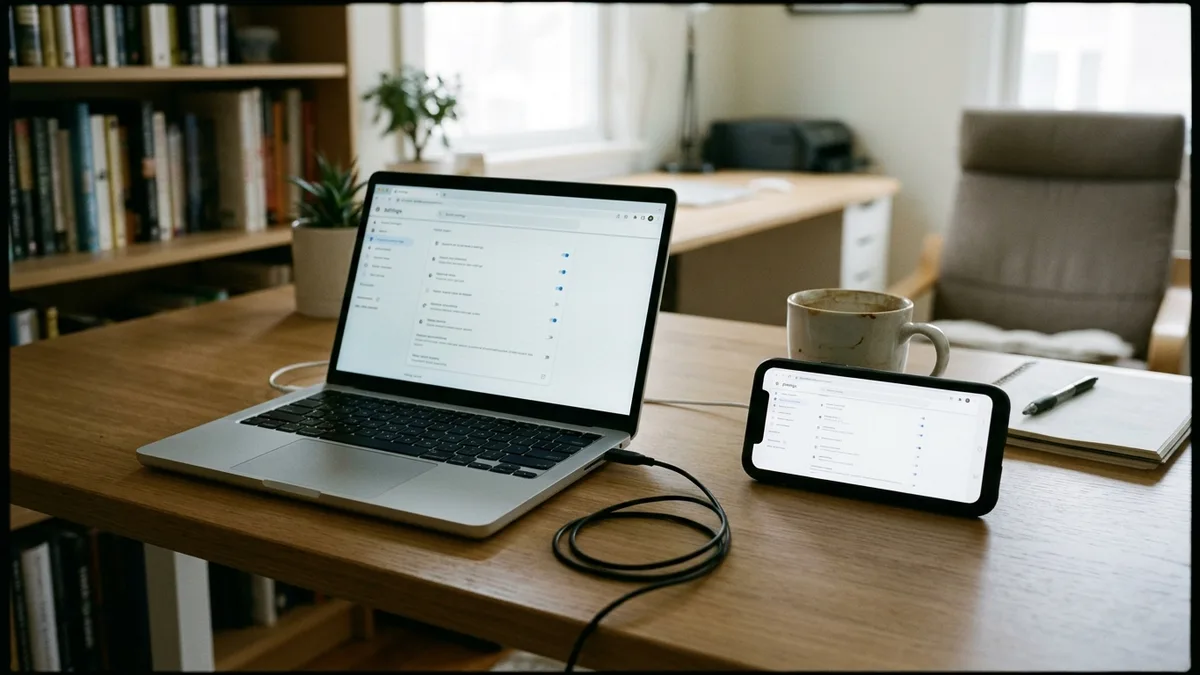
Switching your default search engine takes a few clicks: open your browser settings, find the search engine option, and choose a new default. Phone browsers follow the same path in their app settings. The more useful exercise for you is running your own market queries across several engines and recording what shows up.
- Pick five queries a guest would type, such as "pet-friendly lake house near [your town]", using your own market and property types.
- Run each query in Google, Bing, Brave Search, ChatGPT Search, and Perplexity.
- Record whether your site appears, which page ranks, and whether an AI answer cites you.
- Note which engines read from Bing or Google results, so you fix a page once instead of five times.
- Repeat monthly and compare changes.
Done by hand across five engines, this takes hours and goes stale quickly. We pair the test with inkSTR's Google Search Console integration, which tracks keywords and detects opportunities on the Google side. The Content Calendar keeps new articles flowing on a fixed schedule, so each monthly test has fresh pages to measure.
What Do You Give Up When You Leave Google?
Leaving Google means giving up the largest single source of search traffic. For most operators, adding channels beats abandoning the one that pays.
Google's lead narrows for AI queries: it holds approximately 78 percent of the overall search market but roughly 55 percent of AI-specific queries (Digital Strategy Force, 2026). Privacy claims also need a close read. DuckDuckGo retains anonymous queries without building an identifiable profile, and a self-hosted SearXNG instance is only as private as its operator. Startpage gives you Google results without Google tracking, and that includes Google's rankings.
The cost of walking away shows up in revenue. In one case, a Smoky Mountains cabin rental brand ran a continuous inkSTR content pipeline. Its monthly Google Search clicks grew from 788 to 5,730 in 13 months.
Dropping Google would have forfeited that. The same answer-first structure that earned those clicks also makes the articles citable by AI engines. Our breakdown of ranking on Google for STR operators explains which factors carry the most weight.
Which Google Alternative Fits Which Operator?
The right Google alternative depends on the job: Bing for mainstream reach beyond Google, Brave Search for an independent index, ChatGPT Search and Perplexity for AI answers, and Wix or WordPress for the site itself. Match each tool to the problem you are solving.
- Full-time hosts with a few properties: Stay on Google and Bing, check ChatGPT Search and Perplexity monthly, and host on Wix or WordPress.
- Property management companies: Prioritize AI answers for owner-acquisition queries, since owner leads can arrive from AI search, as the MyTripify result shows.
- Privacy-minded operators: Use Brave Search or DuckDuckGo for your own browsing; it does not change how guests find you.
- Multi-property managers: Give each brand its own content pipeline so every site publishes independently.
Choosing is the easy part. Executing across channels is where operators stall, with a freelance travel writer charging $300-$700 per post and ranking articles that can drive organic traffic for 2-5 years only if you publish them.
inkSTR starts at $99/month, and inkSTR's multi-project support keeps each property or brand in its own pipeline. You can compare plans on the pricing page or start here to build your first keyword plan.
Frequently Asked Questions
Target keywords guests actually search, publish answer-first articles that link to your booking pages, and track results in Google Search Console. A single post rarely moves rankings alone, so consistency matters. Our guide to ranking your vacation rental website on Google covers the full process, and inkSTR automates the keyword research and publishing.
For privacy, yes: DuckDuckGo does not track users and blocks external trackers. It draws mostly on Bing results plus its own crawler, so its rankings resemble Bing's rather than Google's. For your rental site, that means Bing performance decides how you appear there.
Brave Search and Mojeek run independent indexes, as does Bing. Kagi combines its own index with third-party sources and charges for access. Startpage relays Google results, and Yahoo is Bing-powered, so neither adds a separate index.
You do not need separate pages. Answer-first structure and specific facts serve Google and AI engines alike. We build that structure into inkSTR's generated articles through LLM citation optimization.
What is the best property management software for Airbnb hosts, and which channel managers work for vacation rentals?
The best fit depends on your portfolio size and where your bookings come from. For a property management system, check whether it connects to your tools; inkSTR integrates with Hospitable and OwnerRez. For channel managers, compare calendar sync reliability and channel coverage. Per-listing pricing matters too.
Which vacation rental software offers direct booking websites?
Several property management systems include direct booking tools. Both Wix and WordPress also support booking-engine embeds. Whichever you choose, the site still needs visitors, and scheduled articles supply them. inkSTR drafts and publishes those for you.
No. inkSTR publishes in one click to Wix and WordPress. If your current site is on Google Sites, migrating to one of those platforms is the way to use the content calendar and auto-publishing described on the how it works page.
What Should You Do Next?
The strongest approach to google alternatives in 2026 is to keep Google and add channels around it. Bing visibility carries across several engines, and AI answers reward answer-first structure. Wix or WordPress give you a site that can publish steadily. Start with Search Console, run the five-query test, and commit to a publishing schedule. The step most operators never reach is writing and scheduling articles every week, which is exactly what we built the inkSTR content calendar to remove.
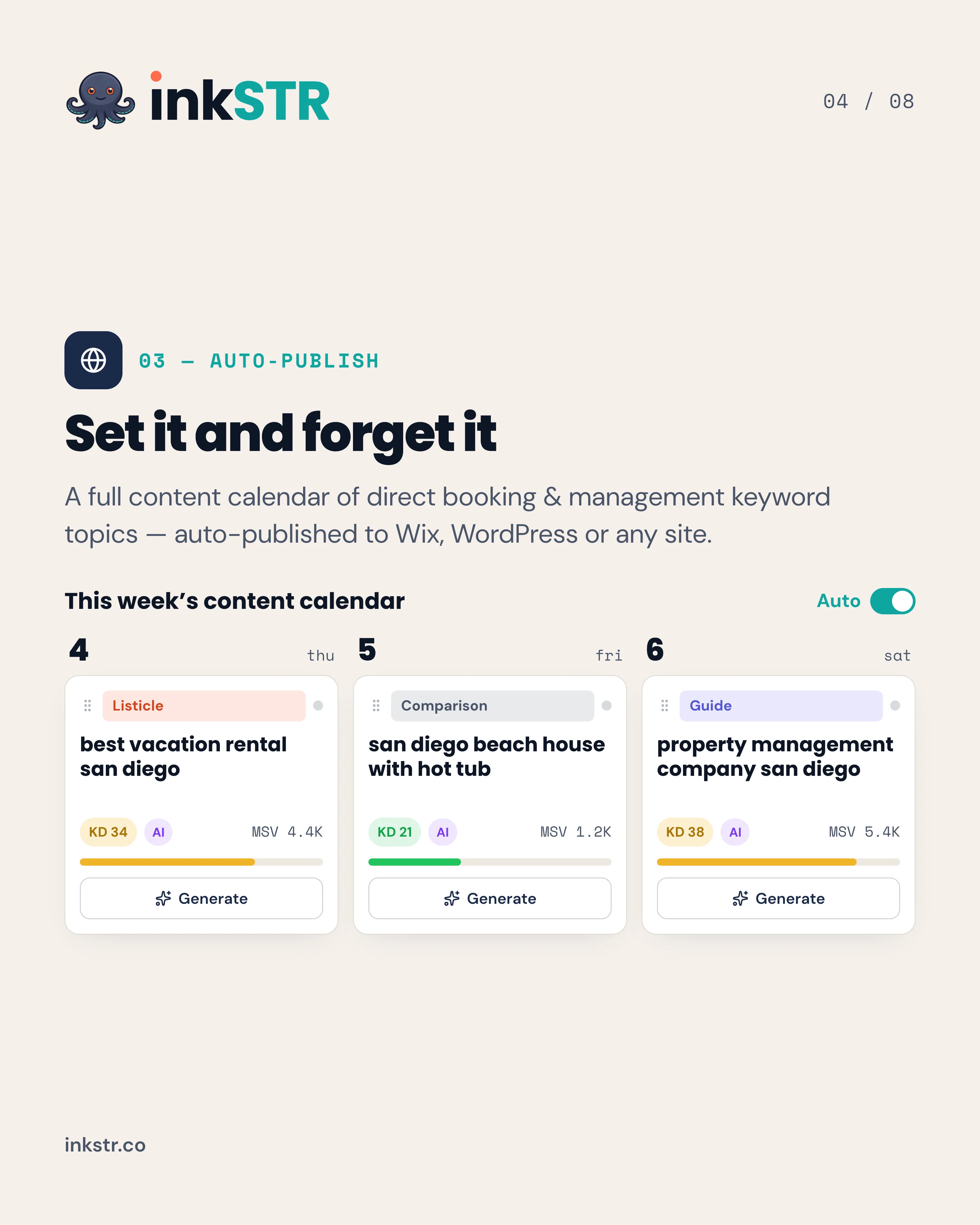
If you want your articles found on Google and in AI answers without writing each one yourself, Start Free Trial with inkSTR. The content calendar queues drafts and auto-publishes to Wix or WordPress on your schedule. You get a keyword plan first, then a steady stream of direct-booking content.
Content powered by inkSTR.co
Enjoyed this article? Share it:
Get more of inkSTR in Google Search
Add inkstr.co as a preferred source and our articles show up more in Top Stories, AI Overviews, and AI Mode, with a “Preferred” badge.
Get more guides like this
New SEO and AI-search guides, straight to your inbox. No spam, unsubscribe anytime.