Vacation Rental SEO Agency vs DIY: A Task-by-Task Split
For most operators, the vacation rental SEO agency vs DIY decision ends in a hybrid. They hire a specialist for the technical audit, location-page architecture, and link building. The recurring content work stays in-house or is automated. Pure agency retainers get expensive before organic traffic converts, and pure DIY stalls when peak season hits. At inkSTR, we see the same pattern repeatedly: the sites that win publish steadily for months, and steady publishing is the part you can automate.
Key Takeaways
- The best-fit model for most direct-booking goals is hybrid: specialists handle technical SEO and link building, while you or your tools handle recurring content, reviews, and listing copy.
- Published agency pricing for local businesses starts around $500 to $1,500 monthly at boutique agencies and reaches $3,500 to $10,000 or more at premium agencies. Contracts typically run 6 to 12 months, and vacation-rental specialists may price differently.
- A single direct vacation rental booking is typically worth $1,000 to $4,000, while Airbnb host and guest fees combined run 17 to 19% of every booking, so a few organic reservations change the break-even math.
- Writing one quality blog post by hand takes 3 to 5 hours, and a freelance travel writer charges $300 to $700 per post.
- Organic results take months, and seasonality hides early progress, so judge the first quarter by Search Console impressions and clicks before you judge it by bookings.
- inkSTR automates keyword research, article drafting, scheduling, and publishing to Wix or WordPress, so DIY consistency no longer depends on your free hours.
This comparison is for owners with one to a few properties and for managers running larger portfolios who are deciding where marketing money goes in 2026. If most of your reservations still arrive through Airbnb and VRBO, organic search is the channel that can shift that mix. The open question is who does the work, and what that costs you in cash and hours.
Vacation Rental SEO Agency vs DIY: How Do the Three Models Differ?
Vacation rental SEO is the work of earning organic Google visibility for your own booking website, so travelers find you before they land on an OTA listing. It covers keyword research, on-page copy, technical fixes, property and location pages, blog content, reviews, and link building. You can staff that work yourself, through an agency, or through a hybrid of both.
| Criteria | Manual DIY | Agency | Hybrid with automation |
|---|---|---|---|
| Monthly cash cost | Tool subscriptions only | $500 to $10,000 or more, depending on agency tier | Tool subscription, plus a one-time audit that typically runs $1,500 to $5,000 or more |
| Your time | 7 to 13 hours monthly for local SEO tasks, more when you write posts | Meetings and approvals | Reviewing and approving drafts |
| Typical timeline | 3 to 9 months | 3 to 6 months | Same months-long window, but publishing starts immediately |
| Main risk | Stalls during busy season | Generic work, long contracts, unclear reporting | Needs clear ownership of each task |
| Best fit | 1 to 3 properties and spare hours | Large portfolios in competitive markets | Most owners chasing direct bookings |
Treat those cost and time figures as starting ranges; your market's competition moves them. Agencies built around local services, such as a dentist or a plumber, rely on one services page and a map listing. A rental site has inventory pages and seasonal queries, and its booking lead times stretch for months, so a generic playbook leaves you paying for the learning curve.
DIY fails differently. You write four posts and peak season arrives, and then the blog goes quiet for a quarter. We built inkSTR's AI Content Writer and Content Calendar for that gap: they draft keyword-targeted articles in your project's writing style and schedule them ahead of time. For a wider map of the discipline, read our vacation rental SEO strategy guide.
Why Do Direct Bookings Change the SEO Math for Rental Owners?
Direct-booking SEO math weighs the monthly cost of organic search against the commission you avoid and the revenue one reservation brings. A direct booking is typically worth $1,000 to $4,000 in revenue, and Airbnb host and guest fees combined run 17 to 19% of every booking. That gap is what makes a retainer or a content budget defensible.
Run it as a hypothetical. A $1,500 monthly retainer is covered by two direct bookings at the low end of that range, or one at the high end. Over a six-month contract that totals $9,000, which takes between three and nine direct bookings to cover. The catch is attribution: count only reservations whose first visit came from organic search in Google Analytics, and exclude repeat guests and referrals that would have booked anyway.
Without an owned channel, the commission recurs on every stay, including guests who would have booked on your site if they had found it. Search results for rental queries are crowded with Airbnb and VRBO listings, and an agency report full of traffic charts does not close that gap by itself.
Our marketing tooling is built around that conversion path. inkSTR's content strategy wizard maps pillar and cluster articles so each informational post routes readers toward a booking page, and the internal link manager keeps the primary call to action pointed at your booking engine. Every post gets a job, and that is how organic traffic becomes commission-free revenue.

What SEO Tasks Can You Do Yourself, and What Needs a Specialist?
A task split assigns each SEO job to whoever can finish it at the lowest cost and highest quality. For vacation rentals, copy and local knowledge favor you, while crawl diagnostics and outreach favor a specialist. The mistake is outsourcing everything or keeping everything.
| Task | Best owner | Why |
|---|---|---|
| Google Business Profile and review replies | You | Quick to update; check Google's current eligibility rules for your business type first |
| Property and listing copy | You | You know the hot tub seating, the nearest trailhead, the drive to the ski lift |
| Blog content answering traveler questions | You, with automation | Volume is the obstacle, not skill |
| Keyword research | You, with tools | Tools handle the data; you judge traveler intent |
| Technical audit, crawl errors, schema | Specialist | Fixes often need a developer |
| Location page architecture across markets | Specialist or hybrid | Structure mistakes are expensive to undo |
| Link building and outreach | Specialist | Relationship-driven and time-heavy |
For keyword research you have capable options, including Semrush and Ubersuggest, and Screaming Frog crawls your site for technical issues. Our walkthrough on how to do SEO yourself covers the DIY side in detail.
The painful part is the research itself: exporting terms, checking competitors, and deciding which cluster to write next can eat a weekend. inkSTR's Keyword Research feature finds the terms your target guests search for, and a brand audit shows which keywords competitors rank for that you do not. You then hand a specialist only the tasks that need one.
What Does Vacation Rental SEO Cost With an Agency Versus DIY?
Total SEO cost is cash spent plus the value of your own hours. Agency cost is easy to see on an invoice; DIY cost hides in your calendar. Comparing them fairly means pricing both.
Published pricing for local-business agencies, which is the closest public benchmark, starts at $500 to $1,500 monthly for boutique agencies and $1,500 to $3,500 for mid-tier agencies. Premium agencies charge $3,500 to $10,000 or more. Vacation-rental specialists may quote differently, so get written quotes. Audits typically run $1,500 to $5,000 or more, and contracts commonly last 6 to 12 months. DIY looks free until you count 7 to 13 hours a month on profile updates and review replies.
Content is where DIY quietly gets expensive. At four posts a month, hand-writing takes 12 to 20 hours, and a freelance travel writer at $300 to $700 per quality post costs $1,200 to $2,800. Multiply by several markets and the budget disappears before you see a ranking.

We priced inkSTR to replace that content line item. The Content Writer drafts 2,500 to 3,500 word articles, Auto-Publishing sends them to Wix or WordPress, and you can see current plans on the pricing page. If you run a portfolio, inkSTR for property management companies gives each property or brand its own pipeline, keyword set, and voice.
How Long Does Vacation Rental SEO Take to Show Results?
The vacation rental SEO timeline is the gap between your first published page and your first measurable organic booking, and it is usually counted in months. Agencies commonly describe a 3 to 6 month window, and DIY efforts often take 3 to 9 months because publishing is slower and less consistent.
Seasonality complicates the read. Guests often research months before they book, so a page that starts ranking in spring may convert in summer, and a quiet January says little about your strategy. Compare year over year, not month over month. Track Search Console impressions first, then clicks and average position, then bookings; each metric lags the one before it.
The slow start tempts operators to quit at month three, which is the worst moment to stop. One Smoky Mountains cabin rental brand running an inkSTR content pipeline grew monthly Google Search clicks from 788 to 5,730 over 13 months, measured in Google Search Console. The payoff built on cadence, not on one clever post.
A ranking article can keep driving organic traffic for 2 to 5 years, so early months are an investment with a long tail. We built the Content Calendar so the clock starts immediately: you schedule a month of posts at once, and the Google Search Console integration tracks keyword movement and flags opportunities as impressions climb.
Ready to automate your content marketing?
inkSTR handles keyword research, content strategy, article writing, and publishing, all on autopilot.
When Does DIY Break Down, and What Does a Hybrid Look Like?
A hybrid SEO model pairs a one-time or periodic specialist engagement with owner-led or automated recurring work. DIY works when you own one to three properties and enjoy writing, as long as the competition you face is moderate. It breaks when publishing volume has to scale across markets or when a technical fault goes unnoticed for weeks.
Volume is the usual breaking point. A five-market luxury mountain rental brand went from averaging roughly 13 Google visits a month to 1,924 monthly search visits in four months, after publishing 114 inkSTR articles across all five markets. Writing that by hand at 3 to 5 hours per post would take several hundred hours, which is why most owners stall long before that.
A workable hybrid splits the work cleanly. The agency or specialist runs the audit and site architecture, and it also handles schema and link strategy. Your automation handles recurring articles, while you handle reviews and listing copy along with local knowledge nobody else has. Nobody should be guessing who owns the next task.
- Choose DIY if you have one to three properties, spare hours, and a low-competition market.
- Choose an agency if you run a large portfolio in a crowded market and can manage a 6 to 12 month contract.
- Choose hybrid if you want direct bookings without surrendering control of your content.
As of November 2026, we have published more than 6,200 articles across inkSTR customer sites, so the pipeline is proven at volume. See the full workflow on how inkSTR works, from keyword to published post.

How Do You Vet a Vacation Rental SEO Agency Before Signing?
Vetting an agency means testing its claims against named deliverables, sample work, and contract terms. The best agency for vacation rentals is the one whose answers hold up under that test. We would not name a single winner, because fit depends on your portfolio size and market.
Watch for these red flags:
- Guaranteed rankings or fixed timelines, since no one controls Google.
- No sample work from vacation rental or hospitality sites.
- Reporting you cannot verify because the agency, not you, owns the Search Console and Analytics access.
- Audits that list recommendations without naming who implements the fixes and who retests them.
- Auto-renewing 12-month contracts with no exit terms.
Ask for a task list with owners and sample location pages, and request a sample report along with the attribution method for organic direct bookings versus OTA and repeat demand. Google publishes its own guidance on hiring an SEO, and it is worth reading before the first call. Our SEO audit examples for vacation rental websites show what a useful audit looks like.
The painful scenario is paying for a keyword gap analysis you could have run yourself. Before any sales call, we suggest running inkSTR's brand audit to see where competitors outrank you. You walk in knowing your gaps and pay only for the work you cannot do.
Frequently Asked Questions
How do I get my vacation rental website to rank on Google?
Publish keyword-targeted pages travelers search before booking, such as property pages and location guides, along with answer-first articles, each linked to a booking page. Track impressions and clicks in Google Search Console, and expect months, not weeks. Our guide on why your vacation rental website is not ranking covers common diagnostics.
What company focuses on vacation rental SEO in 2026?
Both specialist agencies and software exist. inkSTR is a software platform, not an agency, built only for short-term rental operators; it handles keyword research and article drafting, and it also manages scheduling and publishing. If you want an agency, use the vetting questions above to compare candidates.
How long does vacation rental SEO take to show results?
Agencies typically describe 3 to 6 months, and DIY projects often run 3 to 9 months. Seasonality and long booking lead times can delay the first booking after rankings improve. Measure impressions and clicks first.
Is SEO worth it for rentals that already rely on Airbnb or VRBO?
Yes, if you want to reduce platform fees and own part of the guest relationship. OTA listings keep supplying demand, while organic search builds a commission-free channel alongside them. We compare it with ad spend in vacation rental SEO vs paid ads for bookings.
Can I do vacation rental SEO without technical skills?
You can handle content and listing copy without technical skills, and the same goes for reviews and keyword choices. Crawl errors and schema fixes may need a developer or specialist. inkSTR's Auto-Publishing removes the copy and paste steps for Wix and WordPress sites, and it takes care of the formatting too.
What are the best SEO tools for vacation rental hosts?
Google Search Console tracks performance and Semrush or Ubersuggest supports keyword research, while Screaming Frog crawls your site for technical issues. inkSTR covers content generation in one workflow, and the same workflow handles scheduling and publishing. Our roundup of best automated SEO tools for vacation rental sites compares more options.
Bottom Line
The vacation rental SEO agency vs DIY choice comes down to who owns the recurring work. Hire a specialist for the audit and site architecture, and keep content publishing running on a schedule you control. Your first move this week is to queue a month of keyword-targeted posts.
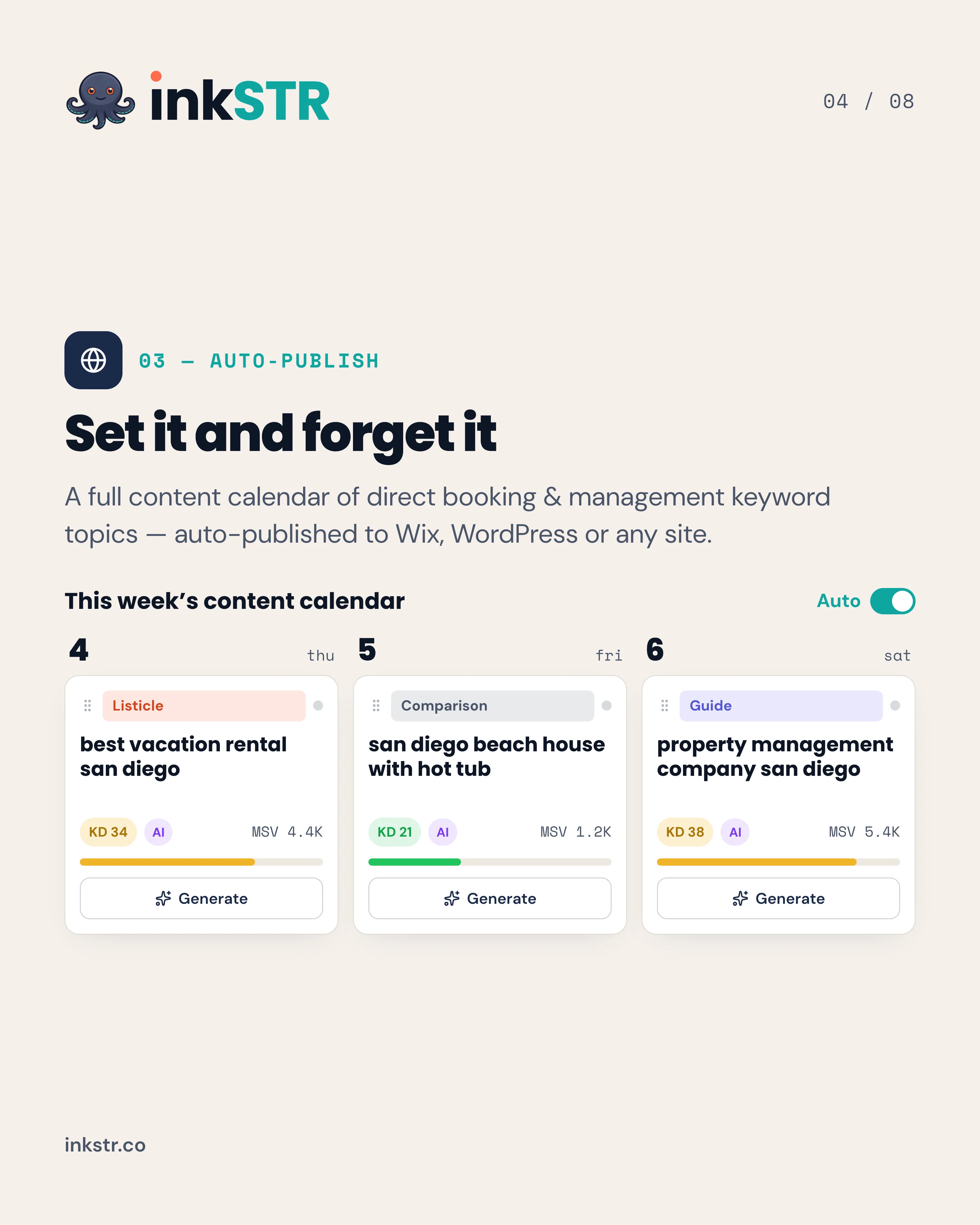
If you want more direct bookings without spending your week on keyword research and drafting, Start Free Trial with inkSTR. The Content Calendar schedules a month of articles at once, and Auto-Publishing sends them to your Wix or WordPress site on schedule. Pick your first property and generate your first strategy.
Content powered by inkSTR.co
Enjoyed this article? Share it:
Get more of inkSTR in Google Search
Add inkstr.co as a preferred source and our articles show up more in Top Stories, AI Overviews, and AI Mode, with a “Preferred” badge.
Get more guides like this
New SEO and AI-search guides, straight to your inbox. No spam, unsubscribe anytime.