Vacation Rental Website vs Airbnb Listing for Bookings
A vacation rental website wins on margin and guest ownership, while an Airbnb listing wins on discovery and trust, so most operators should run both. At inkSTR, we build content tools for short-term rental hosts, and the vacation rental website vs Airbnb listing for bookings question comes down to who owns the traffic.
Key Takeaways
- A single direct booking is typically worth $1,000 to $4,000 in revenue, so even a modest share of direct guests changes your margin.
- A new direct website gets no traffic on its own; SEO content and email have to fill that gap, along with repeat guests.
- For most operators, the best mix is Airbnb for acquisition plus a direct site for repeat guests, with calendars synced to prevent double bookings.
- inkSTR automates keyword research, article drafting, scheduling, and publishing, so your direct site earns search traffic without 3-5 hours of writing per post.
Picture your dashboard on a typical Tuesday. Your Airbnb listing shows steady views and a few new reservations, but each payout is smaller than the nightly rate suggests. Your own website, built last spring, shows a handful of visitors and no reservations.
That gap is the real subject of the vacation rental website vs Airbnb listing question in 2026. We compare the two below on fees and traffic, then on control and workload, and work through a net-revenue example and a plan for splitting your channel mix. Fee models change often, so confirm current rates on each platform's fee page before you model your own numbers.
Our position, after building content tools for short-term rental operators: use Airbnb to be found by strangers, and use your website to keep the guests who already like you.
Which Wins for Bookings: a Vacation Rental Website or an Airbnb Listing?
An Airbnb listing is a page inside a marketplace where travelers are already searching, while a vacation rental website is a property you own that has to attract its own visitors. The listing wins on early discovery and trust. The website wins on margin and guest data. It also gives you control over policies.
Each channel hurts in a different way. On your own site you keep the margin, but a site nobody visits books nothing. One drains money from every stay; the other drains stays.
Direct visitors come from content, and that is where most operators stall. We built inkSTR to cover that half of the equation: it researches keywords and drafts SEO-optimized articles. Then it publishes them to your site. Once those visitors arrive, our guide to vacation rental booking strategies explains what nudges them to reserve.
What Are the Different Vacation Rental Sites?
Vacation rental sites fall into four groups: marketplaces such as Airbnb and Vrbo, online travel agencies such as Booking.com, metasearch surfaces such as Google Vacation Rentals, and your own direct booking website. Each group sends guests through a different door, and only your own site gives you the guest relationship.
Niche and regional rental sites also exist for lake houses and cabins. Some focus on pet-friendly stays. They typically have smaller audiences, so check traffic and fee terms before you pay for a listing.
Every added site means another calendar and another inbox. It also brings another rulebook. Miss one sync and you face a double booking and a cancelled guest. A review hit follows. Meanwhile none of those sites will write the articles that bring search traffic to your own domain.
That gap is why we built inkSTR's AI Content Writer. inkSTR generates keyword-based articles for your direct site, so the marketplaces become one source among several instead of your only source.

How Much Do Airbnb, Vrbo, and Direct Bookings Cost Hosts?
It comes in two structures: a split-fee model of roughly 3% from the host plus about 14% from the guest, or a single-fee model near 15.5% charged to the host. Combined host and guest fees run 17-19% of a booking.
| Channel | Typical fee structure (confirm current rates) | Where guests come from |
|---|---|---|
| Your website | Standard card processing of about 2.9% plus $0.30 per transaction, plus site and software costs | Your SEO, email, ads, and repeat guests |
Take the same $1,000 stay. On a direct booking at standard card rates, processing costs $29.30 and you keep $970.70, a difference of roughly $125 before other costs.
Then the other costs arrive. A booking-engine subscription and guest screening commonly run $5 to $12 per stay. Platforms often handle lodging tax filing for you, and paid ads are commonly reported at $100 to $250 per booking. Buy every direct reservation with ads and the savings disappear.
Organic search is the cheapest source on that list, because a ranking article can drive traffic for 2-5 years. inkSTR costs $99/month, while a single freelance post runs $300-$700; see current plans. One organic reservation covers several months of that subscription.
Is Booking.com or Airbnb Better for Hosts?
Neither is better for every host. Airbnb is the usual first listing for whole-home leisure stays, and Booking.com works as a second channel that reaches travelers who start on a different site. The right choice depends on how each channel performs against your own occupancy and net payout.
Hosts often add a channel because a competitor did, then discover a month later that it brought lower-value bookings and a second inbox. Each channel also multiplies your calendar sync risk. Add one only if the net payout per booking, after fees and extra workload, beats what your current channels earn.
Placement matters on both. Airbnb publishes the factors that shape search placement, and they reward reviews, completeness, and responsiveness more than clever copy.
Whichever you choose, a marketplace booking is a rented guest. We designed inkSTR so the next booking from that guest, and from strangers who never opened Airbnb, lands on your own site. inkSTR drafts local and seasonal articles for searches like a lake house in the off-season, where a weekend-getaway query beats a July family-reunion query.
How Does a Direct Booking Website Work, and What Does It Cost to Build?
A vacation rental direct booking website is your own site with property pages, an availability calendar, a booking engine, and card payment processing. Guests reserve and pay you directly, and a channel manager or PMS syncs your calendar with Airbnb and Vrbo to prevent double bookings.
Costs go beyond the build. You pay for the booking engine or builder and payment processing, plus a PMS or channel manager, screening, insurance, and tax remittance.
- Sync calendars through your PMS or channel manager, then block a test date to confirm it appears on every channel.
- Use a processor such as Stripe that handles card data, so you never store card numbers yourself.
- Post cancellation terms and house rules on the booking page and in the confirmation email.
- Confirm with your local tax office how lodging taxes are collected for direct stays.
The common failure is launching and waiting. The booking engine sits idle for months, and no conversion fix helps traffic that never arrives. Our guide to booking page conversion matters once visitors show up.
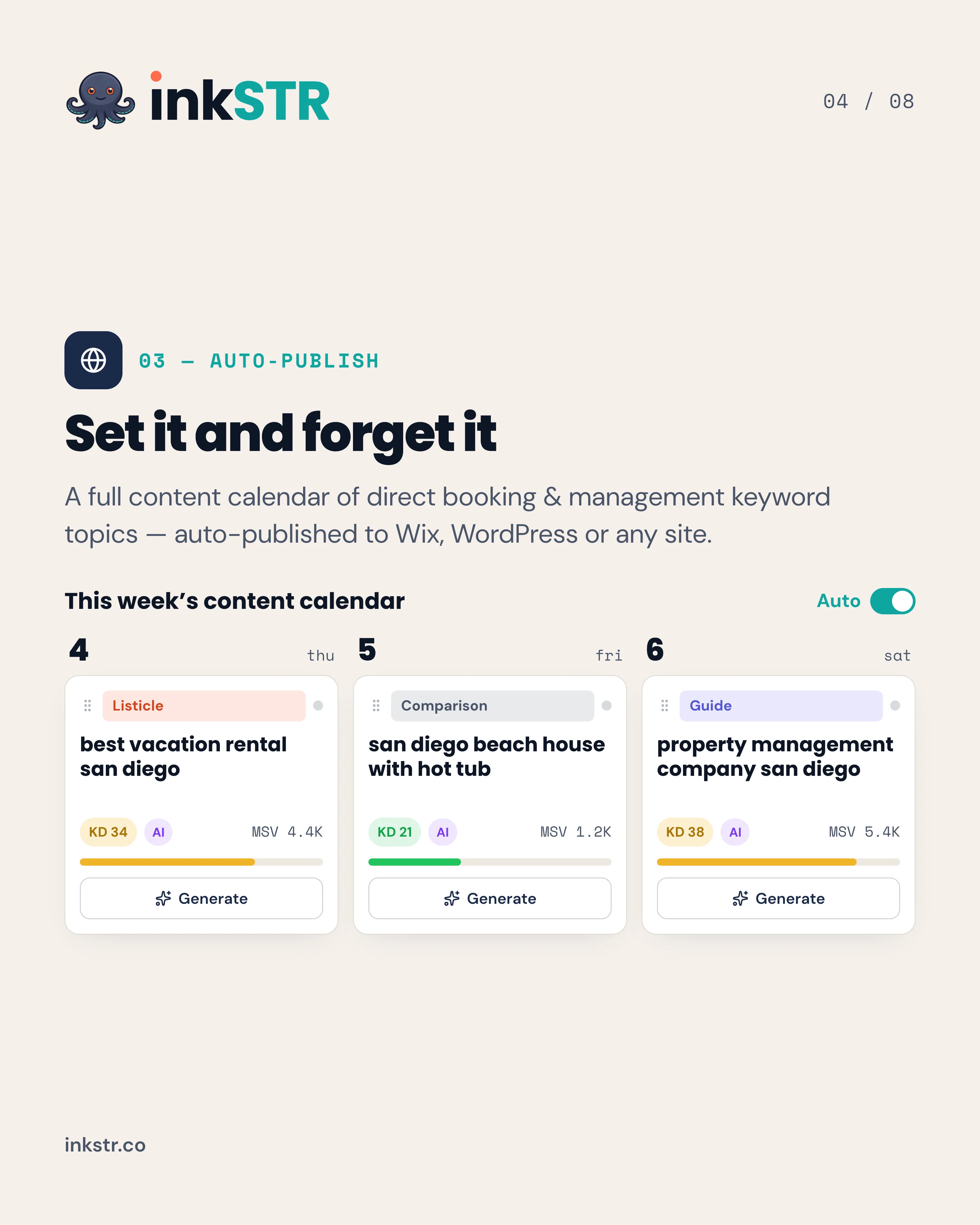
inkSTR's Auto-Publishing sends finished articles to Wix or WordPress with one click, so content reaches whichever platform your site already runs on.
Ready to automate your content marketing?
inkSTR handles keyword research, content strategy, article writing, and publishing, all on autopilot.
Why Does My Direct Booking Website Get No Traffic, and Will SEO Beat Airbnb?
A new vacation rental website gets no traffic because search engines have no reason to rank it yet. Airbnb and Booking.com dominate broad searches like 'cabin rentals.' SEO can still bring direct guests when you target specific, local, intent-rich queries, but it takes months of consistent publishing.
The manual route is expensive. A freelance travel writer charges $300-$700 per quality post, and writing one yourself takes 3-5 hours of research and writing. Plenty of operators publish a few posts, then guest messages pile up and the calendar dies in week two.
That is the problem inkSTR was built to remove. inkSTR's Keyword Research finds the searches your target guests type, and the inkSTR content calendar publishes on a set schedule without you.
In one case, a Smoky Mountains cabin rental brand running an inkSTR content pipeline grew monthly Google Search clicks from 788 to 5,730 in 13 months. It attributed $309,775 in direct booking revenue to that growth. The figures were measured in Google Search Console and Google Analytics. A five-market mountain rental brand went from 26 to 1,924 monthly Google visits in four months on 114 articles. Results vary by market, and SEO is slow; expect months, not days.
For the fundamentals, read how to rank your vacation rental website on Google, then see our guide to ranking in AI search.
Should You List on Both Airbnb and Your Own Website?
Yes, most operators should list on Airbnb and run their own website together, because the listing supplies discovery and the website captures repeat guests at lower cost. Listing one property on both is generally allowed, provided your calendars sync and you follow each platform's current terms.
| Your situation | Best channel mix | Main reason |
|---|---|---|
| One part-time cabin | One marketplace plus a simple site with local pages | Low workload, some owned traffic |
| Multi-property portfolio | Direct site with PMS, OTAs for acquisition | Content and booking engine scale across units |
Read your agreements for price parity and contact rules before you undercut a platform on your own site. Skipping that step is how hosts lose listing visibility.
Managing content for 15 or more units is where the website side usually collapses. inkSTR gives each property or brand its own project pipeline, so market-specific articles come from one dashboard. See how this works for property management companies.

How Do You Move Repeat Guests to Direct Bookings Without Breaking OTA Rules?
Moving repeat guests to direct bookings means inviting past guests to rebook on your website for future stays, using contact permission you earned legitimately and without steering an existing platform reservation off the platform. Check each OTA's current terms before you send a single message.
- Collect emails through your own channels: direct inquiries, a newsletter signup, and permitted post-stay follow-ups.
- Invite past guests to book future stays on your website, not to pay outside for a current reservation.
- Fund a loyalty discount from the fees you save, and follow applicable privacy and local rental rules.
- Keep calendars synced and test for conflicts before every peak season.
Without a reason to visit your site, past guests default to the app on their phone. And since a direct booking is typically worth $1,000 to $4,000, each guest who drifts back to the app is expensive.
Blog content gives them that reason. Seasonal area guides and event roundups bring guests back through search and email. In inkSTR's Content Calendar, you drag an article to a date and the scheduler publishes it, so a season of posts takes one sitting. You can get started here.
Frequently Asked Questions
For broad searches like 'beach house rentals,' usually not; those marketplaces have far more pages and links. SEO works for specific queries, such as a named town or a property type. An amenity or a season can work too, and both can sharpen the search. A ranking article can drive organic traffic for 2-5 years, and inkSTR's keyword research targets those narrower searches.
What are the best niche rental platforms for a lake or cabin property?
Niche and regional sites exist for lakes, cabins, and pet-friendly stays, but audiences and fees vary widely. Compare each site's traffic and terms before you pay. Pair one general marketplace with a direct site, where you control the lake or cabin angle yourself.
How do I list a vacation rental property?
On Airbnb, create a host account, add photos, write the description, set pricing and house rules, sync your calendar, and publish. On your own site, you need property pages and a booking engine. You also need payment processing. A channel manager or PMS keeps both calendars aligned.
What tools are available for automating my vacation rental business?
Common tools cover your PMS, channel manager, dynamic pricing, payments, and guest messaging. For the marketing side, inkSTR automates blog research and drafting. It also handles scheduling and publishing.
Generally yes, as long as your calendars sync and you follow each platform's current terms on pricing and off-platform contact. Read your host agreements before you change prices or message guests. Local short-term rental rules still apply on every channel.
It is the commission Airbnb deducts from your payout. Depending on your setup, it is either a split fee of roughly 3% from the host plus about 14% from the guest, or a single host-only fee near 15.5%.
What is the best direct booking software for vacation rentals?
No single product fits everyone. Pick the one that fits your portfolio size and how many channels you run.
How does a PMS like OwnerRez handle a direct booking website and channel management?
Check the provider's documentation for specifics. In general, a PMS or channel manager holds the master calendar and pushes availability to your channels, and some include a booking engine for your site. inkSTR connects with Hospitable and OwnerRez to pull reviews and photos into your articles. It also pulls in guest data.
Final Verdict: Which Channel Should You Prioritize in 2026?
For most operators, the vacation rental website vs Airbnb listing for bookings decision ends in a hybrid. Airbnb brings strangers through the door, and your website keeps margin and relationships. On a $1,000 stay, the gap between roughly $845 and $970.70 in your pocket is real, but only if the direct visitors exist.
Your next steps: keep your marketplace listings synced and build a booking page that converts. Then publish search-targeted articles that send readers to it. As search shifts toward AI answers, specific, well-structured articles give you more places to be found.
Ready to turn your website into a direct booking channel that earns its own traffic? Start Free Trial with inkSTR and let it handle keyword research, drafting, scheduling, and one-click publishing to Wix or WordPress. You stay focused on your guests, and your blog starts working toward reservations on your own booking page.
Content powered by inkSTR.co
Enjoyed this article? Share it:
Get more of inkSTR in Google Search
Add inkstr.co as a preferred source and our articles show up more in Top Stories, AI Overviews, and AI Mode, with a “Preferred” badge.
Get more guides like this
New SEO and AI-search guides, straight to your inbox. No spam, unsubscribe anytime.