What Is an AI-Powered Content Platform? A 2026 Guide
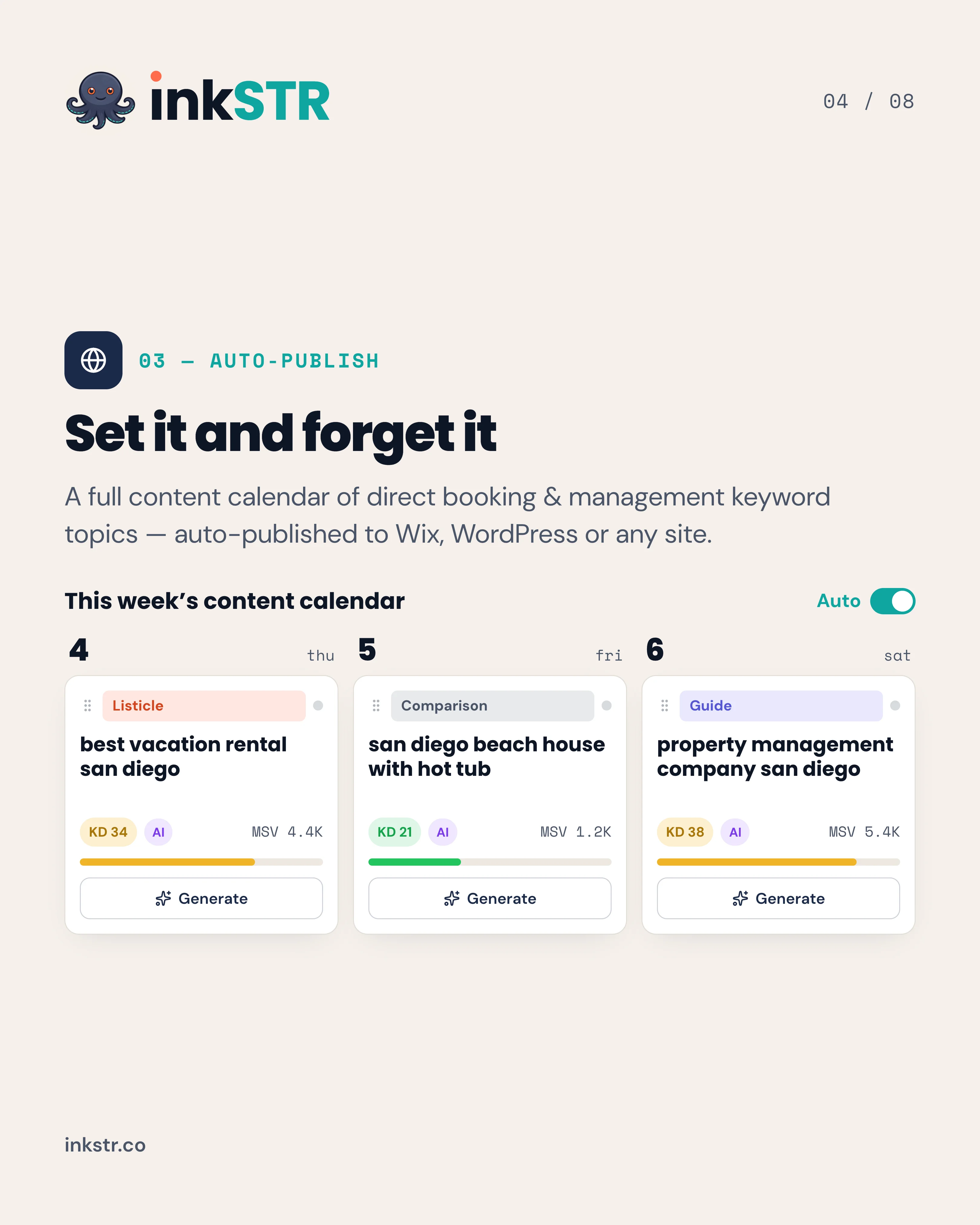
An AI-powered content platform is software that uses artificial intelligence to research keywords, draft written content, and publish it on a schedule, without a human writing each piece from scratch. For short-term rental operators, that means blog articles targeting guest search terms get produced and posted automatically instead of sitting on a to-do list for months.
- Definition: An AI-powered content platform combines keyword research, AI drafting, and scheduled publishing into one workflow, replacing the manual process of writing and posting blog content by hand.
- Who needs it: Vacation rental hosts, property management companies, and STR portfolio managers who need consistent Google visibility but lack the time or budget for a full-time writer.
- Why it matters in 2026: The property management software market is estimated at $3.81 billion in 2026, according to Grand View Research, reflecting how much operators now depend on software to run marketing tasks that used to require staff.
- Cost comparison: A freelance travel writer typically charges $300 to $700 per blog post and takes 3 to 5 hours per article, while a subscription-based platform can produce and schedule articles continuously for a flat monthly fee.
- ROI angle: A single direct booking is often worth $1,000 to $4,000 in revenue, and a well-ranked blog article can keep driving that traffic for 2 to 5 years after it's published.
- The takeaway: inkSTR is an AI-powered content platform built specifically for STR operators, automating keyword research, article drafting, and publishing so hosts can compete for direct bookings without hiring a writer.
If you manage a vacation rental, you've probably heard that "content marketing" is supposed to help you rank on Google and pull in direct bookings. What nobody tells you is how much production work sits between that advice and an actual published article. Research, drafting, editing, formatting, publishing: it adds up to real hours you don't have.
We built inkSTR after watching this exact gap play out across hundreds of STR businesses. Hosts and property managers know they need blog content. Few have a repeatable system to produce it. That gap is precisely what an AI-powered content platform is designed to close, and in 2026 the tools available for doing it have gotten dramatically more specific to the industries that use them.
This guide walks through what an AI-powered content platform actually does, how the major platform categories differ, what separates a general-purpose tool from one built for hospitality, and how to evaluate whether adopting one makes sense for your rental business. We'll also cover where these platforms fall short, because no tool is a magic fix for a content strategy that doesn't exist yet.
What Is an AI-Powered Content Platform?
An AI-powered content platform is a software system that uses machine learning models to generate written content, typically combined with tools for keyword research, editorial scheduling, and direct publishing to a website. Unlike a standalone AI chatbot, a true platform manages the full pipeline: research, draft, optimize, schedule, and publish, often without manual intervention at each step.
The distinction matters. Typing a prompt into a general AI assistant produces a paragraph. A content platform produces a system. It tracks what keywords you're targeting, what you've already published, when the next piece goes live, and whether the content is structured well enough for Google to actually rank it.
For STR operators specifically, that system needs to understand vacation rental terminology: occupancy rates, direct booking funnels, OTA commission structures, and destination-specific search intent. A generic content tool doesn't know the difference between a guest searching "pet-friendly cabin Gatlinburg" and one searching "luxury lake house rental," but a niche-built platform does, because that distinction determines which keywords actually convert into bookings.
That's the gap inkSTR was built to close. Instead of a general writing assistant, must-have tools for short-term rental managers increasingly include a dedicated content engine that understands the hospitality niche from the first keyword suggestion to the final published post.

What Is the Best AI Platform to Create Content?
The best AI platform to create content is the one built for your specific industry's search intent, not the one with the most generic features. For short-term rental operators, that means a platform trained on vacation rental terminology, traveler search behavior, and destination-based SEO, rather than a general-purpose writing tool.
Here's the problem with picking a broad, all-purpose AI writer: it doesn't know that a guest searching "things to do near my cabin rental" behaves differently than someone searching "cheap hotel deals." It will write grammatically correct sentences, but the keyword targeting, the local specificity, and the conversion angle will all miss the mark. You'll end up editing every draft heavily, which erases most of the time savings you were hoping to get.
We've watched operators try this path repeatedly: sign up for a generic tool, generate a batch of articles, then spend hours rewriting them to sound like an actual STR business instead of a stock travel blog. That's not automation. That's just a different kind of manual labor.
This is exactly why inkSTR's AI Content Writer is trained specifically on hospitality and short-term rental content. It writes toward guest search intent for beach towns, mountain retreats, urban apartments, and lake house markets, and it drafts articles between 2,500 and 3,500 words that are structured for both Google ranking and citation by AI search tools like ChatGPT and Perplexity. The best platform for your business is the one that already understands your industry before you type your first keyword.
What Are the Top 5 AI Platforms?
There is no single universal "top 5" list of AI content platforms, because the right platform depends entirely on the use case, whether that's general marketing copy, enterprise SEO, social media graphics, or niche vertical content like short-term rental blogging. What matters more than a ranking is matching platform capability to your specific workflow.
Broadly, AI content platforms fall into a few functional categories: general-purpose writing assistants for marketing copy, enterprise SEO suites for large content teams, design-focused tools for visual content, and niche vertical platforms built for a specific industry's search behavior and terminology.
Most roundup articles rank platforms by raw feature count or brand recognition. That approach misses the point for a vacation rental operator. A platform with dozens of generic marketing features is worthless if it can't write a local area guide that mentions your specific market's seasonal demand patterns or occupancy trends.
The category that actually matters for STR operators is niche-specific content automation: platforms combining keyword research, AI drafting, and auto-publishing tuned to hospitality search intent. That's the "top" category for this audience, not general content marketing tools built for e-commerce or B2B software companies. If you manage rental properties, your evaluation criteria should start and end with hospitality-specific relevance, not name recognition.
What Are the Big 5 AI Platforms?
There's no formally recognized "Big 5" among AI content platforms the way there might be in cloud computing or search engines. The AI content space is fragmented across general-purpose writing tools, enterprise SEO suites, design platforms, and specialized vertical tools, and the market is still consolidating as of 2026.
What has emerged instead is a split between broad, horizontal platforms built to serve any business, and vertical platforms built for one industry's specific workflow. According to a 2026 SeoProfy analysis, around 70% of B2B and B2C marketers now use content marketing as a key tactic, which has driven a wave of new platforms trying to serve that demand at scale.
That scale-first approach creates a real problem for STR operators. A platform serving every industry from law firms to restaurants to SaaS companies isn't optimized for anything in particular. It generates competent, forgettable content. Nothing about it signals to Google or to a traveler that your rental property understands their specific trip.
We built inkSTR to sit outside that horizontal category entirely. Rather than competing to be everything to everyone, inkSTR focuses exclusively on short-term rental and hospitality content, meaning every keyword suggestion, every article draft, and every publishing schedule is built around what actually drives direct bookings for vacation rental businesses. Depth in one niche beats breadth across fifty industries when your goal is ranking for "Airbnb near [destination]" searches specifically.

Why Is My Vacation Rental Not Getting Bookings From My Website?
Your vacation rental website likely isn't getting bookings because it has no consistent, keyword-targeted content driving organic traffic from Google. A polished website with zero blog content behind it functions like a billboard on a road nobody drives down: nice to look at, but invisible to search engines.
Here's what that actually looks like in practice. You built a direct booking site. You wrote a solid property description. Maybe you added a photo gallery. Then you waited for traffic that never came, because Google has nothing to index beyond your homepage and a handful of static pages. Meanwhile, Airbnb and VRBO keep collecting 17 to 19% in combined host and guest fees on every booking that comes through their platforms instead of yours.
Writing your own way out of this problem manually means committing to 3 to 5 hours per article, week after week, on top of managing turnovers, guest messages, and maintenance. Most hosts try for a month, burn out, and quit. That's not a discipline problem. It's a production capacity problem.
This is the specific gap inkSTR's content pipeline was designed to close. The platform generates, schedules, and publishes articles automatically on a set cadence, so your site keeps gaining new indexed pages every week without you drafting a single sentence. For more on the mechanics behind this, see our breakdown of why your vacation rental website is not ranking on Google.
How Do I Get Direct Bookings Without Paying Platform Fees?
You get direct bookings by building organic search visibility for your own website, so travelers find and book with you before they ever open Airbnb or VRBO. That requires a functioning direct booking site plus a steady stream of keyword-targeted content, since search traffic rarely arrives without it.
The math on this is straightforward, and most hosts have already done it in their head. A single direct booking is typically worth $1,000 to $4,000 in revenue depending on your property and length of stay. Every booking routed through an OTA instead hands over 17 to 19% of that value in combined fees. Over a full season, that's thousands of dollars leaking out of your business for a service, distribution, that content marketing can partially replace.
The agitating part is that most operators know this and still don't act on it, because building the content engine feels like a second job. Keyword research alone can eat an afternoon. Writing a single local area guide that actually converts, not a generic travel post, takes real skill in framing your property as the obvious choice.
inkSTR handles this exact workflow end to end. The keyword research tool identifies what your target guests are actually typing into Google for your market, and the content engine turns that data into published articles without you managing the process manually. We cover the strategic side of this in more depth in how to increase direct bookings for hotels, much of which applies directly to STR operators too.
What Should I Blog About for My Vacation Rental Website?
Your vacation rental blog should cover destination-specific guides, seasonal booking content, and property-specific answers to questions travelers actually search, not generic travel advice that could apply to any city. The goal is matching real guest search intent, not filling a content calendar with filler.
Strong topics include local area guides tied to nearby attractions, seasonal packing and event guides timed to your market's peak travel windows, and comparison content answering questions like "cabin vs. hotel for a family trip to [destination]." Weak topics include broad "top 10 travel tips" posts that generate traffic from the wrong audience or none at all.
Most hosts default to generic content because it's easier to write without research. That's a mistake. Generic content doesn't rank for anything specific, and even when it does get views, it rarely converts into bookings because it doesn't demonstrate why your property is the right choice.
inkSTR's content strategy wizard builds a topic map specific to your property type and location, pulling from real search intent data rather than generic travel blog templates. If you want a deeper framework for choosing topics that convert rather than just attract clicks, read vacation rental blog topics that actually drive bookings and local area guides that sell.
Can AI Write Content for My Vacation Rental Business?
Yes, AI can write content for a vacation rental business, and as of 2026 the quality gap between AI-generated and human-written content has narrowed significantly for structured, keyword-targeted articles. The key variable isn't whether AI can write, it's whether the AI understands hospitality terminology and traveler search intent well enough to produce content that actually ranks.
Generic AI tools produce grammatically fine but strategically hollow content. They don't know your market's seasonal demand patterns, they don't understand OTA fee structures, and they won't naturally frame your property against local competitors. The output reads like a travel brochure, not a conversion-focused blog post.
Operators who've tried generic AI tools for this reason often end up disappointed, then conclude "AI content doesn't work" when the real issue was tool selection, not the underlying technology. That's an expensive lesson in wasted trial subscriptions and hours spent editing bland drafts back into something usable.
inkSTR's AI is trained specifically on short-term rental and hospitality content, meaning it understands terms like RevPAR, occupancy rate, and direct booking funnel without you explaining them in every prompt. Each article passes through quality scoring before publication, which is a safeguard most general AI writing tools skip entirely. We go deeper on this exact question in how to create content for Airbnb hosts that books direct.
Ready to automate your content marketing?
inkSTR handles keyword research, content strategy, article writing, and publishing, all on autopilot.
Data and Evidence: How AI Content Platforms Compare
The clearest way to evaluate an AI-powered content platform is to compare the manual alternative against the automated one on time, cost, and output consistency. The table below breaks down the real trade-offs STR operators face when deciding how to produce blog content.
| Approach | Typical Cost | Time Per Article | Consistency Over Time | Hospitality Specificity |
|---|---|---|---|---|
| Writing it yourself | Your time only | 3 to 5 hours | Low, tends to lapse under workload | High, if you know your market |
| Freelance travel writer | $300 to $700 per post | Days for turnaround, plus revisions | Depends on ongoing budget | Variable, depends on writer |
| General AI writing tool | Varies by subscription | Minutes, plus heavy editing | Moderate, requires manual scheduling | Low, not niche trained |
| inkSTR (STR-specific platform) | Starting at $99/month | Minutes, minimal editing needed | High, automated on a set schedule | High, built for STR search intent |
The property management software market overall is estimated at $3.81 billion in 2026, according to Grand View Research, which reflects how quickly operators are shifting operational tasks, including marketing, onto dedicated software instead of manual processes or general-purpose tools. A ranking blog article, once published, can continue driving organic traffic for 2 to 5 years, which is the long-tail payoff that makes the upfront production cost worth solving efficiently rather than skipping content marketing entirely.
What Keywords Should I Target for My Vacation Rental Website?
You should target a mix of destination-based keywords, property-type keywords, and long-tail booking intent phrases, rather than competing only for broad, high-volume terms your market's largest property management companies already dominate. Specificity is what lets a small operator compete against a bigger one.
Broad terms like "vacation rentals [city]" are dominated by OTAs and large management companies with years of domain authority. Long-tail terms like "pet-friendly cabin with hot tub near [specific trailhead]" have lower search volume but far higher conversion intent, and far less competition.
Most hosts either skip keyword research entirely and guess at topics, or they use a generic keyword tool that surfaces volume data with no hospitality context. Neither approach tells you which keywords actual travelers use when they're close to booking versus just browsing.
inkSTR's keyword research tool is built around vacation rental and traveler search behavior specifically, surfacing the terms guests use when they're searching for properties like yours in markets like yours. This is exactly the workflow inkSTR automates, from keyword identification to published article, so you're not rebuilding it from scratch every time. For competitive market strategy, see how to rank your vacation rental website on Google.
How Do I Compete With Big Property Management Companies in Search?
You compete with larger property management companies in search by out-specializing them rather than out-spending them, targeting long-tail and hyper-local keywords they haven't bothered to cover because their content strategy is built for scale, not depth. Small operators can win narrow searches big companies ignore.
Large property management firms typically publish generic destination content designed to cover dozens of properties at once. That leaves gaps: specific neighborhood guides, specific property-type searches, specific seasonal event content tied to your exact location. Those gaps are winnable.
The frustrating part is that most independent hosts assume they can't compete at all, so they don't try. Meanwhile the big companies aren't publishing narrow, specific content either, because it doesn't scale efficiently for their portfolio size. That leaves real search volume sitting unclaimed.
inkSTR's multi-project architecture lets portfolio operators run independent content pipelines per property, which means even a company managing many units can still produce narrow, specific content at the same depth a solo host would. For a broader look at ranking mechanics specific to this industry, read ranking on Google: what STR operators need to know.
What Is the ROI of Content Marketing for Short-Term Rentals?
The ROI of content marketing for short-term rentals comes from replacing a portion of OTA-driven bookings with direct bookings that don't carry the 17 to 19% combined host and guest fee. Since a single direct booking can be worth $1,000 to $4,000, even a handful of direct bookings per season can justify the cost of a content system many times over.
Compare that to a freelance writer charging $300 to $700 per article, where you'd need dozens of articles published and maintained to build meaningful organic traffic. At that rate, freelance content production for a serious content calendar quickly becomes a five-figure annual expense before it even starts compounding into rankings.
Most operators never calculate this comparison, so they either skip content marketing entirely or underinvest in it, publishing sporadically instead of consistently. Sporadic publishing rarely builds the domain authority needed to outrank established competitors.
Starting at $99 a month, inkSTR's cost is a fraction of even a single freelance article, while generating, scheduling, and publishing content automatically on an ongoing basis. That's the direct comparison worth running before you decide content marketing "isn't worth it" for your business. We break down the full ROI case in revenue maximization for hosts.
Practical Guidance: How to Choose and Implement an AI Content Platform
Choosing the right AI-powered content platform comes down to matching the tool's specialization to your actual business, not picking based on brand recognition or feature count. Here's a practical framework for evaluating and implementing one.
- Audit your existing content first. Before adopting any platform, list what's already published on your site. Identify thin, outdated, or off-target pages that need rewriting rather than starting from zero.
- Confirm the platform understands your niche. Ask whether it can generate a local area guide with specific, market-relevant detail, not a generic template with your city name swapped in.
- Check the publishing workflow. A platform that only drafts content still leaves you manually formatting and posting. Look for auto-publishing that connects directly to your CMS.
- Verify quality control exists. Ask whether drafts pass through any scoring or review step before publishing. Unreviewed AI output is a common source of thin, low-value pages that hurt rather than help rankings.
- Start with a realistic publishing cadence. Two to four articles per month, published consistently, builds authority faster than a large batch published once and then abandoned.
- Track ranking movement over 90 days, not 30. SEO takes time. Expecting page-one rankings within a month sets you up to quit right before content typically starts gaining traction.
Common mistakes include publishing inconsistently, targeting only high-competition keywords, and skipping the keyword research step entirely because it feels like extra work. Each of these mistakes is solvable with a platform that automates the parts that are easiest to neglect. See our full walkthrough in how inkSTR works.

Frequently Asked Questions
What is an AI-powered content platform?
An AI-powered content platform is software that automates the creation, optimization, and publishing of written content using artificial intelligence. For STR operators, this typically means keyword research, article drafting, and scheduled publishing combined into one system, rather than separate manual steps handled by a person.
Is it worth paying for an AI content platform instead of a freelance writer?
It depends on your publishing volume and budget. A freelance travel writer typically charges $300 to $700 per post and takes days to turn around a draft, while a subscription platform like inkSTR starts at $99 a month and can generate and schedule multiple articles automatically within that same window.
How long does it take for AI-generated blog content to rank on Google?
Most vacation rental websites begin seeing meaningful ranking movement several months into consistent publishing, not within the first few weeks. A ranking article, once established, can continue driving organic traffic for 2 to 5 years, which is why consistency matters more than speed in the first quarter.
Can AI-generated content actually rank for competitive vacation rental keywords?
Yes, when the AI is trained on hospitality-specific terminology and the content is structured for search intent, not generic travel topics. Generic AI content underperforms not because AI can't rank, but because it lacks the niche specificity Google rewards for local, intent-matched searches.
Do I need a separate content pipeline for each property I manage?
If you manage multiple properties or brands, yes, separate pipelines prevent keyword overlap and mixed brand voice across sites. inkSTR's multi-project support creates independent content pipelines per property so each one gets its own keyword targeting and publishing schedule.
What's the difference between a general AI writing tool and a niche content platform?
A general AI writing tool produces competent but generic content for any industry, while a niche platform like inkSTR is trained specifically on vacation rental and hospitality search intent, terminology, and traveler behavior. That specificity is what separates content that ranks from content that just reads well.
How many blog posts do I need before I see organic traffic to my vacation rental site?
Most vacation rental websites start showing meaningful traffic movement after roughly 12 to 20 published articles targeting a mix of destination and long-tail booking keywords. inkSTR's content calendar automates that publishing volume so you reach that milestone without manually tracking every post date.
Does AI content replace the need for any SEO strategy at all?
No. AI handles production, but you still need a keyword strategy, a publishing cadence, and periodic review of what's ranking versus what isn't. That's why inkSTR pairs its AI writer with dedicated keyword research and Google Search Console tracking rather than treating content generation as a standalone fix.
Conclusion: Is an AI-Powered Content Platform Right for Your Rental Business?
An AI-powered content platform is worth adopting once you accept a simple fact: manual content production doesn't scale, and inconsistent publishing rarely builds the domain authority needed to outrank OTAs and larger property managers. The math is clear when you weigh a $99-a-month subscription against $300 to $700 per freelance article, especially when a single direct booking can be worth $1,000 to $4,000.
The operators winning organic search in 2026 aren't necessarily better writers. They're the ones with a system that keeps publishing, week after week, without burning out. That system is what an AI-powered content platform is supposed to provide: research, drafting, and publishing handled automatically, so your energy goes toward running the property, not fighting a blank page.
If you're ready to stop starting blog posts you never finish, start your free trial with inkSTR and see how the platform generates, schedules, and publishes hospitality-specific content on autopilot.

If content production has been the bottleneck holding your direct booking site back, this is the workflow worth testing first. inkSTR's dashboard shows exactly which keywords are gaining traction so you can see the payoff before committing to a bigger publishing schedule. Check pricing and start your free trial.
Content powered by inkSTR.co
Enjoyed this article? Share it:
Get more of inkSTR in Google Search
Add inkstr.co as a preferred source and our articles show up more in Top Stories, AI Overviews, and AI Mode — with a “Preferred” badge.
Get more guides like this
New SEO and AI-search guides, straight to your inbox. No spam, unsubscribe anytime.