Best SEO Tools for Small Property Management Companies
The best SEO tools for small property management companies start with free Google Search Console and Google Business Profile, then add one keyword research tool, a local rank tracker, and a content engine such as inkSTR that publishes owner-focused articles on a schedule. Buy a paid tool only when a free one runs out of road.
Key Takeaways
- Google Search Console, Google Business Profile, and Google Analytics 4 cover the free baseline; no paid suite replaces them.
- Property management software and SEO tools do different jobs. Software runs operations; SEO tools bring owner and guest inquiries through Google.
- Owner-acquisition keywords and guest or tenant keywords need separate pages, and mixing them is the most common small-firm mistake.
- A freelance writer charges $300-$700 per quality post, and writing one manually takes 3-5 hours, so content production is usually the real bottleneck.
- A 30-day setup plan (audit, local profile, keyword map, first published articles) gets a small firm tracking leads before it spends on agencies.
- inkSTR costs $99/month and automates keyword research, article drafting, scheduling, and publishing to Wix or WordPress for short-term rental and property management sites.
You manage a handful of doors, maybe a few dozen, and your website looks fine but never shows up when an owner searches for a manager in your town. Meanwhile every SEO tool vendor claims to be the one you need, and most roundups mix SEO tools with property management software as if they were the same purchase.
This guide separates them. It maps each SEO job (keywords, local visibility, tracking, audits, reviews, content) to a tool category, tells you what to start with for free, and flags the signal that justifies paying. At inkSTR, we build content automation for short-term rental operators and property managers, so we see where small firms stall in 2026: not at tool selection, but at publishing consistently.
What Are the Best SEO Tools for Small Property Management Companies?
The best SEO stack for a small property management company has five layers: a free Google baseline, a keyword research tool, a local visibility tracker, a site crawler, and a content publishing engine. You add layers in that order, and only when the previous one is producing data you can act on.
The pain is predictable. You sign up for a full SEO suite, stare at dashboards with hundreds of metrics, and never publish anything. The subscription renews and your rankings stay where they were.
| SEO job | Start with | Add when | Cost note |
|---|---|---|---|
| Lead tracking | Google Analytics 4 | Always on | Free |
| Keyword research | inkSTR keyword research | Included | Included in $99/month |
| Local rank grids and citations | A local rank tracker | You target several service areas | Varies by plan |
| Technical audits | A site crawler | Pages stop getting indexed | Free tiers exist; paid varies |
| Content production and publishing | inkSTR | Always on | $99/month |
We built inkSTR to fill the row most firms skip: AI content generation plus scheduling and publishing, so the keyword plan actually becomes pages.

What Are Basic SEO Tools?
Basic SEO tools are the free, first-party Google products that show how search engines see your site: Google Search Console reports queries and indexing, Google Business Profile controls your map listing, and Google Analytics shows what visitors do after they arrive.
Small firms often skip them because they feel unglamorous. Then they pay for a rank tracker that reports positions for keywords nobody on their team chose on purpose. Without Search Console, you cannot see which real queries already bring impressions, so every new page is a guess.
Set up Search Console first and let it collect data for a few weeks. Look at the queries report for phrases that include your city plus words like "property management" or "vacation rental management." Those are your proof of demand, and they cost nothing.
Our Google Search Console integration inside inkSTR reads that same data and flags keyword opportunities, so you do not need to export spreadsheets to decide what to write next. For title and meta description checks before publishing, the free Google SERP Simulator shows how your snippet will truncate.
Which Keyword Research Tools Work for Property Management Keywords?
Keyword research tools for property management show what owners and guests type into Google and how often they type it. They also show how hard it is to rank. For small firms, the right tool is the one that separates owner-acquisition intent from guest and tenant intent, because the two audiences need different pages.
Here is the edge case most guides skip. A search like "property management fees in [your city]" comes from an owner who might hire you. A search like "how to contact my property manager" comes from a current resident. If you write one page for both, it satisfies neither. Your inquiry form stays empty.
Doing this by hand means a spreadsheet and a trial subscription. It also means hours of sorting queries by intent. Most small firms never finish.
That is why inkSTR runs keyword research inside the platform and pairs it with a brand audit that surfaces competitor keyword gaps. You get a plan built around your market, not a raw export. If you also run vacation rentals, our guide on how to rank your vacation rental website on Google covers the guest-side keywords in detail.
How Do You Rank in Google Maps and the Local Pack?
Local SEO for property managers means appearing in Google's map results and in city-specific searches. It depends on a complete Business Profile, consistent name, address, and phone details across directories, recent reviews, and service pages that name the neighborhoods you actually cover.
I will say plainly what many blog-first guides will not: for map-pack searches, your Google Business Profile usually matters more than your blog. A profile with the wrong category and a stale description loses to a competitor who simply keeps theirs current. Six old reviews do not help.
The manual route is tedious. You audit directory listings one by one, then ask owners for reviews in awkward emails. Rank grid trackers help once you target several service areas, because they show where you appear block by block. For a single office and one city, Search Console and a monthly manual check are enough.
Where inkSTR fits is the organic side of local visibility. We draft neighborhood and city pages grounded in real property details, and our research on the local signals Google cares about in 2026 explains how those pages support your profile. Ask for reviews right after owner onboarding, when satisfaction peaks.
How Do You Do Digital Marketing for Real Estate Without an Agency?
Digital marketing for real estate and property management is a loop of search visibility, content that answers owner questions, and a clear path to an inquiry form. Small firms can run it in-house when content production is automated and the website, not a portal, is the destination.
The manual math is brutal. A freelance writer costs $300-$700 per quality post. Writing one yourself takes 3-5 hours of research and drafting. Skip it, and a larger competitor owns every owner-intent query in your market.
In one case, a Smoky Mountains cabin rental management company running a continuous inkSTR content pipeline grew monthly Google Search clicks from 788 to 5,730 over 13 months, measured in Google Search Console. The method was pillar-and-cluster articles grounded in real property data, published on a steady cadence.
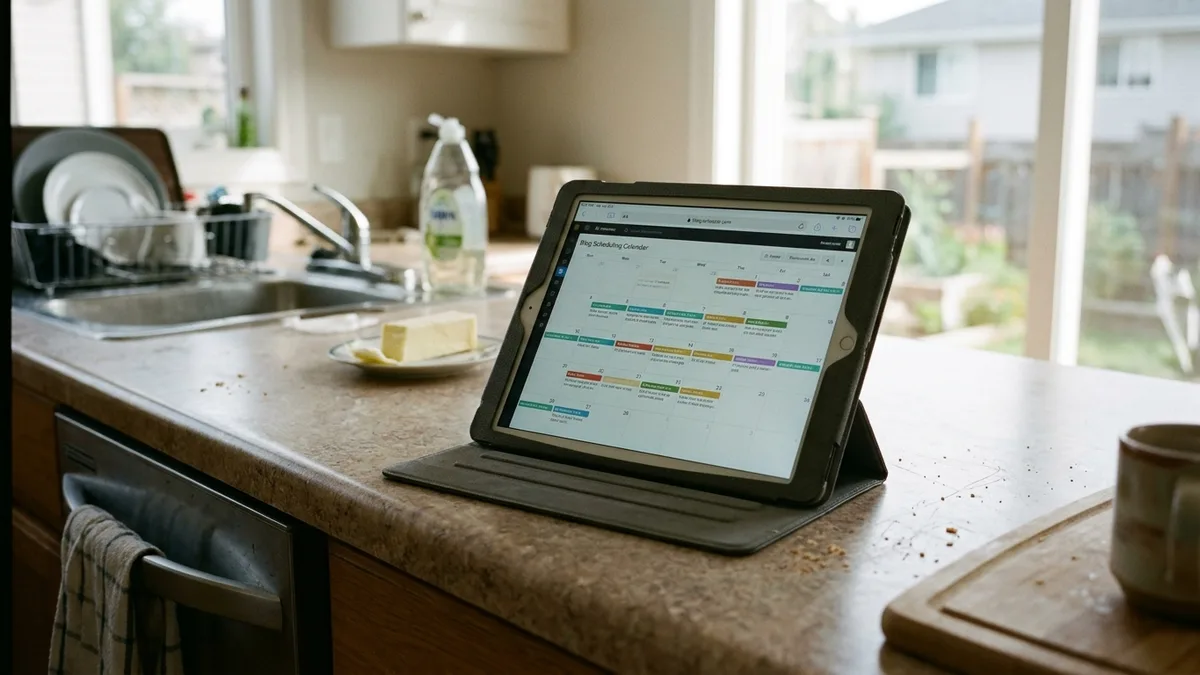
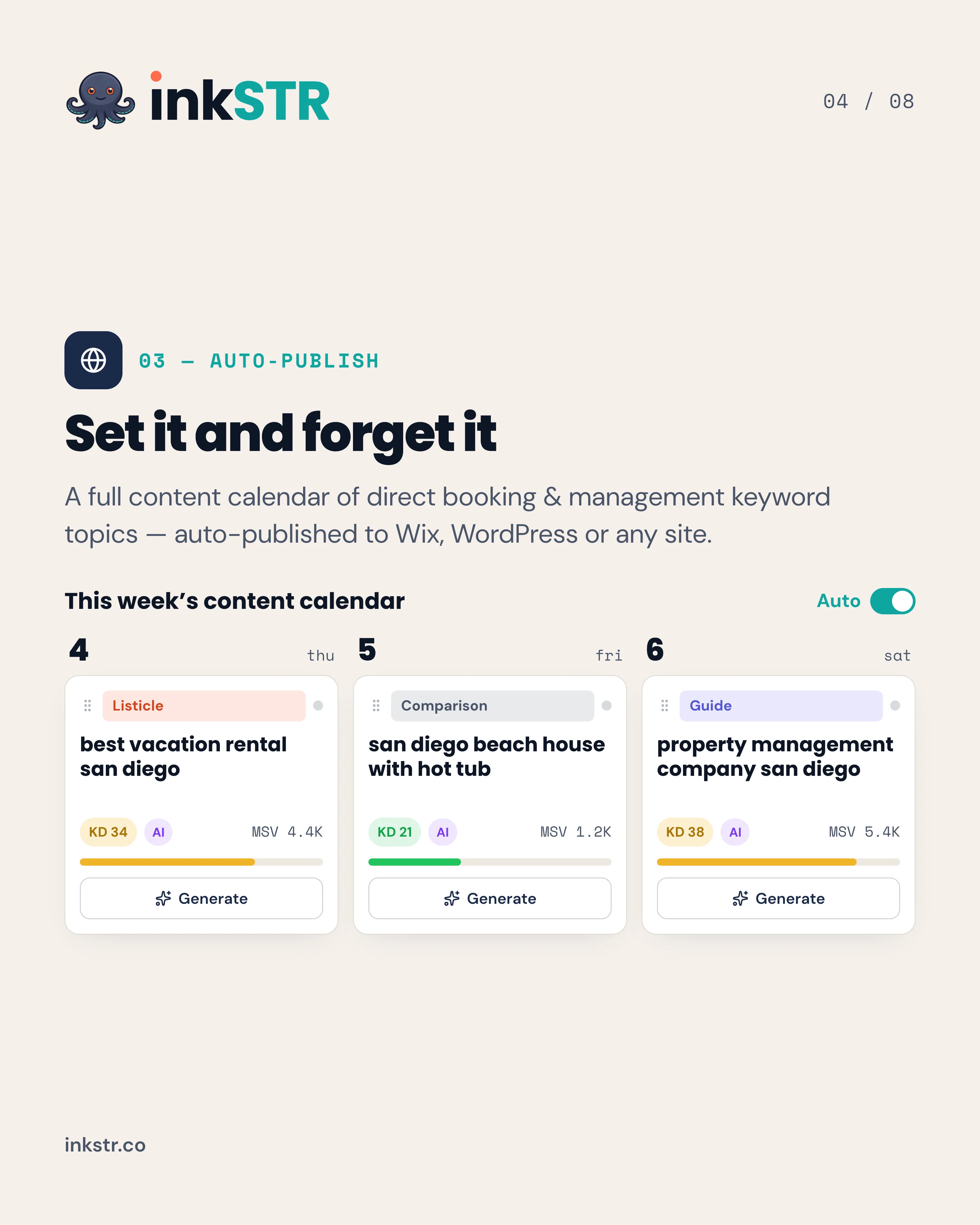
You can replicate the structure. Plan topics in the content calendar, and let auto-publishing push finished posts to WordPress or Wix on schedule. As of November 2026, inkSTR has secured more than 1,700 verified AI-search citations for customer content, which matters because owners now ask ChatGPT and Perplexity who to hire. If direct inquiries are the goal, our direct bookings page shows how content connects to your own booking or inquiry path.
What Is a Good Property Management App, and How Is It Different From SEO Tools?
A property management app is operational software for reservations and owner statements. It also handles messaging and payments. An SEO tool is a marketing product that helps strangers find you on Google. Confusing the two is how small firms overspend on the wrong category.
The software side is well established. In a November 2026 survey of 554 hosts, 89.9% said property management software is an essential tool, and 71.3% said the same of dynamic pricing tools (Hospitable, 2026). That is why top-ranking roundups bury you in software comparisons.
But no property management app writes owner-facing articles or tracks local rankings. None of them publishes a blog either. You can run a flawless back office and still get zero organic leads.
The two categories should connect. inkSTR integrates with Hospitable and OwnerRez to pull reviews and photos into content, along with guest data. Articles then reference real properties instead of generic filler. For a wider view of the operations side, see our roundup of must-have tools for short-term rental managers scaling up.
Ready to automate your content marketing?
inkSTR handles keyword research, content strategy, article writing, and publishing, all on autopilot.
Is SEO Worth It for a Small Business Like Yours?
SEO is worth it for a small property management company when one new owner or one direct booking pays for months of effort. It is slow, though. Expect months, not days, before new pages earn steady traffic, and no tool can guarantee a ranking.
The economics favor patience. A single direct vacation rental booking is typically worth $1,000 to $4,000 in revenue. Airbnb host and guest fees combined take 17-19% of every booking. A ranking article can drive organic traffic for 2-5 years, while a paid ad stops the day you stop paying.
The risk is quitting at month three. Most firms publish six posts and see nothing. They abandon the effort just before the compounding starts.
That is the argument for automation. A Charlotte and Lake Norman management company started inkSTR at the end of April 2026. In its first month, four property-owner leads arrived from AI search. They were tracked in Google Search Console and its own lead records. Results vary, and we never promise them. You can review pricing before committing, and our guide on ranking on Google for STR operators explains realistic timelines.
What Does a 30-Day SEO Setup Plan Look Like for a Small Firm?
A 30-day SEO setup plan sequences the free baseline and a keyword map. The first published articles follow, so you have tracking in place before you spend on anything else. It fits a team of one to ten people.
Without a plan, small firms bounce between tools and publish nothing. Week four arrives with logins everywhere and no new pages.
- Week one, baseline: verify Search Console, set up Google Analytics 4 with a form-submission conversion, and claim or clean up your Business Profile.
- Week two, keyword map: list owner-intent queries and resident-intent queries separately, and assign each to one page.
- Week three, first content: publish service pages for each city or neighborhood you cover, plus two owner-question articles.
- Week four, review and scale: check Search Console for impressions, request reviews from recent owners, and schedule the next month of posts.
We designed the inkSTR workflow to compress weeks two through four. You choose topics from the keyword plan, drag articles onto dates in the content calendar, and publishing happens without further steps. When you are ready, start here.
When Should You Hire an SEO Agency Instead of Using Tools?
Hire an SEO agency when your problems are technical or competitive beyond what tools and steady content can fix, such as site migrations or penalties. Large-scale link building and several markets at once also qualify. For most one-office firms, tools plus consistent publishing come first.
An agency retainer buys strategy and labor, and much of that labor is writing. If you pay a freelancer $300-$700 per post and publish four posts a month, you are spending several times the cost of a content platform before any strategic work begins.
The honest limit of inkSTR is scope. It automates keyword research and drafting, as well as scheduling and publishing. It does not replace a developer fixing a broken site or a PR person earning high-end editorial links. Many firms use the platform for content and add a specialist only for those gaps.
Our property management page outlines how firms run content in-house at $99/month. Compare that figure against an agency quote before you decide, and ask any agency to show Search Console results, not just ranking screenshots.
How Do You Measure Owner and Tenant Leads From Organic Search?
Measuring SEO ROI means connecting search data to inquiries. Search Console shows impressions and clicks. Google Analytics 4 shows which pages lead to a form submission or call. Your own records show which inquiries became signed owners.
Most small firms track only rankings. A page can sit in a high position and produce no owner calls, and a modest page can produce three. Without lead attribution, you cannot tell which is which.
Run a simple monthly routine. First, export the top pages by clicks from Search Console. Second, check conversions per page in Analytics. Third, ask every new owner how they found you, and log the answer. Add one more check as AI search grows: ask ChatGPT or Perplexity who manages rentals in your area and note whether you appear.
inkSTR tracks keyword performance through its Search Console integration. It also builds articles for citation in AI Overviews and ChatGPT, as well as Perplexity. Our guide to ranking in AI search covers that side in more depth.
Frequently Asked Questions
What property management system is best for handling high booking volumes?
Look for a system with reliable channel syncing and automated guest messaging. Calendar rules that prevent double bookings matter too. The right pick depends on your portfolio and channel mix, so test a trial with your real calendars. Whichever you choose, keep SEO separate: inkSTR handles the content that drives direct inquiries.
What is the best property management system for integrating with multiple booking channels?
Prioritize a system with direct two-way connections to Airbnb and VRBO, as well as Booking.com, rather than manual calendar exports. Ask how quickly it updates rates and availability across channels. Whatever PMS you use, a content-driven website gives you a booking path that avoids channel fees entirely.
Is there an all-in-one property management software that supports dynamic pricing?
Yes, several platforms bundle reservations and messaging. Pricing recommendations come in the same package. In a 2026 Hospitable report, 71.3% of surveyed hosts called dynamic pricing tools essential. All-in-one software rarely includes blog publishing or local SEO, so pair it with a content tool.
Which Airbnb management tools suit hosts adding VRBO and Booking.com?
Choose tools with multi-channel calendar syncing and unified messaging so you do not manage three inboxes. Check that reviews and photos can be pulled into your own site. inkSTR connects with Hospitable and OwnerRez to ground your articles in that real guest data.
What are the best niche rental platforms for a lake or cabin property?
Niche platforms can help, but each one adds fees and dependence on someone else's traffic. Your own website, ranked for lake and cabin searches, is the one channel you control. Our vacation rental blog topics guide shows what to publish.
What property management tools offer the best guest portal features?
Compare portals on check-in instructions and document handling. Messaging history and mobile experience matter as well. Ask for a demo using your real workflow instead of a sample property. Portal quality affects retention, while SEO affects how new owners and guests find you.
How long does SEO take to generate leads for a property management company?
Expect months rather than days, and consistent publishing is the main lever you control. Early signals show up as rising impressions in Google Search Console before clicks and inquiries follow. No tool, including inkSTR, can guarantee a specific ranking date.
Conclusion
The best SEO tools for small property management companies are a short, staged stack. It starts with free Google tools, then one keyword tool. Add a local tracker once you cover several areas. Finish with a content engine that keeps publishing. Keep property management software in its own lane, and measure success in owner inquiries, not rank screenshots.
Your next step is the 30-day plan above. Verify Search Console this week, split owner intent from resident intent, and schedule your first month of articles. As search shifts further toward AI answers through 2026 and beyond, consistent, well-structured content is what keeps a small firm visible.
If you want weeks of owner-focused content planned, drafted, and published without writing every post yourself, Start Free Trial with inkSTR. The content calendar and one-click publishing to Wix or WordPress let you schedule a month of articles in a single sitting, at $99/month after your trial.
Content powered by inkSTR.co
Enjoyed this article? Share it:
Get more of inkSTR in Google Search
Add inkstr.co as a preferred source and our articles show up more in Top Stories, AI Overviews, and AI Mode, with a “Preferred” badge.
Get more guides like this
New SEO and AI-search guides, straight to your inbox. No spam, unsubscribe anytime.