How to Compete With Airbnb in Google Search in 2026
You need a direct booking site Google can index, a verified business presence, and a steady blog that feeds those pages.
Key Takeaways
- You do not beat Airbnb head-on in Google; you win branded, long-tail, and location-plus-amenity queries where a marketplace page is a weak match.
- A direct booking site Google can crawl, with a connected booking engine, is the foundation; an Airbnb listing alone does not build a search asset you own.
- A single direct vacation rental booking is typically worth $1,000 to $4,000 in revenue, so a handful of ranking pages can pay for themselves quickly.
- One Smoky Mountains cabin brand grew monthly Google Search clicks from 788 to 5,730 in 13 months using a continuous inkSTR content pipeline.
- inkSTR automates keyword research, article drafting, scheduling, and publishing to Wix or WordPress so a small team can sustain the content Google rewards.
At inkSTR, we build AI content tools for short-term rental operators, and the question we hear most is how to get a website to earn bookings, not just views. In 2026 the answer starts with accepting where Airbnb is strong and where it is not.
Airbnb's domain carries enormous authority, and its city pages dominate generic searches. But Google queries come in thousands of narrower forms, and a marketplace cannot write a thoughtful page for every one of them. You can.
This guide walks through nine steps, in the order we would do them. Expect months, not days. Gains from this kind of work typically show up over a few months of consistent effort, so the lever you control is consistency.
Step 1: Why Is Google Hard to Win Against Airbnb, and Where Can You Win?
Your opening comes from three query types: your own brand name, location plus amenity or trip-need searches, and informational questions about the destination itself.
Most hosts publish a homepage and wait. Airbnb takes the first page. Meanwhile you keep paying 17-19% in combined host and guest fees on every reservation that comes through the platform.
Think about how a guest actually searches. Someone typing "pet-friendly cabin with hot tub near a trailhead" has a specific need, and a general marketplace page is a poor match. Your dedicated page is the better answer.
Here is a worked example of the commission math. Say your cabin earns $2,400 for a four-night stay. At the 17-19% combined fee range, that booking carries roughly $408 to $456 in fees. Book ten such stays a year through your own site instead, and you keep about $4,080 to $4,560 that would otherwise go to the platform. That is the budget you can put into content, and it is why a single ranking page for a query like "hot tub cabin near [trailhead]" can repay its cost within a season.
We built inkSTR's keyword research for exactly this gap. Instead of guessing which narrow searches are winnable, you get a plan built around your market and your competitors, then turn it into articles. A typical output is a list of 40 to 60 specific queries, each tagged with the page type that should answer it.

Step 2: How Does Google Vacation Rentals Work in 2026?
Google Vacation Rentals is a Google search experience that surfaces rental listings with prices and a link to book. Listings typically reach it through a connected channel manager or booking engine, not by a host filling out a simple form. A direct booking website can do the job too.
Many hosts assume that being on Airbnb means being on Google's rental results. That is not a safe assumption. Whether your property appears depends on the integrations your tools support, and it is separate from ordinary organic rankings for your website.
Check what your property management system or booking engine offers for Google connectivity, and confirm current eligibility requirements on Google's own help pages, since they change. Do this before spending on anything else.
A practical sequence: open your booking engine's integrations page and look for a Google Vacation Rentals or Google Hotels connection. Next, ask support whether your plan includes it or charges extra. Then confirm that your property data matches your website, including name, address, photos, and rates. Mismatched data is the most common reason a listing fails to appear. Finally, note the date you applied and check back in two weeks, since approval is not instant.
Treat it as one channel alongside organic search. A feed gets your inventory in front of searchers; your content earns the clicks that never touch a feed at all. inkSTR covers the content side, and its workflow from keyword to published post keeps that work moving while you sort out the technical connections.
Step 3: How Do You Build a Direct Booking Site Google Can Index?
A direct booking site is your own website with a booking engine connected to your calendar, so guests reserve without a marketplace in the middle. For Google, it needs crawlable pages, one page per property, and fast mobile loading. A sitemap submitted in Search Console completes the setup.
Each property page should carry the property name, city and neighborhood, a detailed description, nearby attractions with distances, guest reviews, and photos with descriptive alt text. Add rental schema markup where your platform supports it.
Prioritize in stages. First, get indexed, and confirm pages appear in Google Search Console. Second, fix conversion blockers such as slow mobile checkout. Third, expand content. Many small operators do this backwards and write blog posts for a site Google has not indexed.
To check indexing, type site:yourdomain.com into Google and count the results against your page list. If a property page is missing, open Search Console, paste the URL into the inspection bar, and request indexing. For a five-property site, this takes under 30 minutes and catches the problem before you write a single article.
Booking engines from several providers, including Hostaway, Lodgify, Guesty, and Hostfully, can power a direct site. Pick based on your calendar sync, because double bookings when you sell on Airbnb and direct will cost more than any tool saves.
Our guide to why a vacation rental website is not ranking covers the indexing problems we see most often, starting with blocked pages and duplicate titles.
Step 4: How Do You Set Up Google Business Profile for a Rental?
Google Business Profile is a free listing that shows your business in Google Search and Maps. It requires accurate details and eligibility, which matters for rentals: a company with a customer-facing office or service area often qualifies, while a single unstaffed property may not.
If you run a management company with a real office, claim and verify the profile, complete every field, and keep your name, address, and phone consistent everywhere. If you only own one cabin with no staffed location, check Google's current eligibility rules before investing effort, and lean on your website instead.
The setup runs in this order:
- Search for your business name in Google Maps to see whether a profile already exists, then claim it rather than creating a duplicate.
- Choose the primary category that matches your business, such as vacation home rental agency, since it drives which searches you appear for.
- Enter your service area or office address, and add your phone number and booking website URL.
- Complete verification, which Google usually handles by postcard, phone, or video, and expect it to take several days.
- Upload at least ten real photos, add your business hours, and write a description that names the towns you serve.
- Ask recent guests for reviews and reply to each one within a few days.
Skipping this step costs you the branded search. When someone searches your company name, you want the profile and your site showing, along with your reviews. A directory page that sends them to a competitor is the outcome to avoid.
Honestly, a profile matters less than your site for most single-property hosts. We would rather you spend that hour publishing a strong neighborhood page than perfecting a profile you may not qualify for.
Step 5: How Do You Target Keywords Airbnb Cannot Own?
Long-tail keywords are specific searches that combine a destination, property type, amenity, landmark, or trip need, such as "dog-friendly lake house with dock" or "cabin near [trailhead] for a weekend". These beat broad terms because competition is thinner and intent is clearer.
Here is a query-to-page mapping method competitors rarely explain. If a search names a specific property attribute, it deserves a property or amenity page. If it names a place or event, it deserves a neighborhood or area guide. If it asks a question, it deserves a blog article that links to the relevant booking page.
A worked example: a host with a three-bedroom cabin near Gatlinburg lists 20 queries. "Cabin with game room sleeps 8" maps to the property page. "Cabins near Cades Cove" maps to an area guide. "Best month to see fall color in the Smokies" maps to a blog article that links to the cabin's booking page. Each query gets exactly one target page, so your pages do not compete with each other.
Doing this manually means a spreadsheet, hours of competitor checking, and guessing. A freelance travel writer charges $300-$700 per quality post, so mapping fifty queries to fifty pages costs $15,000 to $35,000 at those rates.
That is why inkSTR runs keyword research and competitor analysis inside the platform, and the brand audit surfaces competitor keyword gaps. For ideas on what to cover, see our list of vacation rental blog topics that drive bookings.
| Search type | Example | Best page to build |
|---|---|---|
| Brand | Your company name | Homepage and Business Profile |
| Amenity plus place | Hot tub cabin near a trailhead | Property or amenity page |
| Trip need | Family reunion house for large groups | Landing page by property type |
| Question | Best time to visit in shoulder season | Blog article linking to booking page |
Step 6: How Do You Search for a Particular Airbnb, and Why Does It Matter?
To find a particular Airbnb in Google, guests usually search the property name plus the town, or paste a listing title. If your own site ranks for that same name, you capture guests who already know you and can book without the platform fee.
This is a branded search problem. Many hosts use a listing title on Airbnb and a different name on their own site, so Google cannot connect them. A guest who saw your cabin on a social post then finds only the marketplace page.
Use one consistent property name across your website and your Google presence. Your listings should match too. Put that name and the town in your page titles, and keep titles under roughly 60 characters with the main keyword near the start. For example, "Pine Ridge Cabin | Hot Tub Cabin in Gatlinburg" fits the limit and leads with the name.
We designed inkSTR's AI content writer to ground articles in real property details, so your name, location, and amenities appear consistently. That consistency helps both Google and AI assistants connect your pages to the property people are asking about.
Ready to automate your content marketing?
inkSTR handles keyword research, content strategy, article writing, and publishing, all on autopilot.
Step 7: Are Reviews and Ratings Like 4.75 Enough to Win Clicks?
Inconsistent descriptions raise doubts as well. In Google, review signals on your own site help you convert the visitors you earn, and trust cues do the same.
Guests commonly look for blurry or too few photos and no clear address area. They also notice unclear cancellation terms and reviews that do not match the description. Your site can answer each of these directly, which a standardized marketplace page cannot always do.
Show real guest reviews on property pages, include several photos per room plus exterior and shared areas, and write alt text that describes what is visible. Link your blog posts about local attractions straight to the relevant booking page. A concrete target: at least 20 photos per property, a plain-language cancellation policy above the booking button, and your three most recent reviews visible without scrolling.
If you use Hospitable or OwnerRez, inkSTR can pull reviews and photos into your content. It adds guest data too, so articles reflect real stays rather than generic copy. Our post on booking page conversion goes deeper on turning views into reservations.

Step 8: What Websites Compete With Airbnb, and Should You Use Them?
Websites that compete with Airbnb include Vrbo, Booking.com, and Expedia, plus metasearch tools such as Google Hotels, Trivago, and Kayak. They widen your reach, but each takes a commission, so they complement a direct site rather than replacing it.
Here is the trap. Hosts add channel after channel, then find their calendar and messaging scattered across five dashboards. Pricing is spread out there too. Each listing builds an asset on someone else's domain, not yours.
A better order: keep the OTAs you need for reach, but treat your website as the channel you own. Use a channel manager to sync calendars and prevent double bookings, and use the content on your site to pull repeat and referral guests away from fees.
| Channel | Who controls the audience | Fee impact | Search asset you own |
|---|---|---|---|
| Direct booking site | You | No marketplace commission | Yes |
For a deeper look at the economics, read our guide on direct bookings. The core idea fits in one sentence: every repeat guest who books on your site instead of a marketplace keeps roughly one fifth of the booking value in your pocket.
Step 9: How Do You Publish Consistently and Measure Results?
Consistent publishing means releasing search-targeted articles on a steady schedule so Google keeps finding fresh, relevant pages. Measure it in Google Search Console and Google Analytics, tracking clicks, impressions, and eventually completed direct bookings.
Writing one quality post manually takes 3-5 hours of research and writing. Do that weekly on top of guest messaging and the plan collapses by week three. We see this pattern constantly with operators who start strong and go quiet.
A ranking article can drive organic traffic for 2-5 years, which is why the effort compounds. In one case, a Smoky Mountains cabin rental brand grew monthly Google Search clicks from 788 to 5,730 in 13 months. It attributed $309,775 in direct booking revenue to this growth. The results were measured in Google Search Console and Google Analytics.
Another example: a five-market mountain rental brand went from 26 to 1,924 monthly Google search visits in four months after publishing 114 articles. Every figure there was measured in Wix Analytics and Search Console.
For your own tracking, check Search Console on the first of each month. Record total clicks, total impressions, and your top five queries in a simple sheet. Add a column for direct bookings and ask each guest how they found you. After three months, the sheet shows which article topics earn clicks and which earn reservations.
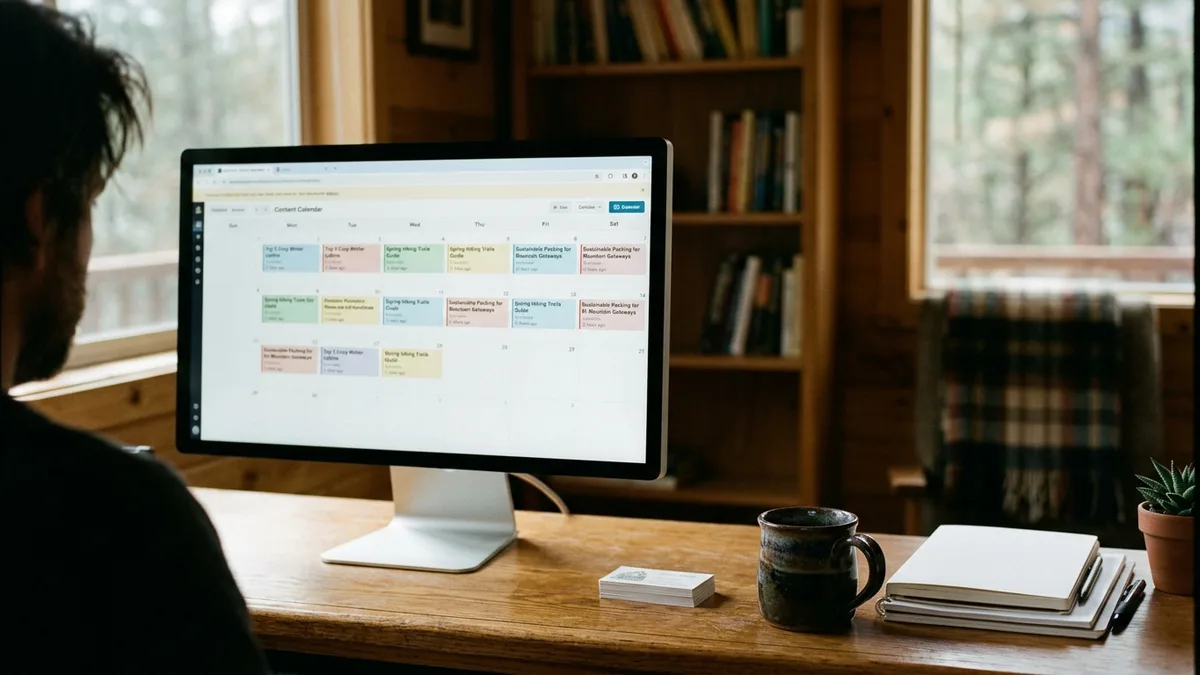
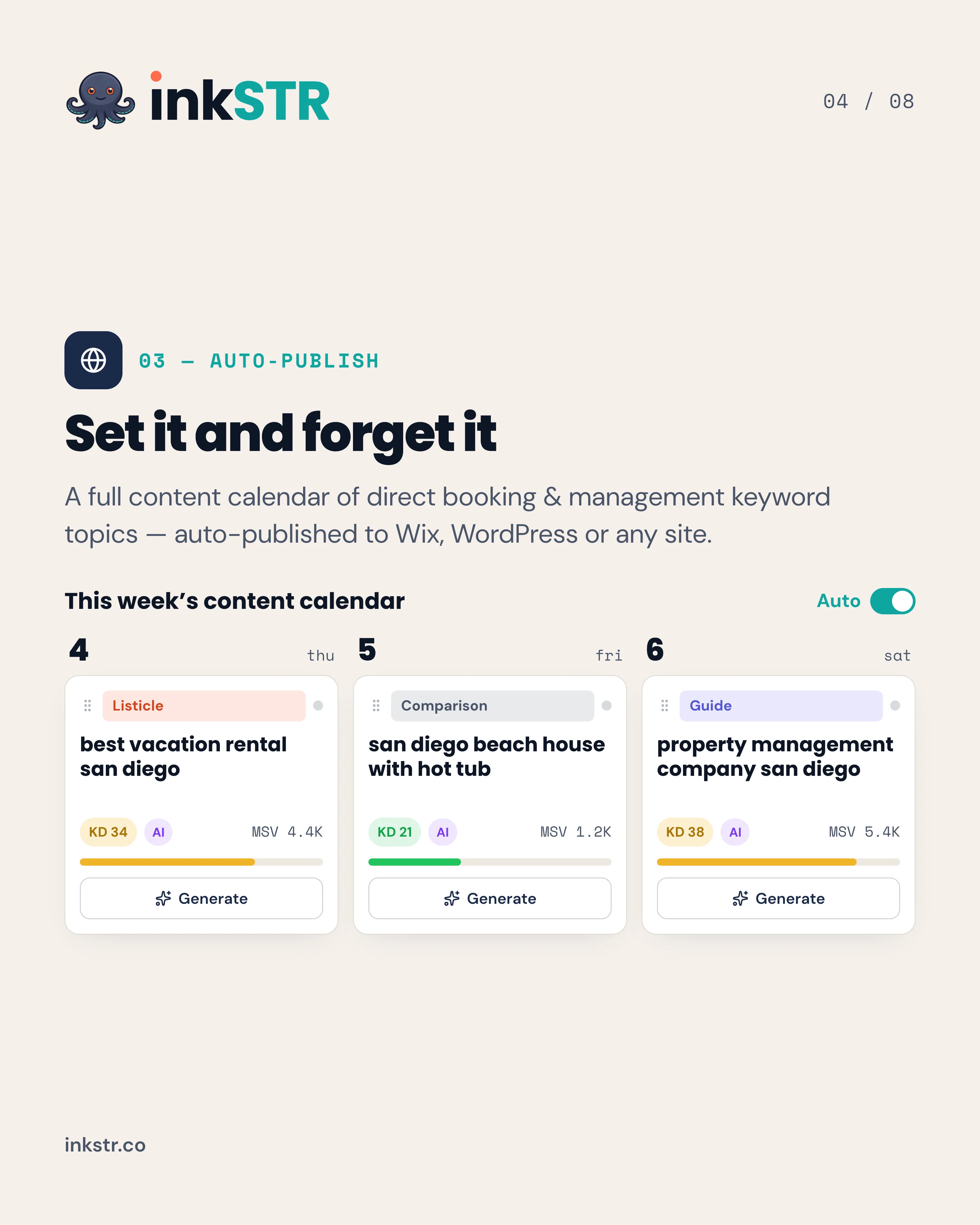
inkSTR's content calendar lets you drag an article to a date, and auto-publishing sends it to Wix or WordPress. Plans start at $99 per month. Our guide on how to rank a vacation rental website on Google adds more on measurement.
Quick-Reference Summary: The Nine Steps
- Accept that you win branded, long-tail, and location-plus-amenity queries, not broad ones.
- Check how your booking tools connect to Google Vacation Rentals.
- Build an indexable direct booking site with one page per property.
- Claim a Google Business Profile if you qualify.
- Map each search query to the right page type.
- Use one consistent property name everywhere.
- Show reviews and trust signals on your own pages.
- Use OTAs for reach while owning your website channel.
- Publish on a schedule and measure in Search Console.
Frequently Asked Questions
On broad searches, probably not, because those platforms carry huge authority. On specific searches, such as your brand name or a neighborhood plus amenity, you can outrank them. Our STR-specific ranking guide explains the factors.
Do I need a direct booking website to get bookings from Google?
Yes, for most searches. A website gives Google a page that you own and can optimize. Without one, your Google visibility depends mostly on marketplace pages.
How long does it take for a new rental website to rank?
Expect months rather than days. Gains commonly appear over roughly three to six months of consistent publishing, though this varies by market and competition.
Which booking engine or channel manager works with Google vacation rental feeds?
Several property management systems and booking engines support Google connections, and support changes over time. Check your provider's current documentation and Google's eligibility pages before committing.
Can I centralize bookings and guest communication on one platform?
Yes, a property management system with a channel manager typically syncs calendars and messages across Airbnb, Vrbo, Booking.com, and your own site. This also reduces double-booking risk. inkSTR handles the content side, so your marketing runs from one place.
Can I track improvement after making audit changes?
Yes. Connect Google Search Console and compare clicks and impressions before and after. inkSTR's Search Console integration tracks keywords and flags opportunities, and its brand audit shows competitor keyword gaps.
Can AI-written content rank on Google?
It can when edited, grounded in real property details, and optimized for the searcher's intent. Read our guide on article automation without losing your brand voice.
Conclusion: How Do You Compete With Airbnb in Google Search?
You compete with Airbnb in Google search by owning what a marketplace cannot: your brand and your neighborhood. The specific trips your property suits are yours too. Build a direct booking site, map queries to pages, and publish steadily. With a single direct booking worth $1,000 to $4,000, a few ranking pages can matter a great deal in 2026 and beyond.

If you want a blog that sends readers to your own booking page instead of an OTA, Start Free Trial with inkSTR. It drafts and schedules search-optimized articles, then publishes them to Wix or WordPress. That way you can stay focused on your guests and your properties.
Content powered by inkSTR.co
Enjoyed this article? Share it:
Get more of inkSTR in Google Search
Add inkstr.co as a preferred source and our articles show up more in Top Stories, AI Overviews, and AI Mode, with a “Preferred” badge.
Get more guides like this
New SEO and AI-search guides, straight to your inbox. No spam, unsubscribe anytime.