Airbnb SEO Tips for Hosts: Get Found Before Competitors
Airbnb SEO tips for hosts start with one uncomfortable fact: your listing's search rank inside Airbnb has almost nothing to do with your Google rank, and most hosts optimize for the wrong one. Airbnb's internal algorithm rewards response speed, instant book, and review velocity. Google rewards keyword-targeted content on a website you actually own. According to research from BuildUp Bookings, Airbnb appears on the first page of Google for vacation rental searches in 79% of the top markets analyzed, but lands in the top 3 organic results in only 5% of those markets. That gap is where hosts either win direct bookings or keep handing Airbnb its cut.
- Airbnb's own ranking system weighs response rate, cancellation history, instant book, and review recency, all separate from Google's ranking signals.
- Airbnb dominates page one of Google in 79% of top markets studied, but rarely holds a top-3 spot, per BuildUp Bookings, 2019, leaving room for host-owned sites to compete.
- Photo resolution matters: industry guidance recommends 1,200 x 800 pixels minimum for listing images to display sharp across devices.
- Airbnb and guest fees combined typically run 17 to 19% of every booking, a cost that disappears entirely on a direct booking.
- Writing one strong blog post manually takes 3 to 5 hours, which is why most hosts stop publishing after a few attempts.
- inkSTR automates the keyword research, drafting, and publishing pipeline so hosts can build the direct booking content Airbnb's own SEO can't replace.
If you're a host trying to figure out why your calendar has gaps despite decent reviews, this guide covers both sides of the SEO equation: what actually moves your Airbnb listing rank, and how to build a Google presence that doesn't depend on Airbnb at all. In 2026, the hosts pulling ahead aren't the ones with the prettiest photos, they're the ones who understand both algorithms and stop treating them as the same problem.
We work with hosts across every kind of market, coastal condos, mountain cabins, urban lofts, and the pattern repeats: hosts fix their listing description, see a small bump, then plateau because they never built anything Google could actually rank. This article walks through Airbnb's internal ranking mechanics first, then the content strategy that captures search traffic Airbnb itself is leaving on the table.
What Is the 75-55 Rule in Airbnb?
The 75-55 rule is a listing-photo guideline circulating among hosts, referring to the idea that your primary listing photo should be framed so the main subject occupies roughly 75% of the frame while capturing at least 55% of the room in view. It's not an official Airbnb policy, but it reflects a real pattern: photos that show scale and context outperform tightly cropped shots in click-through rate.
Airbnb's search algorithm doesn't literally measure photo composition percentages. But it does track how guests interact with your listing after it appears in search, including click-through and time spent viewing photos. A cover photo that looks staged or overly zoomed loses clicks before a guest ever reads your description.
Specifically, hosts who follow resolution guidance of at least 1,200 x 800 pixels for cover photos see sharper rendering across mobile and desktop, which matters since most Airbnb searches happen on phones. Blurry or low-res thumbnails get scrolled past regardless of how good the property actually is.
This is where most hosts stop, at the photo level, and never build anything beyond the Airbnb platform itself. That's the gap we built inkSTR to close. Your photos can be flawless and you'll still lose 17 to 19% of every booking to platform fees unless you're also building a direct booking presence on Google, something Airbnb's internal photo rules have nothing to do with.
How to Improve SEO on Airbnb?
Improving SEO on Airbnb means optimizing the internal ranking factors Airbnb's search algorithm actually weighs: listing title keywords, description completeness, host response rate, instant book status, and review velocity. These factors determine where your listing lands within Airbnb's own search results, not on Google.
First, your title should lead with a specific, searchable descriptor: property type, standout amenity, and location detail. "Modern Cabin with Hot Tub Near Blue Ridge Parkway" beats "Cozy Getaway" because it matches what guests actually type into Airbnb's search bar.
Second, complete every section of your listing: About this space, The space, Guest access, and Other things to note. Incomplete listings rank lower because Airbnb's own ranking documentation confirms completeness is a weighted factor.
Third, response rate and response time matter more than most hosts realize. A 1-hour average response window, a benchmark referenced in industry SEO checklists, keeps you in Airbnb's preferred host tier. Slow replies quietly suppress your search placement.
Fourth, review velocity, how consistently new reviews come in, signals an active, trustworthy listing. A single 5-star review from 2026 carries less algorithmic weight than five reviews spread across the last few months.
None of this touches Google. That's the disconnect hosts miss: Airbnb SEO tips for hosts only fix half the visibility problem. In our experience working with property owners, the hosts who plateau on Airbnb's internal rank but never appear anywhere on Google are leaving the more profitable half of their traffic untouched. inkSTR exists specifically for that second half, generating the AI Content Writer articles that put you in front of guests searching Google directly, before they ever open the Airbnb app.
What Is the 80/20 Rule for Airbnb?
The 80/20 rule for Airbnb, as most hosts use the term, refers to the idea that 80% of your bookings tend to come from 20% of your optimization effort, typically your top few listing photos, your title, and your pricing strategy. It's a Pareto-style shorthand, not an official Airbnb metric.
In practice, this means hosts who obsess over minor description wording while ignoring pricing and photo quality are optimizing the wrong 80%. Your cover photo and your first three interior shots do more work than the fifth paragraph of your description.
The same 80/20 logic applies outside Airbnb, and this is where most hosts miss the bigger opportunity. If 80% of your future revenue growth will come from reducing OTA dependence, then the 20% effort that matters most is building a direct booking website with content that ranks on Google, not tweaking Airbnb copy for the tenth time.
Specifically, a single direct booking is typically worth $1,000 to $4,000 in revenue depending on property size and length of stay, with none of it lost to the 17 to 19% combined Airbnb host and guest fee. That's the real 80/20 trade-off: minor Airbnb tweaks versus a content asset that compounds.
This is exactly the problem inkSTR was designed to solve. Instead of hosts spending another weekend rewording their Airbnb bio, our Keyword Research tool identifies what guests in your specific market actually search on Google, so your limited time goes toward the 20% of effort that actually shifts revenue.
What Is the 25 Rule on Airbnb?
The 25 rule on Airbnb commonly refers to guidance around keeping your listing description's opening line under roughly 25 words so it displays fully in Airbnb's search preview before getting cut off. Search previews truncate aggressively, especially on mobile, so front-loading your strongest hook matters.
Airbnb's search results show only a fragment of your description before a guest taps in. If your first sentence starts with generic filler like "Welcome to our beautiful home," you've burned your allotted preview space on nothing distinctive.
Instead, lead with the specific detail that differentiates you: distance to a known landmark, a standout amenity, or the guest experience you're known for. "Steps from Blue Ridge Parkway, private hot tub, sleeps 8" tells a guest more in 10 words than a full paragraph of atmosphere-setting.
The same truncation problem exists on Google. Meta descriptions get cut off around 155 characters, confirmed repeatedly by Google's John Mueller, so the same discipline of front-loading your strongest hook applies to every blog post and page on your direct booking website too.
We built inkSTR's Content Calendar around this exact discipline: every article draft is structured so the answer, the hook, and the keyword appear before any truncation point, on both Google search snippets and AI Overview extractions. Getting this right on Airbnb is a 25-word exercise. Getting it right across a full content library is a system, and that system is what inkSTR runs on autopilot.
Why Airbnb SEO Alone Won't Get You More Direct Bookings
Airbnb SEO governs visibility inside a platform you don't own, capped by algorithm rules that change without notice and fees that erode margin on every booking. Direct booking SEO, by contrast, builds an asset, a ranking website, that keeps generating traffic for years without a per-booking cut.
Consider the math: if you're paying 17 to 19% combined fees on every Airbnb booking, and a single direct booking is worth $1,000 to $4,000, the fee alone represents hundreds of dollars lost per stay that a direct channel would keep entirely.
Now consider the alternative most hosts attempt and abandon: writing blog content manually. A quality post takes 3 to 5 hours of research and writing, and hiring a freelance travel writer runs $300 to $700 per post. At that rate, a 12-post content library, roughly the minimum needed to start seeing organic movement, costs $3,600 to $8,400 in freelance fees or 36 to 60 hours of your own time.
Most hosts do neither. They write two posts, get discouraged by slow traffic, and quit. Meanwhile Airbnb keeps 17 to 19% of every booking indefinitely, and a competitor's direct booking website starts capturing the search traffic instead.
This is precisely why we built inkSTR at $99 a month: a single direct booking, worth $1,000 to $4,000, pays for a full year of the platform many times over. Our Auto-Publishing feature pushes finished, optimized articles straight to Wix or WordPress on a set schedule, so the 3 to 5 hour writing bottleneck disappears entirely, and a ranking article can then drive organic traffic for 2 to 5 years without touching it again.
What Ranking Factors Actually Separate Airbnb SEO from Google SEO?
Airbnb's internal search algorithm and Google's public search algorithm evaluate almost entirely different signals, which is why optimizing one does nothing for the other. The table below breaks down where hosts should focus effort for each channel.
| Ranking Factor | Airbnb Internal Search | Google Organic Search |
|---|---|---|
| Primary control | Airbnb's algorithm, host has no ownership | Your own website, full control |
| Key signals | Response rate, instant book, review recency, cancellation history | Keyword relevance, backlinks, page structure, content depth |
| Cost per booking | 17 to 19% combined host and guest fees | No per-booking fee once content is published |
| Time to results | Days to weeks after profile changes | Typically 3 to 6 months for meaningful organic movement |
| Content lifespan | Resets with algorithm updates | A ranking article can drive traffic for 2 to 5 years |
| Best tool | Airbnb Performance tab, host dashboard | Google Search Console, keyword research tools |
Notably, the two systems aren't competitors, they're complements. Airbnb SEO gets you found by guests already inside the app. Google SEO gets you found by guests who haven't opened Airbnb yet and might book you directly instead. As a result, hosts who only do one are leaving half their addressable traffic untouched.
We track this exact split inside inkSTR: our How inkSTR Works page walks through the full pipeline from keyword identification to published article, built specifically so the Google side of this table stops being the neglected half of a host's SEO effort.
What Should You Actually Do First: A Practical Sequence
The most effective order for improving your visibility as a host is to fix the free, immediate levers on Airbnb first, then build the compounding asset on Google second. Skipping straight to a website without fixing basic listing hygiene wastes both efforts.
- Audit your title and cover photo. Make sure your title includes a specific amenity or location cue, and your cover photo meets the 1,200 x 800 pixel resolution guidance so it renders sharp on mobile.
- Fill in every listing section completely. About this space, The space, Guest access, and Other things to note should all be complete, since incomplete sections are a documented ranking suppressor.
- Improve response time to under an hour where possible. This single habit change affects your Airbnb search tier more than most description edits.
- Check your Performance tab monthly. Airbnb's dashboard shows search impressions, click-through rate, and conversion, which tells you whether your listing or your pricing is the actual problem.
- Start a direct booking website with a keyword-targeted blog. This is the step most hosts skip because it's the most time-consuming manually, and it's exactly where inkSTR's AI Content Writer removes the 3 to 5 hour per-post bottleneck.
- Publish on a consistent schedule, not in bursts. Google rewards consistency over volume spikes, which is why inkSTR's content calendar schedules posts automatically rather than leaving publishing to whenever you find time.
Common mistake: hosts frequently over-invest in Airbnb-side tweaks (rewriting descriptions monthly, testing new cover photos weekly) while never starting the Google-side asset at all. Airbnb-side changes have a ceiling. A growing content library does not.
Ready to automate your content marketing?
inkSTR handles keyword research, content strategy, article writing, and publishing, all on autopilot.
Reverse-Engineering Guest Language for Better Keywords
Reverse-engineering guest language means mining your own review text and guest messages for the exact phrases travelers use to describe your property, then feeding those phrases back into your listing title and blog content as keywords. Most hosts write copy in their own voice instead of the guest's actual search language.
Specifically, if guests repeatedly mention "walking distance to downtown" or "quiet street but close to everything" in reviews, those phrases are proof of real search intent, since guests tend to search for what they hope to find using similar language.
This tactic is almost entirely absent from standard Airbnb SEO advice, which tends to focus on generic keyword stuffing rather than guest-sourced language. It's a genuine content gap, and it's one of the fastest ways to differentiate a listing description or blog post from a templated one.
Additionally, this same guest language works even better on a direct booking blog than inside an Airbnb description, since Google rewards natural, specific phrasing over keyword-stuffed copy. A local area guide that mirrors how guests actually describe your neighborhood ranks better than one written in generic travel-blog voice.
Our Keyword Research tool cross-references what your target guests search on Google with the language patterns common in vacation rental reviews, so the content inkSTR generates sounds like an actual guest experience, not a template. If you want more on this, our guide on vacation rental blog topics covers specific post ideas built around this exact guest-language approach.
Turning Airbnb SEO Into Local SEO That Shows Up on Google Maps
Repurposing your Airbnb listing content for local SEO means adapting the same location details, amenities, and guest language into content optimized for Google Maps and local search, not just Airbnb's internal search bar. This is a step almost no Airbnb SEO guide covers, and it's a real content gap worth closing.
Specifically, a direct booking website with a Google Business Profile, consistent name, address, and description language across both platforms, starts appearing in local map pack results for searches like "cabin rental near [landmark]," a placement Airbnb listings themselves can't occupy.
This matters because local map pack results sit above organic listings for many location-based searches. A host who only optimizes their Airbnb profile never gets a shot at that placement at all.
As a result, the content built for your direct booking blog, local area guides, neighborhood breakdowns, nearby attraction roundups, does double duty: it ranks in organic Google search and reinforces your local map presence simultaneously. Our piece on local area guides that sell breaks down exactly how to structure that content so it works for both. inkSTR's AI Content Writer is built with this dual purpose in mind, generating destination content that works for both search environments in a single draft.
Why Consistent Blog Publishing Beats a One-Time SEO Fix
A one-time SEO fix, like rewriting your Airbnb description once, produces a temporary bump that fades as competitors update their own listings. Consistent blog publishing, by contrast, builds compounding domain authority that keeps growing month over month.
This is the pattern we see most consistently across the hosts and property managers we work with: the ones seeing real organic traffic aren't necessarily better writers, they simply never stopped publishing.
Specifically, most vacation rental websites show meaningful ranking movement after building out a library of roughly a dozen or more articles targeting a mix of destination keywords and long-tail booking queries, not after a single post. That volume, at 3 to 5 hours per post manually, represents 36 to 60 hours of writing time most hosts simply don't have.
This is the exact gap inkSTR's Content Calendar closes: it schedules and manages that publishing cadence automatically, so a host isn't relying on finding a free Saturday to keep the momentum going. For a deeper look at why this consistency matters more than any single tactic, see our guide on ranking on Google for STR-specific factors, and our piece on why your vacation rental website is not ranking if you've already tried a handful of posts without traction.
Practical Guidance: What to Prioritize and What to Skip
Not every SEO tactic deserves equal time. Based on what we consistently see across hosts and property managers, here's where effort actually pays off versus where it's wasted.
- Prioritize: response time under an hour, complete listing sections, cover photo at proper resolution, and a consistently published direct booking blog.
- Skip: monthly description rewrites with no data behind them, keyword-stuffing your Airbnb title past the point of readability, and one-off blog posts with no follow-up schedule.
- Trade-off to understand: Airbnb SEO improvements show results in days but have a ceiling. Google SEO takes typically 3 to 6 months to show meaningful movement but compounds for years afterward.
- Common mistake: treating a direct booking website as a brochure instead of a content engine. A static site with no blog rarely ranks for anything beyond your exact business name.
Multi-property managers face a compounded version of this problem: coordinating consistent content across 10 or more listings without losing brand voice. That's a use case our must-have tools for short-term rental managers guide covers in more depth, alongside how inkSTR's multi-project architecture keeps each property's pipeline separate.
Frequently Asked Questions
How long does it take for direct booking blog content to outrank Airbnb search results?
Most direct booking websites see meaningful organic movement after 3 to 6 months of consistent publishing, typically once a library of a dozen or more targeted articles is live. inkSTR's Content Calendar automates that publishing schedule so hosts reach that milestone without manually tracking every post.
Can AI-generated blog content actually rank for vacation rental keywords?
Yes, when the content is structured around real search intent, specific keywords, and location detail rather than generic travel language. inkSTR's AI Content Writer is built specifically for short-term rental terminology, which is why it produces content with the specificity Google's ranking systems reward.
Do Airbnb SEO tips also help my Google ranking?
No. Airbnb's internal search algorithm and Google's organic ranking system evaluate completely different signals, response rate versus backlinks and content depth, so improving one has no direct effect on the other. Hosts need separate strategies for each channel.
What is the fastest way to reduce dependence on Airbnb commission fees?
Building a direct booking website with keyword-targeted content is the most sustainable path, since a single direct booking worth $1,000 to $4,000 keeps the full amount instead of losing 17 to 19% to combined host and guest fees. Our guide on increasing direct bookings covers additional tactics beyond content alone.
How many blog posts do I need before I see organic traffic?
Most vacation rental websites need roughly a dozen or more published articles targeting a mix of destination and long-tail booking keywords before ranking movement becomes noticeable. At 3 to 5 hours per post written manually, that volume is why most hosts never reach it without automating the process.
Is it worth paying a freelance writer for vacation rental blog content?
Freelance travel writers typically charge $300 to $700 per quality post, which adds up quickly across the dozen or more articles needed to see traction. inkSTR runs at $99 a month for the full pipeline, generation, scheduling, and publishing, making it a materially lower cost path to the same content volume.
What keywords should I target first for my vacation rental website?
Start with a mix of destination-based keywords (your city or landmark plus property type) and long-tail booking intent phrases guests actually search, ideally pulled from your own review language. inkSTR's Keyword Research tool identifies these automatically based on your specific market.
The Bottom Line on Airbnb SEO Tips for Hosts
Airbnb SEO tips for hosts solve half the visibility problem: response time, photo quality, and listing completeness govern where you rank inside Airbnb's own search results. But as BuildUp Bookings found, Airbnb itself only lands in the top 3 Google results in 5% of markets studied, which means the other half, your own direct booking presence, is wide open for hosts willing to build it.
The hosts pulling ahead in 2026 aren't choosing between Airbnb optimization and a direct booking website. They're doing both, fixing the free internal levers first, then building the compounding content asset that Airbnb's algorithm can never touch. That second half takes consistency more than talent, and consistency is exactly what most hosts run out of time for.
If you're ready to stop losing 17 to 19% of every booking to platform fees, start with the content system, not another round of description edits. Get started with inkSTR and let the keyword research, drafting, and publishing run on autopilot while you focus on the guest experience that earns the reviews in the first place.

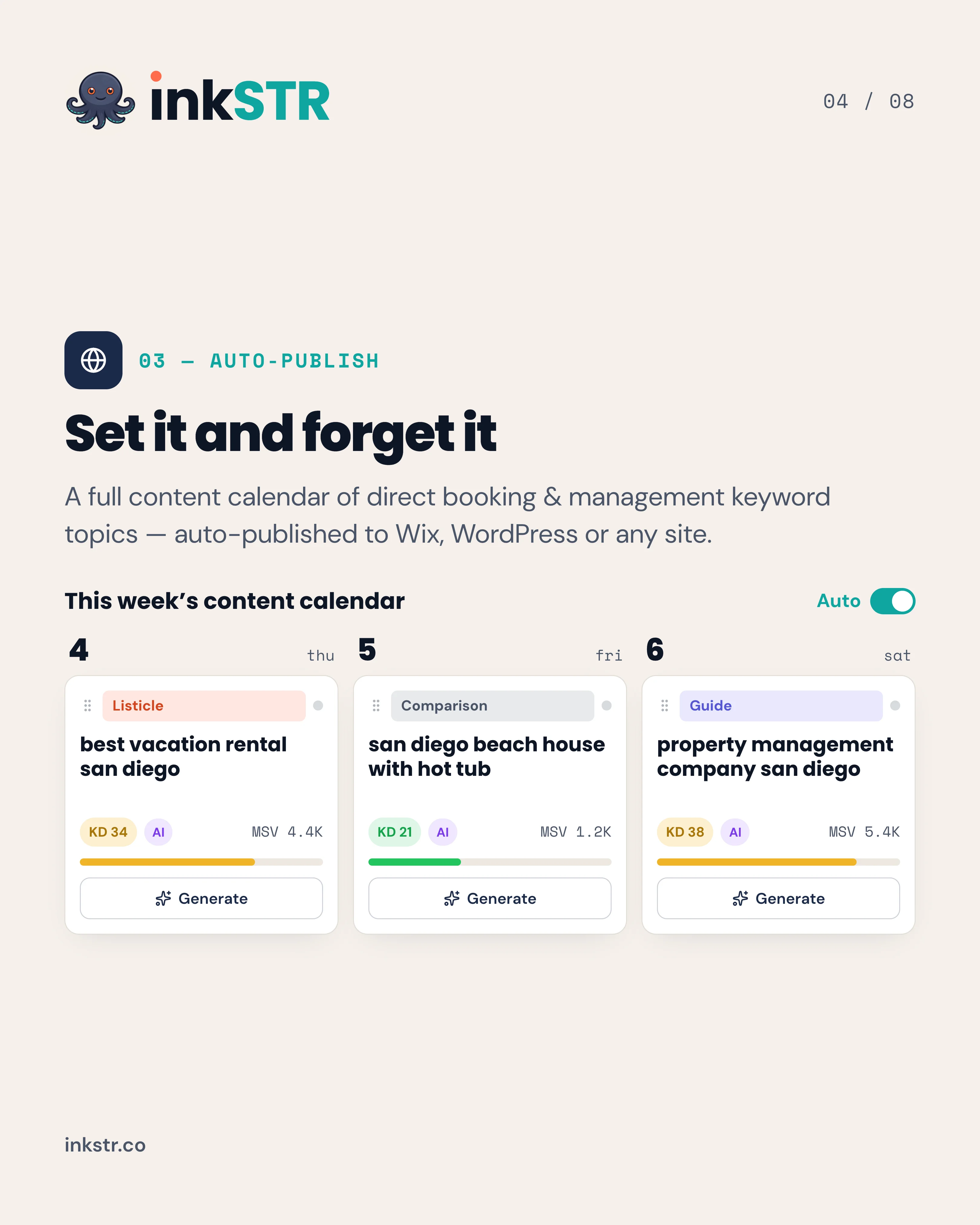
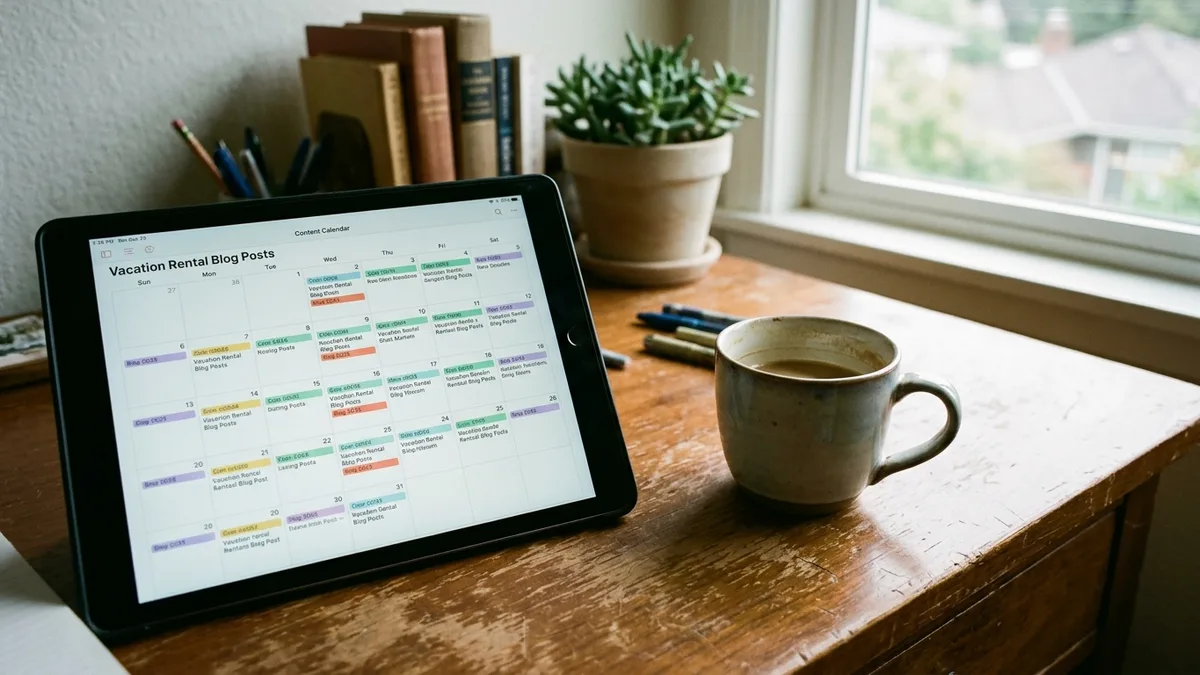
If you manage even a couple of listings and still handle content updates by hand, the content calendar view above is what a running pipeline actually looks like once it's automated. inkSTR builds that pipeline around your specific market so your direct booking blog keeps publishing whether or not you have a free afternoon. See pricing and start your free trial.
Content powered by inkSTR.co
Enjoyed this article? Share it:
Get more of inkSTR in Google Search
Add inkstr.co as a preferred source and our articles show up more in Top Stories, AI Overviews, and AI Mode — with a “Preferred” badge.
Get more guides like this
New SEO and AI-search guides, straight to your inbox. No spam, unsubscribe anytime.