Semrush SEO Suite: What It Does for Vacation Rentals
The Semrush SEO suite is a subscription toolkit for keyword research, competitor analysis, site audits, and rank tracking. Semrush lists its SEO Toolkit plans from $139.95 per month. For a vacation rental operator it works as a research and monitoring layer: it shows you what to publish, but it does not write or publish anything for you.
Key Takeaways
- The Semrush SEO suite groups its tools into Competitive Research, Keyword Research, Link Building, On Page and Technical SEO, Content Ideas, and Extras.
- The Pro, Guru, and Business plans differ mainly by usage limits: websites, tracked keywords, crawled pages, and keyword metric updates.
- Pro allows 5 websites and 500 tracked keywords, which covers most single-brand vacation rental sites.
- Estimated traffic and keyword volume are modeled figures, so check them against Google Search Console before you make decisions.
- The suite tells you what to write but does not draft or publish posts, and writing one quality post by hand takes 3 to 5 hours.
- inkSTR automates keyword research, article generation, scheduling, and publishing for $99 per month, so your research becomes published content that drives direct bookings.
Guests in 2026 find rentals through Google results, AI-generated answers, and OTA listings. Every Airbnb booking costs you 17-19% in combined host and guest fees. A single direct booking is typically worth $1,000 to $4,000 in revenue, which is why so many hosts start shopping for an SEO tool. The Semrush SEO suite is one of the first names that comes up.
At inkSTR, we watch the same pattern repeat. An operator buys a research subscription, spends a weekend in keyword reports, exports a spreadsheet, and then stalls at the blank page. The research was fine. The publishing never happened.
This guide covers what the suite contains, what each plan costs, how to read its numbers, and where its work ends. You will also see how to close the gap between research and published content, so the keywords you find turn into articles that rank.
What Is the Semrush SEO Suite and What Does It Include?
The Semrush SEO suite, sold as the SEO Toolkit, is a set of research and monitoring tools organized into Competitive Research, Keyword Research, Link Building, On Page and Technical SEO, Content Ideas, and Extras. According to Semrush, its database holds about 28 billion keywords and 43 trillion backlinks, the raw material behind every report.
The catalog is long. Semrush's help pages group the named tools like this:
- Competitive Research: Domain Overview, Compare Domains, the organic rankings report, the top pages report, Keyword Gap, and Backlink Gap.
- Keyword Research: Keyword Overview, Keyword Magic Tool, Keyword Strategy Builder, Position Tracking, and Organic Traffic Insights.
- Link Building: Backlinks Tool and Backlink Audit.
- On Page and Technical SEO: Site Audit and On Page SEO Checker.
- Content Ideas: Topic Research and the SEO Writing Assistant, plus a set of extras.
That is a capable toolbox for an agency with a full-time analyst. If you run two cabins and a booking site, it is a lot of dashboard for a job that comes down to one question: what should I write next? Picture opening Keyword Magic Tool on a Sunday night, filtering thousands of phrases for pet-friendly and hot tub modifiers, and closing the laptop with a spreadsheet and no draft.
We built inkSTR's Keyword Research feature to skip the catalog. It finds the terms your target guests actually search, compares them against competitor gaps, and hands the shortlist straight to article generation. If you want the raw reference database, Semrush remains a solid place to browse it.
How Much Does the Semrush SEO Toolkit Cost Each Month?
The Semrush SEO Toolkit is listed at $139.95 per month for Pro, $249.95 for Guru, and $499.95 for Business on the SEO Toolkit pricing page at the time of writing. Prices and packaging change, so confirm the current numbers on Semrush's site before you subscribe.
| Plan | Monthly price | Websites | Tracked keywords | Pages crawled per month | Results per report | Keyword metric updates per month |
|---|---|---|---|---|---|---|
| Pro | $139.95 | 5 | 500 | 100,000 | 10,000 | 250 |
| Guru | $249.95 | 15 | 1,500 | 300,000 | 30,000 | 1,000 |
| Business | $499.95 | 40 | 5,000 | 1,000,000 | 50,000 | 5,000 |
Business includes everything in Guru plus SEO Share of Voice tracking and API access. All three plans list 3 scheduled reports in PDF format. Naming adds confusion: you will see the SEO Toolkit, SEO Classic plans, and newer SEO and AI Search or Semrush One packaging described across different pages, and included features vary between them. Third-party reviews also report add-ons, such as a Content Marketing Toolkit at $60 per month on top of Pro, which lifts the real cost above the headline price.
Here is the agitating part. That subscription starts billing before you have published a single word. A freelance travel writer then charges $300 to $700 per quality post, and if you write it yourself you are back to an evening of work per article. Ten posts at freelance rates costs $3,000 to $7,000 on top of the subscription.
That is the trade-off we designed inkSTR's pricing around. At $99 per month, you get keyword research, AI article generation, a content calendar, and publishing in one plan, so the cost of research and the cost of writing stop being two separate line items.
Which Semrush Plan Fits a Small Business or Rental Portfolio?
For a small business or a vacation rental brand with one to five sites, Pro is usually the right starting tier because it covers 5 websites and 500 tracked keywords. Guru and Business make sense only when you manage many domains, track thousands of keywords, or crawl very large sites. Guru's published limits are three times Pro's on keywords and pages crawled, and four times Pro's on keyword metric updates, so treat the jump as a capacity purchase. Read the plan comparison on Semrush's site to see which extra features come with it.
Choosing wrong hurts in both directions. Overbuy and you pay for capacity you never touch; underbuy and you hit a cap in the middle of a project. These three hypothetical examples show where the lines fall.
Example: a host with one direct booking site
Imagine a host with a single site who wants to track about 40 target keywords. Pro's 500 tracked keywords and 100,000 monthly crawled pages leave plenty of headroom. A 60-page site uses well under 1% of the crawl allowance in a month. Guru would mean paying for capacity that sits idle.
Example: a manager with several brands
Imagine a manager running four brand sites and tracking 150 keywords on each. That is 600 keywords, past Pro's cap but well inside Guru's 1,500 keywords and 15 websites. Keyword count, not site count, triggers the upgrade. Before paying $110 more per month, check whether trimming to the 100 highest-intent keywords per brand keeps you on Pro.
Example: a large portfolio or agency
Business, with 40 websites, 5,000 tracked keywords, SEO Share of Voice, and API access, fits an operator reporting across dozens of sites. Few independent hosts ever need it. At $499.95 per month, it costs more than five inkSTR subscriptions, so it only pays off when client reporting or API pipelines depend on it.
Two cautions apply before you buy. First, useful capabilities sit above the entry tier, so read the plan comparison rather than assuming Pro includes everything you saw in a demo. Second, figures such as estimated traffic and keyword volume are modeled, not measured, so validate them against first-party data in Google Search Console and your own analytics.
That second caution is why we built a Google Search Console integration into inkSTR. You see real clicks and impressions next to your published articles. If you manage 10 or more listings, our property management content workflow gives each brand or property its own independent content pipeline from one dashboard, which beats copying a research routine across every site.

How Does the Semrush Toolkit Work as a Step-by-Step SEO Workflow?
The Semrush SEO suite works best as a five-step loop: find competitors, pick keywords, fix technical issues, optimize content, and track rankings. Reviews list the tools one by one, but the value comes from feeding each step's output into the next.
- Find your real competitors. Domain Overview and the organic rankings report show who ranks for the searches you want, and the top pages report shows which of their pages earn the traffic.
- Pick keywords from the gaps. Keyword Gap and Backlink Gap reveal terms competitors rank for that you do not; Keyword Magic Tool and Keyword Strategy Builder turn them into a list.
- Fix technical problems. Site Audit ranks issues by severity, and third-party reviews report more than 140 checks, including access for AI crawlers.
- Optimize each page. On Page SEO Checker, Topic Research, and the SEO Writing Assistant guide what a draft should cover.
- Track results. Position Tracking monitors rankings by device, location, and SERP feature.
Semrush's own getting-started guidance points the same way: choose 5 to 10 target keywords, set up Position Tracking, and run a Site Audit first.
How do you start a Semrush free trial?
Trial offers vary by plan and region and change over time. The reliable route is to open the Semrush pricing page, pick a plan, and check whether a trial is offered before you enter payment details. Set a calendar reminder for the end date so a trial does not roll into a paid month unnoticed.
The catch comes after step 5. A Site Audit returns a long task list, and every item competes with guest messages and turnovers for your time. A vacation rental site without fresh content keeps failing the same test whichever keywords you track.
That is the reason our AI Content Writer exists. It turns the keywords in your plan into answer-first, SEO and GEO structured articles of 2,500 to 3,500 words, built for both Google and AI search citations. For the ranking side, our guide on how to rank your vacation rental website on Google walks through what to publish first.
Where Does the Semrush SEO Suite Fall Short for Short-Term Rentals?
The Semrush SEO suite falls short for short-term rental operators in one place: execution. Its listed tools research, guide, and monitor, but writing and publishing remain manual. Its keyword data is built for every industry rather than for traveler intent like pet-friendly, hot tub, or near a specific trailhead.
Consider what the manual gap costs. Writing one quality post takes 3 to 5 hours of research and drafting, so a ten-post plan consumes 30 to 50 hours, most of a working month spent at a desk instead of running your properties. Meanwhile competitors with steady publishing schedules keep the positions you were researching.
The gap also shows up in the middle of the workflow. After a Site Audit you still need to decide which fixes matter, brief a writer or open a blank document, format headings, add images, upload to your CMS, and schedule the post. Each step is small, but together they add up to a second job that the suite never touches.

| Workflow step | Semrush SEO suite | inkSTR |
|---|---|---|
| Keyword research | Deep general-purpose database | Built in, tuned to vacation rental search intent |
| Competitor gap analysis | Keyword Gap and Backlink Gap | Brand audit with competitor keyword gap analysis |
| Technical site crawl | Site Audit and On Page SEO Checker | Quality scoring and pre-publish validation for each article |
| Article writing | SEO Writing Assistant guides your own draft | Generates full 2,500 to 3,500 word articles |
| Scheduling and publishing | Not part of the listed toolkit | Drag-and-drop calendar with one-click publishing to Wix or WordPress |
| Performance tracking | Position Tracking | Google Search Console integration |
The proof lives in the pipeline, not the dashboard. In one case, a Smoky Mountains cabin rental brand grew monthly Google Search clicks from 788 to 5,195 in 11 months on a continuous inkSTR pipeline of pillar-and-cluster articles auto-published to WordPress, measured in Google Search Console. In another, a five-market mountain rental brand went from 26 to 1,924 monthly Google search visits in four months with 114 articles.
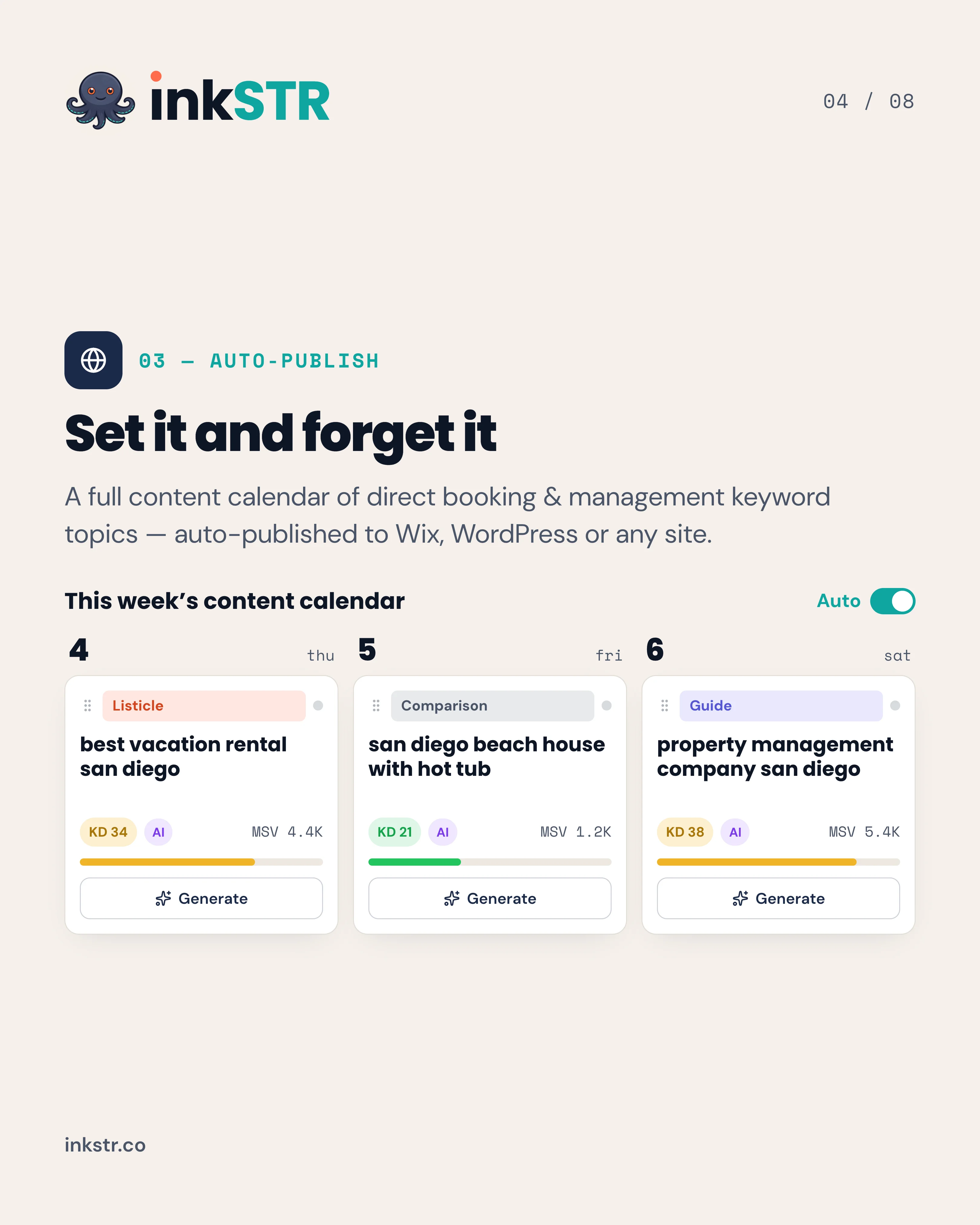
Our Content Calendar schedules articles on a set cadence, and Auto-Publishing pushes them to your site with no copy-and-paste. You can see the whole flow from keyword to live post on our How inkSTR Works page. For the AI search side of that flow, read our guide to ranking in AI search.
Ready to automate your content marketing?
inkSTR handles keyword research, content strategy, article writing, and publishing, all on autopilot.
Can inkSTR Replace a Separate SEO Suite for Your Rental Business?
For most vacation rental operators, yes: inkSTR covers keyword research, competitor gap analysis, article generation, scheduling, and publishing in one $99 monthly plan. A dedicated research suite still adds value for deep backlink audits or crawling very large sites, but it is not needed to publish content that ranks.
The alternative is a stack of three to five separate tools stitched together by you, with data moving between them by spreadsheet. Every handoff is a place where a weekend of enthusiasm turns into an abandoned plan. And every month without published content is a month of guests booking through platforms that keep 17-19% of each stay.
The cost math is simple. Semrush Pro at $139.95 plus a freelance writer at $300 per post puts your first month of four articles at roughly $1,340. The same four articles through inkSTR cost $99. Even if you write the posts yourself, you pay $139.95 for research and give up 12 to 20 hours of writing time.
We built inkSTR for that exact pattern. As of September 2026, across inkSTR customer sites we have published more than 4,400 articles and secured more than 1,200 verified AI-search citations for customer content. Those numbers come from our own database, and they exist because the research step flows directly into the publishing step.
If direct revenue is the goal, start with our page on direct bookings. For a wider view of the tools operators pair with content, see our list of must-have tools for short-term rental managers, or read an honest breakdown of what inkSTR costs and does.
How Long Does It Take for SEO Research to Turn Into Bookings?
Most sites see meaningful search traffic gains within 3 to 6 months of consistent publishing, and a ranking article can keep driving organic traffic for 2 to 5 years. Research alone produces neither result. Only published, indexed articles move rankings.
The mistake we see most often is treating a tool subscription as progress. You track 500 keywords, watch positions barely move, and blame the tool. The real cause is the gap between the list and the live page, and it widens the longer publishing depends on your free evenings.
Use this sequence to keep the work honest:
- Record a baseline of clicks and impressions in Google Search Console before you change anything.
- Choose 5 to 10 target keywords tied to guest intent, such as amenity plus property type searches.
- Publish on a fixed schedule, even one article a week.
- Review clicks, impressions, and ranking queries monthly against your baseline.
- Tie direct booking inquiries back to the pages that produced them.
Here is what that looks like for a two-cabin operator. In month one you record the baseline and publish four articles, for example one on pet-friendly cabins near your town and one on hot tub cabins for couples. In months two and three you keep the weekly rhythm and watch impressions climb for those queries. By month four you have 16 articles, a clear list of which queries earn clicks, and inquiry data showing which pages produce direct requests. Double down on those page types and drop the ones that draw traffic without inquiries.
Avoid these traps: buying a top-tier plan before you have a publishing habit, treating estimated traffic as ground truth, and filling the blog with generic travel content that never mentions your properties. Our breakdown of ranking on Google for short-term rentals explains why property-specific pages beat generic ones.
Industry forecasts for 2026 expect supply and demand in short-term rentals to grow at similar rates, so occupancy gains will not come from a rising tide. Growth leans on pricing and on channels you own. That is where a content calendar earns its keep: inkSTR keeps articles going out on schedule while you handle guests, so the compounding starts in month one instead of month nine.
Is the Semrush SEO Suite Worth It for Your Rental Business?
The Semrush SEO suite earns its price when someone will act on the research every week: pick keywords, write the articles, publish them, and check rankings. It is a strong research and monitoring layer, and the Pro tier fits most single-brand rental sites. The suite itself stops before the writing and publishing, which is where most operators stall.
Start with 5 to 10 target keywords, run one site audit, and put publishing dates on a calendar before you spend on anything else. The 2026 search landscape rewards steady, specific content across Google and AI answers, and a ranking article keeps paying back for years.
If keeping up with keyword research and blog publishing across your properties feels impossible right now, inkSTR was built to automate exactly this. It generates, schedules, and publishes SEO articles on autopilot, anywhere in the U.S. and no matter where your properties are located. Start a free trial and see your first content plan today.
Frequently Asked Questions
What is included in the Semrush SEO Toolkit?
The Semrush SEO Toolkit groups its tools into Competitive Research, Keyword Research, Link Building, On Page and Technical SEO, Content Ideas, and Extras. Named tools include Domain Overview, Keyword Magic Tool, Position Tracking, Backlinks Tool, Site Audit, and the SEO Writing Assistant. Tool availability and limits depend on your plan.
How much does the Semrush SEO Toolkit cost monthly?
Semrush lists Pro at $139.95, Guru at $249.95, and Business at $499.95 per month for the SEO Toolkit at the time of writing. Add-on toolkits cost extra, and packaging changes over time, so confirm current figures on Semrush's pricing page. For comparison, inkSTR costs $99 per month and includes article writing and publishing; see inkSTR pricing.
How do I start a Semrush free trial?
Trial availability and length vary by plan and region and change over time. Open the Semrush pricing page, choose a plan, and check whether a trial is offered before entering payment details. Note the end date so you can cancel in time if it does not fit your workflow.
What can Semrush do for a vacation rental website?
It can show which competitors rank for your target searches, surface keyword gaps, audit your site for technical issues, and track your rankings by location and device. It does not write or publish your blog posts. Pairing research with inkSTR's AI Content Writer turns those findings into live articles.
Which Semrush plan is best for a small business?
Pro is usually the best fit because it covers 5 websites and 500 tracked keywords. Move to Guru only if your tracked keywords or site count outgrow those caps. Most single-brand rental sites never reach that point.
Can the Semrush SEO suite write and publish my vacation rental blog posts?
No. Its content tools help you research topics and score drafts, but you still write and publish each post yourself. inkSTR generates full articles and publishes them to Wix or WordPress on a schedule through Auto-Publishing.
Can AI-generated content rank on Google and get cited in AI search?
Yes, when it is structured for direct answers and grounded in real property details rather than generic travel copy. As of September 2026, we have secured more than 1,200 verified AI-search citations for inkSTR customer content. Our guide to ranking in AI search covers the structure that earns them.
Content powered by inkSTR.co
Enjoyed this article? Share it:
Get more of inkSTR in Google Search
Add inkstr.co as a preferred source and our articles show up more in Top Stories, AI Overviews, and AI Mode — with a “Preferred” badge.
Get more guides like this
New SEO and AI-search guides, straight to your inbox. No spam, unsubscribe anytime.